CPT Code 62284: Injection procedure for myelography
CPT Code 62284: official descriptor and procedure overview The American Medical ...

Last Updated: Oct 19, 2026
J0278 is the HCPCS Level II code for injection, amikacin sulfate, 100 mg. Each billing unit equals 100 mg of amikacin administered, so a 500 mg dose is billed as 5 units.
The drug line is commonly paired with an administration CPT code, such as 96365 for an IV infusion. Unit miscalculation and missing NDC numbers are common causes of J0278 denials, yet both are avoidable once you understand how the code is structured.
Let Pabau's smart automation suggest the right codes, reduce claim denials, and keep your practice compliant—effortlessly.
Automate repetitive tasks and focus on what matters most—your patients.
Reduce coding errors and ensure compliance with the latest regulations.
Clean claims, fewer denials, and faster reimbursements.
Powerful insights and reporting to help your practice thrive.
HIPAA compliant SOC 2 certified GDPR-compliant Trusted by 4,000+ clinics worldwide

HCPCS code J0278 describes amikacin sulfate injection, with each unit equal to 100 mg of the drug administered, not the vial size.
Bill units by dividing the administered dose in mg by 100, so a 500 mg dose is 5 units. Payer rules on partial units vary, with some rounding down and others rounding to the nearest unit, so verify with each payer.
J0278 is commonly paired with a drug administration CPT code such as 96365, 96366, 96372 or 96374. A missing administration code can trigger bundling or rejection edits.
On Medicare Part B claims for a single-dose vial, report discarded amikacin with the JW modifier, or add JZ when none is discarded.
Pabau, the practice management and billing platform we build, runs validation checks before each claim is sent and submits US claims electronically through Claim.MD.
HCPCS code J0278 is defined by CMS as “injection, amikacin sulfate, 100 mg,” with each billing unit representing 100 mg of amikacin sulfate administered. The code sits in the J0120-J8499 range of HCPCS Level II (drugs administered other than oral method). A clinician usually gives these drugs, which is why Medicare typically pays for them under Part B.
Amikacin sulfate is an aminoglycoside antibiotic, given by IV infusion, IV push or intramuscular injection. Prescribers usually reserve it for gram-negative infections that resist gentamicin or tobramycin.
Each unit of J0278 equals 100 mg of amikacin sulfate. To determine the number of units to bill, divide the total milligrams administered by 100.
Rounding rule: Payer rules on partial units vary. Some payers tell billers to round down to the nearest whole unit, while others round to the nearest whole number, so 2.5 becomes 3. Check the rule with the specific payer before you submit.
Bill the dose administered, not the vial size. If a 500 mg vial is drawn and only 400 mg is infused, the drug line carries 4 units, not 5. The clinical record must document the exact dose administered to support the unit count on the claim.
Medicare adds a second step for single-dose vials. Since July 1, 2023, Part B drug claims must carry the JW modifier for any discarded amount, or JZ when none is discarded. CMS sets out the rule in its JW and JZ modifier FAQs. In the example below, the unused 100 mg goes on its own line:
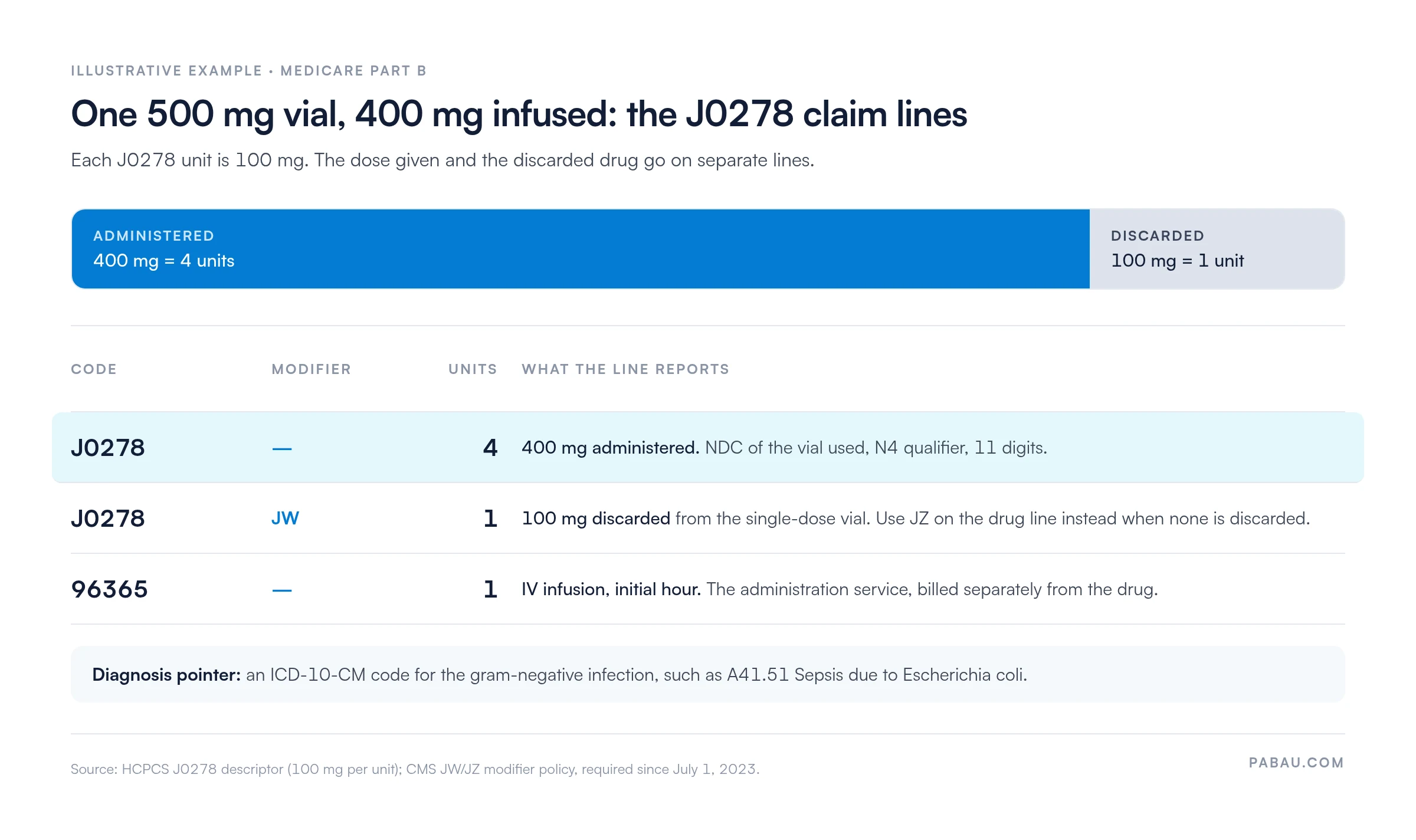
Amikacin sulfate is indicated for serious gram-negative bacterial infections, particularly those caused by organisms resistant to gentamicin or tobramycin. Payers require a diagnosis code that establishes medical necessity. Submitting J0278 without a supporting ICD-10-CM code invites CO-50 (medical necessity) or CO-11 denials.
Common ICD-10-CM codes supporting J0278 claims include:
The clinical record should specify why amikacin was selected over first-line alternatives. Culture and sensitivity results showing resistance to less nephrotoxic agents form the core of the case. Together with the prescriber’s rationale, they are the medical necessity evidence Local Coverage Determinations (LCDs) may require.
HCPCS code J0278 covers the drug only. It is commonly paired with a drug administration CPT code that describes how the drug was delivered. Per the CMS Claims Processing Manual, the administration service is billed separately from the drug itself.
The superbill documentation for each amikacin encounter should capture both the J code and the administration CPT before claim submission. Below are the most common pairings.
96366 is an add-on code, so it is never billed without the initial infusion code 96365. The AMA, which maintains the CPT code set, requires the initial infusion to be reported before any add-on hour.
Medicare Part B reimburses J0278 at the Average Sales Price (ASP) plus 6 percent (before sequestration) under 42 CFR 414.904. CMS updates ASP-based payment amounts quarterly and publishes the current rates in its ASP pricing files.
Because ASP fluctuates quarter to quarter based on manufacturer-reported sales data, the specific dollar amount per unit changes each quarter. Always verify the current ASP+6% rate in the CMS ASP Drug Pricing File before finalizing expected reimbursement for the date of service.
In hospital outpatient settings, amikacin may instead be packaged into an Ambulatory Payment Classification (APC) grouping under the Outpatient Prospective Payment System (OPPS). When OPPS applies, the drug may not generate a separate line-item payment. Verify with your MAC whether J0278 is separately payable in your facility’s APC configuration.
Download the CMS ASP Drug Pricing File each quarter and store it in a shared billing folder with the publication date in the filename. Reference this file whenever a payer questions your J0278 reimbursement expectation. Quarter-specific ASP data is the primary defense against underpayment disputes.
Medicaid reimbursement for J0278 varies by state. Each state Medicaid program sets its own fee schedule for injectable drugs. Rates may be based on Average Manufacturer Price (AMP), the Federal Upper Limit (FUL) or a state-specific pricing model.
Before billing J0278 to a state Medicaid program, check that state’s published fee schedule or contact the MAC or Medicaid administrative contractor. Medicaid managed care plans add another layer. The plan’s formulary and preferred drug list may decide whether J0278 is covered at all, or whether a therapeutic alternative is required.
When billing J0278 to Medicaid, the National Drug Code (NDC) of the specific amikacin product dispensed is required on the claim. CMS Medicaid Drug Rebate Program guidance mandates NDC reporting so that manufacturers owe a rebate to the state. For Medicare claims, NDC reporting is strongly recommended even where not technically mandated, as it supports audit documentation and some MACs require it.
A clean claim submission for amikacin includes the NDC in the correct field with the correct qualifiers. The NDC appears in loop 2410 on the 837P electronic transaction, or in box 24 of the paper CMS-1500 form.
Amikacin sulfate is manufactured by multiple companies, and the NDC varies by manufacturer, product and package size. Use the NDC from the vial administered, not a generic placeholder. Mismatched NDC numbers (e.g., reporting one manufacturer’s NDC while dispensing another’s product) can trigger a pharmacy audit.
Medicare Part B generally does not require prior authorization for J0278, though Medicare Advantage plans may impose their own PA requirements. Commercial insurers and Medicaid managed care organizations frequently require prior authorization before amikacin therapy begins.
When a commercial payer or Medicaid managed care plan requires PA for J0278, submit the following clinical documentation to support the request:
Some payers require the PA to reference the specific NDC of the product that will be dispensed. If the pharmacy substitutes a different manufacturer’s amikacin after PA approval, verify whether the authorization remains valid or whether a new PA is needed.
J0278 denials cluster around a handful of predictable errors. Understanding the denial code behind each rejection tells you exactly what the payer found wrong and what to fix on the corrected claim.
A pre-submission checklist that verifies units, NDC, administration CPT and ICD-10-CM code catches these errors before each J0278 claim leaves the practice. Strong denial management workflows catch patterns across multiple submissions and identify when a payer’s adjudication logic has changed.
Amikacin shares its drug class with gentamicin and tobramycin, each of which has its own HCPCS J code. Miscoding between these aminoglycoside codes is a compliance risk because the unit definitions differ.
A coder who bills J1580 instead of J0278 for an amikacin infusion has submitted the wrong drug code. The claim may pay because the payer’s system doesn’t automatically cross-check the administered drug against the NDC, but it creates an audit liability. Verify the drug name on the physician order and the dispensing record before selecting the J code.
Cross-reference the J code against the NDC on every drug claim before submission. The NDC crosswalk from the CMS ASP Drug Pricing File maps each amikacin NDC to J0278 specifically, not to gentamicin or tobramycin codes. A mismatch between NDC and J code is a documentation error that survives adjudication but fails an OIG audit.
Complete documentation is the foundation of a defensible J0278 claim. The clinical record must contain every element the payer or OIG auditor would expect to find if the claim were reviewed post-payment.
Knowing medical billing documentation standards helps practice managers build intake and order workflows. Those workflows capture the right data at the point of care, so nobody has to reconstruct it later.
Practices billing J0278 repeatedly should use a structured drug administration note template that prompts for every required field. Missing start and stop times and absent NDC numbers are frequent deficiencies in MAC medical reviews of injectable drug claims.
On many billing teams, a J0278 claim passes through several manual steps. A biller copies the dose from the administration record, works out the units and keys in the NDC. The claim is then re-entered in a separate clearinghouse portal, and each hand-off is a chance for the unit count to drift.
In Pabau’s claims software for practices, validation checks run in the background each time you send a claim. They confirm that details insurers need, such as membership numbers and authorization codes, are in place. US claims then go to payers electronically through Claim.MD, without leaving Pabau.
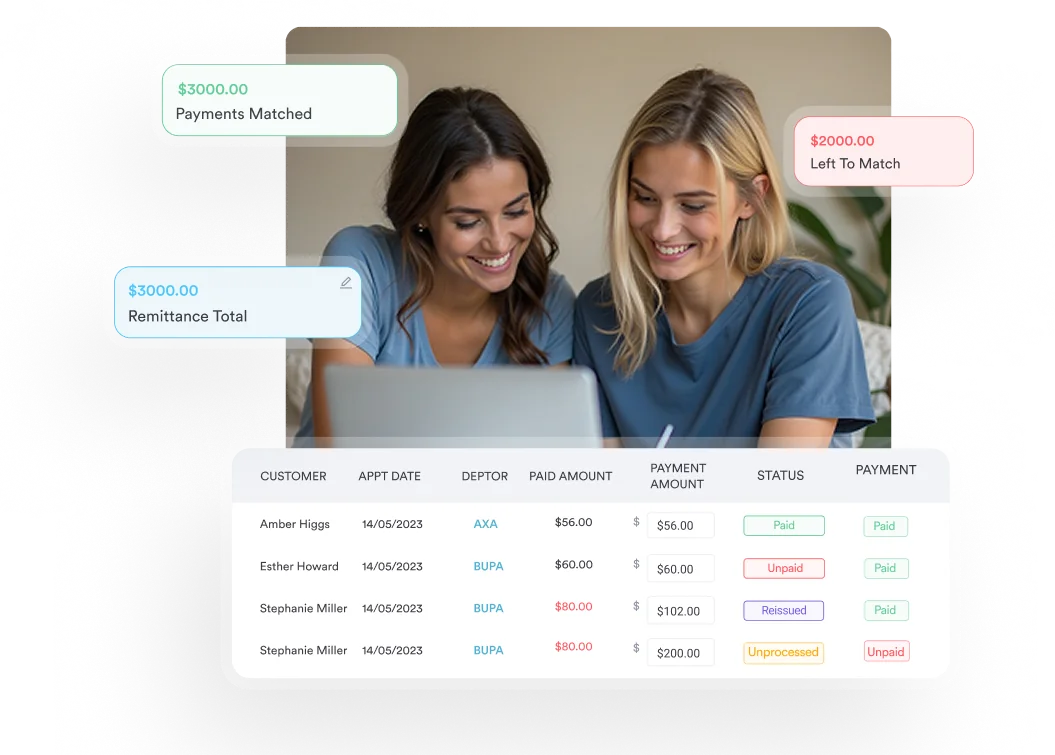
From the same dashboard, you can run real-time eligibility checks before the visit, track each claim’s status and post ERA remittances. A short-paid drug line shows up when the remittance posts, rather than months later in an audit.

Pabau checks claim details before you send them, submits US claims electronically and posts ERA remittances. Your team spends less time resubmitting drug administration claims.

Treat every J0278 claim as at least two lines: the drug and the service that delivered it. Most of the work sits upstream, in an administration record that states the milligrams given and the vial’s NDC. That record should also say why amikacin was chosen over gentamicin or tobramycin.
The trade-off to remember is that payers disagree on partial units, and Medicare adds JW and JZ reporting for single-dose vials. Write each payer’s rounding rule into your pre-submission checklist once, so a denial isn’t the first place you learn it.
Book a demo to see how Pabau checks claim details before submission and tracks each drug claim through to remittance.

Need guidance on denial codes and appeals? Denial management in healthcare covers CARC-based denial workflows and appeal strategies for drug and infusion claims.
Working through the 837P claim format? The 837 file explained details loop structure, segment requirements, and NDC reporting positions for electronic drug claims.
Want to understand revenue cycle fundamentals? What is revenue cycle management walks through the full billing lifecycle from eligibility verification to payment posting.
Billing gentamicin instead? HCPCS code J1580: gentamicin injection covers billing for the first-line aminoglycoside and its 80 mg unit.
Coding another aminoglycoside? HCPCS code J1840: kanamycin sulfate injection walks through billing for a related injectable antibiotic.
HCPCS code J0278 covers injection of amikacin sulfate, with each billing unit representing 100 mg of the drug administered. It applies in physician offices, outpatient infusion centers and other Part B settings. Amikacin is given there by IV infusion, IV push or intramuscular injection for serious gram-negative infections.
Divide the total milligrams administered by 100 to get the unit count. A 500 mg dose is 5 units, and a 750 mg dose works out to 7.5 units. Payer rules on partial units vary, with some rounding down and others rounding to the nearest unit. Bill the dose administered, not the vial size, and confirm the rounding rule with each payer.
Yes, Medicare Part B covers J0278 when amikacin is given in a covered setting, such as a physician office or outpatient facility. The claim also needs an ICD-10-CM code that establishes medical necessity. Payment is ASP plus 6% before sequestration, with rates updated quarterly.
Report the NDC from the specific vial of amikacin sulfate dispensed to that patient on that date. Multiple manufacturers produce amikacin, so the NDC varies by product. Submit in 11-digit format using qualifier N4 in loop 2410 of the 837P, or in box 24 of the CMS-1500. Never use a placeholder or generic NDC.
Medicare Part B traditional fee-for-service does not require prior authorization for J0278. Medicare Advantage, commercial, and Medicaid managed care plans often do require PA. Submit culture and sensitivity results, prescriber rationale, treatment duration, and baseline renal function labs with the PA request.
Common J0278 denial reasons are a missing drug administration CPT code, incorrect unit calculation and an absent or malformed NDC (CO-16). Others are a diagnosis that does not support medical necessity (CO-50 or CO-11) and missing prior authorization (CO-197). A pre-submission checklist that verifies all five elements catches these errors before the claim goes out.
Medicaid reimbursement for J0278 varies by state. Each state Medicaid program sets its own rate using methodologies such as AMP, FUL, or state-specific drug pricing. Always verify the current rate through your state’s Medicaid fee schedule portal or administrative contractor before submitting claims.