CCSD code H4430: Examination of rectum under anaesthetic
CCSD code H4430 pays for the examination alone CCSD code H4430 is the UK private...

Last Updated: Oct 20, 2026
J2460 is the HCPCS Level II code for injection, oxytetracycline hcl, up to 50 mg.
One billed unit covers up to 50 mg, so a 75 mg dose is two units. Medicare prices the code from the quarterly average sales price (ASP) file, not from the physician fee schedule. Most denials trace back to the clinical note rather than to coverage.
Let Pabau's smart automation suggest the right codes, reduce claim denials, and keep your practice compliant—effortlessly.
Automate repetitive tasks and focus on what matters most—your patients.
Reduce coding errors and ensure compliance with the latest regulations.
Clean claims, fewer denials, and faster reimbursements.
Powerful insights and reporting to help your practice thrive.
HIPAA compliant SOC 2 certified GDPR-compliant Trusted by 4,000+ clinics worldwide

HCPCS Code J2460 covers injection, oxytetracycline HCl, up to 50 mg, and bills under Medicare Part B as a HCPCS Level II J-code.
One unit covers up to 50 mg, so the note must record the exact dose and the claim rounds up to the next whole unit.
Medicare sets the payment limit from the quarterly CMS ASP drug pricing file, not from the physician fee schedule.
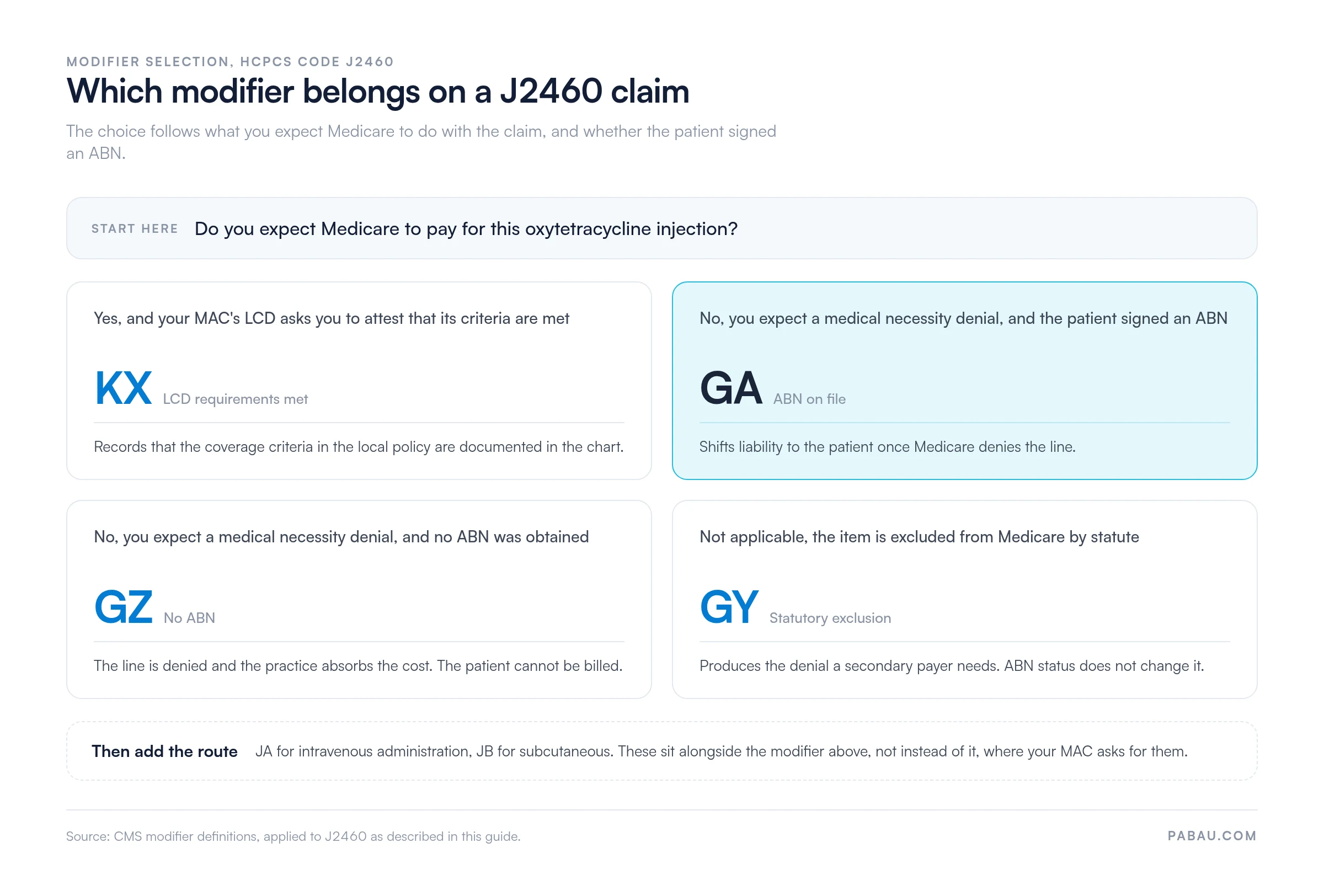
Modifier choice follows the coverage expectation: GA where an ABN is signed, GZ where none was obtained, and GY only for statutory exclusions.
Pabau, practice management software with built-in claims tools, records drug name, dose, and route in the note that feeds the claim.
HCPCS Code J2460 has a single, unambiguous descriptor. Verify it against the current CMS HCPCS file each year to confirm the code remains active.
J-codes sit within HCPCS Level II, the CMS coding system for drugs, supplies, and services that CPT codes do not represent. The CMS HCPCS overview explains the annual update cycle and where to download the official code file. The J range covers drugs given by routes other than oral, including intravenous, intramuscular, and subcutaneous injection.
Oxytetracycline hydrochloride is a broad-spectrum antibiotic in the tetracycline class. Its injectable form is used when oral administration is not clinically feasible, typically in inpatient or acute care settings.
The drug inhibits bacterial protein synthesis, which makes it effective against a range of gram-positive and gram-negative organisms. The injectable form is a supply rather than a procedure, so it falls outside CPT territory and needs its own HCPCS J-code. That code is J2460.
Common clinical indications for oxytetracycline injection include:
Verify current FDA labeling for the exact approved indications. Payer policies for J2460 require documentation of a covered indication, so the prescribing note carries as much weight as the code itself.
Medicare Part B covers drugs given by injection in outpatient settings under the “incident to” drug benefit, provided the drug meets medical necessity criteria. J2460 is payable under Part B when the claim satisfies the conditions below.
Coverage for oxytetracycline injection can vary by Medicare Administrative Contractor (MAC), and some jurisdictions publish their own policies on injectable antibiotics. Read your MAC’s local coverage determinations before the drug is given, not after the denial arrives.
Medicare pays most Part B drugs at the average sales price plus 6%, subject to sequestration. The payment limit for J2460 comes from the CMS ASP drug pricing file, which is republished every quarter. The physician fee schedule does not price J-codes, so a fee schedule lookup returns nothing useful for this claim line.
Pull the current quarter’s CMS ASP pricing file and search it for J2460 to find the payment limit per unit. If the code is not listed in that quarter’s file, your MAC prices it and publishes the amount in its own fee file. Reconcile what you were paid against that figure each cycle, so a locality difference shows up in your reporting rather than in a write-off.
Refresh your charge master from the CMS ASP drug pricing file at the start of every quarter. Payment limits for Part B drugs move with each republication, so a charge built on last quarter’s file no longer matches what Medicare allows.
One missing element in the claim or the clinical note is enough to trigger a denial on J2460. CMS expects specific data on every drug injection claim, and the supporting documentation has to mirror it exactly.
Required claim and documentation elements:
Units on the claim line correspond to 50 mg increments, and payers do not accept fractional units. Round up to the next whole unit, since one unit covers a dose of up to 50 mg. A 50 mg dose is one unit and a 75 mg dose is two, with the exact milligrams recorded in the note either way.
A complete superbill carries the HCPCS code, units, diagnosis code, and provider NPI in one structured document. That keeps the claim line consistent with the record behind it. Practices that retype drug details from the note into the billing system introduce an error at each handoff. Capturing the drug, dose, and route once, at the point of care, removes that step.
Modifiers refine what a J-code claim tells the payer. On a J2460 line, modifier selection decides whether Medicare processes the claim as covered, denies it, or routes it to secondary review.
Not every MAC asks for route modifiers on each J2460 claim, but appending them removes ambiguity and can head off a documentation request. Confirm current requirements with your own MAC before submission, since these policies change between quarters. The choice between GA, GZ, GY, and KX comes down to two questions, which the guide below resolves in order.
Every J2460 claim needs a supporting ICD-10 diagnosis code that establishes medical necessity. The diagnosis must reflect the condition being treated, never the drug or the procedure.
Selecting the most specific ICD-10 code available lowers the risk of a medical necessity denial. Cross-reference the treating provider’s note before choosing from this list. The AAPC HCPCS code reference includes crosswalk guidance on which diagnoses support coverage for a given J-code. Payers also maintain their own approved pairings inside LCD policies, so confirm against your MAC’s published guidance before the claim goes out.
Choosing the wrong J-code for an antibiotic injection is a common coding error, particularly where the drug-specific code is unknown. The table shows where J2460 sits relative to the codes coders most often confuse it with.
J3490 is only appropriate where no specific J-code exists for the drug given. Since J2460 is the designated code for oxytetracycline HCl injection, billing J3490 for it invites a denial or a documentation request. Confirm the drug administered is oxytetracycline rather than another tetracycline-class antibiotic, because each drug carries its own code and its own dosage ceiling.
J3230 is not the only code that shares that ceiling wording. HCPCS Code J2550 reads injection, promethazine HCl, up to 50 mg, and covers a phenothiazine antiemetic rather than an antibiotic.
J2460 denials cluster around a small set of preventable errors, and most begin in the clinical note rather than on the claim form. Tracking the reason at the code level, rather than across the practice as a whole, is what shows you which one you have. The denial codes reference explains what each returned code is telling you.
Audit every J2460 claim submitted in the previous 90 days once a month, filtered by denial reason code. Where most denials share one reason code, the fix belongs in the point-of-care workflow rather than in another round of billing team training.
In most practices the drug details are written once in the clinical note and typed again into the billing system. The dose, the route, and the administering provider all get re-entered by hand, often days later. That second entry is where the milligrams stop matching the units on the claim line.
Pabau is practice management software that keeps charting and billing in the same record. The clinician records oxytetracycline, the milligrams given, and the route as part of the treatment note. The billing team then works from that entry instead of re-keying it. Our claims management software then carries the coded line through submission and tracks what comes back.
The result is fewer J2460 lines rejected for a mismatch between the note and the claim. It is also a faster answer when a payer asks what was given. Remittance data lands against the same record, so a run of denials on one reason code is visible while you can still act on it.

Pabau records drug name, dosage, and route at the point of care, so every HCPCS claim line is supported by the clinical record behind it. Your billing team stops rebuilding documentation after the fact.

J2460 is a straightforward code with three places to get it wrong: the units, the modifier, and the pricing source. Get the dose written down accurately and the units follow. Read the ABN before you pick between GA and GZ. Price the line from the quarterly ASP file rather than the physician fee schedule.
None of that is a billing team problem to solve alone. Each element originates in the room where the injection was given. Practices that record the drug once, at the point of care, see the fewest of these denials. Book a demo to see how Pabau keeps the clinical note and the claim line saying the same thing.

Want to reduce claim denials across your billing workflows? Denial management in healthcare covers how to track, categorize, and resolve claim denials systematically.
Looking for a structured approach to clean claim submission? Clean claim best practices walks through the elements every claim needs before it reaches the payer.
Need to understand how drug billing connects to the broader revenue cycle? Best medical billing software compares platforms built for US billing workflows, including drug administration claim support.
HCPCS Code J2460 covers the injection of oxytetracycline hydrochloride (HCl), up to 50 mg per billed unit. It is a HCPCS Level II J-code used for Medicare Part B billing of physician-administered drug injections. The injectable form must be medically necessary and documented in the clinical record.
Medicare pays J2460 under the average sales price (ASP) plus 6% methodology. The payment limit comes from the CMS ASP drug pricing file, which is republished every quarter. Pull the current quarter’s file and search it for J2460.
Modifiers JA (intravenous) and JB (subcutaneous) identify the route of administration. Use GA when you expect a medical necessity denial and the patient has signed an ABN. Use GZ for the same expected denial when no ABN was obtained. Reserve GY for items Medicare excludes by statute, and use KX where your MAC’s LCD asks you to confirm its criteria are met.
The clinical record must name the drug as oxytetracycline HCl and state the exact dosage administered, with each unit covering up to 50 mg. It also needs the route of administration, the date of service, and the reason the injectable form was required.
The CMS HCPCS overview page provides the official annual code file download. Payment limits for Part B drugs come from the CMS ASP drug pricing file, which is updated quarterly. The NLM Clinical Table Search API offers programmatic HCPCS Level II lookup for practices building their own tools.