

CPT code 48152: Whipple procedure without pancreatojejunostomy
CPT code 48152: Official description and procedure overview CPT code 48152 descr...

Last Updated: Nov 13, 2026
J3260 is the HCPCS Level II code for injection, tobramycin sulfate, up to 80 mg. It covers tobramycin given by intramuscular or intravenous injection, billed at one unit per 80 mg, rounded up.
Most J3260 errors come from three places. Billers count total milligrams instead of 80 mg units, or use J3260 for inhaled tobramycin, which is coded J7682. The third is omitting the National Drug Code when the payer requires it.
Let Pabau's smart automation suggest the right codes, reduce claim denials, and keep your practice compliant—effortlessly.
Automate repetitive tasks and focus on what matters most—your patients.
Reduce coding errors and ensure compliance with the latest regulations.
Clean claims, fewer denials, and faster reimbursements.
Powerful insights and reporting to help your practice thrive.
HIPAA compliant SOC 2 certified GDPR-compliant Trusted by 4,000+ clinics worldwide

HCPCS code J3260 bills tobramycin sulfate given by IM or IV injection, while inhaled tobramycin is billed with J7682 as a DME supply.
One unit covers up to 80 mg, so divide the dose by 80 and round up, counting any discarded drug in the total.
Report JW or JZ only for tobramycin drawn from single-dose containers, never for multi-dose vials.
Medicare Part B pays J3260 at ASP plus 6%, and CMS updates the rate every quarter.
Every J3260 line needs its own administration code, such as 96372, 96374 or 96365.
HCPCS code J3260 is the Level II code for injection, tobramycin sulfate, up to 80 mg. The Centers for Medicare and Medicaid Services (CMS) maintains it. Tobramycin is an aminoglycoside antibiotic given by IV or IM injection for serious gram-negative infections. These include pneumonia, septicemia, urinary tract infections and osteomyelitis. Colistimethate under HCPCS J0770 follows the same pattern, with 1 unit for each 150 mg.
J-codes mostly cover drugs that are not usually self-administered. That is why J3260 is billed when a clinician gives the dose in an office or outpatient setting. Confirm the facts below before a J3260 claim goes out.
J3260 covers tobramycin sulfate delivered by IM or IV injection only. Payers check the route of administration, so billing J3260 for nebulized tobramycin is a straight denial.
Covered under J3260:
Not covered under J3260:
One unit of J3260 covers up to 80 mg of tobramycin sulfate. Divide the total dose by 80 and round up to the next whole unit. Never round down, because billing fewer units than you gave underpays your practice.
Wastage counts toward the units. Billed units cover the amount given plus any amount discarded from the vial. So a 60 mg dose drawn from an 80 mg single-dose vial is 1 unit in total.
JW and JZ apply only to single-dose containers. Report JW on a separate line for discarded drug, or JZ on the J3260 line when none is discarded. Multi-dose vials are not reported with JW or JZ. Many tobramycin 40 mg/mL vials are multiple-dose, so read the label before you add either modifier.
CMS updates its JW and JZ policy through periodic transmittals, so check the current one before you apply these modifiers. The three checks below settle most J3260 lines in order.
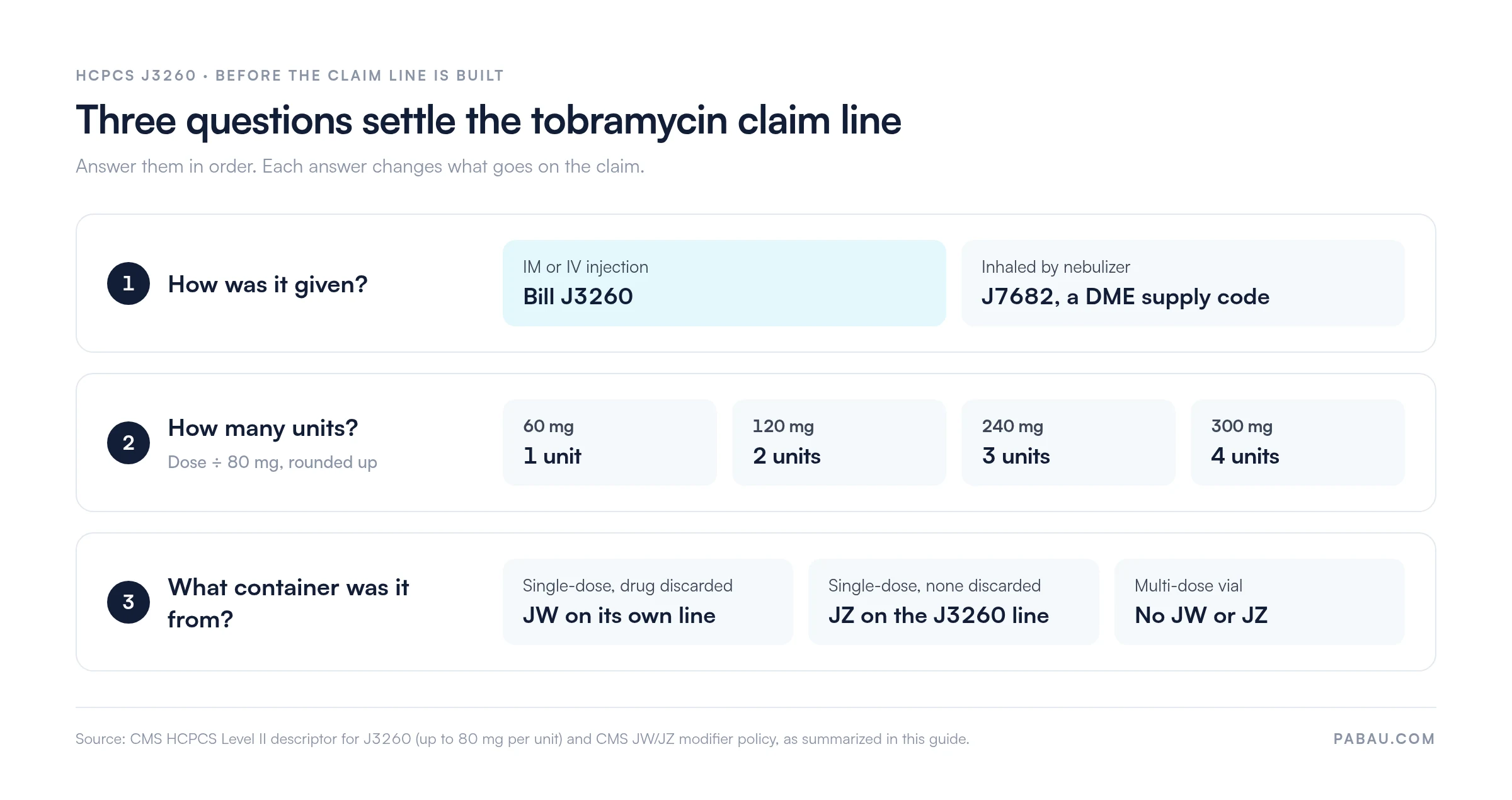
J3260 and J7682 both describe tobramycin, but they are not interchangeable. J7682 covers tobramycin inhalation solution given by nebulizer, mostly for patients with cystic fibrosis. Payers match the code to the route in the clinical notes, so a mismatch is denied.
J3260 is a drug code only. It tells the payer which drug was given and how much, but not how it was given. A separate CPT administration code goes on its own line for the same date of service. For an intramuscular dose that code is 96372, and IV doses use the push or infusion codes below.
Medicare Part B pays J3260 at the Average Sales Price plus 6% (ASP+6%). The limit is set under Medicare Part B’s ASP payment system, published in CMS’s quarterly ASP Drug Pricing File. Because the allowable per unit changes four times a year, keep fixed dollar figures out of your billing notes.
To find the current rate, open the latest quarterly file and look up J3260. The payment amount there is 106% of the volume-weighted ASP across manufacturers.
Office vs hospital outpatient: In a physician office, J3260 is paid separately at ASP+6%. In a hospital outpatient department, the drug and its administration are often packaged into an Ambulatory Payment Classification (APC) under OPPS. Confirm the setting with your billing team before you expect separate payment.
The National Drug Code (NDC) is an 11-digit identifier the FDA assigns to each drug product. NDC rules for J3260 differ by payer type, and mixing them up causes avoidable denials. Good medical billing workflows capture the NDC when the drug is given, not when the claim is built.
How to report the NDC: On an electronic 837P claim, report it in Loop 2410 with the N4 qualifier. On a paper CMS-1500, enter it in the shaded part of Box 24. Use the 11-digit 5-4-2 format without hyphens. Take the NDC from the vial label, and record the lot number in the patient record for audits.
Traditional Medicare generally does not require prior authorization for J3260 given in a physician office. Medicare Advantage plans, Medicaid managed care organizations and commercial insurers may, especially for high-dose or long courses.
Before giving tobramycin to a patient with commercial or managed care coverage, check the payer portal or call the provider line. Record the authorization number in the patient record and on the claim. A request usually needs these elements:
Here is how one illustrative claim moves from the treatment room to payment. A patient with Pseudomonas pneumonia receives 200 mg of tobramycin by IV infusion over 40 minutes in a physician office.
J3260 denials cluster around a predictable set of errors, and most start upstream in documentation or unit math. Sound denial management strategies fix the cause before the claim reaches the rework queue.
When a denial does come back, its remark code names the cause. Our guide to claim denial codes explains how to read each one.
Every J3260 claim must link to an ICD-10-CM code that shows why injectable tobramycin was medically necessary.
Unspecified or site-not-specified codes (such as J18.9, A41.9, N39.0, M86.9) can trigger denials. Payers want enough detail to confirm an aminoglycoside fits, so use the most specific code the documentation supports.
Local Coverage Determinations (LCDs) may list exactly which ICD-10 codes support injectable tobramycin. Check your MAC’s LCD database before you finalize the diagnosis on high-dollar claims.
A few edge cases come up often in practices that give tobramycin. The superbill for each J3260 encounter should capture them at the point of service, not during claim prep.
Home infusion overlap: When tobramycin is prescribed for IV use at home, billing moves away from Part B physician drug billing. Home doses may fall under Part D or a home infusion benefit instead. Bill J3260 only for doses given in your clinical setting.
Incident-to billing: A nurse or medical assistant may give the dose under direct physician supervision in the office. The service may then qualify as incident-to billing under Medicare. The supervising physician must be in the office suite during administration, and the record should show it. Without that note, the claim may be denied or recouped in an audit.
Doses across several days: Tobramycin regimens often call for doses on consecutive days. Bill J3260 on each date of service, with the unit count for that day’s dose. Never combine several days onto one claim line.
A short pre-submission check catches the errors above before a payer sees them. Pair it with your wider clean claim checklist.
Most J3260 errors start at the point of care. A nurse gives the dose, the vial goes in the sharps bin, and billing rebuilds the details days later.
Pabau, the practice management and billing platform we build, records those details as the dose is given. Stock carries a batch number and expiry date, and IV sessions record the lot against the patient and appointment. Prior authorization codes, dates and sessions sit on the patient’s case, with a warning when one is missing.
US practices then send CMS-1500 and 837P claims through Claim.MD, with eligibility checks and ERA remittances in the same system. The result is cleaner claims management, with the drug line, administration line and diagnosis on one patient record.

Pabau keeps lot numbers, prior authorizations and claims on the patient record, so your J3260 claims leave with the details payers check.

J3260 claims are won or lost before anyone opens the billing screen. If you change one habit, capture the dose, NDC and vial type when the drug is drawn, not when the claim is built.
That costs a minute of charting per dose. Skipping it costs a denial, an appeal and a payment that lands months late.
Book a demo to see how Pabau keeps lot numbers, authorizations and claims on one patient record.

Need a full picture of medical billing fundamentals? What is medical billing explains the revenue cycle from charge capture through payment posting.
Getting repeat denials across drug codes? Denial management in healthcare covers how to track, appeal and prevent claim rejections.
Want a checklist for clean claim submission? Clean claim submission outlines the data every claim needs before it reaches a payer.
Infusing tobramycin over more than 15 minutes? CPT code 96365 covers initial IV infusion billing, timing and reimbursement.
Giving the dose as an IV push? CPT code 96374 explains when a push is billed instead of an infusion.
Tobramycin blood levels are billed with CPT 80200, the therapeutic drug assay for tobramycin. It is a lab code, separate from J3260 and the administration code. The lab that performs the assay bills it.
Tobramycin is dosed by body weight and kidney function, so the dose in milligrams varies. The units follow the dose, at one per 80 mg, rounded up. Recalculate them at every visit rather than copying the last claim.
No. J3260 covers injected tobramycin only. Ophthalmic and topical tobramycin products are not billed with it, and they are usually filled as pharmacy prescriptions.
Part B covers tobramycin a clinician gives in an office or outpatient setting, billed with J3260. Doses given at home usually fall under Part D or a home infusion benefit instead.
Yes. J3260 has been part of HCPCS Level II since 1982 and remains active. Its descriptor still reads injection, tobramycin sulfate, up to 80 mg.



