HCPCS Code E0272: Foam rubber mattress billing guide
HCPCS Code E0272: official descriptor and code overview HCPCS Code E0272 is the ...

Last Updated: Nov 6, 2026
H0050 is the HCPCS Level II code for alcohol and/or drug services, brief intervention, per 15 minutes. It covers a short, structured conversation that helps a patient reduce risky alcohol or drug use, usually after a positive screen.
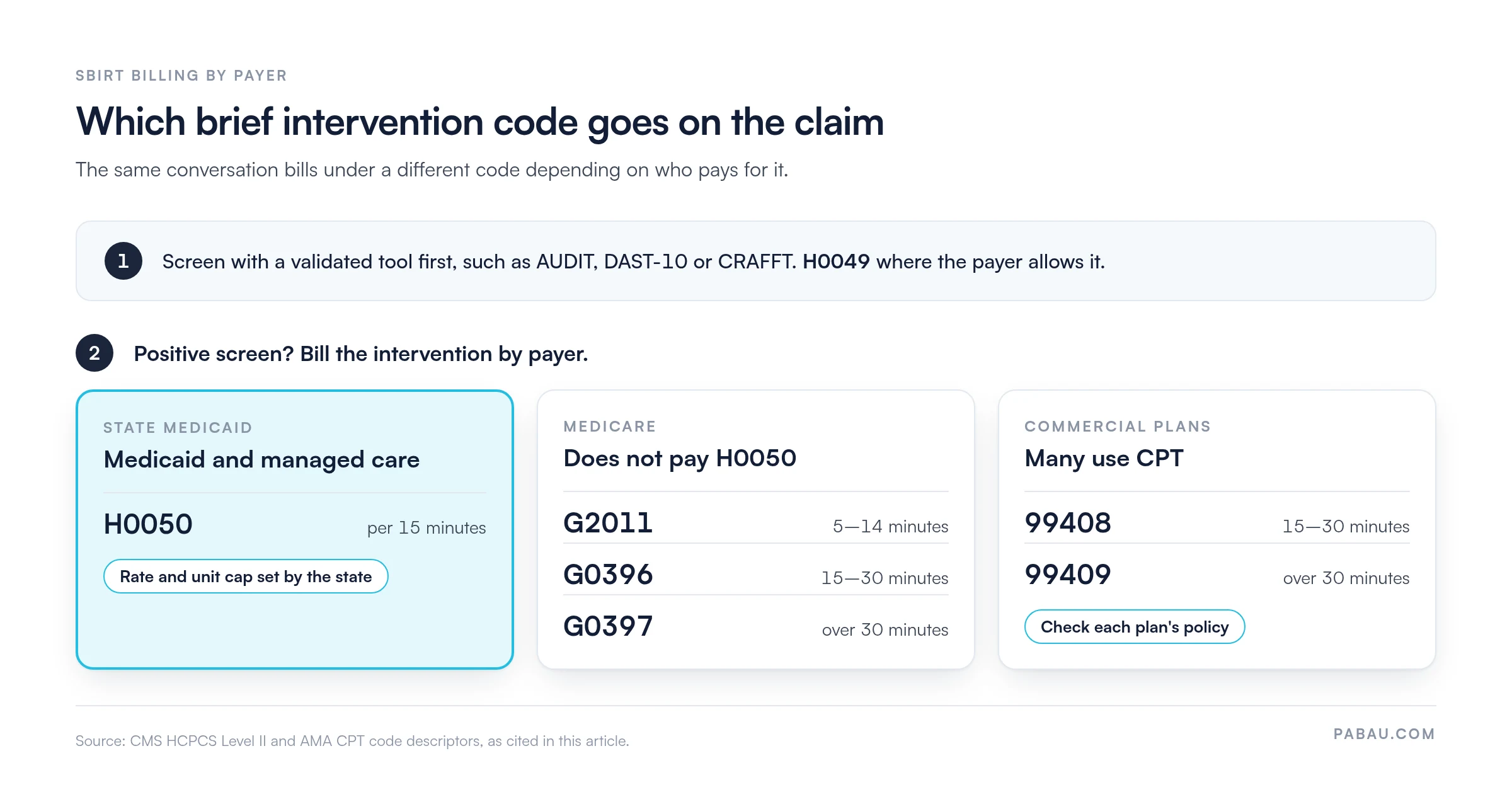
Each 15 minutes of intervention is one unit. State Medicaid programs pay the code, while Medicare does not. Peer support is billed under H0038, not H0050.
Let Pabau's smart automation suggest the right codes, reduce claim denials, and keep your practice compliant—effortlessly.
Automate repetitive tasks and focus on what matters most—your patients.
Reduce coding errors and ensure compliance with the latest regulations.
Clean claims, fewer denials, and faster reimbursements.
Powerful insights and reporting to help your practice thrive.
HIPAA compliant SOC 2 certified GDPR-compliant Trusted by 4,000+ clinics worldwide

HCPCS code H0050 is an alcohol or drug brief intervention, billed in 15-minute units, usually after a positive screen.
Medicare does not pay H0050, so Medicare SBIRT claims use G0396, G0397 or G2011 instead.
Peer support bills under H0038, not H0050, except in narrow roles such as Medi-Cal contingency management.
Common denial triggers are a missing screening score, units the timed note can’t support, and a modifier the plan doesn’t accept.
Each state sets its own rate, so check your Medicaid fee schedule before you project H0050 revenue.
HCPCS code H0050 is the Level II code for “Alcohol and/or drug services, brief intervention, per 15 minutes.” The Centers for Medicare and Medicaid Services (CMS) maintains it. The code covers a short, structured conversation that helps a patient cut back on risky alcohol or drug use. Each 15 minutes of intervention counts as one unit.
H0050 is the “BI” in SBIRT: Screening, brief intervention, and referral to treatment. A practice screens with a validated tool first, billed as H0049 where the payer allows it. A positive result then leads into the H0050 conversation.
The code sits in the H-series, one of the letter groups in our full HCPCS code library. State Medicaid agencies use the H-series for behavioral health and substance use services. CMS lists H0050 as not payable by Medicare.
Medicare and many commercial plans bill SBIRT under G-codes or CPT 99408 and 99409 instead. So the same conversation lands on a different code depending on who pays for it.
Payers read H0050 narrowly. It covers a short intervention, not ongoing treatment, so the content of the session decides whether the code fits.
Covered under H0050:
Not covered under H0050:
Watch the line between brief intervention and counseling. Once the conversation turns into ongoing treatment planning, H0004 or a psychotherapy code fits better than H0050.
Each state Medicaid program decides which practitioners can deliver H0050. There is no national provider list, so the state billing manual is the source to check.
State plans commonly allow physicians, nurse practitioners, physician assistants and licensed behavioral health clinicians to bill it. Some states also accept certified alcohol and drug counselors, or trained staff working under a licensed supervisor.
Certified peers are a narrow exception. In Medi-Cal, DHCS Behavioral Health Information Notice 22-056 lets certified peer support specialists act as contingency management coordinators. The Los Angeles County peer support services guide bills that work as H0050 with the HF modifier. Other peer services bill under H0038.
Three claim fields decide whether an H0050 claim pays: The unit count, the modifiers, and the place of service. Each one follows state rules, so set them up per payer.
One unit equals 15 minutes of intervention time. A 15-minute conversation is one unit, and a 30-minute conversation is two. Check how your payer treats partial units, because some apply a midpoint rule and others require the full 15 minutes.
Payers also cap how often H0050 can be billed. Limits can run per day, per year or per episode, so confirm the cap before you schedule repeat sessions. Los Angeles County’s FY 2023-2024 rates matrix, for example, lists a 96-unit maximum for H0050.
Brief intervention happens wherever screening happens, so H0050 claims carry a wide range of place of service (POS) codes. Common choices include POS 11 (office), POS 23 (emergency room), POS 53 (community mental health center) and POS 57 (non-residential substance abuse treatment facility).
Telehealth claims use POS 02 or POS 10, depending on where the patient is. Confirm which POS codes your state accepts for H0050, because a mismatch denies the claim even when the note is complete.
Pull your state Medicaid manual and build a one-page H0050 reference card for the billing team. List the unit rule, accepted modifiers, valid POS codes and frequency cap. It takes minutes to set up and stops technical denials before claims leave the practice.
The note has to show that a screen came first, that an intervention followed, and how long it took. A line such as “discussed alcohol use” will not hold up in an audit.
Every H0050 note should include:
Contingency management notes under Medi-Cal also need the program’s own elements, such as the drug test result. An EMR with required note fields lets a behavioral health practice build an H0050 template that won’t save until each field is filled.
A brief intervention often happens before anyone has diagnosed a disorder, which is the point of SBIRT. Payers differ on which diagnoses they accept. Some take counseling Z codes for risky use, while others require a substance use disorder code from F10-F19.
Confirm your state’s accepted diagnosis list before you bill. A code outside that list denies the claim, however complete the note is.
Brief intervention usually follows a screen in the same visit, so waiting for approval would defeat its purpose. Even so, each state Medicaid program and managed care plan sets its own prior authorization rules for H0050.
Check the rules again when sessions repeat or run inside a structured program, such as contingency management. Where a plan does require authorization, it typically asks for:
Record each authorization number against the patient’s insurance details, and attach it to every claim it covers.
There is no national rate for H0050. Each state Medicaid program sets its own fee, and managed care plans can pay different rates within the same state.
Medicare does not pay H0050. CMS lists it with coverage code I, which marks it as not payable by Medicare. The Medicare Physician Fee Schedule prices the G-code SBIRT services instead.
Published fee schedules give a reference point. Los Angeles County’s Substance Abuse Prevention and Control (SAPC) program publishes one in its peer support services guide. Its FY 2023-2024 rates matrix lists H0050 at $46.67 per 15-minute unit. That rate covers contingency management in the county’s DMC-ODS program, so it does not transfer to other states.
Check your state’s current fee schedule before you build revenue projections around H0050.
Several codes sit close to H0050, and two are often mixed up with it. H0038 is the peer support code, and H2038 is a skills training code. Neither one is a version of H0050. The AAPC HCPCS Level II code lookup lets billers compare descriptors side by side.
When the screen and the intervention happen in one visit, check whether your state lets you bill H0049 alongside H0050. Peer-delivered recovery support belongs on H0038.
H0050 denials follow a few predictable patterns. Practices using claims management software can flag missing fields before a claim goes out.
Run a 30-claim audit of last month’s H0050 submissions: 10 paid, 10 denied and 10 pending. Compare the notes side by side. Denied claims usually miss one or two fields that paid claims always carry, and that pattern becomes your checklist.
H0050 denials often start before the claim is built. The screen sits in one place, the timed note in another, and the biller pieces the units together afterward. The medical billing compliance rules for behavioral health codes leave little room for that.
Pabau, the practice management and EMR platform we build, keeps the screening form, the treatment note and the invoice in one patient record. You can build an H0050 note template that asks for the screening score, start and stop times, and the goal agreed.
Because the note and the claim share a record, the biller checks units against documented time instead of chasing the clinician. Pabau then carries those details through each step of the medical billing process, so fewer claims come back for missing information.

Pabau keeps screening forms, timed treatment notes and claims in one patient record. Your H0050 claims go out with the units and details payers check.

Treat H0050 as what it is: A short, timed intervention that follows a screen. When the service fits that shape, the code is simple to bill. When it drifts into peer support, counseling or crisis work, another code fits better.
The practical step is a payer-by-payer reference for units, modifiers, POS codes and frequency caps. Pair it with a note template that records the score and the minutes. Set that up once, and most technical denials stop at the source.
Pabau keeps the screen, the timed note and the claim in one patient record. Book a demo to see how it supports brief intervention billing in your practice.

Need a process for working behavioral health denials? Denial management in healthcare covers the full denial workflow from identification through appeal.
Looking for the compliance standards behind SUD billing? Medical billing compliance outlines the documentation and workflow standards that Medicaid auditors evaluate.
Want to understand how claims clearinghouses process behavioral health submissions? How medical claims clearinghouses work explains the validation and routing process that affects H-series claim outcomes.
Referring a patient on after a positive screen? HCPCS code H0001 covers the full alcohol and drug assessment that often follows a brief intervention.
Did the session turn into a crisis response? HCPCS code H2011 explains how crisis intervention bills per 15 minutes.
HCPCS code H0050 is the Level II code for alcohol and/or drug services, brief intervention, per 15 minutes. It covers a short, structured conversation about risky alcohol or drug use, usually after a positive screen. State Medicaid programs pay it, but Medicare does not.
No. H0050 is a brief intervention code. Peer support bills under H0038, self-help/peer services, per 15 minutes. The main exception is Medi-Cal, where certified peers acting as contingency management coordinators bill H0050 with the HF modifier.
One unit equals 15 minutes of intervention, so a 30-minute session is two units. Each state sets its own daily, yearly or episode cap. Check your Medicaid billing manual before you schedule repeat sessions.
No. CMS lists H0050 with coverage code I, so Medicare does not pay it. Bill Medicare SBIRT services with G2011 for 5 to 14 minutes, G0396 for 15 to 30 minutes, or G0397 for over 30 minutes.
H0049 is alcohol and/or drug screening, the step that identifies risky use. H0050 is the brief intervention that follows a positive screen, billed per 15 minutes. Some states let you bill both in one visit, while others bundle them.
The two codes are unrelated. H2038 is skills training and development, per diem. H0050 is an alcohol and drug brief intervention billed per 15 minutes. H0050 did not replace H2038, and neither one is a peer support code.
Common causes are a Medicare claim, a missing screening score, units the timed note can’t support, and a diagnosis outside the plan’s list. A missing state modifier, such as HF for contingency management, also triggers denials. Read the remittance reason code, fix the cause, then resubmit.