

HCPCS code E0198: Water pressure pad billing guide
HCPCS code E0198 is a water pad for a standard mattress HCPCS code E0198 is the ...

Last Updated: Oct 13, 2026
99408 is the CPT code for alcohol and/or substance (other than tobacco) abuse structured screening and brief intervention (SBI) services. The time band is 15 to 30 minutes, and the descriptor names AUDIT and DAST as example instruments.
It sits in the Behavior Change Interventions subsection of Evaluation and Management. Bill it when a clinician administers a validated tool, scores it, and delivers a brief intervention in the same encounter. The 15-minute floor is absolute, and a 14-minute session is not billable at a reduced rate. Medicare beneficiaries need HCPCS G0442 and G0443 instead.
Let Pabau's smart automation suggest the right codes, reduce claim denials, and keep your practice compliant—effortlessly.
Automate repetitive tasks and focus on what matters most—your patients.
Reduce coding errors and ensure compliance with the latest regulations.
Clean claims, fewer denials, and faster reimbursements.
Powerful insights and reporting to help your practice thrive.
HIPAA compliant SOC 2 certified GDPR-compliant Trusted by 4,000+ clinics worldwide

CPT code 99408 covers 15 to 30 minutes of alcohol or substance screening plus a brief intervention in one encounter.
The screening has to use a validated instrument, such as AUDIT, AUDIT-C, DAST-10, or CAGE, and the score belongs in the note.
Medicare patients need HCPCS G0442 and G0443 instead, and sending 99408 to Medicare is a primary denial trigger.
Billing 99408 on the same day as an E&M visit requires modifier 25 on the E&M code, and some payers bundle it anyway.
Pabau’s claims management software pre-fills the claim from the patient record and submits it through Claim.MD in the US.
CPT code 99408 reports two services delivered in one encounter. The first is a structured screening for alcohol or substance use. The second is the brief intervention that follows the score.
Here is how the American Medical Association words it. “Alcohol and/or substance (other than tobacco) abuse structured screening (eg, AUDIT, DAST), and brief intervention (SBI) services; 15 to 30 minutes.”
The code lives in the Evaluation and Management chapter, 99202-99499. Inside that chapter it belongs to Preventive Medicine Services, in the Behavior Change Interventions subsection.
Its immediate neighbors are 99406 and 99407 for tobacco cessation counseling, and 99409 for the same alcohol or substance service over 30 minutes.
Both halves of the service have to happen, and both have to appear in the note. A screening with no intervention falls outside the descriptor. So does advice offered without a scored instrument behind it.
The code bundles four elements and stops there. Knowing where that boundary falls is what keeps a behavioral health charge from being unbundled at the payer.
Included in 99408:
Not covered by 99408:
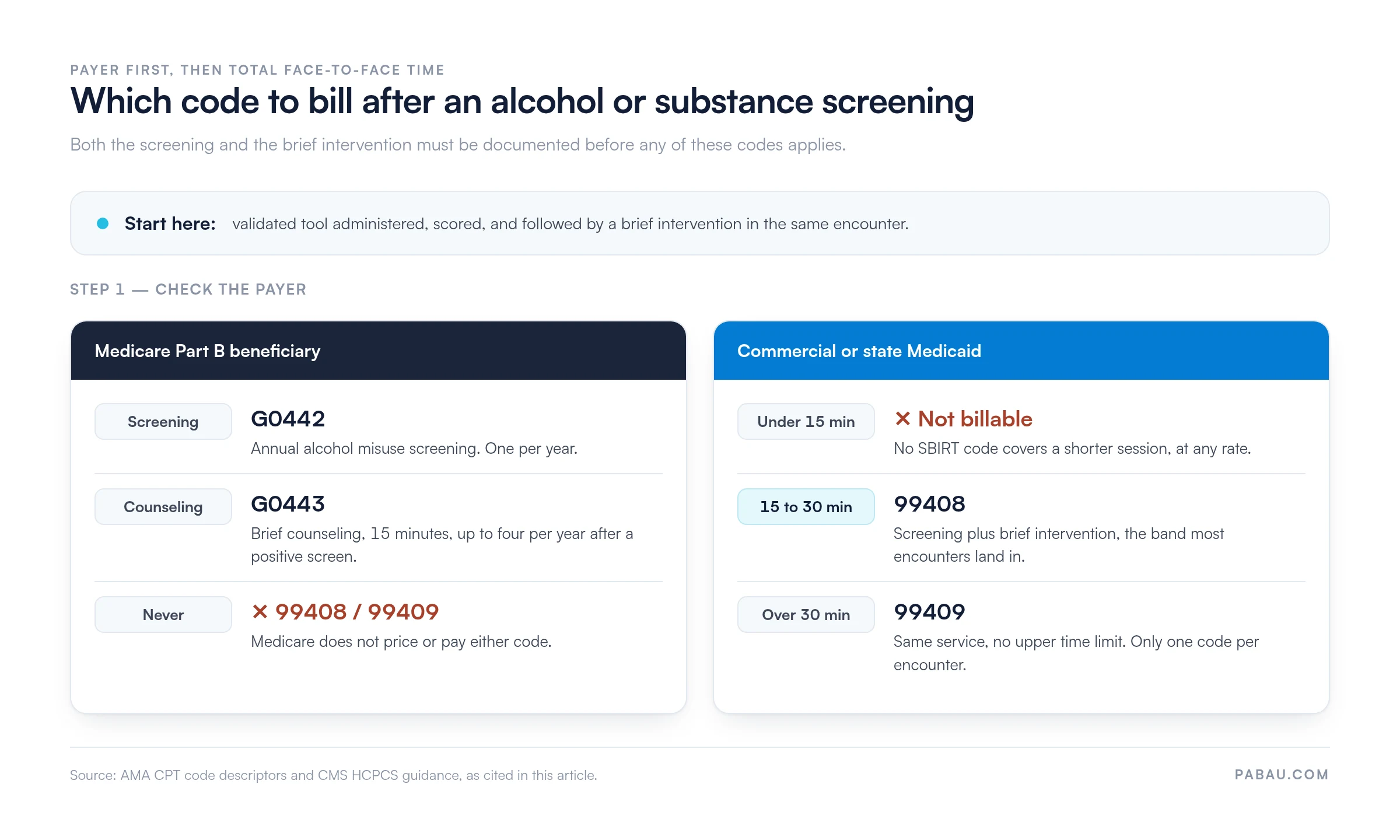
Total documented face-to-face time picks the code, not the difficulty of the conversation. 99408 covers 15 to 30 minutes. 99409 covers the same service beyond 30 minutes, with no upper limit in the descriptor.
Only one of the two may be billed per encounter, and submitting both for one date of service draws an automatic CO-97 denial.
Note what the 99409 row does not say. There is no 60-minute ceiling in the descriptor, so a 75-minute intervention is still one unit of 99409. The note still has to carry the total time. “SBIRT performed” with no minutes attached supports neither code.
Medicare Part B pays neither 99408 nor 99409 for its own beneficiaries. It uses two HCPCS G-codes instead. G0442 covers annual alcohol misuse screening, with no intervention component attached.
G0443 covers the brief counseling that follows a positive screen. Per CMS HCPCS guidance, the substitution is mandatory rather than preferred.
Put the payer question first and the stopwatch second, and the routing below falls out on its own.
An auditor reading a 99408 note looks for five specific items. Miss one and the charge is exposed, whether at adjudication or two years later at a recoupment review.
A referral line belongs in the note too, whenever the score warrants one. Record where the patient was sent and how they responded. That closes the referral-to-treatment half of SBIRT.
Here is what a compliant entry looks like in practice. “AUDIT-C administered, score 6, hazardous drinking range. Discussed weekly unit count, two alcohol-free days, and the link to her reflux.
Patient agreed to track intake for four weeks. Declined referral. Face-to-face 09:12 to 09:31, 19 minutes.” That is four lines, and it supports the charge.
Open your EHR note template for SBIRT encounters and look for a ‘time spent’ field that is separate from the encounter duration. If there isn’t one, add it. Auditors read documented face-to-face minutes as the proof that the service happened, and a blank time field is treated the same as a missing service.
The ICD-10-CM code on the claim has to explain why the screening happened. Reaching for an unrelated complaint from the same visit is a leading cause of medical necessity denial on this service.
Screening a patient for alcohol use and billing it against a knee pain code will not survive review.
Some payers publish a restricted diagnosis list for 99408 in a Local Coverage Determination. Check the applicable policy before you code, especially for plans that have issued behavioral health coverage rules of their own. Our ICD-10-CM code library has the full descriptor for each of the codes above.
The AMA descriptor names no license type, so eligibility is decided by the payer contract rather than by the code. That distinction matters, because a service can be clinically appropriate and still be denied on the rendering provider’s credentials.
Providers who commonly bill it, subject to payer credentialing:
Settings. 99408 is billed in outpatient and primary care settings, emergency departments, and federally qualified health centers. An inpatient stay does not support the code. Incident-to rules apply when a non-physician delivers the service under physician supervision, and supervision requirements vary between payers. Verify your own contracts before you bill through an incident-to arrangement.
Whether 99408 is payable at all depends on who is paying. The table below is the starting point, not the answer for a particular patient. Run eligibility before the appointment and you find out at intake rather than at remittance.
Medicaid coverage for 99408 is not universal, and one state’s policy is no guide to the next. Verify at plan level, never at payer-category level.
There is no national average rate for 99408. A benchmark would normally come from the CMS Physician Fee Schedule, which carries the code with a status that makes it non-payable.
Commercial rates are usually quoted as a percentage of the Medicare allowable. A code Medicare never prices cannot anchor that calculation.
The practical consequence is worth planning around. Before you build a screening program on this code, pull the actual allowed amount from your two or three largest commercial contracts. A number someone quoted you as a national average for 99408 came from somewhere other than Medicare.
99408 can be billed on the same date as an evaluation and management visit, provided modifier 25 goes on the E&M code. The modifier tells the payer that the E&M was a significant, separately identifiable service. Leave it off and most payers fold the 99408 into the visit and deny it as inclusive.
What both notes have to show:
One caveat is worth knowing before you file an appeal. A number of commercial payers bundle 99408 into a preventive E&M visit whatever modifier you use. Their contract says so, and the claim itself is fine. Check that policy first, because the fix is a contract conversation and not a resubmission.
Other screening services added to a visit follow the same rule. Instrument-based ocular screening billed as CPT code 99177 also needs modifier 25 on the same-day E&M code. Several commercial plans bundle it into the preventive visit regardless.
A 99408 charge passes four checkpoints between the exam room and the deposit. Each one rejects a different kind of mistake, and knowing which is which saves a lot of guessing.
Before you submit, confirm all five:
Payment is the checkpoint that gets the least attention, because it is easy to stop at “submitted”. Remittance posting tells you which 99408 charges were paid, and at what allowed amount.
Six triggers account for the bulk of 99408 rework, and five of them are decided before the claim leaves the building. Building the check into charge entry beats appealing after the fact, which is the core argument behind most denial management programs.
One word of caution on the codes in that table. CO-97 and CO-50 are the standard reason codes for bundling and medical necessity. The other four triggers surface under reason codes that differ from payer to payer. Read the remittance advice instead of assuming which code you will see.
The 99408 charge usually gets retyped at least once on its way to a payer. A clinician records the instrument, the score, and the minutes in the clinical note. Someone else then reads that note and keys the charge into a separate billing system. Every retype is a chance to drop the time entry or pick the wrong payer’s code.
Practice management software like Pabau removes that step. Pabau’s claims management software pre-fills the claim form straight from the patient record.
The CPT code attached to the service lands on the charge line, and the ICD-10 slots are seeded from the recorded problem list. Built-in ICD-10-CM and CPT lookup libraries sit behind a search icon, refreshed with the official releases.
From there the claim goes out through Claim.MD, our US clearinghouse partner. Real-time eligibility checks, claim status tracking, and electronic remittance posting come back the other way.
Required claim fields are validated before the send button unlocks. The result is a shorter path between the note the clinician wrote and the payment the practice banks.

Pabau pre-fills each claim from the patient record and submits it through the Claim.MD clearinghouse, with eligibility checks, claim tracking, and remittance posting built in. See how it handles behavioral health billing in your practice.

99408 is one of the few preventive codes where the clinical work is easy and the billing is not. The service itself is a validated questionnaire and a short conversation. What decides whether it gets paid is the payer check at charge entry and the minutes in the note.
So treat both as workflow problems, not coding problems. Put the Medicare question in front of the coder before the charge is built, and make the time field impossible to skip. Practices that do both spend their denial time on genuine coverage disputes instead of on rework they created.
If your SBIRT charges are still being rekeyed from the clinical note into a billing system, that is where the errors are coming from. Book a demo to see how Pabau carries a screening encounter through to a submitted claim without the retype.

Need to understand how claims reach the payer? Medical claims clearinghouse guide explains how scrubbing, routing, and remittance processing work end to end.
Billing substance use services across several codes? Superbill documentation best practices covers how to structure charge capture for multi-code encounters.
Want to cut claim denials across the practice? Denial management in healthcare outlines the workflow steps that reduce denial rates before claims go out.
No. SBIRT is the clinical framework, covering screening, brief intervention, and referral to treatment. 99408 is one of the billing codes used to report that work. The referral component belongs in the note, but it is not what the code pays for.
The substance is what separates them. 99406 and 99407 report tobacco use cessation counseling, with 99407 covering intensive counseling greater than 10 minutes. 99408 explicitly excludes tobacco and covers alcohol or other substances.
It depends entirely on the plan. Medicare does not cover 99408 in any setting, and commercial payers set their own telehealth rules for SBIRT. Check the plan’s telehealth policy for the place of service code and modifier it expects.
The AMA descriptor sets no frequency limit, so the payer does. Commercial plans commonly allow one or two a year as a preventive benefit, and state Medicaid programs publish their own limits. Confirm the limit before running a repeat screening program.
No. Z13.89 covers a preventive screening in a patient with no established diagnosis. An F10 to F19 code is used instead when the screening confirms a disorder.



