Pabau Engage inbox

Pabau Engage is here: every patient conversation in one inbox.

Learn more
HCPCS Code

HCPCS code G0143 – Thin-layer Pap screening with manual rescreening


Code Definition

G0143 is the HCPCS Level II code for a screening Pap test on a thin-layer slide. A cytotechnologist screens the slide manually, then rescreens it, under physician supervision. Medicare covers it every 24 months for average-risk patients, or yearly for high-risk ones, and pays the lab from the Clinical Laboratory Fee Schedule.

That second manual read is what sets G0143 apart. Report one cytotechnologist screen as G0123, or an automated first read as G0144 or G0145. Picking between these siblings, pairing the right screening diagnosis code and timing the claim inside Medicare's window decide whether it pays.

Section
G0000-G9999 Procedures and professional services (temporary)
Category
G0123-G0148 Screening cytopathology codes (Medicare cervical/vaginal screening)
Status
Active Level II code, effective January 1, 1999
Billable
No
Code also known as
Thin-layer Pap manual screening and rescreening by cytotechnologist
Save time. Improve accuracy. Get paid faster.
Automate coding with Pabau

Let Pabau's smart automation suggest the right codes, reduce claim denials, and keep your practice compliant—effortlessly.

  • AI-powered code suggestions
  • Real-time compliance checks
  • Faster claims, fewer denials
Why practices choose Pabau
Save hours every week

Automate repetitive tasks and focus on what matters most—your patients.

Improve accuracy

Reduce coding errors and ensure compliance with the latest regulations.

Get paid faster

Clean claims, fewer denials, and faster reimbursements.

Grow with confidence

Powerful insights and reporting to help your practice thrive.

HIPAA compliant SOC 2 certified GDPR-compliant Trusted by 4,000+ clinics worldwide

Key takeaways

Key takeaways

HCPCS code G0143 covers a thin-layer Pap slide that a cytotechnologist screens and then rescreens manually, under physician supervision.

Medicare covers the screening every 24 months for average-risk patients and every 12 months for high-risk patients, per CMS MLN909032.

The lab bills G0143 on the Clinical Laboratory Fee Schedule, while the practice that collects the specimen bills Q0091.

The denials to watch for are frequency timing, a sibling G-code chosen in error, and a diagnosis code missing from Medicare’s screening list.

Pabau, the practice software we build, submits and tracks screening claims and keeps the lab report on the patient record.

HCPCS code G0143 means two manual reads of one liquid-based slide

HCPCS code G0143 is an active Level II G-code that CMS maintains for screening Pap tests. The lab reports it when a cytotechnologist screens a thin-layer slide by hand, then rescreens it.

CMS splits the official descriptor into two halves. The specimen half reads “Screening cytopathology, cervical or vaginal (any reporting system), collected in preservative fluid, automated thin layer preparation”. The work half reads “with manual screening and rescreening by cytotechnologist under physician supervision”.

In plain terms, four elements have to be true for G0143 to fit:

  • The specimen is cervical or vaginal.
  • It was collected in preservative fluid and prepared as an automated thin-layer slide, such as ThinPrep or SurePath.
  • A cytotechnologist screened the slide manually, then rescreened it manually.
  • The work ran under physician supervision.

If one of them is missing, a sibling code describes the test better. The lab report is where you confirm all four.

FieldDetail
CodeG0143
Code setHCPCS Level II (CMS-maintained G-code)
Status (2026)Active, effective January 1, 1999
Preparation methodAutomated thin-layer (liquid-based cytology)
Rescreening typeManual rescreening by cytotechnologist under physician supervision
Fee scheduleClinical Laboratory Fee Schedule (CLFS)
Primary payerMedicare Part B
Collection code (practice)Q0091

G0143 vs. G0123, G0124, G0141, G0144, G0145, G0147 and G0148: Who reads the slide picks the code

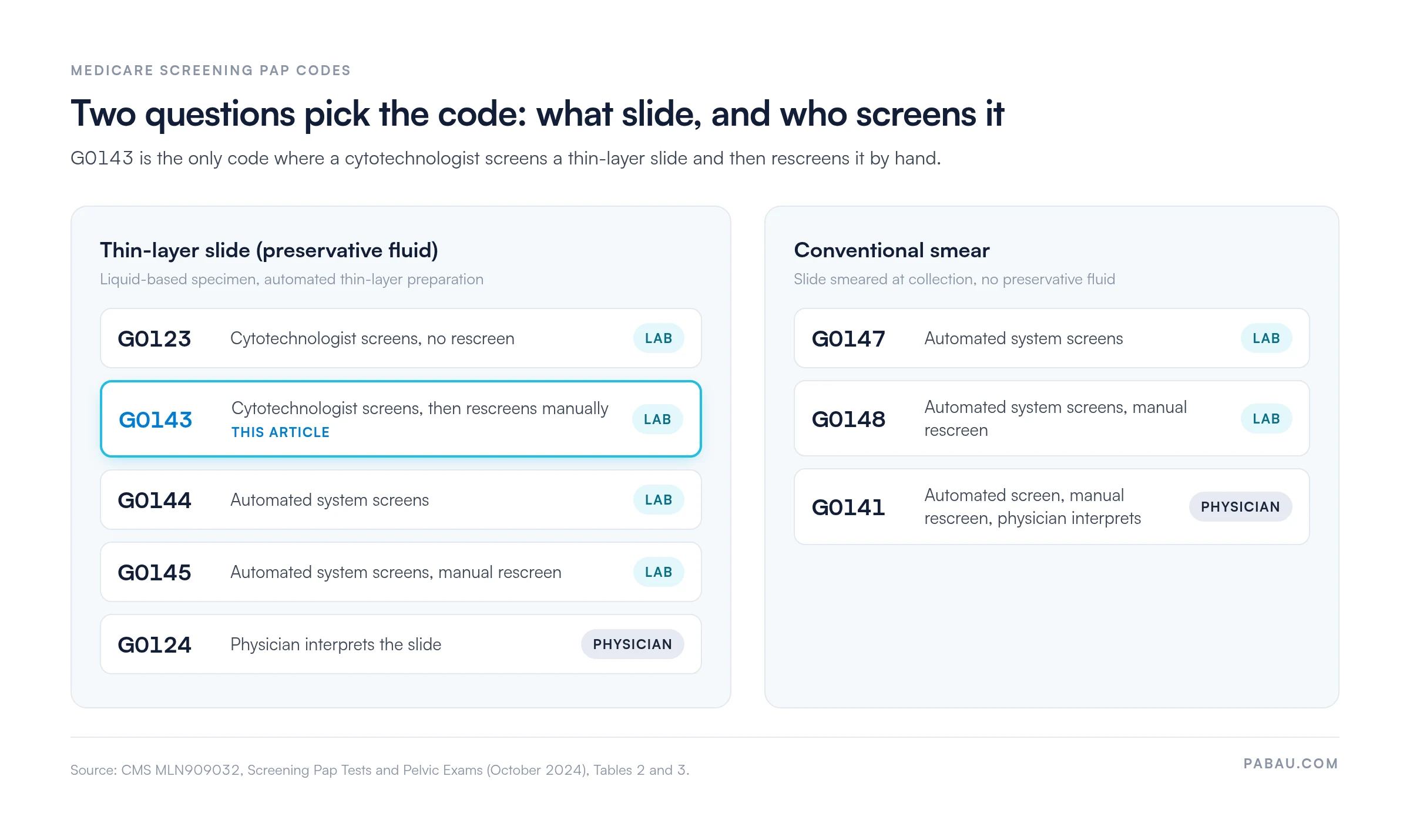
Medicare’s screening Pap codes split on two questions. Was the specimen a thin-layer slide or a conventional smear? And who screened it: a cytotechnologist, an automated system, or a physician? The map below sorts all eight codes by those two answers.
Decision map of eight Medicare screening Pap codes
G0143 is the only thin-layer lab code with two manual reads, so the screening path on the report settles the choice. Codes and descriptors from CMS MLN909032, Tables 2 and 3.
CodeSpecimenScreening methodWhen it fits
G0123Thin-layer, preservative fluidScreening by cytotechnologist under physician supervisionOne manual read, no rescreening
G0143Thin-layer, preservative fluidManual screening and rescreening by cytotechnologist under physician supervisionTwo manual reads of the same slide
G0144Thin-layer, preservative fluidScreening by automated system under physician supervisionThe imaging system reads the slide, no manual rescreen
G0145Thin-layer, preservative fluidScreening by automated system and manual rescreening under physician supervisionThe system reads first, then a person rescreens
G0124Thin-layer, preservative fluidThin-layer, physician interpretation (Medicare Table 3)A physician interprets the thin-layer slide
G0141Conventional smearsAutomated system with manual rescreening, requiring interpretation by physicianA physician interprets a conventional smear
G0147Conventional smearsAutomated system under physician supervisionThe system screens a conventional smear
G0148Conventional smearsAutomated system with manual rescreeningThe system screens a smear, then a person rescreens

G0143 vs. G0123: G0123 is the closest sibling. It uses the same thin-layer slide, but the cytotechnologist screens it once and nobody rescreens it. One manual read on the report means G0123. A second manual read means G0143.

G0143 vs. G0141: G0141 sits in a different CMS table altogether. It’s a physician-interpretation code for conventional smears that an automated system screened, with manual rescreening. It never describes a thin-layer slide, so it can’t stand in for G0143.

G0143 vs. G0144 and G0145: Both cover thin-layer slides that an automated imaging system screens first. G0145 adds a manual rescreen after the machine’s read. On G0143, both reads are done by a cytotechnologist.

How a G0143 claim moves from the exam room to the lab’s payment

A screening Pap usually produces two claims from two billers. Here’s the path, step by step.

  1. The practitioner collects the specimen in preservative fluid and bills Q0091 for obtaining, preparing and conveying it to the lab.
  2. If a pelvic and clinical breast exam happens at the same visit, the practitioner adds G0101 on its own line.
  3. The practice’s lines go out with the office place of service (POS), typically POS 11.
  4. The lab prepares the thin-layer slide, and a cytotechnologist screens and rescreens it under physician supervision.
  5. The lab bills G0143 with its own place of service and a screening diagnosis code from Medicare’s list.
  6. Medicare pays the lab from the Clinical Laboratory Fee Schedule, with no deductible or coinsurance when coverage conditions are met.

Each biller owns its own lines. When a lab copies the office POS onto G0143, or a practice reports the lab’s code, the claim stops matching the service.

The diagnosis on a G0143 claim has to say screening, and say the risk level

Medicare requires one of its listed screening diagnosis codes on every G0143 claim. The code also signals whether the patient is low or high risk, which sets the frequency limit. A symptom-driven code signals a diagnostic test, which falls outside the screening benefit.

ICD-10-CM codeDescriptionRisk level (MLN909032)
Z01.419Encounter for gynecological examination (general) (routine) without abnormal findingsLow
Z01.411Encounter for gynecological examination (general) (routine) with abnormal findingsLow
Z12.4Encounter for screening for malignant neoplasm of cervixLow
Z12.72Encounter for screening for malignant neoplasm of vaginaLow
Z72.51High risk heterosexual behaviorHigh
Z72.52 / Z72.53High risk homosexual behavior / high risk bisexual behaviorHigh
Z77.29Contact with and (suspected) exposure to other hazardous substancesHigh
Z77.9Other contact with and (suspected) exposures hazardous to healthHigh
Z91.89Other specified personal risk factors, not elsewhere classifiedHigh

MLN909032 Table 6 also lists Z11.51, Z12.79, Z12.89 and four Z92.8 treatment-history codes. Check each descriptor in our ICD-10-CM code library before you pick one. Commercial payers keep their own lists, so confirm each plan’s policy too.

Medicare covers G0143 every 24 months, or yearly for high-risk patients

Medicare covers G0143 under Part B as a preventive screening service. The frequency rules come from CMS MLN909032 (Screening Pap Tests and Pelvic Exams). They’re simple to state, but the risk category behind them has to be documented.

  • Average risk: any asymptomatic female patient, once every 24 months. At least 23 months must pass after the last screening Pap test or pelvic exam.
  • High risk: once a year, at least 11 months after the last screening Pap test or pelvic exam.

A patient qualifies for the yearly interval through either of two CMS pathways:

  • Her medical history or other findings show high risk for cervical or vaginal cancer, and her physician recommends testing more often than every 2 years.
  • She’s of childbearing age and had a screening Pap test or pelvic exam in any of the previous 3 years. That result indicated cervical or vaginal cancer or another abnormality.

For the first pathway, CMS names these high-risk factors:

  • Early onset of sexual activity, before age 16.
  • Five or more sexual partners in a lifetime.
  • A history of sexually transmitted infection (STI), including HIV.
  • Fewer than 3 negative Pap tests, or no Pap tests, in the previous 7 years.
  • Diethylstilbestrol (DES) exposure, as the daughter of a woman who took DES during pregnancy.

The ordering practitioner documents which risk category applies and must have an NPI on file. Medicare doesn’t require prior authorization for a covered screening Pap test. Commercial plans set their own rules, so check each one.

Documentation that keeps a G0143 claim standing in an audit

A G0143 claim holds up when the record confirms each element of the descriptor. Good medical billing compliance means checking that record before the claim leaves, rather than after a denial arrives.

  • Ordering provider NPI: on the claim, with the provider enrolled in Medicare.
  • Patient risk classification: average or high risk, with the supporting history in the record.
  • Specimen type: cervical or vaginal, stated on both the requisition and the report.
  • Preparation method: thin-layer, liquid-based, with the system named (for example, ThinPrep or SurePath).
  • Manual screening and rescreening: the report shows a cytotechnologist screened and rescreened the slide under physician supervision.
  • Final cytopathology result: signed, dated and reported under the supervising physician.
  • Place-of-service code: the lab’s own POS on the G0143 line. The collecting practice reports its office POS, typically 11, on Q0091.
  • Date of service: at least 23 months (average risk) or 11 months (high risk) after the last screening.

Pro Tip

Run an eligibility check before you collect the specimen. Your MAC portal or HETS shows the date a patient is next eligible for a screening Pap test. If that date hasn’t arrived yet, the screening claim will deny for frequency.

G0143 is paid from the lab fee schedule, not the physician one

G0143 is paid under the CMS Clinical Laboratory Fee Schedule (CLFS) rather than the Physician Fee Schedule. CMS updates CLFS rates every January 1. Check the current file for this year’s G0143 rate instead of relying on an old figure.

  • The lab bills G0143 for the slide preparation and both manual reads. The practitioner who collected the specimen bills Q0091 separately.
  • Medicare waives the deductible and coinsurance for a covered screening Pap test. A charge may apply if the patient sees a non-participating provider.
  • Commercial payers negotiate their own rates. The Medicare CLFS rate is a common reference point, but it doesn’t bind them.

Six denial patterns that keep hitting G0143 claims

G0143 denials tend to repeat. Good denial management in healthcare starts with knowing which ones to catch before submission.

  • Frequency violation: the claim lands before 23 months (average risk) or 11 months (high risk) have passed. Expect CARC 119 (benefit maximum reached). Check the next-eligible date before collection.
  • Wrong G-code selected: billing G0144, G0145 or G0123 when the lab did manual screening and rescreening (G0143). Those codes describe automated screening or a single read with no rescreen.
  • Unsupported diagnosis code: a symptom code such as N87.0 (mild cervical dysplasia) on a screening claim. Use a code from Medicare’s screening list, such as Z12.4 or Z01.419.
  • Missing rescreening documentation: the report doesn’t show manual screening and rescreening by a cytotechnologist under physician supervision. A report with only the final result won’t support G0143.
  • Incorrect place of service: the POS doesn’t match the billing entity’s setting. That returns CARC 5 (procedure code or bill type inconsistent with place of service).
  • Unenrolled ordering provider: the ordering practitioner isn’t enrolled in Medicare. CMS checks the claim’s NPI against its enrollment records.

Before you submit: Run this six-point G0143 checklist

These checks give the claim its best shot at a clean claim submission on the first pass. Every rework cycle adds staff time and moves you closer to the timely-filing limit.

  • Check eligibility and the next-eligible screening date before the specimen is collected.
  • Confirm the lab report documents thin-layer preparation plus manual screening and rescreening by a cytotechnologist. Ask for a corrected report if the wording is vague.
  • Match the code to the report. Two manual reads on a thin-layer slide is G0143, one read is G0123, and an automated first read is G0144 or G0145.
  • Confirm the diagnosis code is on Medicare’s screening list and matches the documented risk level.
  • Put the lab’s own POS on the G0143 line. The collecting practice bills Q0091 with its office POS, typically 11.
  • Confirm the ordering practitioner’s NPI is active and enrolled in Medicare.

Which codes can share a screening visit with G0143?

Several services often fall on the same date as G0143. Most of them go on the practice’s claim, while G0143 goes on the lab’s.

An evaluation and management (E/M) visit can be billed the same day with modifier 25. The visit needs a significant, separately documented problem beyond the screening itself. A visit only to collect the Pap specimen isn’t separately billable.

G0101, the screening pelvic and clinical breast exam, often goes out alongside G0143. Each needs its own claim line and has to meet its own coverage rules. In most cases, the practice bills G0101 and the lab bills G0143.

CodeSame screening episode as G0143?Conditions
E/M (99202-99215)Yes, with modifier 25The visit is separately documented and medically necessary beyond the screening
Q0091YesThe practice’s code for obtaining, preparing and conveying the specimen
G0101YesPelvic and breast exam on its own line, with both services separately documented
Any other G01xx screening cytopathology code (G0123, G0124, G0141, G0144, G0145, G0147, G0148)NoOnly one cytopathology code from the G01xx family per screening episode
Annual wellness visit (G0438/G0439)YesPreventive screenings can accompany the AWV, following NCCI edit guidance

Check the current NCCI Policy Manual and your Medicare Administrative Contractor (MAC) for local edits. NCCI tables update quarterly, so a pair that cleared last year can hit a new edit this year.

How Pabau keeps the screening visit and its claim on one record

In many gynecology and women’s health practices, a screening visit leaves a scattered trail. The note sits in the EHR, the lab report arrives by fax or portal, and the claim lives in a clearinghouse.

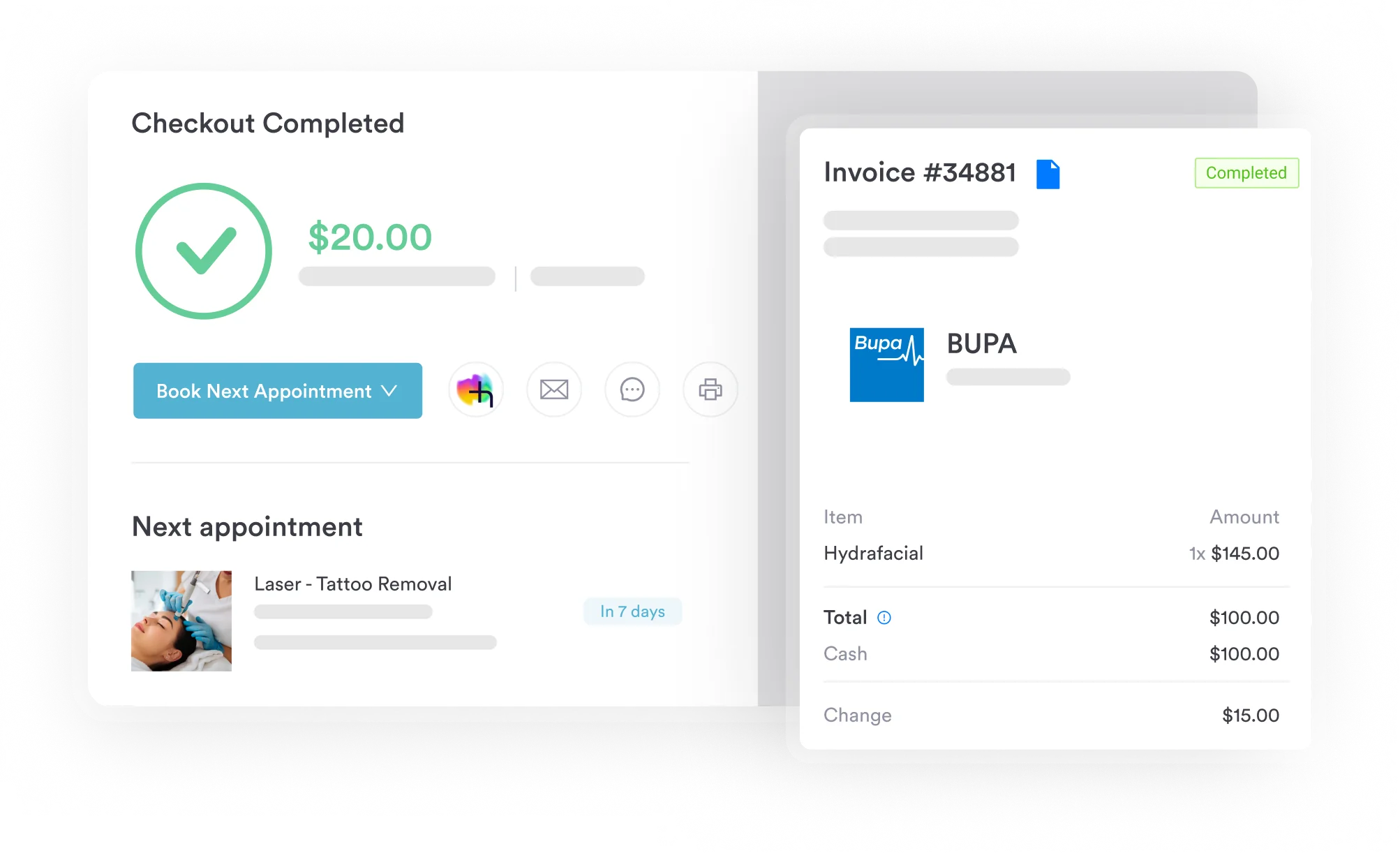
Pabau, the practice management platform we build, keeps those pieces on one patient record. Its simpler claims management software pre-fills the practice’s claim from that record, Q0091 and G0101 included. It also checks required fields before the claim goes out.

In the US, claims go out through Claim.MD, with eligibility checks and status tracking after submission. When a payer queries the visit, the requisition, the lab report and the claim are already in the same place.
Pabau claims management screen for submitting and tracking insurance claims
Pabau’s claims management sends the screening visit’s claim from the patient record, so the lab report and notes behind it are one click away.

Keep every screening claim tied to its record

Pabau’s claims management software pre-fills claims from the patient record, checks required fields before sending, and tracks each claim after submission. Visit notes, lab reports and claims stay in one place.

Pabau claims management dashboard

Conclusion

G0143 rewards whoever reads the lab report before the fee schedule. Two manual reads by a cytotechnologist on a thin-layer slide is the whole test. If the report can’t show both reads, bill the sibling code that matches it.

The bigger risk sits on the calendar. A correctly coded G0143 still denies if it lands inside the 23- or 11-month window, so put the eligibility check on collection day.

If your practice handles the collection side, keep the Q0091 and G0101 claim tied to the record that justifies it. Book a demo to see how Pabau keeps screening visits, lab reports and claims in one place.

Continue your research

Continue your research

Need to understand denial patterns before they hit? Denial management in healthcare covers the appeals process and upstream fixes that reduce rework.

Want to see how claims move from submission to payment? What is medical billing walks through the full revenue cycle from coding to collection.

Does the lab use an imager before the manual rescreen? HCPCS code G0145 explains the thin-layer code for automated screening plus manual rescreening.

Still processing conventional smears? HCPCS code G0147 covers automated screening of conventional Pap smears under physician supervision.

Frequently asked questions

How is G0143 different from G0123, G0124, G0141, G0144, G0145 and G0147?

G0143 is the thin-layer code with manual screening and rescreening by a cytotechnologist. G0123 has one manual screen with no rescreen, and G0144 and G0145 start with an automated screen. G0124 and G0141 are physician-interpretation codes, and G0147 covers automated screening of conventional smears.

Can G0143 be billed instead of a Pap CPT code?

Yes, on Medicare screening claims. G0143 replaces the CPT cytopathology codes (88141-88155) there. Commercial payers may still require the CPT codes, so check each plan’s policy before you bill.

Can G0143 be billed with an HPV test?

Yes. Medicare covers HPV screening (G0476) with a screening Pap test for asymptomatic patients aged 30 to 65. It’s covered once every 5 years, and each test goes on its own claim line.

Is there an age limit for Medicare’s screening Pap test?

MLN909032 sets no upper age limit for the screening Pap benefit. Any asymptomatic female patient qualifies every 24 months, or every year if she meets the high-risk criteria.

What happens if the lab can’t read the Pap specimen?

The practice can collect a new specimen when the lab can’t interpret the first one. Per MLN909032, bill the re-collection with Q0091 and modifier 76 (repeat procedure or service).


Avatar photo
Monika Lazarevska
Content Writer

Monika Lazarevska writes content for owners and healthcare professionals who want clear, no-fluff content that actually helps them run their practice better. With a background in storytelling and SEO, she knows how to make even the driest topics worth reading. Off the clock, you'll find her in a café somewhere in Europe, probably with a good book and an even better coffee.
×