HCPCS Code J7333: Hyaluronan (Visco-3) billing guide
HCPCS Code J7333: Official descriptor, drug, and deleted status HCPCS Code J7333...

Last Updated: Oct 16, 2026
G0147 is the HCPCS Level II code for screening cytopathology smears, cervical or vaginal, performed by automated system under physician supervision. The laboratory that screens a conventional Pap smear bills it, and Medicare pays it under the Clinical Laboratory Fee Schedule.
G0147 does not cover collecting the smear. The physician or practitioner who takes the sample bills Q0091 instead, under the Physician Fee Schedule. Thin-layer specimens use G0123 or G0124, and an automated screen with manual rescreening uses G0148.
Let Pabau's smart automation suggest the right codes, reduce claim denials, and keep your practice compliant—effortlessly.
Automate repetitive tasks and focus on what matters most—your patients.
Reduce coding errors and ensure compliance with the latest regulations.
Clean claims, fewer denials, and faster reimbursements.
Powerful insights and reporting to help your practice thrive.
HIPAA compliant SOC 2 certified GDPR-compliant Trusted by 4,000+ clinics worldwide

G0147 is the HCPCS Level II code a laboratory bills for screening a conventional cervical or vaginal smear by automated system under physician supervision.
The physician or practitioner who collects the smear bills Q0091, so G0147 never covers taking the sample.
Medicare covers a screening Pap test once every 24 months, or every 12 months for high-risk women and some women of childbearing age.
Common denials are frequency exceeded (CO-119), a diagnosis that doesn’t support the screen (CO-11), and a place of service mismatch (CO-5).
Medicare pays G0147 under the Clinical Laboratory Fee Schedule, so look up the rate in the current CLFS file.
HCPCS code G0147 is the laboratory code for screening cytopathology smears, cervical or vaginal, performed by automated system under physician supervision. It describes how a conventional Pap smear slide is screened once it reaches the lab.
It does not describe taking the sample. The physician or practitioner who collects the smear reports that work with Q0091. Per the CMS HCPCS Level II code system, G-codes are assigned and maintained by CMS rather than the AMA. You can look up the neighboring G-codes in our full HCPCS code library.
G0147 covers the laboratory screening of a conventional cervical or vaginal smear by an automated system, under physician supervision. The service starts once the slide arrives at the lab. Mixing up collection and screening is a frequent coding error with this code.
A lab reports one screening code per smear, matched to how the slide was prepared and screened. G0147 is never added on top of another screening code for the same slide.
G0147 belongs to a family of Medicare codes that split the screening Pap test into collection and laboratory screening. The lab code depends on the preparation type and on whether rescreening or physician interpretation was added. The table below sets out each option.
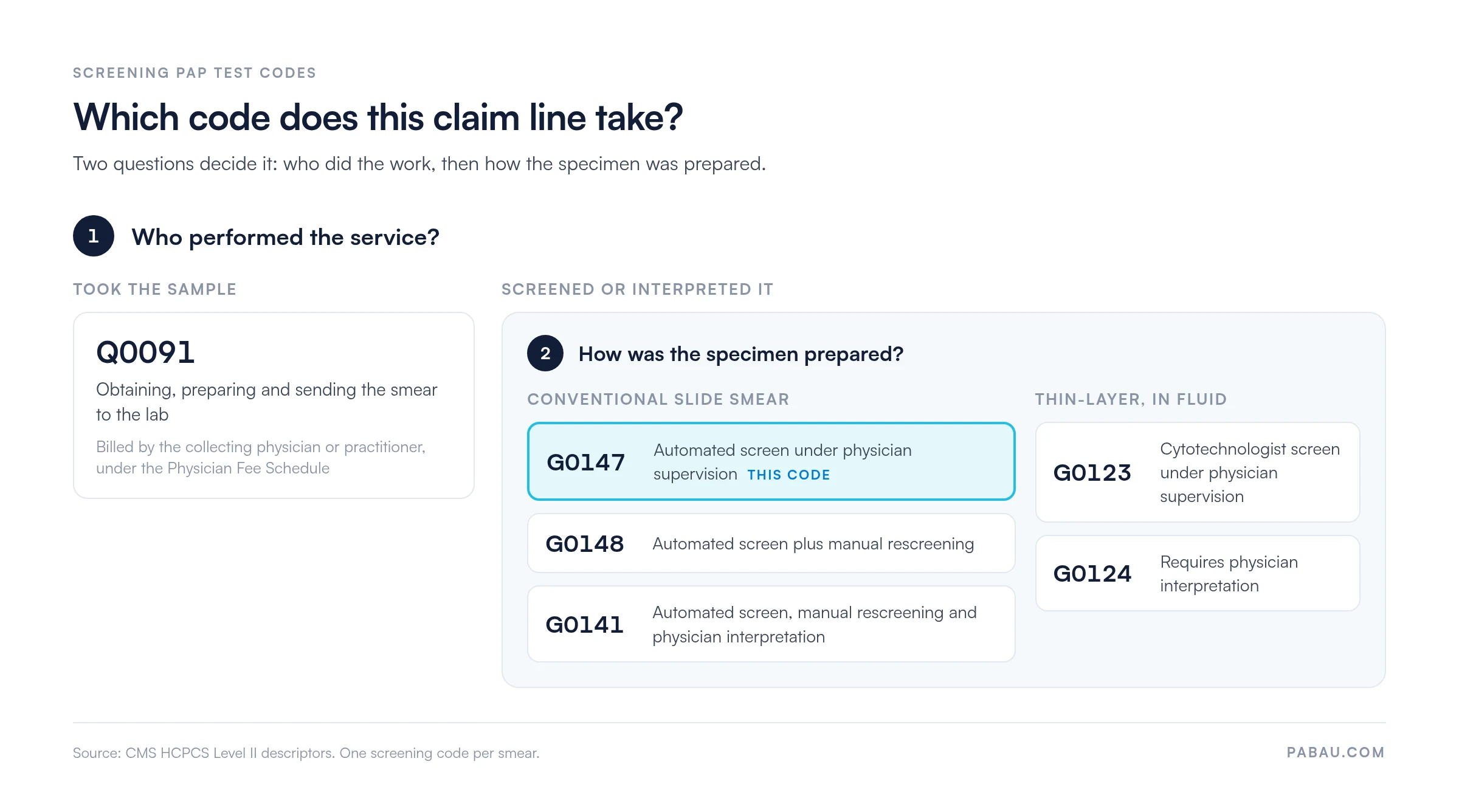
The first decision is who performed the service. Q0091 is the collection code, billed by the practice that takes the sample. G0147 and the other screening codes belong to whoever screens or interprets the specimen.
Within the lab, preparation type decides the rest. G0123 is the thin-layer alternative to G0147, so a lab never bills the two for one specimen. G0124 covers thin-layer specimens that need physician interpretation, and it is never paired with G0147 either. The chart below maps both decisions to a single code.
Medicare covers the screening Pap test under Part B’s preventive benefit, and its frequency limit applies to G0147 like every other code in the family. The deductible and coinsurance are waived on a correctly coded claim. Practices and labs both need the interval right to avoid CO-119 (frequency exceeded) denials.
Medicare counts the interval in full months. At least 11 months, or 23 months for the 24-month benefit, must pass after the month of the last covered screen. CMS lists these high-risk factors for cervical cancer:
For vaginal cancer, the high-risk factor is DES (diethylstilbestrol) exposure before birth. Women of childbearing age also qualify for annual screening after an abnormal result. That applies when an exam in any of the preceding three years showed cancer or another abnormality.
The chart must record the specific factor that justifies annual billing. Running insurance eligibility verification at scheduling catches most frequency problems before the smear is even taken.
Every G0147 claim needs an ICD-10-CM diagnosis code that supports screening. The lab usually takes it from the requisition, so the code chosen at collection carries through to the lab claim. A missing or unsupported code is the most consistent technical denial after frequency.
Always verify accepted diagnosis codes against the current coverage policy for cervical cytology in your MAC jurisdiction. Policies vary by region and change independently of the national code set. An annual screen billed with only Z12.4 risks a frequency denial, because the claim shows no high-risk reason.
Medicare auditors reviewing HCPCS code G0147 claims look for proof of screening intent, the right interval and a properly handled specimen. Missing any of these can lead to a recoupment request in post-payment review. Practices with solid medical billing compliance protocols spot these problems before the claim goes out.
The two halves of this record live in different places. The collecting practice owns the risk factor and the last-screening date, while the lab owns the screening method. The requisition is where the two have to agree.
HCPCS code G0147 is billed by the laboratory that performs the automated screen, not by the practice that collects the smear. That split matters in OB-GYN and women’s health settings, where the collecting clinician, the ordering provider and the lab are often different.
The supervising physician named in the descriptor oversees the lab’s automated screening, not the collection visit. Check your MAC’s laboratory billing guidance before an office lab reports G0147. On the practice side, accurate superbill documentation should capture Q0091, the screening diagnosis and the ordering provider.
G0147 does not routinely require a modifier on a standard Medicare fee-for-service claim. Two situations can call for one.
For place of service, POS 81 (independent laboratory) is the most common setting for G0147. A hospital lab follows the hospital’s own claim rules. A place of service that conflicts with the billing provider can return a CO-5 denial, which a corrected claim usually fixes.
The National Correct Coding Initiative (NCCI) publishes edit pairs that restrict which codes one provider can bill together on the same date. For G0147, the main rule is simpler. Report one screening code per smear. Knowing how to submit a clean claim avoids most cytopathology billing errors.
NCCI edits are updated quarterly. Check the current edit files on the CMS NCCI page before relying on any edit pair, including those listed here.
Medicare pays G0147 under the Clinical Laboratory Fee Schedule (CLFS), not the Physician Fee Schedule. The CLFS sets one national payment amount per code, with no geographic adjustment. Download the rate for the quarter you are billing from the CMS CLFS files page, since amounts can change each quarter.
Because the screening Pap test is a preventive service, the patient pays no deductible or coinsurance. The collection is paid separately, with Q0091 falling under the Physician Fee Schedule. Medicare Advantage plans set their own rates, so check the plan contract before quoting a figure.
HCPCS code G0147 has a predictable denial pattern. Most rejections trace back to five causes, each with a claim adjustment reason code and a clear fix. Effective denial management for cytopathology catches these before submission rather than on appeal.
Frequency denials are the hardest to reverse. Medicare holds the patient liable only when a valid ABN was signed before the service. When the interval hasn’t passed, the collecting practice should tell the patient and record their choice before taking the smear.
Risk status changes the frequency, the diagnosis code and the documentation on a G0147 claim. The lab bills from the requisition, so a risk factor that never reaches it can’t support an annual claim. The table below lays out each path.
A lab that bills G0147 annually for an average-risk patient will get a CO-119 denial, and no modifier fixes that. The fix is documenting the CMS-defined high-risk factor in the chart and on the requisition before the first annual screen. A general note that says “high-risk patient” is not enough.
Run a quarterly audit of screening Pap claims from the past 12 months. Filter for patients screened twice within 24 months, and check that each annual claim carries a documented high-risk factor. Catching this early prevents CO-119 denials and audit findings.
Many women’s health practices still track Pap screening on paper requisitions and spreadsheets. Staff retype the risk factor and the last-screening date from the visit note. Every retyped field is a chance for the lab claim to fail.
Pabau, the all-in-one practice management system we build, keeps the appointment, the treatment note, the forms and the invoice on one patient record. Digital intake forms can ask for the last Pap date and any high-risk factor before the visit. The clinician then has both in front of them when collecting the smear.
For OB-GYN teams, Pabau keeps Q0091, the screening diagnosis and the ordering provider next to the note. Its claims tools then build cleaner insurance claims from that same record, so details aren’t copied between systems.
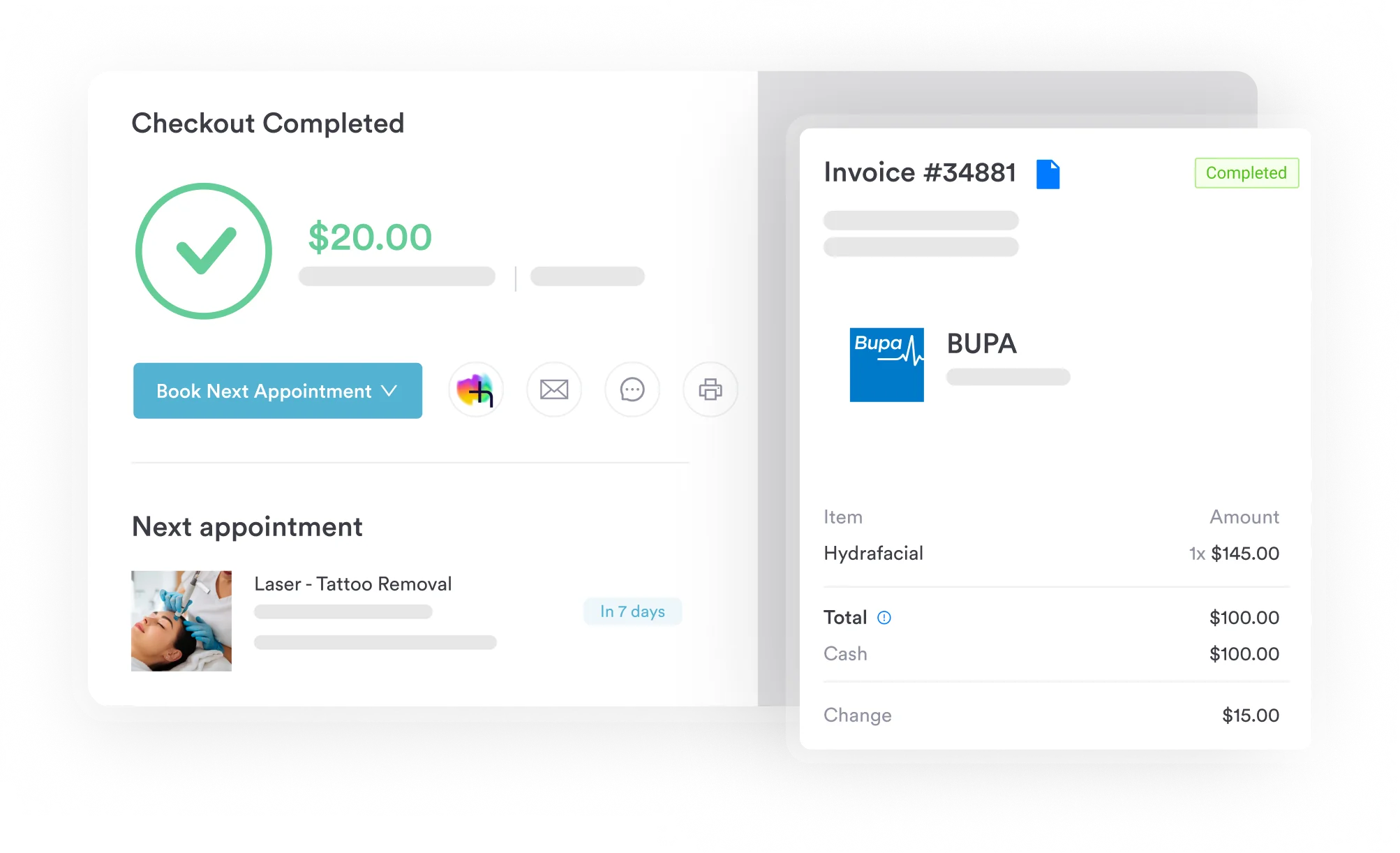
The result is fewer retyped fields between the exam room and the claim. Requisitions reach the lab complete, and fewer frequency denials come back.

Pabau keeps the visit note, screening history, forms and invoice on one patient record. Your team bills Q0091 and sends complete requisitions without retyping details.

G0147 is a lab code, and most of its billing problems start when it is treated as a collection code. Get that split right first. The practice bills Q0091 for the smear, and the lab bills G0147 for the automated screen.
After that, the claim depends on two facts the collecting practice controls: the date of the last screen and the documented risk factor. Put both on the requisition, and the lab can bill the right interval without a CO-119 coming back.
Billing teams that keep the visit note and the requisition in one place spend less time correcting claims. Book a demo to see how Pabau keeps Pap screening records and claims in step for women’s health practices.

Need to understand denial codes by remark number? Denial codes in medical billing explains the most common CMS adjustment reason codes and how to respond to each one.
Want a framework for submitting claims without errors? Clean claim best practices walks through the pre-submission checklist that reduces first-pass denial rates.
Handling insurance eligibility before the appointment? Insurance eligibility verification covers real-time eligibility checks and how to integrate them into scheduling workflows.
Billing an automated screen that added a physician review? HCPCS code G0141 covers the rescreening and interpretation version of this service.
Working with thin-layer specimens instead? HCPCS code G0123 explains the liquid-based alternative to G0147 and how labs bill it.
HCPCS code G0147 covers the laboratory screening of a conventional cervical or vaginal smear by automated system, under physician supervision. It does not cover collecting the smear, which the collecting physician or practitioner bills as Q0091. Thin-layer specimens use G0123 or G0124 instead.
Medicare covers a screening Pap test once every 24 months for average-risk women, and once every 12 months for high-risk women. Annual screening also applies to women of childbearing age with an abnormal Pap test in any of the past three years. High-risk factors include five or more lifetime sexual partners, an STD history, DES exposure, or fewer than three negative Pap tests in seven years.
G0147 is for a conventional smear screened by automated system under physician supervision. G0123 is for a thin-layer specimen collected in preservative fluid and screened by a cytotechnologist under physician supervision. They are alternatives, so a lab reports one or the other for a specimen, never both.
For average-risk patients, Z12.4 (encounter for screening for malignant neoplasm of cervix) is the standard diagnosis code. For high-risk patients screened annually, add a high-risk code your MAC’s coverage policy accepts, such as Z72.51–Z72.53. A claim billed annually with only Z12.4 risks a CO-119 frequency denial, because it shows no high-risk reason.
G0147 doesn’t routinely need a modifier on a Medicare claim. Modifier 59 applies only where NCCI edits allow it, for a genuinely distinct service. Modifier GA applies when a valid ABN is on file for a screen expected to be denied for frequency.
G0147 is an HCPCS Level II code, not a CPT code. It is a Medicare G-code maintained by CMS rather than the AMA. Labs report it in the same procedure code field as CPT codes, and Medicare pays it under the Clinical Laboratory Fee Schedule.