

CPT Code 52352: Ureteroscopic stone removal billing guide
CPT Code 52352: Official descriptor and procedure overview CPT Code 52352 descri...

Last Updated: Oct 30, 2026
G0144 is the HCPCS Level II code for screening cytopathology, cervical or vaginal (any reporting system), collected in preservative fluid. The slide gets an automated thin-layer preparation and is screened by an automated system under physician supervision, with no manual rescreening.
Common G0144 denials come from billing it when symptoms are documented, or confusing it with sibling codes such as G0123, G0124, G0143 or G0145. Medicare Part B covers it once every 24 months, or every 12 months for high-risk beneficiaries.
Let Pabau's smart automation suggest the right codes, reduce claim denials, and keep your practice compliant—effortlessly.
Automate repetitive tasks and focus on what matters most—your patients.
Reduce coding errors and ensure compliance with the latest regulations.
Clean claims, fewer denials, and faster reimbursements.
Powerful insights and reporting to help your practice thrive.
HIPAA compliant SOC 2 certified GDPR-compliant Trusted by 4,000+ clinics worldwide

HCPCS code G0144 covers a thin-layer screening Pap slide read by an automated system under physician supervision, with no manual rescreening.
Average-risk Medicare beneficiaries are covered once every 24 months; high-risk beneficiaries qualify annually. Billing outside that window without an ABN triggers automatic denial.
G0144 is a screening code only. Any documented symptom or known abnormality shifts the encounter to a diagnostic pathway and makes G0144 incorrect.
Pabau, the practice management platform we build, pre-fills claims from invoices, validates them and flags any claim that needs action before submission.
HCPCS code G0144 covers screening cytopathology, cervical or vaginal (any reporting system), collected in preservative fluid. The CMS HCPCS Level II long descriptor finishes with “automated thin layer preparation, with screening by automated system, under physician supervision.” It contains no manual rescreening step.
Three elements in the descriptor determine whether G0144 is the correct code for a given encounter:
If any element doesn’t match — a conventional smear, a manual-only read, or an added manual rescreen — G0144 is the wrong code. The claim is then at risk of denial or audit recovery.
G0144 sits in a family of Medicare screening cytopathology codes for thin-layer slides. Picking the wrong sibling is a frequent coding error in this family. The table compares G0144 with four related cytopathology codes by who screens the slide and whether anyone rescreens it.
G0144 vs. G0145: The two codes share the same specimen, preparation and automated screening. The difference is the manual rescreen. G0144 covers the automated read alone, and G0145 adds a manual rescreening after it. If the lab report shows a manual rescreen, bill G0145. The decision path below starts one step earlier, with whether the visit is a screening at all.
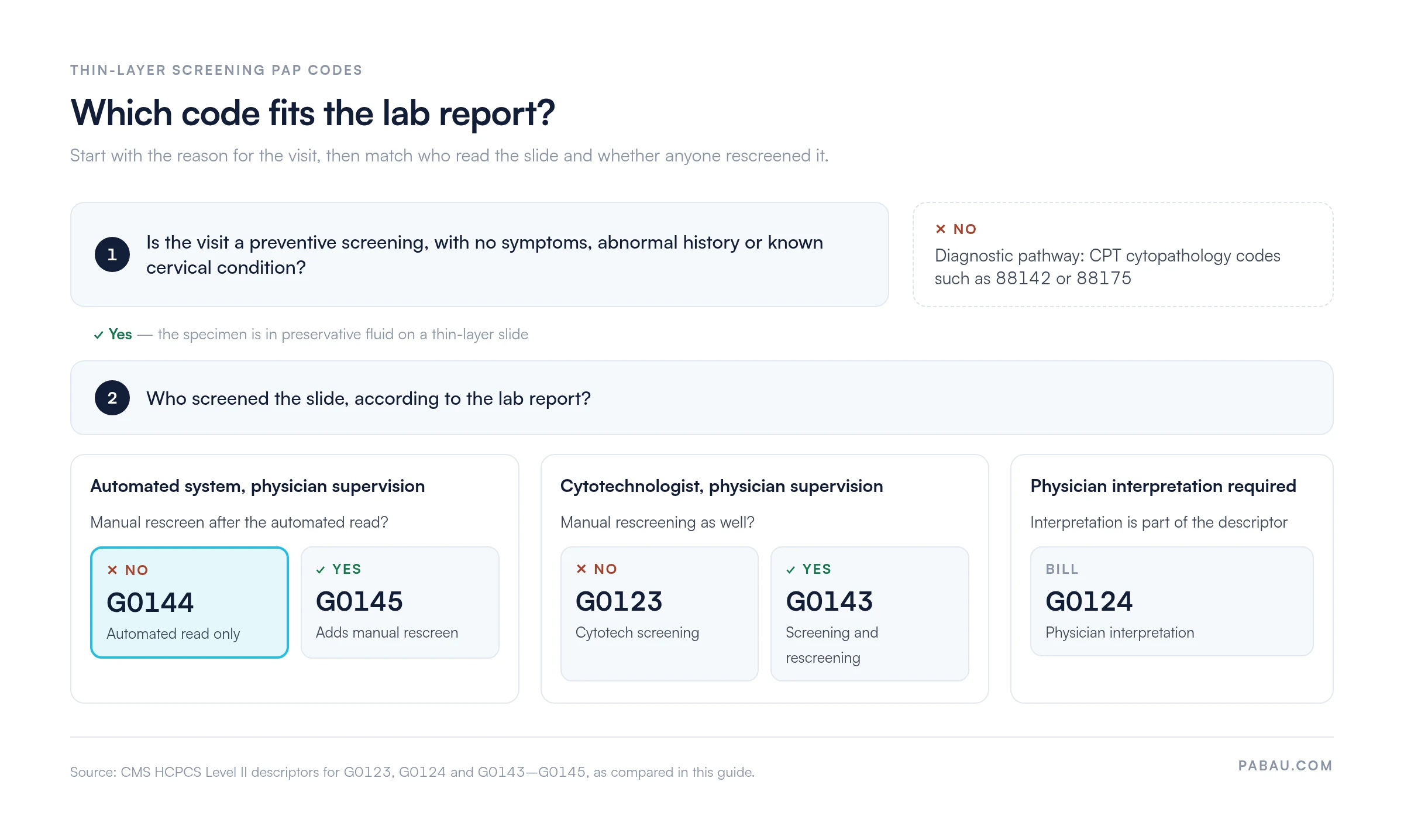
G0101 is an exam code, not a cytopathology code: G0101 covers the cervical or vaginal cancer screening pelvic and clinical breast examination. The practitioner who performs the exam bills it, while the laboratory bills G0144 for the slide. Both services can happen on the same date of service. Confirm any same-day billing rules with your MAC before submitting.
Medicare Part B covers G0144 under the preventive services benefit. Coverage frequency depends on the beneficiary’s risk classification, which the treating provider must document to support the claim. Confirm current parameters with your MAC’s LCD. Frequency rules follow current policy-year guidance and may vary by jurisdiction.
MAC-specific Local Coverage Determinations (LCDs) may add requirements beyond the baseline CMS policy. The A/B MAC jurisdiction covering the practice location governs. Billing compliance requirements for preventive screenings vary by MAC, so always check the applicable LCD rather than relying on a single national reference.
Linking the correct ICD-10-CM code to a G0144 claim signals screening intent to the payer. A diagnostic ICD-10 code implies symptoms or a known condition. It converts the encounter from a covered preventive benefit to a diagnostic service and is a leading cause of denial.
Important: The specific ICD-10-CM codes accepted for G0144 coverage vary by MAC LCD. Some LCDs maintain a defined list of qualifying diagnosis codes. A code that isn’t on that list triggers denial, even when the procedure is clinically appropriate. Check the current LCD and the current ICD-10-CM code set, which CMS updates every year.
Audit exposure for G0144 centers on two areas: a lab report that doesn’t support the billed screening method, and weak risk-classification evidence. Structured risk-assessment fields, completed at the point of care, stop those omissions before claim submission.
The medical record supporting a G0144 claim must include:
Most G0144 claims are submitted without modifiers. A few modifier scenarios do arise, and billing staff should know when each one applies. Confirm each against your MAC’s current guidance.
G0101 and G0144 usually go out on separate claims from separate billers, so a distinct-service modifier such as 59 is not a standard pairing. Apply one only if your MAC’s edits call for it in your billing setup.
Submitting a clean claim for HCPCS code G0144 requires matching five claim elements precisely. Here is the field-by-field approach for CMS-1500 and 837P electronic submissions.
The superbill documentation for the encounter should pre-populate the diagnosis and procedure codes. The claim submission team then doesn’t need to re-interpret clinical notes. Structured superbill fields for G0144 and the linked ICD-10-CM code reduce keying errors at the front end of the revenue cycle.
Medicare pays G0144 under the Clinical Laboratory Fee Schedule (CLFS), not the Physician Fee Schedule, because it describes a laboratory screening service. CMS updates CLFS rates every January 1.
Rates change each year, so a static figure here would go stale. Check the current CMS Clinical Laboratory Fee Schedule file for this year’s G0144 rate before you quote or post a payment.
Medicare waives the deductible and coinsurance for a covered screening Pap test. Commercial payers negotiate their own rates for the service. Understanding medical billing workflows for laboratory services helps practices separate the lab’s line from their own from the start.
Run a G0144 frequency audit quarterly. Pull all G0144 claims submitted in the prior 24 months and cross-reference against the current patient panel. Flag any patient whose last covered screening falls within the 24-month window. Build the frequency check into your pre-authorization workflow so staff verify eligibility before the specimen is even collected.
G0144 denials cluster around five patterns, and most are preventable with pre-submission checks. The denial management process for cytopathology codes starts with the denial code and its cause. Correct the root cause before resubmission.
Knowing the medical billing denial codes that accompany each rejection helps billing staff route the correction to the right team member. Claims then don’t land in a generic work queue. Read the claim adjustment reason code on each remittance before you decide whether to correct, appeal, or write off.
G0144 applies only when the encounter is purely preventive screening, with no symptoms, no known abnormalities, and no follow-up of a prior abnormal result. When clinical documentation reflects any of the following, the encounter shifts to a diagnostic pathway and G0144 is the wrong code.
In all four scenarios, the correct billing pathway uses CPT cytopathology codes (such as CPT 88142 or 88175 for thin-layer slides). They’re billed as diagnostic services, with ICD-10 codes reflecting the known condition or symptom. Billing G0144 in these scenarios misrepresents the clinical encounter and creates a compliance risk. It typically results in denial when the diagnosis code signals abnormality rather than screening.
The clearest documentation practice is a short statement in the encounter note: “This is a routine preventive cervical cancer screening. The patient presents without symptoms, and there is no history of abnormal cytology in the prior 24 months.” That note, combined with the Z12.4 code, anchors the claim as a screening encounter.
The coding decision itself stays with the coder. Claims management software then validates each claim and flags the ones that need a fix before submission.
Most G0144 problems start before the specimen leaves the room. The risk level goes unrecorded, the last screening date sits in another system, or a symptom note turns a screening into a diagnostic visit.
Pabau keeps the screening visit on one patient record. Staff can see the patient’s screening history and recorded risk factors there before the specimen is taken.
For the practice’s own lines, such as the G0101 exam, claims management pre-fills the claim from the invoice and validates it. Any claim that needs action is flagged before it goes out as a CMS-1500 through Claim.MD.

Pabau validates claims before submission, tracks each claim’s status and keeps screening history on the patient record. See how it works for women’s health practices in a live demo.

Every G0144 denial in this guide comes from a claim that disagrees with the record. The diagnosis code, the frequency window, the lab’s screening method and the reason for the visit all have to line up.
So read the lab report and the encounter note before you code. An automated read with no manual rescreen is G0144, and an added rescreen is G0145. A documented symptom takes the screening code off the table.
Pabau’s claims management validates each claim and flags the ones that need a fix before submission, so fewer come back as denials. To see it with your own screening workflow, book a demo.

Need a full guide to navigating preventive screening claim denials? Denial management in healthcare covers the end-to-end process for investigating, correcting, and resubmitting denied claims across all Medicare preventive benefits.
Need the rules your HCPCS claims have to meet? Medical billing compliance guidance explains the regulatory requirements practices must meet when submitting HCPCS claims through an electronic claims pathway.
Building a more structured superbill for OB-GYN or women’s health services? Superbill documentation best practices outlines how to structure procedure and diagnosis fields to support clean claim submission for preventive screening services.
Billing the screening exam on the same day? HCPCS code G0101 covers the pelvic and clinical breast exam the practitioner reports alongside the lab’s slide.
Did a cytotechnologist screen and rescreen the slide? HCPCS code G0143 explains the manual thin-layer code and how it differs from the automated ones.
HCPCS code G0144 is the Medicare code for a screening Pap test on a liquid-based specimen with automated thin-layer preparation. An automated system screens the slide under physician supervision, with no manual rescreening. It applies only to preventive screening, not diagnostic testing.
Once every 24 months for average-risk Medicare beneficiaries, and annually for high-risk beneficiaries. Billing outside the covered window without an Advance Beneficiary Notice results in denial and provider liability for the cost.
Z12.4 (encounter for screening for malignant neoplasm of cervix) is the primary screening-intent code for most G0144 claims. High-risk claims may require additional ICD-10-CM codes per the applicable MAC LCD. Using a diagnostic code instead of a Z-code causes denial because it signals a non-screening encounter.
Modifier GA applies when an ABN is on file and the service falls outside the covered frequency window. Modifier GZ applies when no ABN was obtained and denial is expected. Don’t apply QW (CLIA waiver), because G0144 is not a waived test.
The common denial reasons are a frequency limit exceeded without an ABN, or a diagnostic ICD-10 code on the claim. Others are a code that doesn’t match the lab’s screening method, a wrong place of service, or the wrong biller reporting the line. A lab report showing a manual rescreen supports G0145, not G0144.
Yes, both services can happen on the same date. The practitioner bills G0101 for the screening pelvic and breast exam, and the laboratory bills G0144 for the slide. They usually go on separate claims, so check your MAC’s guidance before adding any modifier.



