HCPCS Code P9100: Platelet pathogen test
HCPCS code P9100: Definition and code history HCPCS code P9100 carries the offic...

Last Updated: Nov 2, 2026
P3001 is the HCPCS Level II code for a screening Papanicolaou smear, cervical or vaginal, up to three smears, requiring interpretation by physician. It applies when a physician reads the smear, while P3000 covers the same smears read by a technician under physician supervision.
Most P3001 denials trace back to using it when P3000 applies, frequency limits, or a missing screening ICD-10.
Let Pabau's smart automation suggest the right codes, reduce claim denials, and keep your practice compliant—effortlessly.
Automate repetitive tasks and focus on what matters most—your patients.
Reduce coding errors and ensure compliance with the latest regulations.
Clean claims, fewer denials, and faster reimbursements.
Powerful insights and reporting to help your practice thrive.
HIPAA compliant SOC 2 certified GDPR-compliant Trusted by 4,000+ clinics worldwide

HCPCS code P3001 reports a screening Pap smear that a physician interprets, while P3000 covers the same smears read by a technician under physician supervision.
Medicare covers a screening Pap every 24 months, or every 12 months for high-risk patients, whichever of the two codes is billed.
Z12.4 is the standard screening diagnosis, and a documented high-risk code such as Z72.51 supports the 12-month interval.
P3001 is paid on the Medicare Physician Fee Schedule at 0.72 total RVUs in 2026, while P3000 is paid on the Clinical Laboratory Fee Schedule.
Collecting the specimen is billed separately as Q0091, and a screening pelvic and breast exam as G0101.
HCPCS code P3001 reports a screening Papanicolaou (Pap) smear of the cervix or vagina, up to three smears, that requires interpretation by a physician. It is a Level II code maintained by the Centers for Medicare & Medicaid Services, not a CPT code. The P-code range, P0000 through P9999, covers pathology and laboratory services. Our HCPCS code reference lists the related G- and Q-codes billed alongside it.
The official descriptor reads: Screening Papanicolaou smear, cervical or vaginal, up to three smears, requiring interpretation by physician. Its sibling code P3000 describes the same smears read by a technician under physician supervision. The split turns on who reads the slide, not on the patient’s risk level.
P3000 and P3001 describe the same screening smears and differ on one point. P3001 applies when a physician interprets the smear. P3000 applies when a technician screens it under physician supervision. Patient risk does not decide between them, so billing P3001 for an average-risk patient is correct when a physician read the slide.
Three questions route any Pap smear to its code, starting with whether the test is a screening at all.
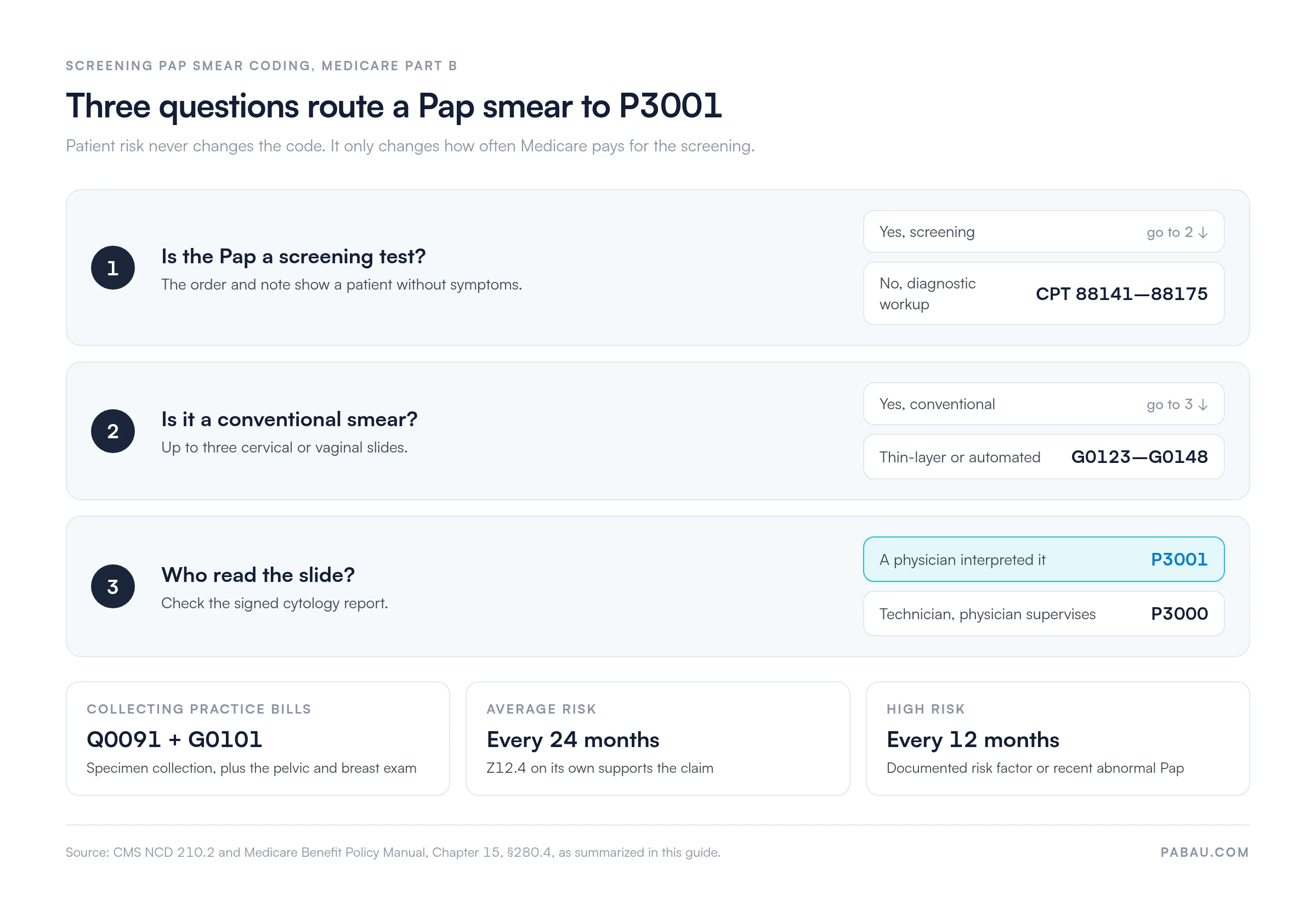
Frequency follows the patient, not the code. A high-risk patient qualifies for annual screening whether the smear is billed as P3000 or P3001. An average-risk patient qualifies every 24 months under either code.
Medicare Part B covers a screening Pap smear under NCD 210.2 and the Medicare Benefit Policy Manual, Chapter 15, §280.4. The standard interval is once every 24 months. CMS counts it as 23 full months after the month of the last covered screening.
The interval shortens to once every 12 months in two situations:
Medicare lists early onset of sexual activity (under 16) and five or more lifetime sexual partners as high-risk factors. A history of sexually transmitted disease, including HIV, counts too. Fewer than three negative Pap smears in the past seven years, or none at all, also qualifies. So does prenatal exposure to diethylstilbestrol (DES).
The specimen collection (Q0091) and the screening pelvic and breast exam (G0101) follow the same frequency rules. They are billed separately from P3001, not under an evaluation and management code. The patient pays no deductible or coinsurance for a covered screening Pap.
Routine insurance eligibility verification should include the date of the last covered screening. A smear performed before the interval has passed is not covered.
ABN requirement: If the screening falls inside the frequency window, give the patient an Advance Beneficiary Notice of Noncoverage (ABN) before the service. Without a valid ABN, the practice cannot bill the patient when Medicare denies the claim.
P3001 needs a record showing that a physician interpreted the smear. Good billing documentation starts in the chart and the cytology report, not in the billing system. Check these elements before assigning P3001:
If a technician screened the smear and no physician interpretation was documented, bill P3000 instead. Documentation decides the code, so the cytology report is the first place to look.
Every P3001 claim needs a screening ICD-10-CM code. For most patients, Z12.4 on its own is the correct diagnosis and supports the 24-month interval. Add a high-risk code only when the record documents the risk factor and you bill at the 12-month interval.
CMS lists the low-risk and high-risk screening codes on its screening Pap test page. Check your MAC’s billing guidance before finalizing claim submissions, since local edits can differ.
P3001 is paid on the Medicare Physician Fee Schedule (MPFS), not the Clinical Laboratory Fee Schedule. CMS prices it on national relative value units (RVUs), with a geographic adjustment for each payment locality. P3000, by contrast, is paid on the lab fee schedule.
Always verify your locality rate in the CMS physician fee schedule lookup tool before updating your practice fee schedule. Third-party lookup sites may lag behind the January 1 effective date of the annual update.
Each December, pull the new P3001 rate for your locality from the CMS physician fee schedule lookup tool. Update your fee schedule before January 1 so the first claims of the year go out at the current rate.
Modifier choice for HCPCS code P3001 mostly turns on whether Medicare will cover the screening on that date. Sound medical billing compliance depends on applying the right modifier before the claim leaves the system.
Do not append GA and GZ to the same line. GA signals an ABN was obtained, and GZ signals it was not.
Only the entity whose physician interprets the smear bills P3001. The place of service (POS) code reports where that interpretation took place. Check your MAC’s guidance for the setting you bill from.
POS codes often seen on P3001 claims:
Who bills which code:
P3001 is not a CPT code. Searches for a “Pap CPT code” often land on the HCPCS P-codes, but each code set covers a different situation. The table below shows which code fits which scenario.
Medicare uses the P- and G-codes for screening Pap smears billed under Part B. The CPT 88141 to 88175 cytopathology codes report diagnostic Pap testing. Many commercial payers accept CPT codes for screening as well, so check each payer’s provider manual. For the collection-side exam, see G0101.
P3001 denials usually trace back to one of the scenarios below. Tracking them through denial management workflows stops the same error from recurring across claims.
Appeals for frequency denials can succeed when the record documents a high-risk factor that was missing from the original claim. Attach the chart note and cite the high-risk ICD-10 code. Without that documentation, a clean claim submission will still deny on the same grounds.
Most P3001 errors start when the code choice and the cytology report sit in different places. Whoever builds the claim then guesses who read the slide, or misses the date of the last screening.
A clean P3001 setup in any practice management system covers these steps:
In Pabau, the practice management platform we build, the encounter note, the diagnosis and the charge sit on one patient record. Pabau’s claims management software builds the claim from that recorded data. US practices then submit and track it through Claim.MD, so the code your team chose reaches the payer without rekeying.
For women’s health practices, that puts screening visits, clinical notes and billing in one system. Front-desk staff can check the date of the last screening visit on that record before booking the next Pap.
Store the cytology report on the patient record before the claim is built. The biller can then confirm a physician interpretation in seconds and choose between P3000 and P3001 without chasing the lab.

Pabau’s claims management builds each claim from the codes and diagnoses already on the patient record, then submits and tracks it, so denials surface early.

Code P3001 from the cytology report, not from the patient’s risk profile. If a physician read the smear, P3001 is correct. If a technician screened it under supervision, P3000 is correct.
Risk changes how often Medicare pays for the screening, never which code applies. Teams that check the interpreting physician and the last screening date before billing avoid most P3001 rework.
Book a demo to see how Pabau keeps the cytology report, diagnosis and charge together so your P3001 claims go out right the first time.

Billing the technician-read version of the same smear? HCPCS code P3000 covers screening smears read under physician supervision and paid on the lab fee schedule.
Working with a thin-layer preparation instead of a conventional smear? HCPCS code G0123 covers thin-layer cytology screened by a cytotechnologist under physician supervision.
Need guidance on managing claim denials across your practice? Denial management in healthcare covers the systematic approach to tracking, appealing, and preventing claim rejections.
Want to understand how clearinghouse scrubbing catches billing errors before submission? Clean claim submission explains what a clean claim requires and how pre-submission checks prevent denials.
Looking to verify patient eligibility and benefit history before the appointment? Insurance eligibility verification walks through the process of confirming coverage and frequency limits before the patient arrives.
HCPCS Code P3001 reports a screening Pap smear, cervical or vaginal, up to three smears, that requires interpretation by a physician. It is a Level II code maintained by CMS. Medicare pays it on the Physician Fee Schedule.
The difference is who reads the smear. P3000 covers screening smears read by a technician under physician supervision. P3001 covers smears that require physician interpretation. Patient risk does not decide between them.
P3001 is an HCPCS Level II code, not a CPT code. Medicare uses P3000, P3001 and the G0123 to G0148 codes for screening Pap smears. CPT codes 88141 to 88175 report diagnostic cytopathology, and some commercial payers accept them for screening too.
Modifier GA applies when a valid ABN is on file for a screening inside the frequency window. Modifier GZ applies when no ABN was obtained, and the practice absorbs the cost. GY is rare, because screening Pap smears are a covered benefit. GA and GZ are never used together.
Common causes are billing P3001 when a technician screened the smear, so P3000 applies, and billing before the 24-month or 12-month interval has passed. A missing screening diagnosis such as Z12.4 also causes denials. So does billing by a practice that collected the smear but did not interpret it.
P3001 is billed by whoever interprets the smear, so it rarely shares a claim with the collecting visit. The collecting practice bills Q0091 for the specimen and G0101 for a screening pelvic and breast exam. A separately documented problem-oriented visit may also support an evaluation and management code.