

HCPCS Code L0472: Hyperextension TLSO billing guide
HCPCS code L0472: Official descriptor and device definition HCPCS code L0472 des...

Last Updated: Nov 5, 2026
C1753 is the HCPCS Level II code for catheter, intravascular ultrasound. It reports the single-use IVUS catheter that images a coronary or peripheral vessel from the inside.
Under the Hospital Outpatient Prospective Payment System (OPPS), C1753 carries status indicator N, which marks a packaged item. Its cost is packaged into the payment for the primary procedure, so the line is never paid separately. Hospitals still report it with an IVUS add-on code, because device charges feed future rate-setting.
Let Pabau's smart automation suggest the right codes, reduce claim denials, and keep your practice compliant—effortlessly.
Automate repetitive tasks and focus on what matters most—your patients.
Reduce coding errors and ensure compliance with the latest regulations.
Clean claims, fewer denials, and faster reimbursements.
Powerful insights and reporting to help your practice thrive.
HIPAA compliant SOC 2 certified GDPR-compliant Trusted by 4,000+ clinics worldwide

HCPCS code C1753 reports a single-use intravascular ultrasound (IVUS) catheter. Its official descriptor is Catheter, intravascular ultrasound.
Under OPPS, C1753 carries status indicator N, so its cost is packaged into the primary procedure’s payment and never paid as a separate line.
Hospitals still report C1753 with its charge, because device charges feed the cost data CMS uses to set future APC rates.
Pair C1753 with an IVUS add-on code: 92978 or 92979 for coronary vessels, 37252 or 37253 for non-coronary vessels.
Hospital outpatient departments report C1753 on the UB-04. ASCs bill Medicare on the CMS-1500 under the ASC payment system.
HCPCS code C1753 is the Level II code for a single-use intravascular ultrasound (IVUS) catheter. The Centers for Medicare & Medicaid Services (CMS) gives it the long descriptor Catheter, intravascular ultrasound. Hospitals report it when an IVUS catheter is used during a coronary or peripheral vascular procedure.
C1753 belongs to the C-code series, temporary HCPCS codes that CMS created for the Hospital Outpatient Prospective Payment System (OPPS). In the October 2026 OPPS Addendum B, C1753 carries status indicator N, which marks a packaged item. Its cost is packaged into the payment for the procedure it supports, so the catheter line is never paid on its own.
C1753 supports intravascular ultrasound (IVUS), a catheter-based imaging procedure that shows the inside of a blood vessel. The catheter is advanced to the target vessel. An ultrasound transducer at its tip produces cross-sectional images of the lumen, the plaque and the vessel wall.
Cardiologists use IVUS in the catheterization lab alongside coronary angioplasty and stent placement. Vascular teams use it in peripheral arteries and veins to size vessels and guide treatment. The catheter is single-use and discarded after the case. The ultrasound console and other reusable equipment are not reported with this code.
Under OPPS, status indicator N means a service is paid, but its payment is packaged into the payment for other services. There is no separate APC payment for the C1753 line. Medicare pays the hospital through the APC assigned to the primary procedure on the claim. Confirm the current status in the quarterly CMS OPPS Addendum B files.
The IVUS add-on codes are packaged too. In the October 2026 Addendum B, 92978, 92979, 37252 and 37253 all carry status indicator N as well. The coronary procedures they usually accompany, such as 92928 stent placement and 93458 catheterization, carry J1. That is a comprehensive APC, which folds nearly every service on the claim into one payment. The diagram below lays out how those lines sit on one coronary IVUS claim.
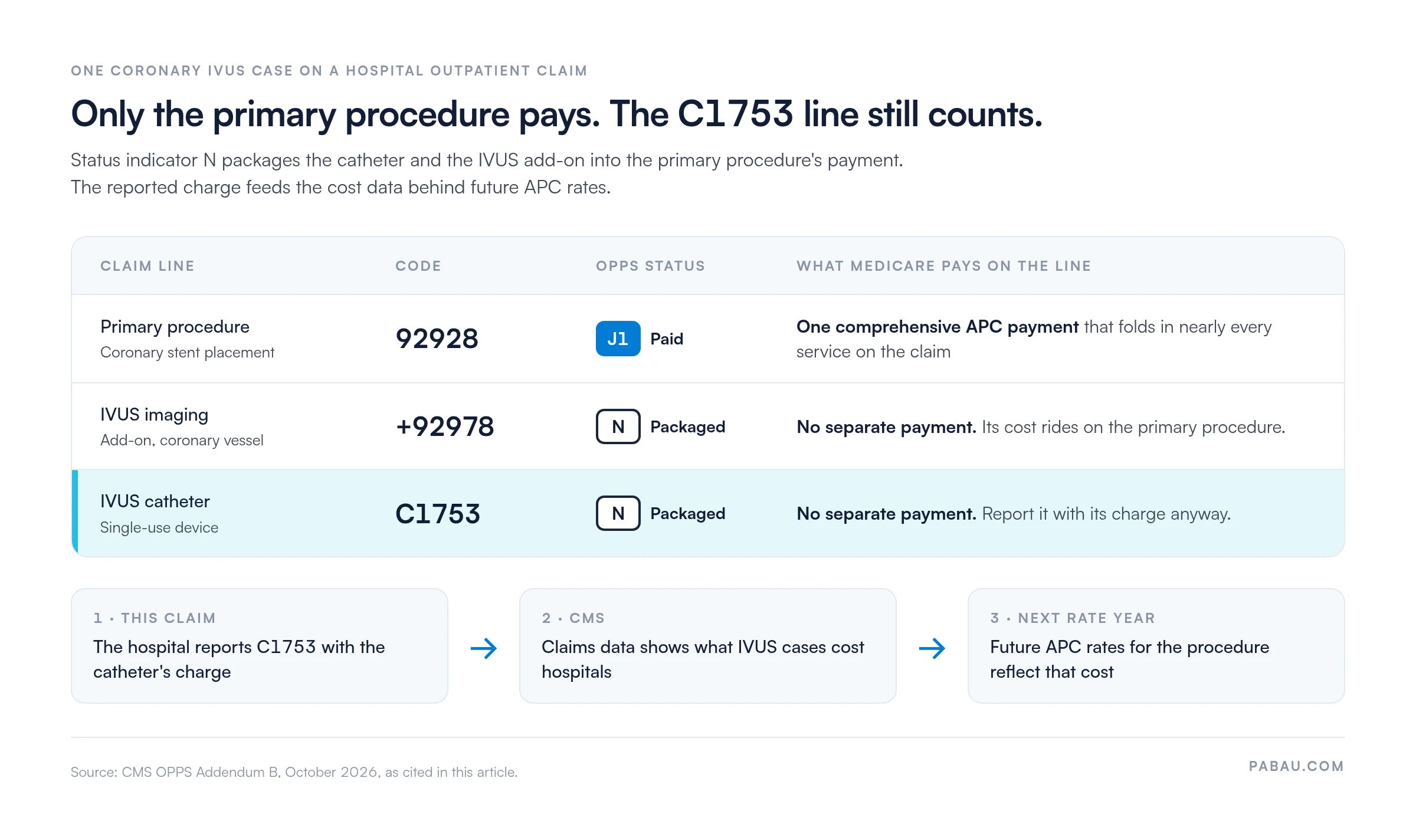
So why report C1753 at all? CMS sets future APC rates from the charges hospitals report on their claims. A catheter left off the claim makes IVUS cases look cheaper to CMS than they were. That logic is easy to miss if your team learned medical billing on fee schedule codes, where every line carries its own rate.
Key rules for C1753 under OPPS:
Use the table below as a quick reference. Status indicators can change from quarter to quarter, so confirm C1753 in the current CMS OPPS Addendum B before you update your chargemaster.
Map every IVUS catheter in your chargemaster to C1753 and to no other code. A catheter mapped to C1725 or left unmapped distorts the cost data behind future APC rates.
C1753 sits on the same claim as the IVUS code that describes the imaging. All four IVUS codes are add-on codes (+), reported with a primary catheterization or intervention code. You can look up each primary procedure in our CPT code reference library. Check the quarterly NCCI tables before submitting, because edits change.
Coronary vs. non-coronary: Use 92978 and 92979 for coronary vessels and grafts. Use 37252 and 37253 for non-coronary vessels. The vessel imaged decides the code family, so take it from the procedure note.
Units: Report C1753 units to match the catheters actually opened and used. One catheter can image more than one vessel, so the additional-vessel codes do not by themselves mean another C1753 unit. Units keep the charge accurate but do not create separate Medicare payment.
C1753 is often confused with nearby catheter codes. C1725 is the code most often swapped in, because its descriptor also names a vascular catheter. C1754 and C1755 sit in the same numeric block but describe spinal catheters.
Decision rule: If the catheter imaged a vessel with ultrasound, report C1753. If it dilated a vessel, look at C1725. If it sat in a disc or the spinal canal, look at C1754 or C1755. When in doubt, check the device label and the procedure note before you assign the code.
Most C1753 problems trace back to charge capture and documentation rather than coverage. Keep the elements below in the record before the claim goes out. A medical billing compliance checklist for device codes makes them routine.
Commercial payers: Some commercial contracts pay device lines separately or carve out high-cost supplies. Others follow Medicare packaging. Check each contract and any invoice requirement before the first submission.
Medicare makes no separate payment for C1753 under OPPS. The catheter’s cost is packaged into the APC payment for the primary procedure on the claim. Here is what that means in practice:
Prior authorization (PA) for C1753 follows the procedure rather than the device code. Payers that require PA attach it to the primary procedure and the IVUS service, not to the C1753 line.
Practical note: When a PA denial arrives, check whether it targets the primary procedure or the IVUS service. A zero-paid C1753 line on its own usually reflects packaging, not a coverage decision. Fix authorization problems at the procedure level, where payers make the decision.
Most C1753 line problems fall into a few patterns. Effective denial management starts with telling expected packaging apart from errors you can fix.
Review a sample of IVUS cases each quarter against the current Addendum B. While C1753 shows status indicator N, a zero-paid C1753 line is expected. A missing C1753 line on an IVUS case is the error worth chasing, because it understates the cost data.
C1753 billing depends on two inputs that change on a schedule. CMS updates OPPS status indicators in the annual final rule and the quarterly addenda. NCCI edits change every quarter.
Build both checks into your billing calendar. When the OPPS final rule publishes each November, confirm the status indicator for C1753 and the IVUS add-on codes. When quarterly NCCI tables release, recheck the code pairs your team reports. Teams with strong revenue cycle management schedule these device-code reviews alongside every quarterly update.
For descriptor changes, check the quarterly HCPCS release on the CMS HCPCS overview.
The C1753 line belongs to the hospital’s facility claim, built in the hospital’s own billing system. The cardiology or vascular practice behind the case still holds much of the evidence. That includes the procedure note, the vessels imaged and the signed consent.
Pabau, the practice management platform we build for private practices, holds those records on one patient file. Treatment notes and digitally signed consent forms sit side by side. When a facility or payer asks for the case file, your team can send it without hunting through folders.
Pabau’s claims management tools cover the practice’s own professional claims. Pabau does not build hospital facility claims or assign device C-codes. Its job here is keeping the practice side of each IVUS case complete. Every subscription includes these tools, and structured onboarding fits them to your existing workflow.

Pabau keeps procedure notes, signed consent forms and insurance claims on one patient record. Your team can send a complete case file whenever a facility or payer asks.

C1753 brings in no separate Medicare payment under OPPS, so a zero-paid catheter line is expected rather than a denial to fight. Reporting it still matters, because that charge feeds the cost data behind future APC rates.
The practical move is a chargemaster check. Map IVUS catheters to C1753, keep angioplasty catheters on C1725 and pair each C1753 line with its IVUS add-on code. Then recheck Addendum B every quarter.
Book a demo to see how Pabau keeps IVUS procedure notes, signed consent and claims together for your cardiology and vascular patients.

Need to understand how medical billing clearinghouses process HCPCS claims? Medical claims clearinghouse guide covers how electronic claims flow from facility to payer and where HCPCS device codes fit in the process.
Dealing with recurring claim rejections on device codes? Clean claim submission checklist outlines the field-by-field requirements that prevent technical denials before they reach the payer.
Want to understand how the 837 institutional transaction handles HCPCS lines? 837 file guide explains how UB-04 data maps to the electronic 837I transaction, including revenue code and HCPCS line placement.
HCPCS code C1753 reports a single-use intravascular ultrasound (IVUS) catheter, with the official descriptor Catheter, intravascular ultrasound. Hospital outpatient departments report it on the UB-04, alongside an IVUS add-on code such as 92978 or 37252.
C1753 describes an intravascular ultrasound catheter used to image blood vessels. C1754 describes an intradiscal catheter, used inside a spinal disc. The two codes cover different anatomy, so reporting one in place of the other is a coding error.
No. In the October 2026 Addendum B, C1753 carries status indicator N, which marks a packaged item. Its cost is packaged into the APC payment for the primary procedure, so the C1753 line pays nothing on its own. Hospitals still report it with its charge.
Prior authorization follows the primary procedure, not the C1753 device line. Medicare fee-for-service generally does not require it for IVUS. Medicare Advantage plans and commercial payers set their own rules, so check the primary procedure code with each plan.
Under Medicare, a zero-paid C1753 line with reason code 97 usually reflects packaging, not an error to appeal. Fixable problems include a missing revenue code, no matching IVUS add-on code, or C1753 on a professional claim. Check the remittance codes, then correct the line.
C1753 pairs with the IVUS add-on codes 92978 and 92979 for coronary vessels and grafts, and 37252 and 37253 for non-coronary vessels. All four are add-on codes reported with a primary procedure. Check current NCCI edits each quarter.



