

CCSD code G5100: Bypass of duodenum billing guide
CCSD code G5100 bills a bypass that leaves the duodenum in place CCSD code G5100...

Last Updated: Oct 16, 2026
CPT code 92978 is the add-on code for IVUS or OCT imaging of the first coronary vessel or graft. It's reported with an approved primary cardiac catheterization or PCI code. One code covers both imaging methods, and it includes supervision, interpretation and the report.
Because it can't be reported alone, a claim without its primary code is denied. Most 92978 denials trace back to three slips: thin documentation, a missing parent code and miscounted vessels. Each extra vessel goes on CPT 92979, which is where the counting usually goes wrong.
Let Pabau's smart automation suggest the right codes, reduce claim denials, and keep your practice compliant—effortlessly.
Automate repetitive tasks and focus on what matters most—your patients.
Reduce coding errors and ensure compliance with the latest regulations.
Clean claims, fewer denials, and faster reimbursements.
Powerful insights and reporting to help your practice thrive.
HIPAA compliant SOC 2 certified GDPR-compliant Trusted by 4,000+ clinics worldwide

CPT code 92978 covers IVUS or OCT imaging of the first coronary vessel or graft, and each additional vessel goes on CPT 92979.
As an add-on code, 92978 is typically reported with a primary catheterization or PCI code, and a claim without one is denied.
Missing medical necessity documentation and wrong vessel counts are the two most common denial triggers for this code.
Medicare pays the physician the modifier 26 professional component, about $93 national average in 2026 (2.78 total RVUs).
Pabau, the practice software we build, pre-fills claims from the record and checks required fields before Claim.MD submission.
CPT code 92978 covers IVUS or OCT imaging of the first coronary vessel or graft during a diagnostic cath or a coronary intervention. It includes imaging supervision, interpretation and the report. The current descriptor names both modalities in one code, so OCT never needs a code of its own.
“First vessel” means one native coronary artery or one bypass graft. Say the physician images the left anterior descending (LAD) artery and then the right coronary artery (RCA). The LAD goes on 92978 and the RCA goes on 92979.
Use this table when you build the charge master entry. Medicare figures change every January, so check the CMS fee schedule before you rely on them.
Four situations look like 92978 but bill differently. Knowing them heads off the most common overbilling mistakes.
92978 is typically reported with a coronary intervention or a diagnostic catheterization code. Angioplasty under 92920 is a common pairing, as are stent and atherectomy codes. The American Medical Association (AMA) CPT book lists the approved parents for each code year.
Always verify the current AMA code list before you submit. NCCI edits update quarterly, and parent-code eligibility can shift between code years.
CPT code 92978 covers the first coronary vessel or graft imaged. CPT 92979 covers each additional one, one unit per vessel. Vessel counting is where most sequencing errors on these claims start, as the diagram below shows.
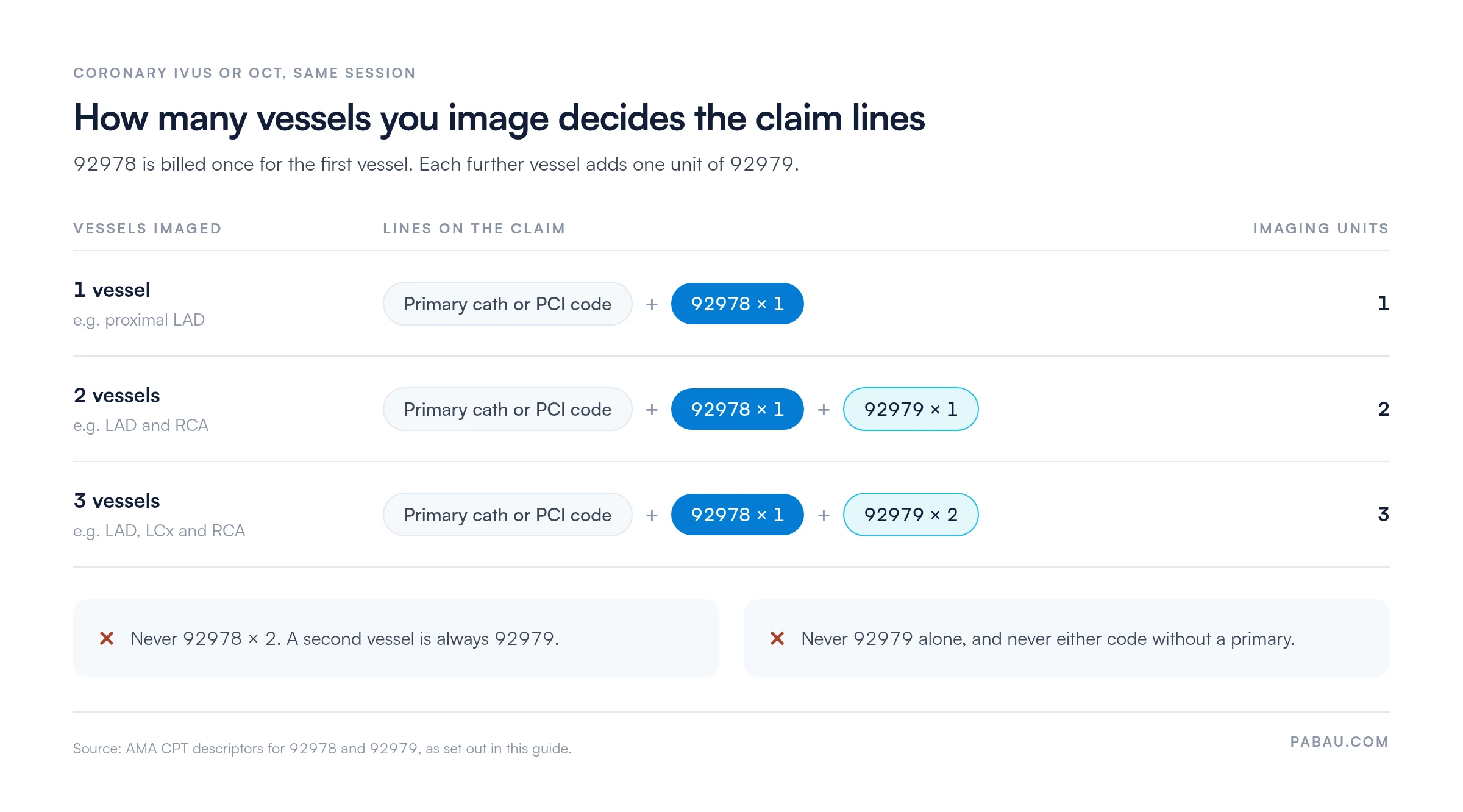
A two-vessel session (LAD and RCA) shows 92978 x1 and 92979 x1, both tied to the same primary code. Billing 92978 x2 overcounts. Billing 92979 without 92978 loses both lines.
Sometimes, but check the edits first. CPT 92978 is structural imaging with IVUS or OCT. CPT 93571 is a physiologic measurement of stenosis severity using fractional flow reserve (FFR) or instantaneous wave-free ratio (iFR). Before you put both on one claim, verify the current NCCI PTP edits and the modifier indicator for the pair.
When both codes appear on one claim, each needs its own documentation in the cath lab report. One generic sentence covering both studies is a common audit flag.
Reviewers look for five elements on a 92978 claim. If one is missing, expect a denial or a recoupment on post-payment review.
Build a cath lab dictation macro that prompts the physician for all five elements before the procedure note is signed. A structured IVUS/OCT template makes the documentation consistent from one case to the next.
Medicare prices 92978 on the professional component only. The physician bills it with modifier 26 under the Medicare Physician Fee Schedule (MPFS), at about $93 national average for 2026. The hospital is paid under the OPPS, with the imaging packaged into the primary procedure’s APC.
Your local rate depends on geographic adjustments. Check it in the CMS Physician Fee Schedule lookup tool, since rates change every year with the conversion factor.
Usually not for Medicare, but commercial payers vary. Coverage still depends on documented medical necessity, and meeting each payer’s medical billing compliance requirements falls to the billing team.
Most 92978 denials are preventable, and the same five mistakes cause nearly all of them. The table maps each one to its fix. When a denial does land, the claim denial codes on the remittance tell you which row applies.
Good denial management workflows track which of these rows keeps coming back. That pattern tells you whether the fix belongs in dictation, charge entry or prior authorization.
Run this five-point check on every claim. It takes a minute and catches the errors in the table above.
A clean claim submission for 92978 passes all five before it leaves charge entry.
Add-on logic is hard to manage on a spreadsheet or a paper charge sheet. A set routine at charge entry catches most errors before the claim enters the revenue cycle management queue.
Pabau’s cleaner claims management software pre-fills claims from the patient record and includes a CPT and HCPCS lookup library. Required claim fields are checked before Send unlocks. You then submit claims electronically through Claim.MD, with eligibility checks and ERA posting in the same place.

The software handles the form. Your billing team still owns the coding decisions, and these steps keep them consistent:

Pabau pre-fills claims from the patient record, gives you a CPT and HCPCS lookup library and checks required fields before Send. Claims go out through Claim.MD, with eligibility checks and ERA posting built in.

92978 is a simple add-on on paper, but it only pays when the claim is built right. The work happens before charge entry, in the dictation and the vessel count. Fix those upstream and denials on this code become rare.
Start with the next ten cath lab claims. Check each one against the five-point list and note where it falls short. That shows you whether the problem sits with the physician’s note, the charge set or the payer rules.
Pabau pre-fills claims from the record, checks required fields and submits through Claim.MD. To see how it fits a cardiology billing workflow, book a demo with the Pabau team.

Need to understand how clearinghouse validation works? Medical claims clearinghouse guide explains how electronic claim routing and edit checks catch errors before payer submission.
Want to reduce remittance posting errors on cardiology claims? Electronic remittance advice (ERA) explained covers how 835 files automate payment posting and denial identification.
Billing the diagnostic cath that carries the imaging? CPT code 93458: Left heart catheterization billing guide walks through one of the most common parent codes for 92978.
Looking for a complete revenue cycle reference for your billing team? What is revenue cycle management? covers the end-to-end process from eligibility through collections.
About $93 national average in 2026. That is the modifier 26 professional component, based on 2.78 total RVUs. Your local rate varies, so check the CMS fee schedule lookup.
No. 92978 is for coronary vessels and grafts only. Peripheral IVUS uses 37252 for the first noncoronary vessel and 37253 for each additional one.
Yes, on the physician claim in a facility setting. Medicare prices 92978 as a professional component only. The hospital’s share is packaged into the primary procedure under the OPPS.
Yes. The current descriptor covers IVUS or OCT in one code. If both are used on the same vessel, report one unit, not two.
Yes. The descriptor covers a coronary vessel or graft. If the first vessel imaged is a graft, it goes on 92978, and each further vessel or graft goes on 92979.



