

CPT Code 30801: Superficial turbinate ablation billing guide
CPT Code 30801: Official descriptor and procedure overview The American Medical ...

Last Updated: Nov 27, 2026
37253 is the CPT add-on code for intravascular ultrasound (IVUS) of each additional noncoronary vessel imaged during a diagnostic or therapeutic vascular procedure. It includes the radiological supervision and interpretation for that vessel.
It is always reported with 37252, which covers the first vessel, and with the primary procedure the IVUS was performed during. Each further vessel named in the operative note is one unit of 37253. Coronary IVUS uses 92978 and 92979 instead.
Let Pabau's smart automation suggest the right codes, reduce claim denials, and keep your practice compliant—effortlessly.
Automate repetitive tasks and focus on what matters most—your patients.
Reduce coding errors and ensure compliance with the latest regulations.
Clean claims, fewer denials, and faster reimbursements.
Powerful insights and reporting to help your practice thrive.
HIPAA compliant SOC 2 certified GDPR-compliant Trusted by 4,000+ clinics worldwide

CPT code 37253 reports intravascular ultrasound (IVUS) of each additional noncoronary vessel, after the first vessel is reported with 37252.
Both 37252 and 37253 are add-on codes with a ZZZ global period, so 37253 never appears on a claim without 37252 and a primary procedure.
The primary procedure can be diagnostic or therapeutic, from catheter placement and angiography to the 2026 lower-extremity revascularization codes.
In the CMS 2026 fee schedule, 37253 carries 1.40 work RVUs, and each additional vessel named in the operative note is one unit.
Coronary IVUS is reported with 92978 and 92979, so applying 37253 to a coronary vessel is a miscoding error.
CPT code 37253 is the add-on code for intravascular ultrasound (IVUS) of each additional noncoronary vessel imaged during a vascular procedure.
Both 37253 and 37252 are add-on codes reported with a primary procedure, as Endovascular Today’s CPT 2016 coding review explains. 37252 covers the first vessel, and 37253 adds one unit for every further vessel. The official descriptor reads:
Intravascular ultrasound (noncoronary vessel) during diagnostic evaluation and/or therapeutic intervention, including radiological supervision and interpretation; each additional noncoronary vessel (List separately in addition to code for primary procedure)
Official CPT descriptor for 37253, American Medical Association
IVUS uses a catheter-mounted ultrasound transducer, advanced into the vessel lumen, to produce real-time cross-sectional images of the vessel wall. During a peripheral procedure, the physician uses these images to assess plaque morphology, lumen diameter and vessel size before stent deployment. The same images confirm the result after treatment.
CPT code 37253 is an add-on code with a ZZZ global period, and it is reported only with 37252 on the same claim. 37252 is itself an add-on to the primary procedure. Billing 37253 without 37252, or under an unrelated procedure code, draws an automatic denial.
A correct claim therefore stacks three lines. The primary procedure comes first, then one unit of 37252 for the first vessel and one unit of 37253 per further vessel. The diagram below shows how the layers depend on each other.
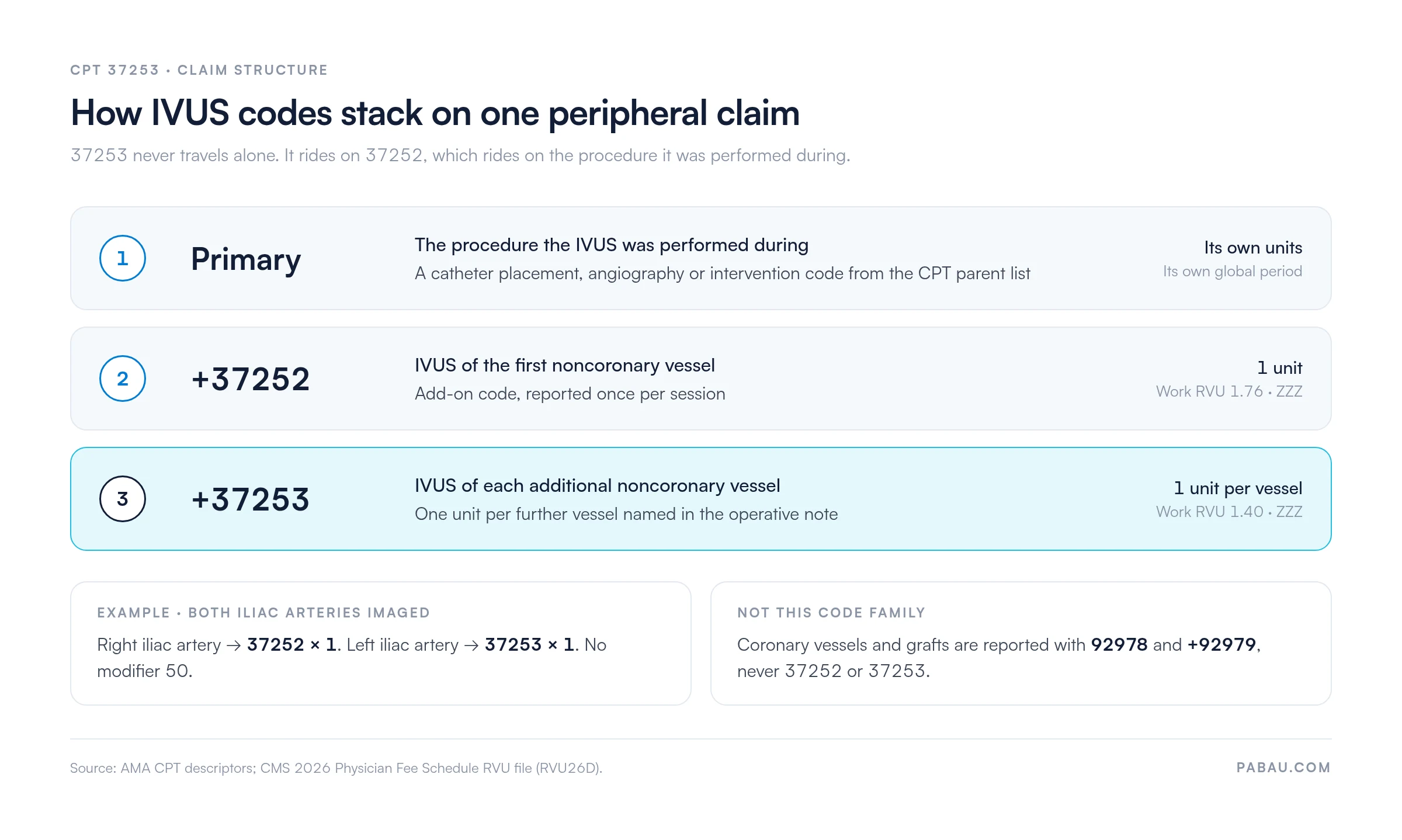
Leaving 37252 off and billing only 37253 is a common error on these claims, and it fails the whole IVUS portion.
The CPT book follows 37252 and 37253 with a list of eligible primary procedures. Because the descriptor covers IVUS “during diagnostic evaluation and/or therapeutic intervention,” the list includes diagnostic work as well as treatment. Endovascular Today names vessel catheterization codes such as 36005, 36200 and 36245 as valid base codes. Common parents in peripheral arterial work include:
The lower-extremity ranges above replaced 37220-37235 in CPT 2026. For dates of service in 2025, those older codes are the parents. In that series, 37222 and 37223 cover each additional ipsilateral iliac vessel, with angioplasty and with stent placement respectively.
This is a working list, not the full parenthetical. Check the current CPT book before appending 37252 to a code outside it.
37253 rarely needs a modifier, but a few situations call for one:
When IVUS images both the right and left iliac arteries in the same session, the second side counts as an additional vessel. If the right iliac artery is reported with 37252, the left iliac artery is one unit of 37253.
The 2026 Medicare fee schedule gives 37253 a bilateral indicator of 0, so modifier 50 does not apply. Each additional vessel is one more unit of 37253, supported by an operative note that names it. Commercial payers vary. Some accept multiple units on one line, while others want a separate line per vessel, so check unit reporting rules before submission.
Before billing multiple units of CPT 37253, confirm that the operative report names every vessel imaged with IVUS. A single reference to ‘bilateral iliac imaging’ does not support two vessels. For each vessel, record its name and territory, the pre-intervention lumen measurement, the post-intervention result and the physician’s interpretation.
The ICD-10-CM code on the claim must reflect the condition being treated, not the imaging technique itself. These codes commonly support medical necessity for peripheral IVUS:
Medicare LCDs for peripheral vascular interventions usually require a diagnosis of atherosclerosis, stenosis, occlusion or critical limb ischemia. An unspecified vascular disease code rarely satisfies them.
For restenosis inside a stent placed earlier, T82.856A is the initial-encounter code. Use the most specific code available, and confirm it appears on the payer’s accepted diagnosis list.
Medicare covers peripheral IVUS when it is performed during an eligible procedure and the operative note documents medical necessity. Coverage follows the Local Coverage Determinations (LCDs) of the Medicare Administrative Contractor for the provider’s jurisdiction. There is no national coverage determination specific to peripheral IVUS.
Payment amounts for CPT code 37253 are set each year by the Medicare Physician Fee Schedule (MPFS). In the CMS 2026 RVU file, 37253 carries 5.08 total RVUs in a non-facility setting and 1.87 in a facility.
At the 2026 conversion factor of $33.4009, that is about $169.68 non-facility and $62.46 in a facility, before geographic adjustment. Qualifying APM participants use a $33.5675 factor, which gives $170.52 and $62.77.
Commercial payers handle IVUS coverage differently from Medicare. Highmark, Cigna, Aetna and UnitedHealthcare each publish medical policies on peripheral IVUS. Many follow Medicare LCD criteria broadly but add restrictions. A policy may require a facility setting, or cover iliac and femoral vessels but not tibial ones.
If coverage is uncertain, call the payer’s provider line before the procedure date. Running an eligibility check through the Claim.MD clearinghouse before the procedure shows the benefits on file. Billing staff can then request prior authorization where required, instead of finding the problem in a denial.
Traditional Medicare does not usually require prior authorization for CPT 37253, though some Medicare Advantage plans do. Commercial payers are more likely to require it, particularly for elective peripheral interventions with IVUS.
List every code in the anticipated claim on the request: the primary procedure, 37252, and 37253 with the expected unit count. That way the authorization covers the whole claim.
Every code on a claim must be supported by the medical record, a basic rule of medical billing. Add-on codes like 37253 carry a heavier documentation burden, because each unit stands for a distinct vessel. The operative report must contain the following for each vessel imaged:
Payers running post-payment audits look for vessel-by-vessel documentation. A note that mentions IVUS without vessel-specific entries will not support multiple units of 37253.
The National Correct Coding Initiative (NCCI) edit tables govern which codes may be billed together. For CPT code 37253, the bundling rules that matter most involve imaging and supervision codes. Keeping up with medical billing compliance on these edits prevents automatic rejections and OIG audit exposure.
Key NCCI considerations for 37253 include:
CMS updates the NCCI edit tables every quarter, and bundling relationships do change. Billing staff should check the current tables on the CMS NCCI edits page rather than relying on last year’s lists.
CPT code 37253 applies only to noncoronary vessels. Coronary imaging is reported with 92978 for the first coronary vessel or graft and 92979 for each additional one. Those codes sit in the Medicine section of the CPT book, while 37252 and 37253 sit in the cardiovascular system subsection of Surgery.
Miscoding usually starts with a combined procedure note that covers coronary and peripheral work in one session. The coder has to split the note by territory and apply the matching code set to each part.
Effective denial management for add-on codes comes down to sequencing, documentation and payer policy. These are the most frequent denial triggers for CPT code 37253:
Review your clearinghouse rejection reports alongside the denial codes in medical billing to group denials by cause. A pattern such as 37252 missing from every IVUS claim is then fixed once at the source, instead of one appeal at a time.
Run a quarterly audit of every claim containing CPT 37253. Check that (1) CPT 37252 is present and (2) an eligible primary procedure code is present. Then confirm (3) the 37253 units match the vessels in the operative report and (4) the ICD-10 code appears on the applicable LCD. These four checks catch the denial triggers above before an auditor does.
Denials on 37253 usually trace back to three slips. 37252 is left off the claim, the unit count outruns the operative note, or an authorization is missing. Each one is easier to catch when the billing team works from the same record the physician documented in.
Pabau, a practice management platform with built-in claims management software, sends US claims as CMS-1500/837P files through the Claim.MD clearinghouse. Eligibility checks and ERA remittances come back against the same patient record. A denied 37253 line then shows up next to the note that should support it.
Prior authorization is tracked on the patient’s case, with the auth code, dates and sessions, and Pabau warns when one is missing. For a session billed with a primary procedure, 37252 and several units of 37253, that warning arrives before the claim goes out.
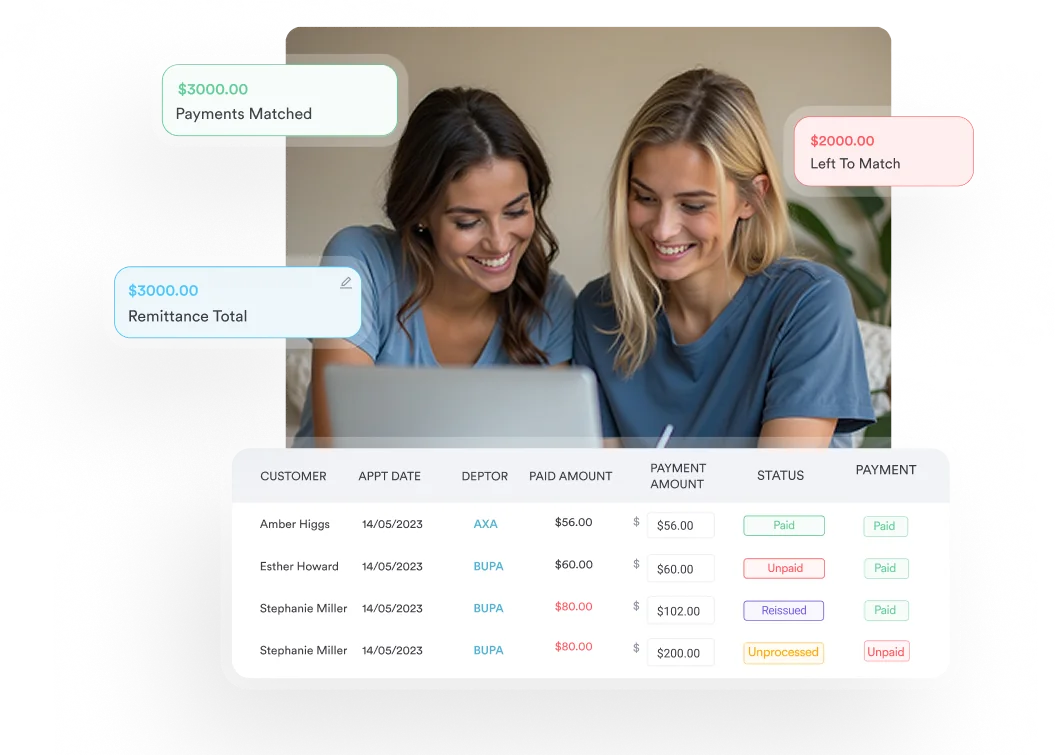

Pabau’s claims management software submits 837P claims through Claim.MD, checks eligibility and posts ERA remittances against the patient record. See how vascular practices keep IVUS add-on claims clean.

37253 pays only when the claim proves two facts. 37252 has to be on the same claim, and every unit has to match a vessel named in the operative note.
Get the vessel-by-vessel documentation right on the day of the procedure, and the unit count, the parent code and any appeal follow from it. At 1.40 work RVUs per additional vessel in 2026, each unit left off a claim is revenue worth recovering.
Book a demo to see how Pabau keeps operative documentation, eligibility checks and claim submission for vascular procedures in one workflow.

Need a clearinghouse connected to your vascular billing workflow? Medical claims clearinghouse guide explains how clearinghouse validation reduces rejection rates before claims reach Medicare and commercial payers.
Seeing recurring denials across your CPT code set? Revenue cycle management overview covers how systematic RCM workflows prevent the upstream documentation failures that drive downstream denials.
Need to verify 837 file submission for IVUS claims? 837 EDI claim file guide covers the electronic transaction format used to submit professional claims to Medicare and commercial payers.
CPT code 37253 describes intravascular ultrasound of each additional noncoronary vessel during a diagnostic evaluation or therapeutic intervention. The first vessel is reported with 37252. It is an add-on code, so it is never billed without 37252 and a primary procedure.
CPT 37252 covers IVUS of the first noncoronary vessel imaged in a session and is reported once. CPT 37253 covers each additional vessel and can be reported in several units. Both are add-on codes, and 37253 always requires 37252 on the same claim.
Modifier 59 or XU may be appended to 37253 when documentation supports bypassing a specific NCCI edit. Modifier 76 occasionally applies in staged procedures, so check payer policy before using it. Modifier 50 does not apply, because Medicare gives 37253 a bilateral indicator of 0.
Yes, through additional units of 37253 rather than modifier 50. If the right iliac artery is reported with 37252, the left iliac artery is one unit of 37253. Name each vessel in the operative report to support the unit count.
Yes, when the IVUS is performed during an eligible diagnostic or therapeutic vascular procedure and the record documents why it was needed. Coverage follows the Local Coverage Determinations of each Medicare Administrative Contractor. Some Medicare Advantage plans also require prior authorization.
The work RVU for CPT 37253 is 1.40 in the 2026 Medicare Physician Fee Schedule. Its total RVUs are 5.08 in a non-facility setting and 1.87 in a facility. CMS updates these values every year, so check the current RVU file before forecasting revenue.




