

HCPCS code E0198: Water pressure pad billing guide
HCPCS code E0198 is a water pad for a standard mattress HCPCS code E0198 is the ...

Last Updated: Oct 13, 2026
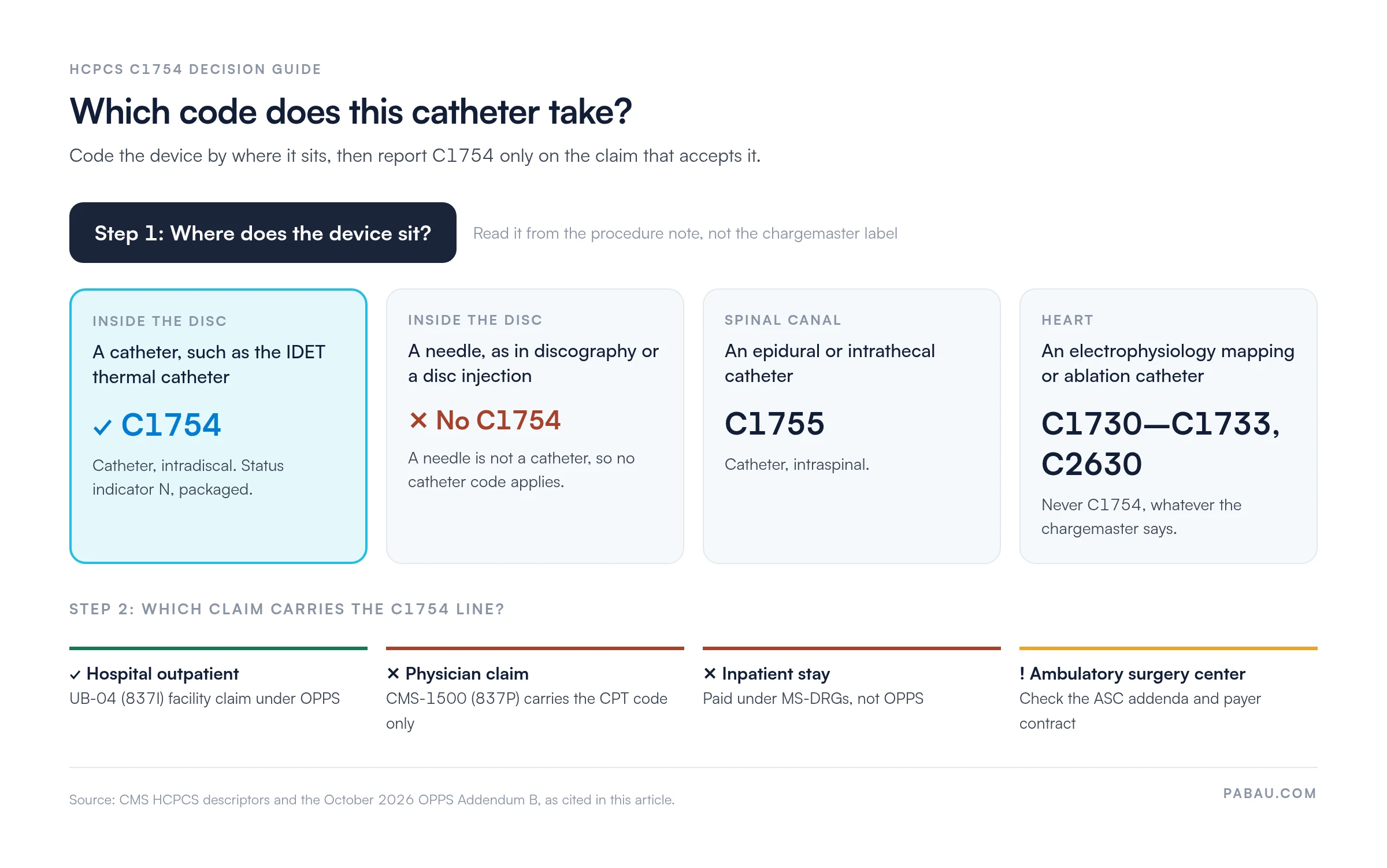
C1754 is the HCPCS Level II code for catheter, intradiscal. It describes a catheter placed inside the intervertebral disc, such as the thermal catheter used in intradiscal electrothermal therapy (IDET).
Hospitals report it on outpatient facility claims under the Outpatient Prospective Payment System (OPPS). It carries status indicator N, so Medicare packages the catheter's cost into the primary procedure's payment.
Let Pabau's smart automation suggest the right codes, reduce claim denials, and keep your practice compliant—effortlessly.
Automate repetitive tasks and focus on what matters most—your patients.
Reduce coding errors and ensure compliance with the latest regulations.
Clean claims, fewer denials, and faster reimbursements.
Powerful insights and reporting to help your practice thrive.
HIPAA compliant SOC 2 certified GDPR-compliant Trusted by 4,000+ clinics worldwide

HCPCS code C1754 is the Level II device code for an intradiscal catheter, a catheter placed inside the intervertebral disc.
Hospitals report C1754 on outpatient facility claims under OPPS, not on physician professional claims or inpatient claims.
C1754 carries status indicator N in the October 2026 OPPS Addendum B, so Medicare packages its cost and pays nothing separately for the line.
The classic C1754 procedure is IDET (CPT 22526 and 22527), which Medicare has treated as non-covered under NCD 150.11 since September 29, 2008.
Electrophysiology catheters are not C1754 and are reported with C1730, C1731, C1732, C1733 or C2630.
HCPCS code C1754 covers an intradiscal catheter, a catheter placed into the intervertebral disc space during a percutaneous spinal procedure. The official descriptor from the Centers for Medicare and Medicaid Services (CMS) is “Catheter, intradiscal”.
C1754 is a device category C-code within HCPCS Level II. Hospitals report it on outpatient facility claims under the Outpatient Prospective Payment System (OPPS), alongside the CPT code for the procedure that used the catheter.
The descriptor is narrow. The catheter has to sit inside the disc itself, not beside it or in the spinal canal.
The classic example is the thermal catheter used in intradiscal electrothermal therapy (IDET). The physician threads it into the disc under fluoroscopy and heats the annulus to treat discogenic low back pain.
Several neighboring devices do not fit C1754:
C1754 is sometimes mislabeled as an electrophysiology (EP) catheter in chargemasters and secondary references. That mapping is wrong, and it puts cardiac catheters on claims under a spinal device code.
EP catheters have their own codes: C1730, C1731, C1732, C1733 and C2630. If your chargemaster maps an EP catheter to C1754, fix the mapping before the next claim run.
C1754 belongs on hospital outpatient facility claims. The physician who performs the procedure bills the CPT code on the professional claim and does not report the catheter.
Medicare does not pay separately for C1754. In the October 2026 OPPS Addendum B, the code carries status indicator N, which CMS uses for items packaged into the payment for other services.
A zero-paid C1754 line is expected, so there is no denial to appeal. The catheter’s cost is folded into the payment for the primary procedure.
Report the line anyway, with its charge. CMS instructs OPPS hospitals to report device category codes when they use the device. Those charges also feed the cost data behind future APC rates.
Status can change from one quarter to the next. Before you rely on the values above, verify the current status in the quarterly OPPS Addendum B on the CMS site.
Add C1754 to your quarterly chargemaster review. Pull the newest Addendum B, search for C1754, and confirm that N is still its status indicator. If CMS changes it, update your billing rules before the next claim cycle.
C1754 never stands alone. It sits on the facility claim with the CPT code for the procedure that used the catheter. The table shows how common disc procedures line up, with status indicators from the October 2026 Addendum B.
Status indicator E1 means Medicare does not pay for the service under OPPS. For thermal intradiscal procedures, the reason is NCD 150.11. Since September 29, 2008, Medicare has treated these procedures as not reasonable and necessary for low back pain.
The NCD names IDET, intradiscal biacuplasty and percutaneous intradiscal radiofrequency thermocoagulation, among others. It also lists percutaneous disc decompression and coblation, which matters when 62287 is performed with a thermal technique.
For a Medicare patient, issue an Advance Beneficiary Notice (ABN) before the procedure and append modifier GA. Without a signed ABN, append GZ, and the hospital absorbs the cost. Our guide to CPT code 22527 covers the add-on rules for extra levels.
Commercial payers often take a similar line. Many medical policies list IDET as investigational, so check the payer’s policy and secure any required authorization before scheduling.
Auditors who review a packaged device line look for proof that the device matches the code. Keep these items with the record:
Medical billing compliance at the device level comes down to one rule. The code on the claim must match the device in the note.
The catheter C-codes sit close together and look alike on a chargemaster. These neighbors are the ones most often confused with C1754.
The C1755 intraspinal catheter code is the closest neighbor and the easiest mix-up on spine cases. Bill by where the catheter sits. Inside the disc is C1754, and inside the spinal canal is C1755.
The AAPC HCPCS lookup shows the descriptor text for each C-code if you need to check a device quickly.
Most C1754 problems start before anyone builds the claim. These five patterns cover the usual rejections and edits.
One more pattern is not a denial at all. A C1754 line paid at zero is the packaged status working as designed, so don’t appeal it.
Reviewing denial management data monthly separates rejections from packaged lines. A clean claim checklist with a device-to-procedure check catches most of these patterns before submission.
The C1754 line lives on the hospital’s facility claim, built in the hospital’s own billing system. The spine or pain practice behind the procedure still holds much of the evidence. That includes the procedure note, the disc levels treated and the signed consent.
Pabau, the practice management platform we build for private practices, keeps those records on one patient file. Treatment notes and digitally signed forms sit together. Your team can send the facility a complete record without searching through folders.
Pabau’s claims management tools handle the practice’s own professional claims. Pabau does not build hospital facility claims or assign device C-codes. It keeps the practice side of the case organized.
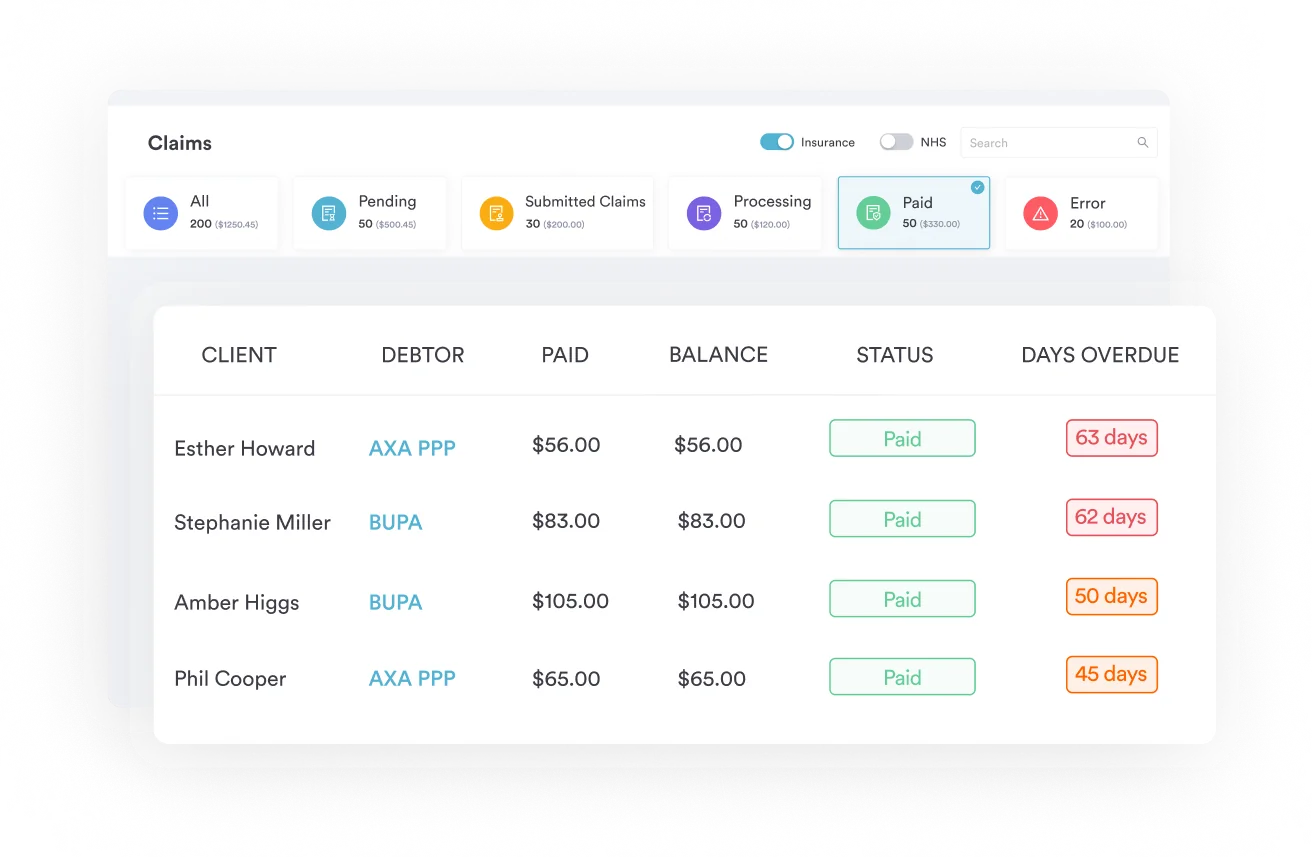
The forms, records and claims tools come with every Pabau subscription. Structured onboarding sets them up around the way your practice already works.

Pabau keeps procedure notes, signed consent forms and insurance claims on one patient record. Your team can answer a facility’s documentation request in minutes.

C1754 brings in no separate payment under OPPS, and its main procedure is non-covered for Medicare patients. Coding it correctly still protects claim accuracy, the cost data behind future rates and your audit position.
The practical move is a chargemaster check. Confirm that only intradiscal catheters map to C1754 and that EP catheters map to their own codes. Make sure IDET cases for Medicare patients carry a signed ABN, then recheck Addendum B each quarter.
Book a demo to see how Pabau keeps procedure notes, consent forms and claims for your spine and pain patients in one place.

Want to understand how medical billing rules apply to outpatient device claims? What is medical billing covers the foundational rules every billing team needs before tackling complex HCPCS device codes.
Struggling with denied claims across multiple code types? Denial management in healthcare walks through the systematic approach to identifying and resolving the root causes of claim rejections.
Need a compliance framework for your outpatient billing team? Medical billing compliance outlines the documentation and audit requirements that protect outpatient facilities from recovery audit exposure.
Billing an epidural or intrathecal catheter instead? HCPCS code C1755 explains the intraspinal catheter code that sits next to C1754 on spine cases.
Treating more than one disc level? CPT code 22527 covers the add-on rules for each additional IDET level.
HCPCS code C1754 covers an intradiscal catheter, a catheter placed into the intervertebral disc space during a spinal procedure. The classic example is the thermal catheter used in intradiscal electrothermal therapy (IDET). Hospitals report it on outpatient facility claims under OPPS.
No. C1754 carries status indicator N in the October 2026 OPPS Addendum B, so its cost is packaged into the payment for the primary procedure. Report the line with its charge anyway, because CMS uses device charges when it sets future APC rates.
Not currently. The October 2026 OPPS Addendum B lists status indicator N and no pass-through expiration date for C1754. CMS updates Addendum B every quarter, so check the latest file before you rely on it.
The closest match is CPT 22526 for single-level intradiscal electrothermal annuloplasty, with add-on 22527 for additional levels. Both carry status indicator E1, and NCD 150.11 makes thermal intradiscal procedures non-covered for Medicare patients. Needle-based procedures such as discography (62290) don’t use a catheter and shouldn’t carry C1754.
C1754 is a catheter placed inside the intervertebral disc. C1755 is an intraspinal catheter placed in the spinal canal, such as an intrathecal or epidural drug-delivery catheter. Bill the code that matches where the catheter sits.
No. The CMS descriptor for C1754 is “Catheter, intradiscal”. Electrophysiology catheters are reported with C1730, C1731, C1732, C1733 or C2630, depending on the device.
The usual causes are a missing ABN on a Medicare thermal intradiscal procedure and a wrong chargemaster mapping. Others include C1754 billed with a needle-based procedure, a professional or inpatient claim, and a commercial policy that treats IDET as investigational.



