CPT Code 62284: Injection procedure for myelography
CPT Code 62284: official descriptor and procedure overview The American Medical ...

Last Updated: Oct 19, 2026
A4719 is the HCPCS Level II code for "y set" tubing for peritoneal dialysis.
Payment is the part worth settling before anything is submitted. A4719 is a home dialysis supply. Medicare pays for it inside the End-Stage Renal Disease prospective payment system rate that goes to the renal dialysis facility. A DME supplier cannot bill it separately.
Let Pabau's smart automation suggest the right codes, reduce claim denials, and keep your practice compliant—effortlessly.
Automate repetitive tasks and focus on what matters most—your patients.
Reduce coding errors and ensure compliance with the latest regulations.
Clean claims, fewer denials, and faster reimbursements.
Powerful insights and reporting to help your practice thrive.
HIPAA compliant SOC 2 certified GDPR-compliant Trusted by 4,000+ clinics worldwide

HCPCS Code A4719 is the HCPCS Level II code for Y set tubing used in peritoneal dialysis.
Medicare does not pay A4719 separately. Its cost sits inside the ESRD prospective payment system rate paid to the dialysis facility.
CMS lists A4719 among the ESRD supply codes that are not payable to DME suppliers, so a supplier claim denies.
The supporting diagnoses are N18.6 and Z99.2. Z49.32 covers peritoneal dialysis adequacy testing, and Z49.31 covers hemodialysis.
Dialysate solution is coded by fill volume from A4720 through A4726, in 1,000 cc bands above 999 cc.
HCPCS Code A4719 describes “Y set” tubing used in peritoneal dialysis. It is classified under the A-series of the HCPCS Level II system, which the Centers for Medicare and Medicaid Services updates each year. The code is active and valid for the current plan year.
HCPCS Level II codes like A4719 are not CPT codes, and the difference matters when you are hunting for a rate. CPT codes describe procedures performed by clinicians. HCPCS Level II codes describe supplies, equipment, and items given to patients, and CMS maintains them rather than the American Medical Association. The medical billing fundamentals behind that split explain why the two sets are priced through different files. Payment posting from a remittance file is faster than manual entry and keeps the adjustment reasons attached. Payment posting from a remittance file is faster than manual entry and keeps the adjustment reasons attached.
A Y set is a tubing system used in continuous ambulatory peritoneal dialysis and in automated peritoneal dialysis. The Y shape connects the patient’s catheter to a fresh dialysate bag and a drain bag at the same time. Used dialysate drains out and fresh solution flows in during one exchange.
Peritoneal dialysis is a home-based kidney replacement therapy for patients with end-stage renal disease. It uses the patient’s own peritoneal membrane as the filter, rather than routing blood through a machine at a dialysis center. The Y set is a single-use item, replaced at every exchange and often a few times a day.
Diabetes and hypertension cause most new ESRD cases, so the referring practice is often the one managing those conditions long before dialysis starts. Practices working at that stage tend to run on a metabolic health EMR, where the diagnosis history that later supports a dialysis claim already lives.
Medicare pays for A4719 inside the ESRD prospective payment system, not as a separate supply claim. Home dialysis items moved into that bundled per-treatment rate on January 1, 2011, when the Method II option ended. Every home dialysis claim has come from a renal dialysis facility since then.
Non-Medicare payers set their own rules. Some state Medicaid programs and commercial plans do accept A4719 on a supplier claim, with their own unit definitions and coverage limits. Running insurance eligibility verification before the first shipment tells you which route a given plan expects.
Before you set up a new home peritoneal dialysis patient, confirm who the payer expects the supply claim from. For Medicare, that is always the renal dialysis facility. For a commercial plan or a state Medicaid program, read the supply policy first. Some do allow a supplier to bill A4719 under their own unit limits.
There is no DMEPOS fee schedule amount for A4719. CMS does not price the code separately under Part B, because the payment already sits inside the ESRD bundle. Searching the physician fee schedule tool for it returns nothing useful, which is a common source of confusion.
The base rate and its adjusters are the figures worth tracking, and CMS publishes both each year. Fee schedule files for durable medical equipment sit on the CMS DMEPOS fee schedule page, but A4719 carries no amount there. Third-party lookup tools often show a blank or a stale figure for codes like this one, so work from the source file.
The renal dialysis facility submits the claim for a home peritoneal dialysis patient. A4719 can appear on that claim as a reported supply, but it does not create a payment line of its own.
Keeping the medical necessity documentation together at the point of order is what survives an audit. The order, the ESRD diagnosis, and the home training record all have to point at the same modality.
A clean claim for a home dialysis month passes every front-end edit the first time. That means a valid modality revenue code, a supporting ICD-10 diagnosis, and units that match the prescription. Medicare processes clean institutional claims inside its standard 14 to 30 day window.
Every home dialysis claim needs at least one ICD-10-CM code that shows medical necessity for peritoneal dialysis. The four codes below are the ones that carry that weight. Check them against the current code set on the CMS ICD-10 page and against your payer’s policy.
N18.6 with Z99.2 is the pairing that supports an ongoing home peritoneal dialysis month. Z49.32 belongs on an adequacy testing encounter for peritoneal dialysis. Z49.31 is the hemodialysis version of that code, so putting it on a peritoneal dialysis claim invites a medical necessity denial.
Y set tubing is one line in a broader family of peritoneal dialysis supply codes. A facility giving a full month of supplies touches a few A-series codes at once. Descriptors change with the annual update, so check each one against the NLM HCPCS Level II API before you file a claim.
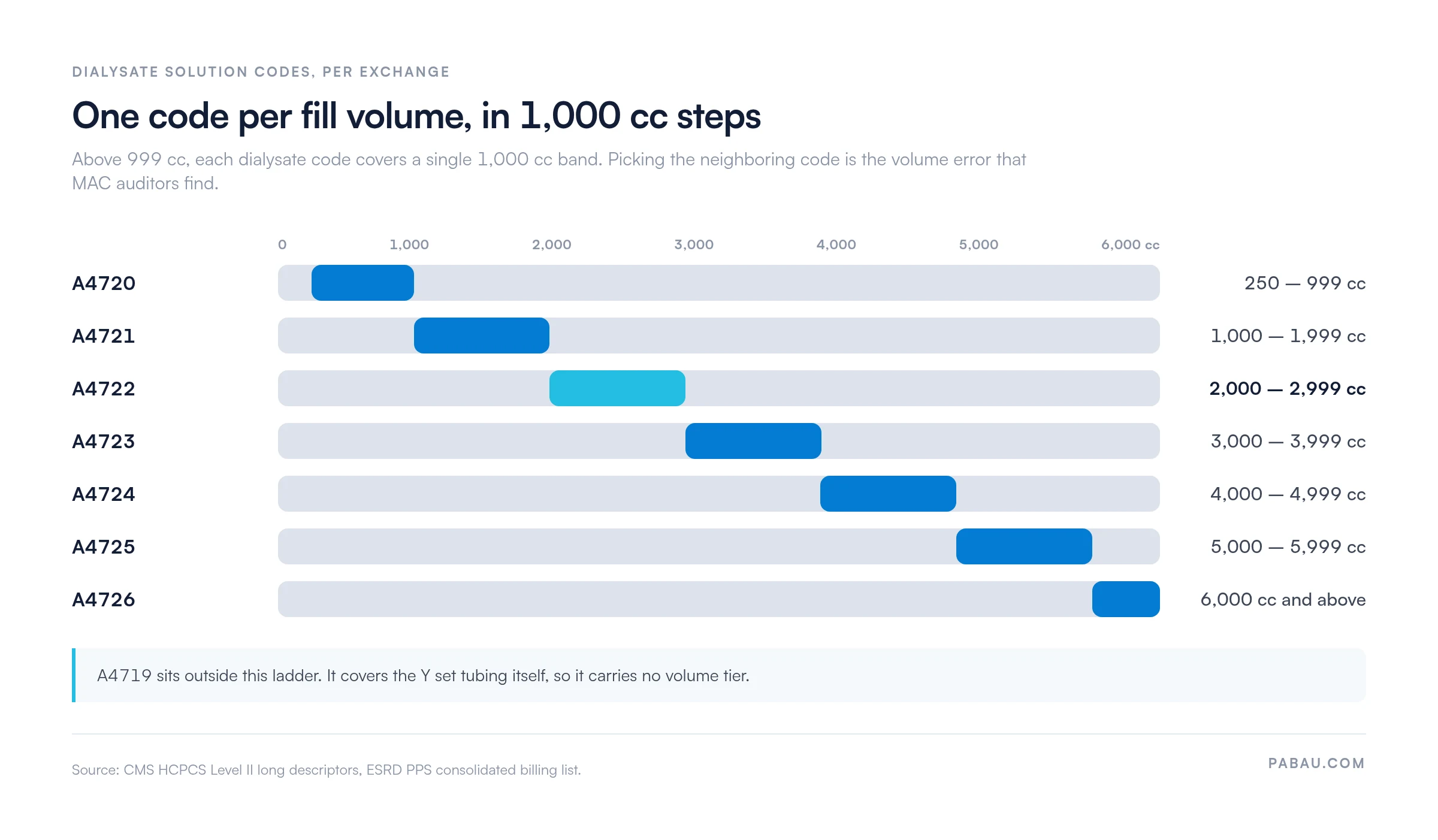
Those volume tiers are where unit errors start. Reaching for the neighboring code changes the reported volume by a full liter, and the quantity no longer matches the prescription. Adjacent dialysis supplies such as supplies such as A4736 and A4929 sit outside the ladder and carry descriptors of their own.
Five patterns account for most denials and audit findings on peritoneal dialysis supply claims. Four of them are paperwork problems. The first is a routing problem, and it is the most expensive one to unwind.
Sending A4719 to a DME MAC is the costliest error on this code. CMS lists it among the ESRD supply codes that are not payable to DME suppliers. The claim denies while the supplies are already out the door. Route the item through the renal dialysis facility, or confirm in writing that the plan is not Medicare. Denial management workflows should carry a payer routing check before the first shipment.
A home dialysis claim without an ESRD-related ICD-10 code denies for medical necessity. N18.6 confirms the ESRD status and Z99.2 documents ongoing dialysis dependence. Attaching Z49.31 to a peritoneal dialysis claim is the mismatch that comes up most, since that code covers hemodialysis adequacy testing. A code pairing check before filing catches it.
CMS requires a written physician order before the first dispense of peritoneal dialysis supplies. An order that is missing, expired, or naming the wrong modality exposes the whole period to recoupment. Many payers also require annual renewal for ongoing supplies. HIPAA-compliant documentation practices with secure order storage and expiration tracking keep that from happening.
Every HCPCS code carries a defined billing unit, and the definitions are not consistent across the A-series. Supply allowance codes such as K0553 treat one month of supply as a single unit, while dialysate codes turn on fill volume per exchange. Quantities that miss the prescribed exchange frequency create overpayment exposure. The common denial codes reference sets out the adjustment reason codes that unit errors trigger.
A patient who moves from home peritoneal dialysis to in-center hemodialysis no longer needs Y sets. Supplies often keep arriving for a cycle or two, and the claims behind them have no supporting order. A medical billing compliance calendar that tracks modality changes with order renewal dates prevents the most avoidable denials.
Audit your home dialysis supply claims quarterly. Pull every claim denied for medical necessity or a diagnosis mismatch, then check each one against the physician order on file. A repeating mismatch often points at the intake step rather than the clinical record. One change to order intake tends to clear the whole pattern.
HCPCS Code A4719 has held an active status across recent coding years. CMS publishes HCPCS Level II updates each fall for a January 1 effective date. Changes can include descriptor revisions, unit changes, or, in rare cases, deletion and replacement.
A descriptor change resets how the billing unit reads, which is why the annual file deserves a formal review. Order templates and supply forms quoting the old wording go stale quietly. For a high-volume item like peritoneal dialysis tubing, a single word can affect whether the claim is accepted.
A home dialysis month rests on paperwork that often lives in three places. The signed physician order sits in a scanned folder. The ESRD diagnosis sits in the chart, and the supply record sits with whoever shipped the box. When a payer asks for all three, someone loses an afternoon putting them together.
Practice management software like Pabau holds them together instead. Intake forms, consent, treatment notes, and the diagnosis all attach to one patient record, so the order and the clinical narrative never drift apart. Practices running their own infusion or chronic therapy programs carry the same paperwork load, which is why infusion center software follows the same pattern.
For the claims a practice submits itself, Pabau’s claims management software pulls what is already on the record into a pre-filled claim. The Claim.MD integration then submits it and tracks its status, so a stalled claim surfaces before the filing limit does.
Pabau is built for private practices rather than DME suppliers, so treat it as the record and filing layer behind a claim. The routing rules for a bundled ESRD supply still belong to the payer’s policy, and no software decides them for you.
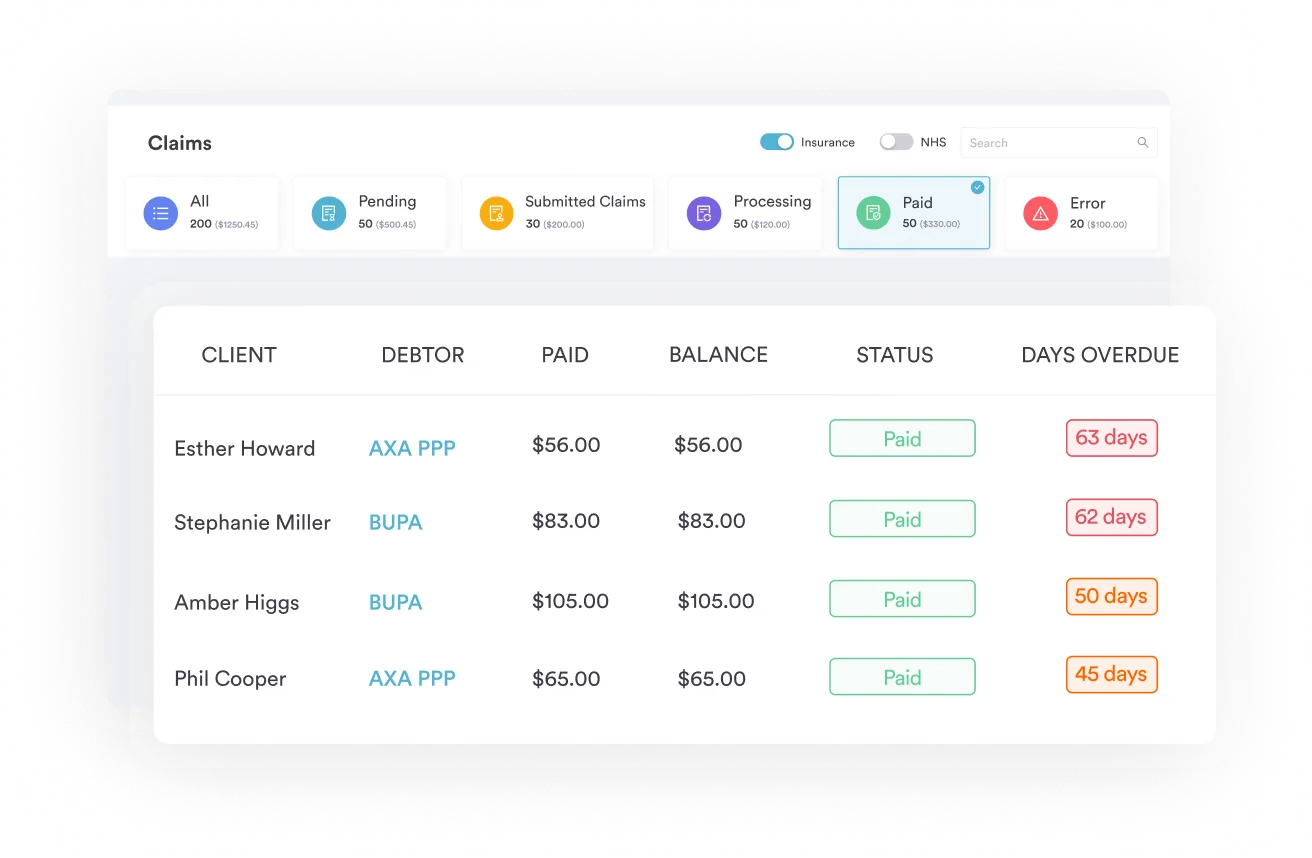

Pabau brings intake forms, consent, treatment notes, and diagnoses into a single patient record. Claims submit and track through the Claim.MD integration, so nothing stalls unnoticed.

A4719 is a plain descriptor sitting on top of a payment rule that catches people out. The tubing is covered, but never as its own paid claim line, and the money moves through the dialysis facility’s bundled rate.
Settle the routing question first, for every patient and every payer, and the rest of this code is ordinary paperwork. Confirm who submits, confirm the modality named on the order, and keep both attached to the record. Book a demo to see how Pabau keeps orders, diagnoses, and claim status in one place.

Billing the largest dialysate bags? A4726 covers every fill volume above 5999 cc and has no upper bound.
Coding the drainage side of an exchange? A4911 covers the drain bag or bottle furnished with each set.
Replacing catheter tips between exchanges? A4860 is reported per 10 disposable tips rather than per patient.
Documenting the access itself? C1750 covers the long-term catheter used for peritoneal or hemodialysis access.
Need the physician side of the same encounter? 90945 is the code for a dialysis procedure with a single physician evaluation.
HCPCS Code A4719 identifies Y set tubing used in peritoneal dialysis. It is a HCPCS Level II A-series supply code. Medicare treats it as a home dialysis supply, so payment sits inside the ESRD prospective payment system rate paid to the renal dialysis facility.
Yes, but not as a separately payable item. Y set tubing is a home dialysis supply. Medicare folds its cost into the ESRD prospective payment system rate paid to the renal dialysis facility. CMS lists A4719 among the ESRD supply codes that are not payable to DME suppliers.
The core codes are N18.6 for end-stage renal disease and Z99.2 for dependence on renal dialysis. Z49.32 covers an adequacy testing encounter for peritoneal dialysis. Z49.31 is the hemodialysis equivalent, so it does not belong on a peritoneal dialysis claim. Check every pairing against your payer’s current policy.
The renal dialysis facility gives home dialysis supplies and submits the home dialysis claim. Since January 1, 2011, DME suppliers can no longer bill Medicare separately for these items. A commercial plan or state Medicaid program may still expect A4719 on a supplier claim, so check the individual policy.
There is no separate Medicare amount for A4719. CMS does not price it under the DMEPOS fee schedule, because payment is bundled into the ESRD prospective payment system base rate. That base rate and its case-mix adjusters are published each year in the ESRD PPS final rule.
The record needs a physician order naming peritoneal dialysis as the prescribed modality. It also needs the ESRD diagnosis, the home training and support notes, and evidence that the supplies were given. Keep the order current, since the facility carries the audit exposure for a bundled supply.