HCPCS code V2313: Trifocal spherocylinder lens billing guide
HCPCS code V2313 covers a strong trifocal lens with high astigmatism HCPCS code ...

Last Updated: Oct 20, 2026
A4736 is the HCPCS Level II code for topical anesthetic, for dialysis, per gram.
CMS lists A4736 on the End-Stage Renal Disease (ESRD) prospective payment system consolidated billing list. It sits in the group of supplies that are not payable to DME suppliers.
Let Pabau's smart automation suggest the right codes, reduce claim denials, and keep your practice compliant—effortlessly.
Automate repetitive tasks and focus on what matters most—your patients.
Reduce coding errors and ensure compliance with the latest regulations.
Clean claims, fewer denials, and faster reimbursements.
Powerful insights and reporting to help your practice thrive.
HIPAA compliant SOC 2 certified GDPR-compliant Trusted by 4,000+ clinics worldwide

HCPCS code A4736 covers a topical anesthetic for dialysis, billed per gram under the Level II A-series supply codes.
Medicare pays for the anesthetic inside the ESRD facility’s per-treatment bundle, not as a separately billable supply line.
CMS lists A4736 among the ESRD supplies that are not payable to DME suppliers, so a DME claim is denied.
NU, RR, and UE report rental or purchase status for equipment, so none of them belongs on a per-gram supply code.
Practice management software like Pabau pulls the record data you already hold into a claim, then submits it through Claim.MD.
HCPCS code A4736 is the Level II HCPCS supply code for a topical anesthetic used specifically for dialysis, billed per gram. According to the Centers for Medicare and Medicaid Services (CMS), Level II HCPCS codes cover equipment, supplies, and services that CPT codes do not describe. A4736 sits in the A-series, which holds medical and surgical supplies.
The code is active for 2026 and carries a DME-jurisdiction supply designation. Payment for it does not run through the DMEPOS fee schedule, which is where most of the confusion around it starts. Use the table below to check the attributes before you build a claim.
Check the descriptor each year against the annual CMS HCPCS release, ahead of its January 1 effective date. Codes also move between the two groups on the consolidated billing list, so read the current Attachment B rather than last year’s copy.
Hemodialysis patients undergo needle insertions at their arteriovenous fistula or graft up to three times a week. Those cannulations hurt, so a topical anesthetic goes on the access site 30 to 60 minutes before each session.
A4736 covers that anesthetic supply, and patients with ESRD are the core population for the code. The needles used on a fistula come from a separate supply, the fistula cannulation set reported under HCPCS code A4730.
Agents billed under A4736 include EMLA cream, a lidocaine and prilocaine combination, and similar topical preparations. The code does not cover procedural anesthesia given by injection or during surgical access creation. Injectable anesthetic for dialysis has its own code, A4737. A4736 is a supply code for the topical preparation, counted per gram.
Dialysis technicians and registered nurses at ESRD facilities apply the anesthetic. The ordering practitioner, usually a nephrologist or ESRD attending, sets the treatment plan. Whoever writes it up, the record has to tie the anesthetic to a covered dialysis encounter.
Medicare pays for A4736 through the dialysis facility’s bundled per-treatment rate, and not as a separately billable supply. The ESRD prospective payment system covers the drugs, laboratory tests, supplies, and equipment furnished for the treatment of ESRD. Topical anesthetic for a cannulation is one of those supplies.
CMS publishes the affected codes each year in Attachment B of its ESRD PPS consolidated billing list. The attachment splits the supply codes into two groups. One group carries consolidated billing edits, where the AY modifier can release separate payment for an item used outside ESRD treatment.
A4736 sits in the second group, the codes not payable to DME suppliers at all. That placement matters because the descriptor itself names dialysis. There is no non-ESRD use of a topical anesthetic for dialysis, so appending AY does not make the line payable. The DME claim is denied either way.
The facility’s own payment comes from the ESRD PPS base rate, adjusted for patient and facility characteristics. CMS resets that rate each January 1 in the annual ESRD PPS final rule. None of it is code-specific, which is why a fee schedule lookup on A4736 returns nothing useful. The breakdown below shows where each version of the claim lands.
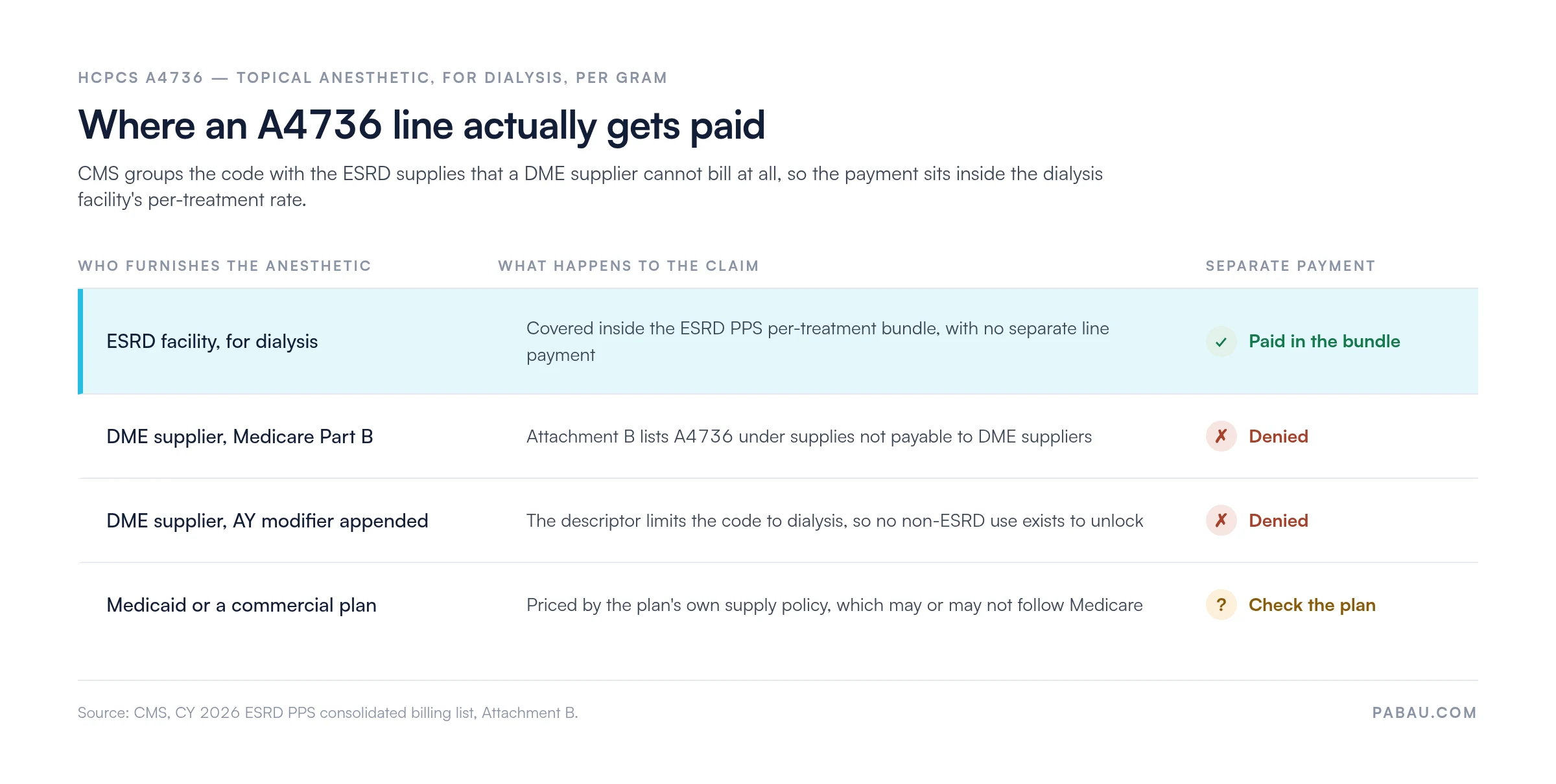
The bundle covers the anesthetic itself, so there is no separate allowable to look up and no MAC-specific amount to chase. What does still apply is the mechanics around the code.
Facilities still count grams at the chair. The number does not move a Medicare payment. It still feeds cost reporting, supply reconciliation, and any commercial or Medicaid claim that prices the code separately.
Start with who furnished the anesthetic, because that decides whether a separate claim line exists at all. Work through the steps below before anything goes out the door.
Read the current Attachment B of the ESRD PPS consolidated billing list every January. Codes move between the two groups from year to year. A supply that was separately payable one year can sit inside the bundle the next. The denial that follows looks nothing like a coding error.
Medicare is the primary payer for most patients with ESRD, because ESRD coverage reaches people under 65 who meet the eligibility criteria. Medicaid and commercial plans sit alongside it for some beneficiaries, and their A4736 policies vary widely. Billing compliance requirements differ by payer and state, so never treat Medicare’s handling of the code as the default.
Medicare’s coding guidance explains what a Level II code describes. It does not settle payment, so cross-reference the plan’s own policy before you submit anything.
A4736 sits in a cluster of A-series dialysis supply codes, and the neighboring numbers do not all describe dialysis items. Verify a full descriptor against the current CMS HCPCS file before billing by code number. The codes below are the ones that genuinely come up alongside A4736.
A4735 still turns up in older references as local or topical anesthetics for dialysis only. CMS deleted it effective January 1, 2002, so it is not an alternative to A4736. Every code in the table above appears on the same CY 2026 list, which means the payment question is identical for all of them.
Our guides to A4728 and guides to A4728 and A4719 work through the same rule for two other supplies on that list.
The errors below are what turns an A4736 line into a denial. Most of them trace back to treating the code as an ordinary DMEPOS supply.
Pull a quarterly report of every A4736 line your practice has submitted, split by payer. Any line that went to a DME MAC is a process problem rather than a coding one. It will keep recurring until the anesthetic is handled on the facility claim instead.
Dialysis supply billing goes wrong in the record long before it goes wrong on the claim. The order for topical anesthesia sits in one system, the session note in another, and the quantity used on a paper log at the chair. When a reviewer asks who ordered the anesthetic and when it went on, someone spends an afternoon reassembling the answer.
Practice management software like Pabau keeps those pieces on one patient record. The order, the treatment note, and the quantity administered attach to the encounter they belong to. Pabau does not choose the code for you. It holds the data your team has already recorded and carries it into the claim.
From there, Pabau’s claims management software pre-fills the claim from that record and sends it through the Claim.MD integration. Claim.MD submits electronically, validates the membership and authorization fields you have stored, then tracks the claim status and the remittance that comes back.
Practices that bill consumables per unit hit the same problem outside dialysis. IV therapy practices and metabolic health practices run the same record-to-claim path for their own supply lines.
For a patient on three sessions a week, automated workflows handle the repeat documentation. Nobody re-enters the same order and note links every billing cycle.
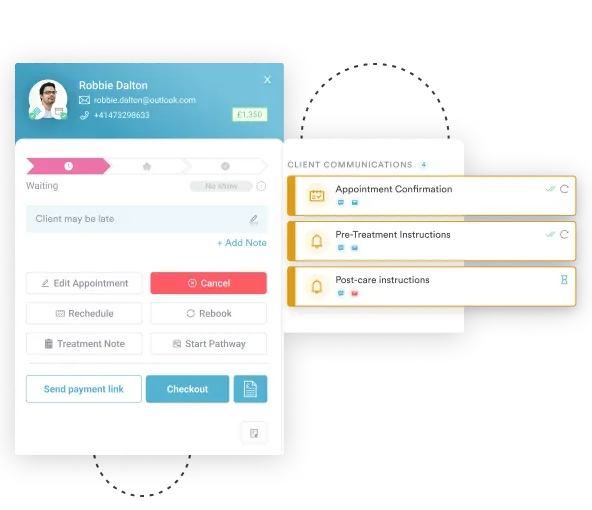

Pabau holds the order, the treatment note, and the quantity administered on one patient record, then submits the claim through Claim.MD and tracks it. Your documentation is ready before a reviewer asks for it.

A4736 is easy to identify and easy to misroute. The descriptor leaves no room for doubt, and the payment rule behind it is where practices lose claims. Once you know the code sits on the ESRD consolidated billing list, the DME denials stop being a mystery.
That leaves two jobs. Keep the order, the note, and the grams administered together for post-payment review. Then read each non-Medicare payer’s supply policy before assuming the code is billable on its own line.
Where dialysis supply billing sits alongside a full clinical workload, the record is where the time goes. Book a demo to see how Pabau keeps the documentation and the claim on the same patient record.

Billing peritoneal dialysis tubing? A4719 covers the Y set tubing code and how consolidated billing treats it.
Need the rule for dialysate solution? A4728 applies the same bundling logic to non-dextrose dialysate.
Reporting hemodialysis blood tubing? A4750 explains where that supply line lands under the ESRD bundle.
Handling peritoneal drainage supplies? A4911 walks through the drain bag and bottle code for dialysis.
Billing an ESRD anemia biosimilar? Q5105 covers how the ESRD bundle pays for Retacrit.
HCPCS code A4736 is a Level II HCPCS supply code for a topical anesthetic used in dialysis, billed per gram. It covers the anesthetic cream applied to a hemodialysis patient’s vascular access site before needle insertion, in an ESRD treatment context.
Yes, but not as a separately payable supply. Medicare covers the anesthetic inside the ESRD facility’s bundled per-treatment payment under the ESRD prospective payment system. CMS lists A4736 among the ESRD supplies that are not payable to DME suppliers, so a separate DME claim for it is denied.
No. Payment is bundled into the ESRD facility’s per-treatment rate. There is no separate allowable to look up, and no MAC-specific amount for the code. The facility’s rate comes from the ESRD PPS base rate, which CMS resets each January 1 in the annual final rule.
An ESRD facility reports its dialysis treatments on the institutional claim, and the anesthetic is already covered by that payment. Where a Medicaid or commercial plan prices A4736 separately, bill the grams actually administered on the CMS-1500 or 837P. Keep the practitioner’s order and the session note in the patient record either way. Where a practice does not bill the payer directly, the patient needs an itemized statement carrying this code and its charge.
Not under Medicare, because there is no separate payment to authorize. Medicaid and commercial plans that do price the code may require authorization above a quantity threshold, or when the treatment plan is out of date. Check each plan’s own supply policy before submitting.