CPT Code 62284: Injection procedure for myelography
CPT Code 62284: official descriptor and procedure overview The American Medical ...

Last Updated: Oct 19, 2026
A4355 is the HCPCS Level II code for an irrigation tubing set for continuous bladder irrigation through a three-way indwelling foley catheter, each. Medicare covers it under LCD L33803 when the record shows catheter obstruction that intermittent irrigation cannot clear, up to one tubing set per day.
The code covers the tubing set only. Insertion trays bill separately as A4313, A4314 or A4316, and A4338 is a two-way Foley catheter that cannot carry irrigation.
Let Pabau's smart automation suggest the right codes, reduce claim denials, and keep your practice compliant—effortlessly.
Automate repetitive tasks and focus on what matters most—your patients.
Reduce coding errors and ensure compliance with the latest regulations.
Clean claims, fewer denials, and faster reimbursements.
Powerful insights and reporting to help your practice thrive.
HIPAA compliant SOC 2 certified GDPR-compliant Trusted by 4,000+ clinics worldwide

HCPCS code A4355 covers one irrigation tubing set for continuous bladder irrigation (CBI) through a three-way indwelling Foley catheter, billed per set.
Medicare coverage is governed by LCD L33803 (Urological Supplies) together with Policy Article A52521.
The LCD covers continuous irrigation only when the record shows catheter obstruction that intermittent irrigation could not clear.
A Standard Written Order must reach the supplier before the claim is submitted, and more than one tubing set per day is denied.
A4355 is not separately billable during an inpatient stay, so bill it only for supplies delivered to the patient after discharge.
HCPCS code A4355 describes an “Irrigation tubing set for continuous bladder irrigation through a three-way indwelling foley catheter, each.” It is a Level II A-series supply code maintained by CMS under the HCPCS system, within the A4310–A4360 urinary supplies range. Billing is per unit (each tubing set), not per day or per month.
The descriptor anchors to a specific device: a three-way indwelling Foley catheter. That third lumen is what makes simultaneous irrigation inflow and urine outflow possible. A standard two-way Foley does not support CBI, so A4355 cannot be billed when a two-way catheter is documented.
Neighboring catheters, trays and drainage bags each carry their own code, and our HCPCS codes index lists them alongside A4355.
CBI is most frequently ordered after transurethral resection of the prostate (TURP) or other endoscopic bladder procedures, where bleeding creates clot risk. The three-way catheter carries irrigant in, keeps the bladder clear, and drains fluid and clots out through the same device.
The conditions below commonly lead to CBI. LCD L33803 sets no ICD-10 requirement for A4355, so none of these codes qualifies a claim on its own.
Report the diagnosis your records support. The claim still stands on the documented history of catheter obstruction, not on which of these codes appears.
Medicare covers A4355 under the urological supplies benefit when the criteria in LCD L33803 and Policy Article A52521 are met. Coverage applies to supplies delivered to the patient at home. During an inpatient stay, supplies are bundled under the DRG, so billing A4355 separately is incorrect.
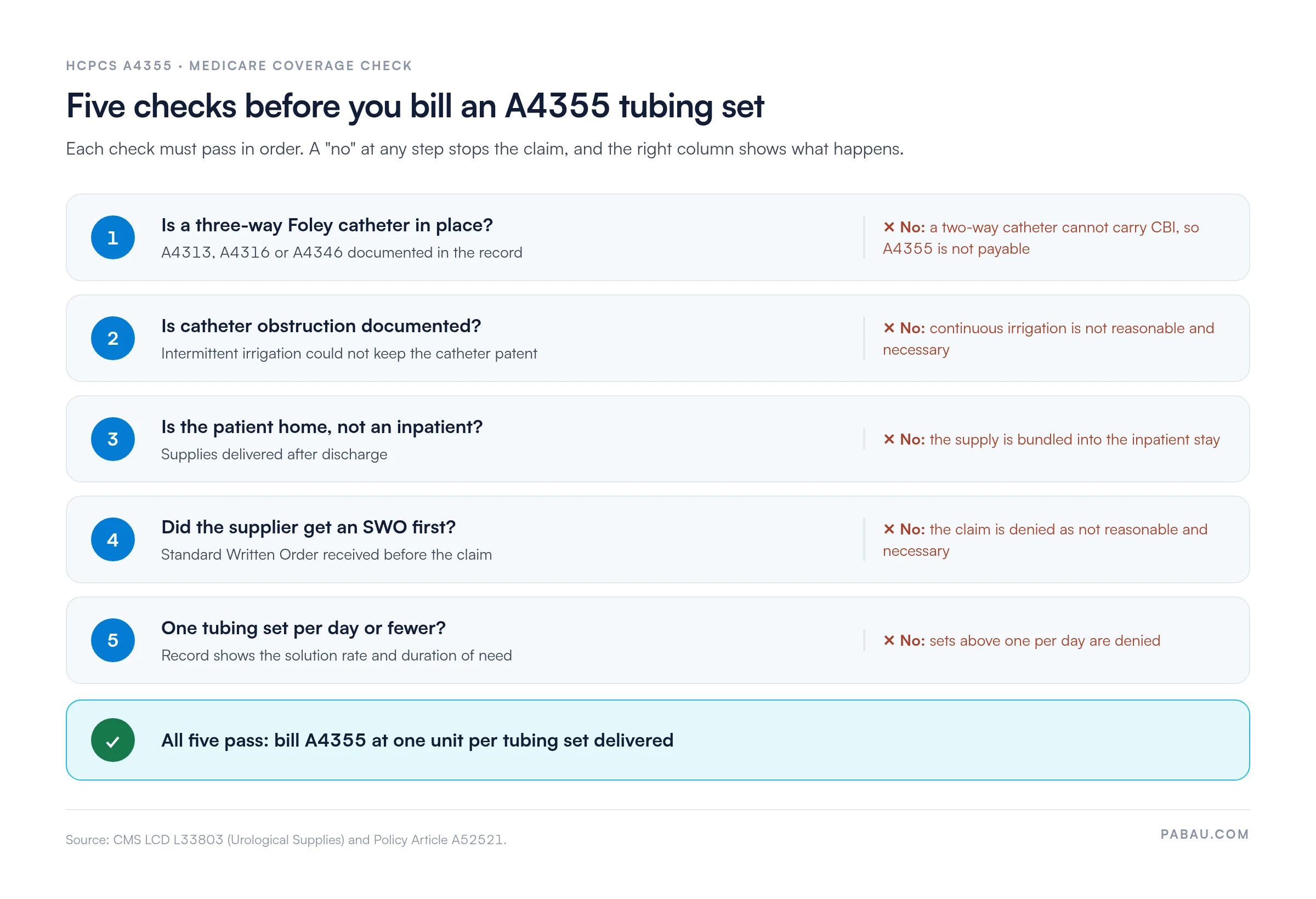
These criteria work as a sequence, and a single “no” ends the claim. The checklist below follows that order.
The DMEPOS supplier bills A4355, not the treating physician’s practice. If your urology practice is not a registered DMEPOS supplier, the claim goes through a contracted DME supplier that bills the patient’s DME MAC.
Missing or incomplete documentation is the leading denial trigger for A4355. Understanding medical billing workflows for DMEPOS supply codes means treating the order and the medical record as the base of every claim.
Every A4355 claim file must contain the following:
Run a pre-billing documentation audit on every A4355 order before submission. Confirm the SWO arrived before the claim, the obstruction history and solution rate are documented, and proof of delivery is on file. That short checklist catches the most common denial triggers before they become audit findings.
A4355 is billed by the DMEPOS supplier, not the treating physician’s office. Submitting a clean claim from the start reduces processing time and denial risk.
The Medicare allowable for A4355 is published in the CMS DMEPOS fee schedule. Rates update each January 1, so pull the current rate directly from CMS before quoting reimbursement.
Key points for 2026 billing:
Do not hard-code a dollar figure for A4355 into billing templates. The rate changes annually, and a claim built on an outdated amount can trigger a repayment obligation during post-payment review.
The urinary supply codes around A4355 often appear together on post-TURP discharge claims, and billing the wrong one is a frequent audit finding. LCD L33803 lists the covered CBI set as a three-way Foley (A4313, A4316 or A4346), the A4355 tubing set, and sterile water or saline (A4217).
Key rule: A4355 and A4338 cannot logically appear together on the same claim for the same beneficiary on the same date. A4338 is a two-way Foley, and A4355 requires a three-way Foley. If your claim has both, the documentation should show two separate clinical scenarios. Otherwise, one of the codes is wrong.
When the three-way catheter is placed from a tray that includes a drainage bag, the tray bills as A4316 alongside A4355. A tray billed as A4314 points to a two-way catheter, which cannot carry irrigation.
Most A4355 denials trace back to a handful of root causes. Structured denial management starts with tracking denial reason codes by category. That lets you spot patterns and fix upstream documentation, not only rework individual claims.
LCD L33803 and Policy Article A52521 apply in all four DME MAC jurisdictions. CGS administers the B and C jurisdictions, while Noridian runs the A and D jurisdictions. Every DME MAC publishes the same LCD and policy article, so the A4355 coverage rules do not change by region.
The claim goes to the DME MAC for the beneficiary’s state. Look up the right contractor on the CMS list of MACs before billing.
Private payers set their own coverage rules. Some mirror LCD L33803, while others apply different quantity limits or require prior authorization. Check the payer contract or the plan’s provider portal before assuming Medicare rules apply.
Build a payer-specific coverage matrix for A4355 across your top five payers. Record quantity limits, modifier requirements and prior authorization triggers in one reference document. Update it each January when fee schedules refresh.
A4355 claims fail on details that are easy to lose between the order, the delivery and the claim. When those details sit in separate spreadsheets and payer portals, a claim can go out before the paperwork is ready.
Pabau, the practice management platform we build, includes claims management software that submits US claims through its Claim.MD integration. Validation checks run in the background before submission, so missing claim details surface before the payer sees them.
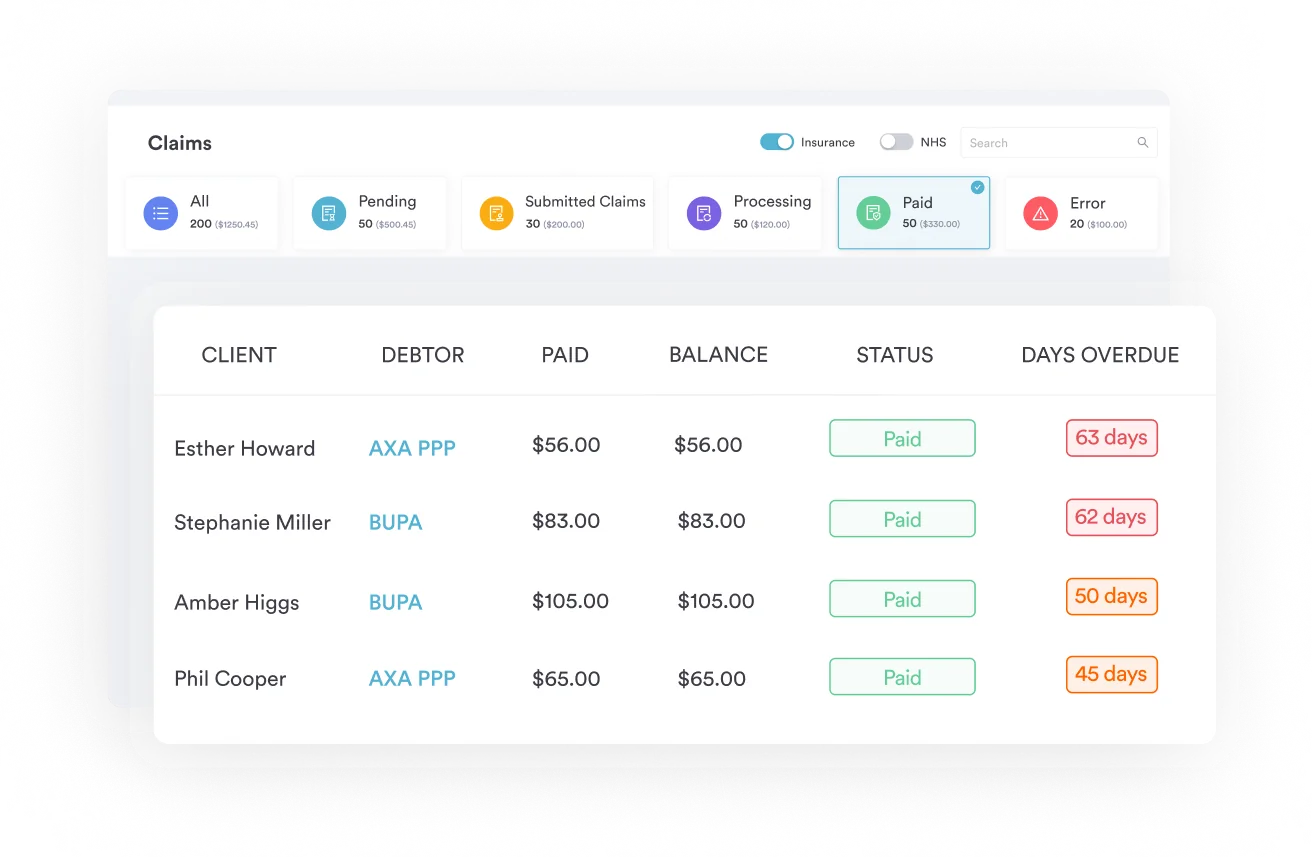
That five-stage claim tracker also gives your billing team one view of every open supply claim. A rejected A4355 claim gets reworked while the SWO and delivery records are still fresh.

Pabau’s claims management software submits US claims through Claim.MD, runs validation checks in the background, and tracks each claim through five stages. Your team spots problems on A4355 and other supply claims before they turn into denials.

A4355 is simple to code and easy to lose on documentation. Before each claim, confirm that a three-way Foley is in place and that the SWO arrived first. Then check that the record shows obstruction intermittent irrigation could not clear.
Build those checks into supplier intake rather than claim review. A missing obstruction note caught at intake costs one call to the practitioner, while the same note caught after a denial costs an appeal.
The trade-off is a slower first claim in exchange for fewer reworked ones. Book a demo to see how Pabau’s claim validation and tracking keep A4355 supply claims moving.

Need to understand how supply claim denials get resolved? Denial management in healthcare covers how to build a structured appeals workflow that reduces write-offs on DMEPOS and other supply codes.
Want a cleaner claims process from intake to payment? Submitting a clean claim explains the documentation and billing elements that prevent payer edits before submission.
Looking for end-to-end billing compliance guidance? Medical billing compliance outlines the regulatory standards urology and DMEPOS billing teams must meet under CMS rules.
Billing the drainage bag that goes home with the catheter? HCPCS code A4358 covers the leg and abdomen urinary drainage bag code.
Supplying a bedside bag for overnight drainage? HCPCS code A4357 covers the bedside drainage bag code and how it differs from leg bags.
HCPCS code A4355 covers an irrigation tubing set used for continuous bladder irrigation through a three-way indwelling foley catheter, billed per set. It is an HCPCS Level II A-series DMEPOS supply code. It covers only the tubing set, not the catheter itself.
Yes, Medicare Part B covers A4355 under LCD L33803 when the patient has a documented history of catheter obstruction that intermittent irrigation cannot clear. A three-way indwelling Foley must be in place, and a Standard Written Order must reach the supplier before the claim. Coverage does not apply during inpatient stays, where supplies are bundled under the DRG.
No diagnosis code qualifies A4355 on its own, because LCD L33803 sets no ICD-10 requirement for it. Coverage rests on a documented history of catheter obstruction. Conditions that commonly lead to CBI include N40.1 (BPH with lower urinary tract symptoms), R31.0 (gross hematuria) and N32.0 (bladder-neck obstruction).
A4355 covers only the irrigation tubing set used with a three-way Foley already in place. A4314 covers an insertion tray with drainage bag and a two-way Foley catheter (A4313 is the three-way tray without bag). A4355 is an ongoing replacement supply, while A4314 is a one-time insertion kit.
One. Under LCD L33803, more than one irrigation tubing set per day for continuous irrigation is denied as not reasonable and necessary.
The top denial reasons are a missing or late Standard Written Order and no documented history of catheter obstruction. Others are more than one tubing set per day, billing during an inpatient stay, and records showing a two-way Foley. A pre-submission checklist addresses all five.
No. A4338 describes a two-way Foley catheter, which cannot support continuous bladder irrigation. That makes A4355 clinically incompatible with A4338 on the same date of service for the same patient. If both appear on a claim, one code is usually wrong, so verify catheter type in the clinical record before submitting.
Check the 2026 Medicare allowable for A4355 directly in the CMS DMEPOS fee schedule, which lists rates by state. Do not rely on historical figures, because the rate updates each January 1.