

CPT Code 30801: Superficial turbinate ablation billing guide
CPT Code 30801: Official descriptor and procedure overview The American Medical ...

Last Updated: Nov 27, 2026
52315 is the CPT code for cystourethroscopy, with removal of foreign body, calculus, or ureteral stent from urethra or bladder (separate procedure); complicated. It covers the scope-guided removal of a stone, a retained object or a ureteral stent when the work goes well beyond a routine removal.
"Complicated" describes the effort, not the number of items removed. A heavily encrusted stent, a stone that needs repeated manipulation, or bleeding that must be controlled can all support 52315. Routine removals go to 52310, and the operative note has to show which one happened.
Let Pabau's smart automation suggest the right codes, reduce claim denials, and keep your practice compliant—effortlessly.
Automate repetitive tasks and focus on what matters most—your patients.
Reduce coding errors and ensure compliance with the latest regulations.
Clean claims, fewer denials, and faster reimbursements.
Powerful insights and reporting to help your practice thrive.
HIPAA compliant SOC 2 certified GDPR-compliant Trusted by 4,000+ clinics worldwide

CPT code 52315 covers cystourethroscopic removal of a foreign body, calculus or ureteral stent from the urethra or bladder when the removal is complicated.
52310 is the simple version of the same service, and the split rests on documented effort, not on how many items come out.
A heavily encrusted stent, repeated manipulation, tract dilation, electrocautery or hemorrhage control are the kinds of extra work that support 52315.
CPT sets no stone-size cutoff, so a large stone or a bladder diverticulum supports 52315 only when the note shows the extra work it caused.
Pair 52315 with a diagnosis that matches what was removed, such as N21.0 for a bladder stone or T19.1XXA for a bladder foreign body.
CPT code 52315 covers a cystoscopic removal of a foreign body, stone or ureteral stent from the urethra or bladder when the removal is complicated.
Urology Times coding guidance defines that split by the effort and work the removal took, whatever the number of items. Its sibling, CPT code 52310, covers the same removal when it is simple.
The full AMA descriptor for 52315 reads: Cystourethroscopy, with removal of foreign body, calculus, or ureteral stent from urethra or bladder (separate procedure); complicated. 52310 carries the same descriptor ending in “simple”, and both sit in the transurethral surgery range for the urethra and bladder.
Each part of the descriptor tells you what the operative note has to show:
Some references call 52315 a “complicated cystolithotomy”, which is the wrong term. Cystolithotomy is an open operation that removes a stone through a bladder incision, and it has its own code, 51050. CPT code 52315 is an endoscopic removal, and it covers stents and foreign bodies as well as stones.
“Complicated” in CPT code 52315 describes the effort the removal took. It is not set by stone size or by the number of items removed. Urology Times notes that removing several stents or foreign bodies does not, on its own, make a procedure complicated.
Work that commonly supports 52315 includes:
The descriptor sets no size cutoff. A large stone, or a stone lodged in a bladder diverticulum, supports 52315 only when the note shows the extra work it caused.
A removal can also stay simple when the scope goes in more than once. Urology Times gives the example of two or three stones removed without difficulty, which supports 52310 rather than 52315.
The two codes share one descriptor, so the operative note decides between them. The comparison below maps the main decision points.
Downcoding usually follows a note that says “complicated” without describing the work. A note that lists several stents but describes no extra effort supports only 52310, however many items came out.
The decision path below adds the neighboring codes. It routes a removal through an open incision or a crushed stone to the right code too.
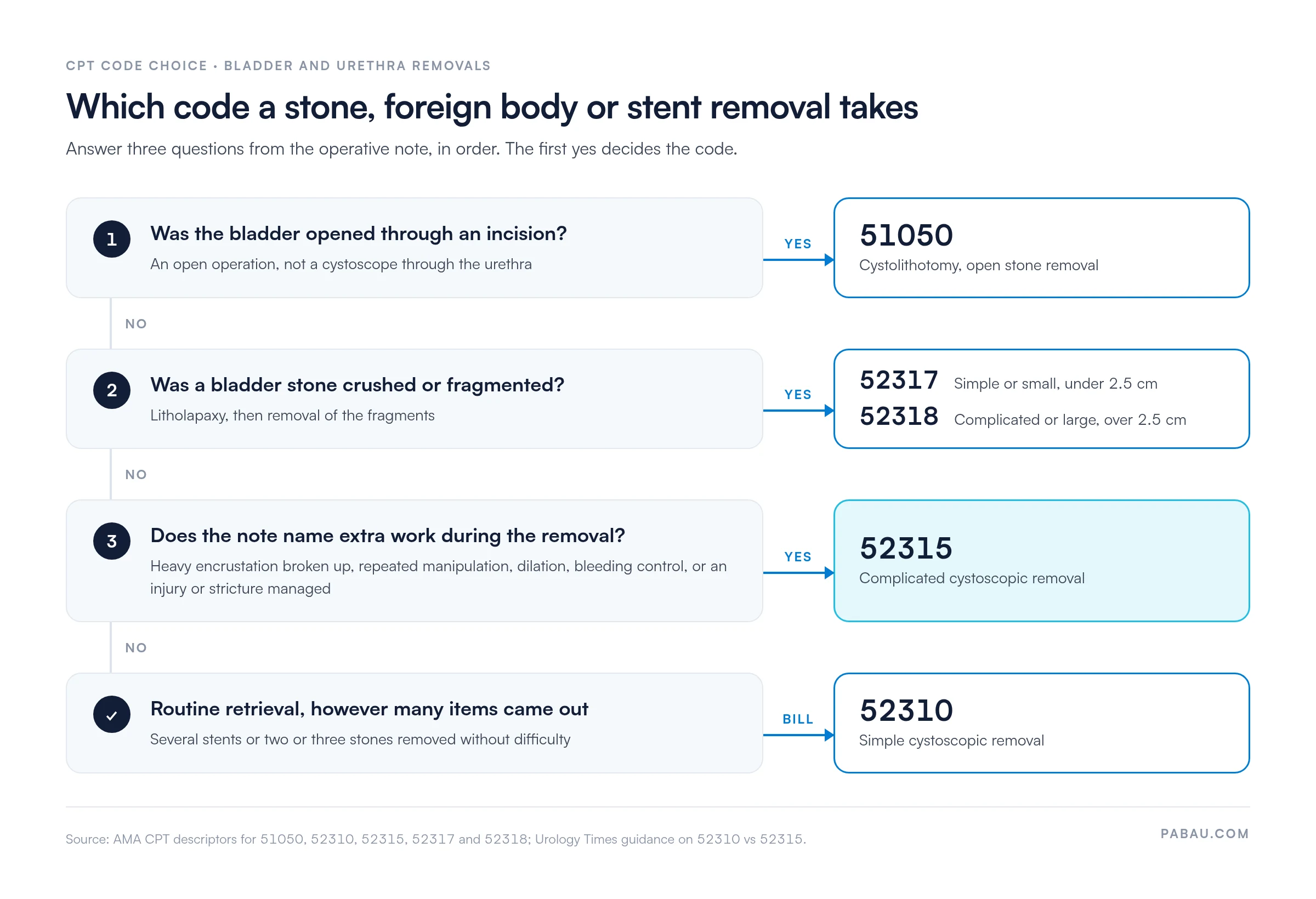
CPT code 52315 sits inside the 52000-series transurethral surgery codes. Knowing its neighbors prevents bundling errors and the wrong code choice. Per AAPC’s CPT code reference, the codes most often confused with 52315 are:
The National Correct Coding Initiative (NCCI) edit tables govern which of these codes can be billed together. Check the current tables before billing any combination, because CMS updates them every quarter.
Before you bill 52315 on the same day as a stent insertion (52332), check the current quarter’s NCCI table. AUA coding guidance reports that a same-day stent removal is bundled into 52332. Keep a dated copy of each quarter’s table so your team codes from the same edition.
Every claim for CPT code 52315 needs an ICD-10-CM code that matches what was removed. A bladder stone code doesn’t support a stent removal, and a ureteral stone code doesn’t support a bladder procedure.
Stent removal diagnosis coding isn’t fully settled. An AAPC reader answer points coders to a T19 code, such as T19.1XXA, for a ureteral stent removal. Another AAPC answer suggests T83.192A as a secondary code for a calcified stent. Some coders use Z46.6 for a planned removal instead. Use the code your record supports, and confirm each one in the current ICD-10-CM tabular list.
The CMS Medicare Physician Fee Schedule (MPFS) sets the national payment for CPT code 52315. Rates change every year and vary by locality through the Geographic Practice Cost Index (GPCI). Always check the current year’s schedule for your locality and setting.
Because payment figures change with each annual MPFS rule, never hardcode them in a billing policy. Use the CMS lookup tool or a current-year RVU calculator to find the rate for your locality and setting.
Prior authorization rules for CPT code 52315 vary by payer and plan type. Traditional Medicare rarely requires prior authorization for this kind of procedure, but Medicare Advantage plans often do. Commercial payers such as UnitedHealthcare, Aetna and Cigna set their own rules, which can change each year.
When authorization is required, payers typically ask for:
A clean authorization request with complete records reduces the chance of a retrospective denial. Record the authorization number in the patient record and quote it on the claim.
The operative report is the billing record for CPT code 52315. If the extra work is not in the note, a payer will treat the removal as simple. These are the elements a reviewer or auditor will check:
A superbill template that prompts the surgeon to record the extra work at the point of service cuts missing-information denials. Pair it with a clean-claim checklist to catch errors before the claim leaves the practice.
Denials for CPT code 52315 cluster around a small set of preventable errors. The table pairs each one with its fix and whether to refile or appeal. The remittance codes behind each denial are explained in our guide to medical billing denial codes.
Modifiers clarify billing circumstances and prevent or resolve NCCI edit denials. The modifiers most often used with CPT code 52315 are:
Track which modifier combinations each payer accepts in your claims management software, so a rejected pair is corrected once rather than claim by claim.
Run a quarterly audit of your 52315 claims against your denial log. Filter for CARC 11 (diagnosis inconsistent with the procedure) and CARC 4 (procedure code inconsistent with the modifier used). Check each one against that quarter’s NCCI edit table, since edits can change mid-year.
Practices billing 52315 juggle operative notes, diagnosis codes, payer rules and authorizations. When those sit in separate systems, a claim can leave the practice without the detail that justifies “complicated”.
Pabau, a practice management and billing platform, keeps the clinical record and the claim in one place. Structured forms can prompt the surgeon to record what was removed and the extra work it took.
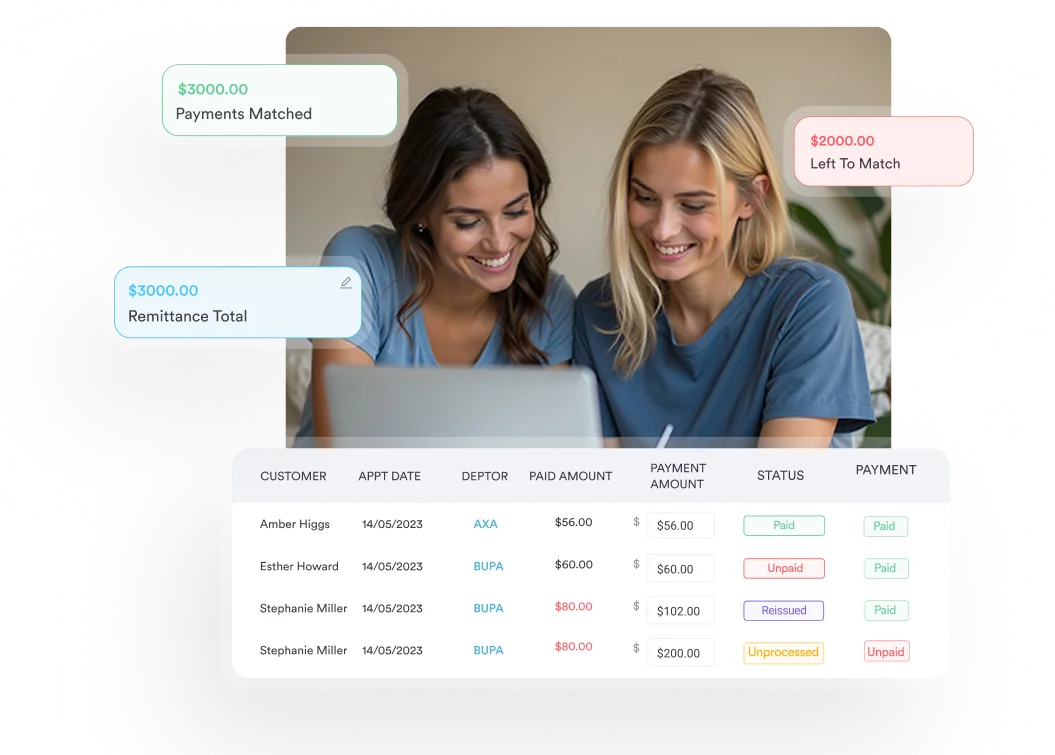
For US practices, Pabau submits claims through Claim.MD and runs eligibility checks before the procedure date. ERA remittances come back into Pabau, so a denied 52315 claim can be corrected and resubmitted from the same record.

Pabau keeps operative notes, diagnosis codes and claims on one record, and sends US claims to payers through Claim.MD.

Whether a 52315 claim holds up comes down to one passage of the operative note. If it names the encrustation broken up, the dilation or the bleeding controlled, the complicated code has its support. If it only says “complicated”, expect the payer to pay at the 52310 level.
If your practice bills cystoscopic removals, keep the operative note, the diagnosis code and the claim on one record. The coder then reads the same detail the surgeon wrote. To see how Pabau handles that workflow, book a demo.

Need to track denial reason codes across your urology claims? Medical billing denial codes breaks down the most common CARC and RARC codes and what each one requires as a corrective action.
Looking to understand how clearinghouses process 52315 claims? Understanding the 837 file format explains how electronic claim data maps from your practice management system to the payer.
Want to act on denials the day they arrive? Electronic remittance advice (ERA) explains how to read 835 remittance files so your team can act on denial codes the same day they arrive.
Was the removal routine after all? CPT code 52310 covers the simple version of the same cystoscopic removal.
CPT code 52315 is used for cystourethroscopy with complicated removal of a foreign body, calculus or ureteral stent from the urethra or bladder. Complicated means the removal took extra documented work, such as breaking up a heavily encrusted stent or controlling bleeding.
Both codes share the same descriptor, but 52310 ends in “simple” and 52315 ends in “complicated”. The difference is the effort documented, not the number of items removed. Several stents removed easily support 52310, while one heavily encrusted stent can support 52315.
No. The CPT descriptor sets no size cutoff. A large stone supports 52315 only when the operative note shows the extra work it caused, such as repeated attempts or significant manipulation.
The operative note should state what was removed and where it was, then name the extra work and why it was needed. Add the instruments and technique, the stone or stent details and the surgeon’s signature. A note that only says “complicated removal” invites downcoding to 52310.
Payment varies by locality, setting and year. Find-A-Code lists a national work RVU of about 5.07 for 52315. Check the current CMS Physician Fee Schedule or FastRVU for the rate that applies to your practice.
Match the code to what was removed: N21.0 or N21.1 for a bladder or urethral stone, and T19.1XXA or T19.0XXA for a foreign body. For an encrusted stent, T83.192A is a common secondary code, and Z46.6 covers a planned stent removal.
Diagnostic cystoscopy (52000) is included in 52315 and isn’t billed separately for the same session. NCCI also bundles 52310 into 52315. AUA coding guidance reports that a same-day stent removal is bundled into stent insertion code 52332. Check the current NCCI table before billing any pair.
CPT 52317 and 52318 cover crushing or fragmenting a bladder stone and removing the fragments. CPT 52315 covers removing a stone, foreign body or stent without that crushing step. Choose the code that matches the technique in the operative note.
No. Cystolithotomy is an open procedure that removes a bladder stone through an incision in the bladder, coded 51050. CPT code 52315 is an endoscopic removal through the urethra with a cystoscope.




