

HCPCS code E0198: Water pressure pad billing guide
HCPCS code E0198 is a water pad for a standard mattress HCPCS code E0198 is the ...

Last Updated: Oct 13, 2026
A4314 is the HCPCS Level II code for a Foley catheter insertion tray with a drainage bag and a two-way, coated latex catheter. The tray, bag and catheter ship together and bill as one line.
Most coding errors come from confusing it with the other complete kits. A4315 holds an all-silicone two-way catheter, and A4316 holds a three-way catheter for continuous irrigation. Medicare covers A4314 under LCD L33803 when the patient's urinary retention or incontinence is permanent.
Let Pabau's smart automation suggest the right codes, reduce claim denials, and keep your practice compliant—effortlessly.
Automate repetitive tasks and focus on what matters most—your patients.
Reduce coding errors and ensure compliance with the latest regulations.
Clean claims, fewer denials, and faster reimbursements.
Powerful insights and reporting to help your practice thrive.
HIPAA compliant SOC 2 certified GDPR-compliant Trusted by 4,000+ clinics worldwide

HCPCS code A4314 is the complete latex Foley kit: an insertion tray, a drainage bag and a two-way coated latex catheter.
The catheter decides the code, so an all-silicone kit is A4315 and a three-way irrigation kit is A4316.
Medicare covers A4314 under LCD L33803 when urinary retention or incontinence is permanent, meaning long and indefinite in duration.
One tray is covered per catheter insertion, and the usual maximum is one A4314 per month.
KX is appended when the LCD coverage criteria are met and documented, while GA, GY or GZ apply when they are not.
HCPCS code A4314 is the Level II code for a Foley catheter insertion tray that ships with a drainage bag and an indwelling catheter. The catheter is two-way latex with a coating of Teflon, silicone, silicone elastomer or a hydrophilic finish.
All three parts ship together and bill as one line. The code sits in the A range of the HCPCS Level II codes, alongside the other urological supplies that DME suppliers bill to Medicare.
CMS maintains the HCPCS code set and its descriptors. The table below sums up the attributes that matter when you code and bill A4314.
Seven tray codes look almost the same on a packing slip. Two questions separate them: is a drainage bag in the kit, and which catheter came with it?
A4314, A4315 and A4316 all hold a tray, a bag and an indwelling Foley. Only the catheter differs. A4314 carries the two-way coated latex catheter, A4315 the two-way all-silicone one, and A4316 the three-way catheter for continuous irrigation.
Take the bag away and you move to the tray codes without one. A4311 holds a coated latex Foley, A4312 an all-silicone one, and A4313 a three-way one. A kit with no catheter at all is A4310 without a bag, or A4354 with one.
The grid below maps every combination, so you can match the shipped kit at a glance.
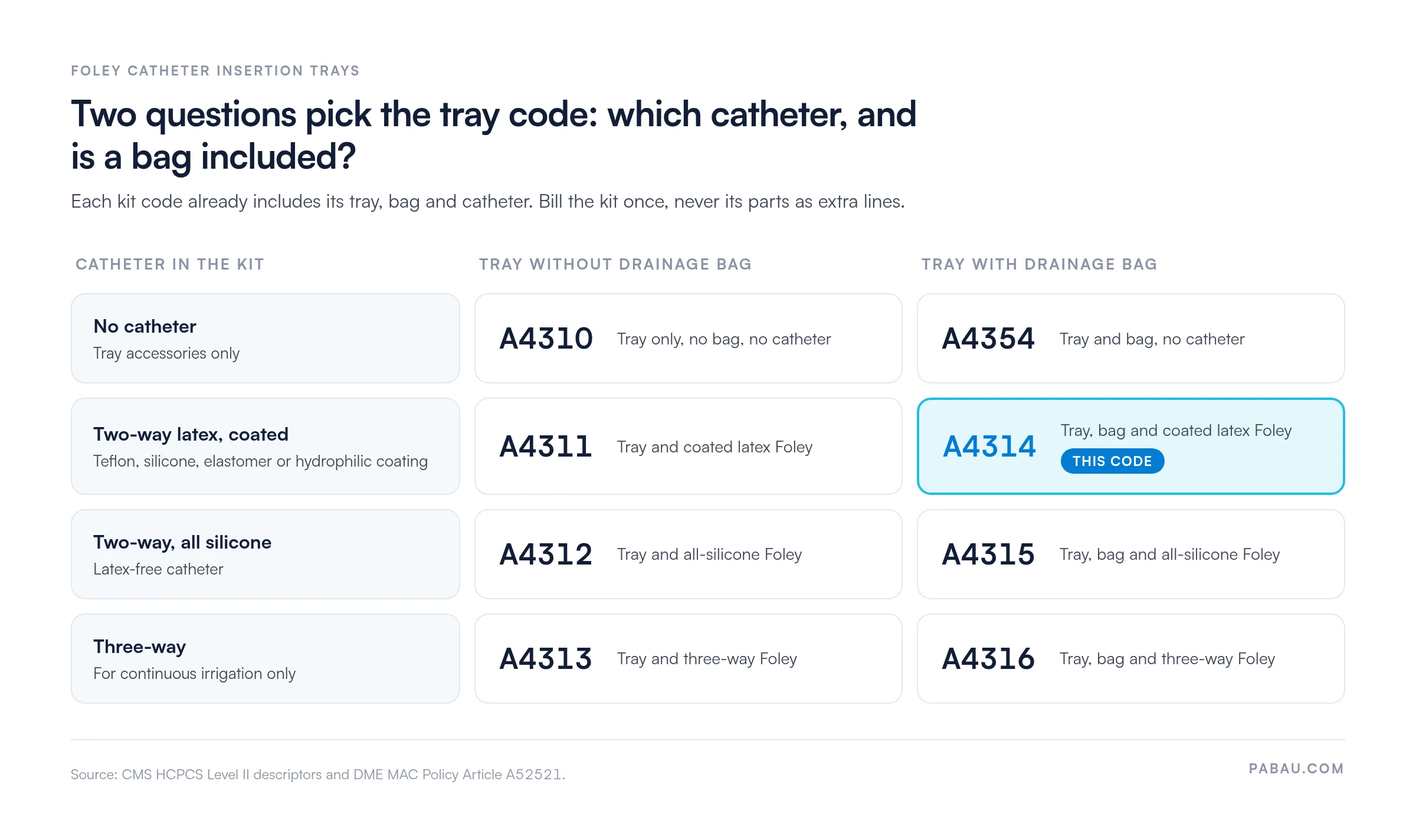
The three complete kits differ only in the catheter, and each one has its own coverage condition.
The practical rule is simple. Read the catheter on the packing slip before you pick the code. A silicone or three-way kit coded as A4314 misstates what shipped, and an audit will spot it.
A4314 never fits a latex-sensitive patient, because its catheter is latex under the coating. Bill the complete tray, bag and all-silicone Foley kit as A4315. Use A4344 only when the all-silicone catheter ships on its own. Record the latex sensitivity in the medical record to support the choice.
Medicare Part B covers A4314 under the prosthetic device benefit, following LCD L33803 (Urological Supplies). The patient needs permanent urinary retention or permanent urinary incontinence.
Permanent doesn’t mean the condition can never improve. The test is met when the medical record, including the treating practitioner’s judgment, shows it is long and indefinite in duration.
Before you code, confirm three coverage points:
When the condition is temporary, the supplies can’t be billed to the DME MAC. They count as incident to the practitioner’s service, and the practitioner’s payment covers them.
Quantity rules come next. Medicare covers one insertion tray per catheter insertion, and the usual maximum for A4314 is one per month. A second change in the same month needs a documented reason, such as:
A Medicare-enrolled DMEPOS supplier bills A4314 to the DME MAC for its region. Noridian handles Jurisdictions A and D, and CGS handles Jurisdictions B and C.
Setting matters as much as enrollment. During an inpatient stay or a covered Part A facility stay, the kit is bundled into the facility payment. A DME supplier can’t bill it separately to Part B.
Three conditions apply before a supplier submits a claim:
Most A4314 claims follow the same path. Here is the walkthrough, one step at a time.
Refills run on their own clock. The supplier contacts the patient no sooner than 14 days before the current supply runs out. The refill then ships no sooner than 10 days before that date.
Picture a patient with neurogenic bladder after a spinal cord injury. The urologist documents permanent retention and orders a coated latex Foley.
On day 1, the supplier ships one A4314 kit and a spare bedside bag, A4357. Medicare counts that as two drainage bags, which is the usual monthly maximum.
On day 18, the patient pulls the catheter out. The supplier ships a second A4314, and the record notes the accidental removal.
That second kit goes past the usual maximum, so the documentation has to explain it. Without that note, the extra line is denied as not reasonable and necessary.
LCD L33803 and Policy Article A52521 set out what a supplier keeps on file. A complete file is your best protection during post-payment review.
Your DME MAC can ask for more during an audit, so check its current guidance before you submit. Filing records by claim, rather than by patient date, makes those requests faster to answer.
A couple of minutes with this list catches most A4314 problems before the MAC does.
Medicare prices A4314 from the DMEPOS fee schedule. CMS publishes it each January and updates it quarterly, and the amounts differ by state.
Check the current amount for your state on the CMS DMEPOS fee schedule before you quote a patient or post a payment. Medicare pays 80% of the allowed amount after the Part B deductible. The patient, or a Medigap plan, covers the other 20%.
Load the January DMEPOS fee schedule for your state into your billing system before you submit January claims, then repeat the check each quarter. Otherwise your expected payments won’t match the remittances, and someone has to reconcile the difference by hand.
A4314 denials cluster around six causes, and each one is preventable at order intake. Good denial management starts there, long before a remittance advice arrives.
Fix all six and you’re most of the way to a clean claim on the first pass.
First, prior authorization. A4314 isn’t on the CMS required prior authorization list for DMEPOS. Medicare Advantage plans can set their own rules, so check the plan before you ship.
The modifier is where most A4314 lines go wrong. Here are the four questions billers ask most.
KX is appended when the LCD coverage criteria are met and documented. That includes the permanence test and any extra need for a special catheter.
Use one of them when you expect a medical necessity denial. GA means a valid Advance Beneficiary Notice (ABN) is on file. GZ means it isn’t.
GY tells Medicare the item fails the benefit itself, for example when the condition isn’t permanent.
If you expect a denial and ship without a valid ABN, the supplier carries the cost, not the patient. Issue the ABN before delivery, while the patient can still decide.
Policy Article A52521 doesn’t publish a diagnosis list for A4314. Its only ICD-10-CM list covers A4336, a urethral insert. Coverage for A4314 rests on documented permanence instead.
Even so, the claim needs a specific diagnosis that explains the retention or incontinence. These codes often appear on indwelling catheter claims.
Specificity still matters. Coding R33.9 when the notes name a cause weakens the file on review, so use the most specific code the record supports.
A4314 sits in a family of A codes. When the shipped supplies differ from the full kit, one of these usually fits.
If your practice is enrolled as a DMEPOS supplier, A4314 paperwork tends to scatter. The SWO sits in email, the delivery slip in a folder, and claim status in a separate portal.
Pabau, the all-in-one practice management system we build, keeps orders, treatment notes and invoices on the patient record. Its simpler claims management tools pre-fill the claim from that record and check required fields before you send it. In the US, claims go through Claim.MD, so you can track claim status and remittances in one place.
The coding call stays with your team. Pabau holds the documentation and claim status side by side, so a MAC request is quicker to answer.

Pabau’s claims management tools keep orders, delivery notes and claim status on the patient record. See how it fits your urological supply billing.

A4314 rewards suppliers who code from the packing slip, not from habit. Check the catheter, confirm a bag shipped, and bill the kit as one line.
The bigger risk sits in the file. Get permanence documented and the SWO in hand before you submit, and most denials never happen. Your team then spends less time on appeals and more time on patients.
Want to see how Pabau keeps orders, notes and claim status together for your supply billing? Book a demo.

Billing the silicone catheter on its own? A4344 covers the two-way all-silicone Foley when it ships without a tray or bag.
Shipping a spare bedside bag this month? A4357 explains the replacement drainage bag code and how it counts toward the monthly maximum.
Want a framework for fewer supply denials? Denial management in healthcare covers the root-cause approach billing teams use to lift first-pass rates.
Preparing your files for a MAC audit? Medical billing compliance outlines the documentation habits that protect suppliers during review.
New to the full billing lifecycle? What is medical billing walks through how payer rules, claim submission and remittances fit together.
No. The coating covers the latex but doesn’t remove it, so A4314 doesn’t suit a latex-sensitive patient. Bill the all-silicone kit, A4315, and document the sensitivity.
No. Urological supplies are billable to the DME MAC only when retention or incontinence is permanent. Short-term supplies count as incident to the practitioner’s service, and that payment covers them.
The Pricing, Data Analysis and Coding (PDAC) contractor. Policy Article A52521 tells suppliers to contact the PDAC when they’re unsure which code a product takes.
Contact the patient no sooner than 14 days before the current supply runs out. Then ship the refill no sooner than 10 days before that date.
Keep proof of delivery for seven years from the date of service. Auditors can request it at any point in that window.
Yes, when both are needed. Medicare counts the A4314 bag and the A4357 bag together, and two bags is the usual monthly maximum.
Not under traditional Medicare, because A4314 isn’t on the CMS required prior authorization list for DMEPOS. Medicare Advantage plans set their own rules, so check the plan first.



