CPT Code 62284: Injection procedure for myelography
CPT Code 62284: official descriptor and procedure overview The American Medical ...

Last Updated: Oct 19, 2026
A4316 is the HCPCS Level II code for an insertion tray with drainage bag with indwelling catheter, Foley type, three-way, for continuous irrigation. One unit covers the full kit: the three-way catheter, the insertion tray, and the drainage bag.
Coders often confuse A4316 with A4338 and A4344, which are two-way Foley catheters billed per catheter with no tray. Those two differ by material, coated latex versus all silicone or polyurethane. A4316 applies only when the physician orders continuous bladder irrigation.
Let Pabau's smart automation suggest the right codes, reduce claim denials, and keep your practice compliant—effortlessly.
Automate repetitive tasks and focus on what matters most—your patients.
Reduce coding errors and ensure compliance with the latest regulations.
Clean claims, fewer denials, and faster reimbursements.
Powerful insights and reporting to help your practice thrive.
HIPAA compliant SOC 2 certified GDPR-compliant Trusted by 4,000+ clinics worldwide

HCPCS Code A4316 describes a three-way Foley insertion tray kit for continuous bladder irrigation, not a standalone catheter or a two-way indwelling device.
Modifier KX belongs on every Medicare claim for A4316 once medical necessity documentation is on file. Leaving it off is the leading cause of payment denial.
A4338 and A4344 are two-way Foley catheters billed per catheter with no tray. They differ by material, coated latex versus all silicone or polyurethane.
DME MACs process A4316 claims, not the Part B carrier, and the beneficiary’s state of residence decides which DME MAC receives the claim.
HCPCS Code A4316 is a Level II supply code for an insertion tray with drainage bag with indwelling catheter, Foley type, three-way, for continuous irrigation.
The Centers for Medicare and Medicaid Services (CMS) maintains it. It sits in the A4310-A4360 incontinence supply range, and claims go to a Durable Medical Equipment Medicare Administrative Contractor (DME MAC).
The defining clinical feature is the three-way lumen configuration. A standard Foley catheter has two lumens: one for urine drainage and one for balloon inflation. A three-way catheter adds a third lumen specifically for instilling irrigant fluid into the bladder while urine drains simultaneously. This design is used in continuous bladder irrigation (CBI), most commonly after transurethral prostate procedures or bladder tumor resections. It is also used for gross hematuria that needs ongoing washout to prevent clot retention.
The code bundles three components into a single kit: the insertion tray, the drainage bag, and the three-way catheter itself. The tray holds lubricant, antiseptic swabs, a sterile drape, gloves, and a syringe for balloon inflation. Billing the components separately when the kit is supplied counts as duplicate billing, and the extra lines are denied.
The kit covers the catheter, the tray, and the bag. Irrigation fluid and any extra collection device sit outside it and are billed on their own lines.
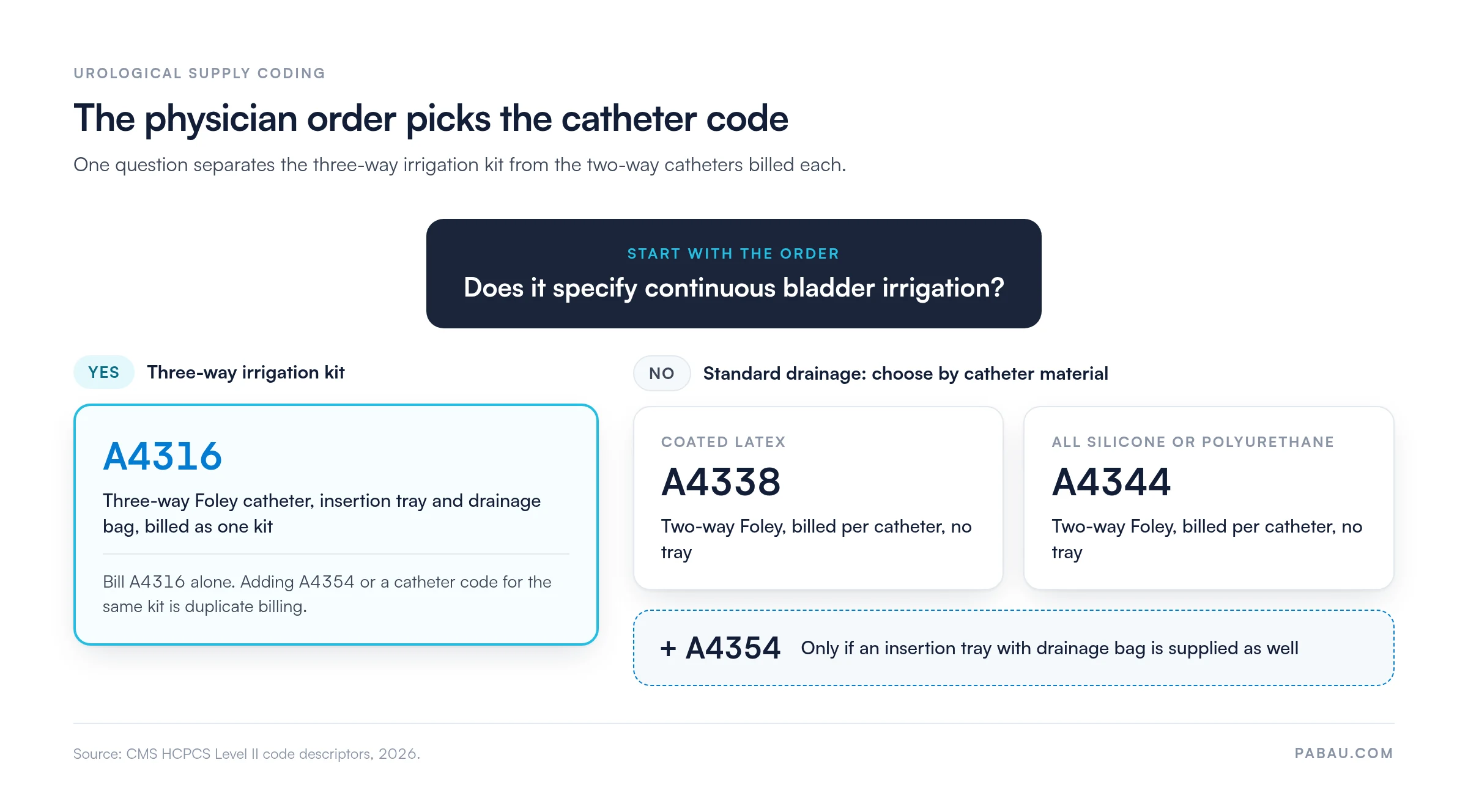
A4316 applies only when continuous irrigation is the documented clinical indication. Supplying a three-way catheter for standard urinary drainage without a specific irrigation order does not qualify. Payers check the physician order for explicit mention of continuous irrigation. If it is absent, the claim is denied, whichever catheter was dispensed.
A4316 is the only one of these codes that bundles a catheter, an insertion tray, and a drainage bag into one kit. A4338 and A4344 are both two-way Foley catheters billed per catheter, and neither includes a tray or kit. They differ by material: A4338 is latex with a coating, while A4344 is all silicone or polyurethane.
The physician order decides the code, as the decision path below shows. If it specifies continuous bladder irrigation, use A4316. For standard indwelling drainage, choose A4338 or A4344 by the catheter’s material. If an insertion tray with drainage bag is supplied as well, bill it separately under A4354.
If the tray and bag come packaged with a two-way coated latex Foley, the kit code is A4314 rather than A4316.
One audit finding comes up often. A supplier bills A4316 month after month, but the physician renewed a standard indwelling catheter order without specifying irrigation. The three-way catheter may have been dispensed, yet A4316 cannot be billed without the irrigation order.
The prescriber needs to confirm the device the patient needs, usually a two-way catheter billed as A4338 or A4344 by material. Checking the order language at every renewal stops this pattern before it grows into a retrospective overpayment demand. The AAPC HCPCS code range reference lists full descriptors for the adjacent urological codes.
Medicare coverage for A4316 is governed by Local Coverage Determination L33803 (Urological Supplies), maintained by the DME MACs. Coverage is not automatic simply because a physician ordered an indwelling catheter. The beneficiary and the clinical scenario must each meet specific criteria, so check eligibility before you supply the kit.
For a three-way catheter used for continuous irrigation, the claim needs all of the following:
Claims go to the DME MAC for the beneficiary’s state of residence, not the Part B carrier. Noridian Healthcare Solutions handles Jurisdictions A and D, while CGS Administrators handles Jurisdictions B and C for the remaining states. Filing A4316 to the Part B carrier rather than the correct DME MAC results in an immediate jurisdictional denial. Build the routing check into claim creation, so a wrong contractor is caught before the claim is sent.
Run a payer routing audit quarterly: pull every A4316 and adjacent catheter code claim and verify each one reached the correct DME MAC jurisdiction. Jurisdictional misrouting is invisible at the point of submission and only surfaces as a denial weeks later. By then, part of the 12-month timely filing limit has already been used.
Modifier selection is the most common controllable failure point in A4316 billing. The table below covers the modifiers that come up on A4316 claims, with the scenario that triggers each one.
KX is the linchpin modifier. Every Medicare A4316 claim where documentation is on file must carry KX. The DME MAC interprets its absence as a supplier attestation that documentation is incomplete, and pays nothing. Suppliers who train billing staff to append KX only when prompted, rather than as a default workflow step, generate the most preventable denials.
Incomplete records are what most often trigger an A4316 audit. CMS and the DME MACs require a complete, traceable record linking the supply to a specific patient need. Capturing each element below at the point of care makes the record faster to assemble after supply, and more accurate.
A missing element puts more than the current claim at risk. It creates audit liability for the full period the patient has been receiving supplies. Suppliers audited by a Recovery Audit Contractor (RAC) face extrapolated overpayment calculations based on a statistical sample.
A4316 is billed to the DME MAC on the CMS-1500 claim form (or 837P electronic equivalent) by DMEPOS suppliers. Facilities that supply catheter kits to inpatients use the UB-04/837I with revenue code 270 (medical/surgical supplies). The steps below apply to the supplier billing scenario.
For reimbursement amounts, consult the current CMS DMEPOS fee schedule. Rates change every year and vary by state, so a fixed dollar figure here would mislead. Update the fee schedule in your billing system each January so claims never go out at stale rates.
Seven denial patterns come up again and again on A4316 claims. Each one is preventable with the right workflow controls, and fixing the root cause saves more time than appealing claims one by one.
Our guide to medical billing denial codes covers the codes that most often accompany these patterns. CARC 4 (modifier missing or inconsistent), CARC 18 (duplicate claim), and CARC 96 (non-covered charge) each map to a root cause in the table above. Each one needs a different appeal strategy.
Urological supplies, including catheter insertion kits, are generally not on CMS’s current Medicare Part B list of items that need prior authorization. However, CMS updates the prior authorization required list periodically, and commercial payers may impose prior authorization requirements that differ from Medicare. Always check the specific payer’s current policy before supply.
The DMEPOS Competitive Bidding Program (CBP) is a separate question. Under CBP, CMS sets bid-based prices for certain DMEPOS product categories in defined competitive bidding areas. Urological supplies, catheters included, have never been a CBP product category in any past round. CMS has proposed adding them to the next round, with contracts expected no earlier than January 1, 2028. If that goes ahead, only contracted suppliers will be able to bill Medicare for A4316 in a competitive bidding area.
Plan for the next CBP round now. If urological supplies are added, check each new referral’s ZIP code against the CMS competitive bidding area list before you confirm supply of A4316. A non-contract supplier in a bidding area would get no Medicare payment for the kit.
An A4316 claim depends on four checks: an irrigation order, the KX modifier, the right DME MAC, and a quantity that matches the order. When those checks live in separate spreadsheets and inboxes, one missed step turns into a denial weeks later.
Practice management software like Pabau keeps patient records and billing in one place. Its claims software for practices pre-fills the claim form from the patient record, with a searchable HCPCS and CPT code library. It also checks that required claim fields are complete before you send the claim.
In the US, claims go through Claim.MD, with eligibility checks, claim status tracking, and remittance posting. Your team spends less time reworking catheter claims and more time supplying patients.

Pabau pre-fills claims from the patient record, checks required fields before submission, and tracks each A4316 claim through to payment.

Read the irrigation order before you touch the code. If it names continuous bladder irrigation, bill the three-way kit as A4316 and add nothing else for it. If it doesn’t, the patient needs a two-way catheter coded by material, however the kit was packed.
The trade-off is a few minutes at intake. Check the order, the obstruction history, and the DME MAC before the kit ships. That costs far less than an overpayment demand extrapolated across years of supplies.
Want those checks to happen before each claim leaves? Book a demo to see how Pabau keeps DME claims and patient records together.

Need a structured approach to healthcare claim denials? Denial codes in medical billing breaks down the most common CARC and RARC codes and how to respond to each one.
Unfamiliar with clearinghouse submission for DME claims? Medical claims clearinghouse explains how 837P electronic claims reach the DME MAC and what happens when they are rejected at the clearinghouse level.
Want to reduce revenue leakage from incomplete documentation? Submitting a clean claim covers the checklist elements that DME MAC claim scrubbers validate before a claim is adjudicated.
HCPCS Code A4316 is used to bill for an insertion tray with drainage bag with indwelling catheter, Foley type, three-way, for continuous bladder irrigation. It applies when a physician orders continuous irrigation (typically after urological surgery or for gross hematuria) and the complete kit is supplied to the beneficiary. It does not apply to standard two-way indwelling catheters or intermittent catheterization supplies.
Bill A4316 to the DME MAC for the beneficiary’s state of residence, on the CMS-1500 claim form or 837P electronic transaction. Append modifier KX when medical necessity documentation is on file. Set the unit of service to one kit per catheter change event, matching the quantity to the physician’s documented change frequency. Do not file to the Part B carrier.
Modifier KX (requirements on file) is the most critical and must appear on every Medicare claim where documentation is complete. Modifier EY (no physician order) is appended when the supply was furnished without a valid order, which results in non-coverage. Modifier KE does not apply, because urological supplies have never been part of a DMEPOS competitive bidding round. Modifier GY is used when the item is statutorily non-covered and a denial is needed for secondary payer billing.
A4316 is a complete kit for continuous bladder irrigation: a three-way Foley catheter, an insertion tray, and a drainage bag. A4338 and A4344 are two-way Foley catheters billed per catheter, and neither includes a tray or kit. A4338 is latex with a coating, while A4344 is all silicone or polyurethane. A tray and bag supplied with either one are billed separately under A4354.
Medicare does not currently list urological catheter insertion tray supplies in its prior authorization required category for Part B DME. However, CMS updates its prior authorization policies periodically, so verify current guidance directly with the DME MAC before each supply cycle. Commercial payers often do require prior authorization for indwelling catheters, and requirements vary by plan and contract year.
Medicare allows one A4316 kit per catheter change event, with the number of changes per month determined by the physician’s documented clinical order. LCD L33803 and DME MAC guidance set out standard change frequencies. Billing more kits than the order documents leads to a quantity-exceeded denial. Always match the billed quantity to the change frequency specified in the current physician order.