

HCPCS Code L0472: Hyperextension TLSO billing guide
HCPCS code L0472: Official descriptor and device definition HCPCS code L0472 des...

Last Updated: Nov 5, 2026
A rapid HIV-1/2 antibody test that reads simply reactive or nonreactive is billed with CPT code 86703. The code covers one assay that detects antibodies to both HIV-1 and HIV-2 and returns one combined result. Its official descriptor is “Antibody; HIV-1 and HIV-2, single result.”
The result format decides the code, not the number of viruses tested. A differentiation assay that reports each virus separately is billed 86701 + 86702. A kit that also detects p24 antigen is 87389. Below, we cover how to tell the tests apart, which diagnoses fit, and how Medicare bills screening.
Let Pabau's smart automation suggest the right codes, reduce claim denials, and keep your practice compliant—effortlessly.
Automate repetitive tasks and focus on what matters most—your patients.
Reduce coding errors and ensure compliance with the latest regulations.
Clean claims, fewer denials, and faster reimbursements.
Powerful insights and reporting to help your practice thrive.
HIPAA compliant SOC 2 certified GDPR-compliant Trusted by 4,000+ clinics worldwide

CPT code 86703 reports one assay that detects HIV-1 and HIV-2 antibodies and returns a single, undifferentiated result.
A differentiation assay that reports HIV-1 and HIV-2 separately, such as Geenius, is billed 86701 + 86702, not 86703.
A kit that also detects p24 antigen is 87389, even though it detects antibodies too.
Medicare pays 86703 under the Clinical Laboratory Fee Schedule for diagnostic testing. Routine screening under NCD 210.7 is billed with HCPCS G-codes instead.
Read the result lines on the lab report before you code, because the report decides between 86703 and 86701 + 86702.
CPT code 86703 carries the official AMA descriptor: Antibody; HIV-1 and HIV-2, single result. It sits in the Immunology subsection (86000-86849) of the Pathology and Laboratory chapter. The code reports a qualitative immunoassay that detects antibodies to both HIV-1 and HIV-2. It returns one combined result from one specimen.
The “single result” wording decides the code. The assay answers one question: are HIV antibodies present? It doesn’t say whether those antibodies belong to HIV-1 or HIV-2. A combined antibody screen or a rapid HIV-1/2 antibody test that reads reactive or nonreactive fits this description.
An assay that reports HIV-1 and HIV-2 as separate results is a different test. Differentiation assays such as the Bio-Rad Geenius HIV-1/2 Supplemental Assay work this way. They’re billed 86701 for the HIV-1 result and 86702 for the HIV-2 result.
So what sits just outside the code? The table sets what 86703 covers against the neighboring HIV tests that take a different code.
The line between 87389 and 86703 trips up plenty of coders. CPT 87389 covers the fourth-generation screen that detects HIV-1 p24 antigen alongside HIV-1 and HIV-2 antibodies. CPT 86703 covers an antibody-only assay with one combined result. If the kit detects p24 antigen, it’s 87389, even though it also detects antibodies.
CPT code 86703 isn’t one of the three steps in the CDC-recommended laboratory HIV testing algorithm. Instead, the code changes at each step of that sequence:
86703 fits antibody-only tests that return one combined answer, such as a point-of-care rapid HIV-1/2 test. A reactive result from one of those tests is preliminary. The patient then moves into the laboratory algorithm for supplemental testing.
Labs often reflex supplemental tests automatically. That makes the paperwork matter: a standing order protocol or a real-time order from the treating provider must be on file. Payers deny a reflexed test when no order connects it to the screen that triggered it.
The three HIV antibody codes look alike, but the choice turns on one question. How many results does the assay report? One combined result is 86703. Separate HIV-1 and HIV-2 results are 86701 and 86702.
Read the result format on the lab report before you code. A reactive/nonreactive line for “HIV-1/2 antibodies” supports 86703. Separate interpretations for HIV-1 and HIV-2, as a Geenius report gives, support 86701 + 86702. Laboratories that run differentiation panels bill them with 86701 and 86702.
Here’s a quick example. A sexual health practice runs a rapid HIV-1/2 antibody test for a commercially insured patient, and it reads nonreactive. That’s 86703, one unit, with Z11.4. The same screen for a Medicare patient goes on G0435 instead.
The decision tree below runs the whole check in the order a coder meets it.
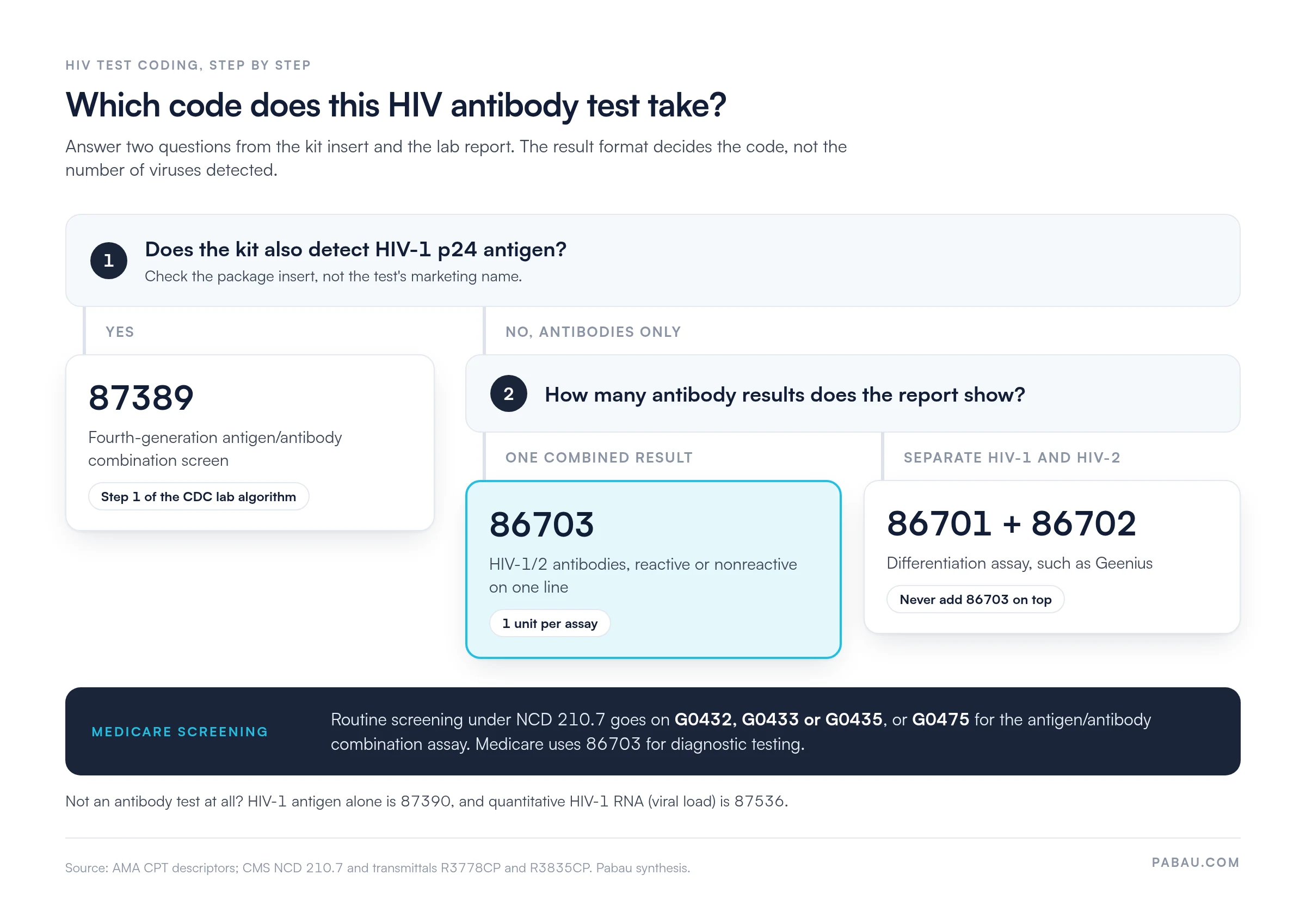
Every CPT code 86703 claim needs a paired ICD-10-CM diagnosis code that establishes medical necessity. Missing or unsupported diagnosis codes are a leading reason these claims come back.
With commercial payers, Z11.4 usually supports a routine screen on 86703 by itself. When testing follows a specific exposure, Z20.6 documents why the test was ordered. Confirm with each payer whether Z11.4 alone satisfies medical necessity.
Antibody testing for a patient coded Z21 or B20 needs a clear reason in the chart. Their HIV status is already known, so a payer will ask why the test was repeated.
For those patients, ongoing monitoring usually runs on viral load testing, billed as 87536. If the order says antibody test, the note should say what question it answers.
Medicare reimburses CPT code 86703 under the Clinical Laboratory Fee Schedule (CLFS), not the Physician Fee Schedule. CMS publishes the CLFS data files each quarter. Rates change, so check the current file before you quote a figure to a provider or patient.
These are the Medicare rules that shape an 86703 claim:
Before you send a Medicare HIV claim, decide whether the test was screening or diagnostic. Screening goes on the G-code, while diagnostic testing goes on 86703 at the current CLFS rate.
Think of the claim as five handoffs. A slip at any one of them shows up later as a denial.
Place of service is where many hospital labs slip. Independent labs use POS 81. Hospital-based labs typically use POS 22 (on-campus outpatient hospital) or POS 19 (off-campus outpatient department).
A two-minute check before the claim leaves catches most of the denials covered further down. Tick off each line:
Check the CMS NCCI procedure-to-procedure (PTP) edit tables for the quarter that matches the date of service. The tables list which code pairs are edited and whether a modifier can bypass the edit.
Billing 86701 and 86702 together is the expected coding for a differentiation assay that reports HIV-1 and HIV-2 separately. The error to avoid is adding 86703 for that same assay. Doing so reports one test under two sets of codes, and the claim no longer matches the lab report.
Modifier 59 (Distinct Procedural Service) applies only when a PTP edit exists for the pair and the services were separate. Typical examples are different specimens, different encounters or different dates of service. The medical record must document what made the procedures distinct.
Routine use of modifier 59 to unbundle codes is a compliance risk. The AMA’s CPT guidelines and the CMS NCCI Policy Manual both caution against using modifiers to get around edits without documented clinical justification.
Most CPT code 86703 denials fall into one of six patterns. Each one has a fix you can build into the workflow.
Repeated denials on the same code usually point to an intake or order workflow problem, not a one-off coding slip. Tracking denial reasons by code through structured denial management shows those patterns before they turn into write-offs.
A CPT code 86703 claim needs supporting records at two levels: the ordering provider’s record and the performing laboratory’s record.
The methodology note is what defends the code choice in an audit. If the report shows separate HIV-1 and HIV-2 interpretations, the payer will expect 86701 + 86702. Map each assay to its code in your lab order templates, so the choice is made once rather than claim by claim.
The same mapping logic applies across the lab menu. Our index of CPT codes covers the neighboring immunology and molecular codes when you build those templates.
HIV lab claims tend to fail on details set at intake. The usual culprits are a code mapped to the wrong assay, a missing ordering NPI, or a plan that excludes screening. Without a clearinghouse check, those errors surface weeks later on the remittance.
In Pabau, the practice management platform we build, the claim form fills from the patient record. The CPT code attached to the service lands on the charge line. Pabau’s claims management software then checks that required fields are complete before the claim can be sent.
For US practices, Pabau connects to the Claim.MD clearinghouse. Your team checks eligibility in real time before the test runs, submits 837P claims, and posts ERA/835 remittances against each claim. If 86703 keeps coming back from one payer, claim tracking shows the pattern, so you can fix the assay mapping at its source.
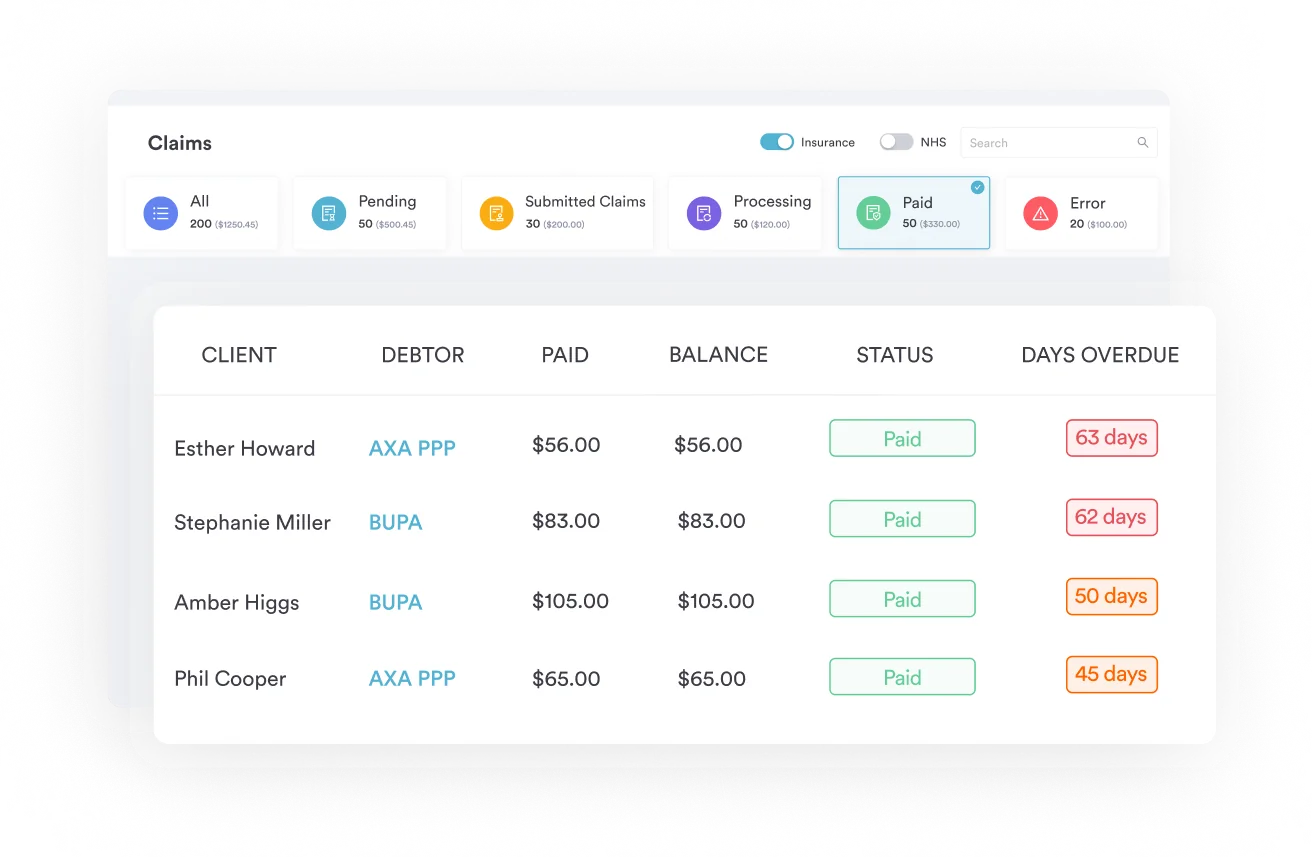

Pabau fills each claim from the patient record and sends it through Claim.MD, with eligibility checks before the test and ERA posting after. Your 86703 claims go out complete.

Code HIV antibody tests by the result format on the lab report, not by the viruses the test detects. For Medicare, add one more question before you code: was this screening or a diagnostic test?
Settle both answers once, when the lab adds an assay to its menu, and map each assay to its code in the lab information system. A reactive screen then stops triggering a coding guess on every claim. The trade-off is upkeep. When the lab switches kits, the mapping has to change with it.
Once the mapping is right, the claim itself is the easy part. Book a demo to see how Pabau carries HIV lab claims from order to payment.

Need to decode a remittance? Denial codes in medical billing explains the CARC and RARC codes that appear on HIV lab remittances and how to act on them.
Billing Medicare for lab work? Medicare billing for practices walks through a Medicare claim from appointment to payment.
Want fewer rejections on the first pass? What is a clean claim covers the fields and checks that get a claim paid without rework.
Checking your billing against the rules? Medical billing compliance covers the regulatory framework behind electronic claim submission and payer requirements.
New to the billing cycle? What is medical billing lays out each stage from charge capture to payment posting.
Two come up most. Modifier 92 marks a test run on a single-use, disposable kit, such as many rapid HIV tests. Medicare also expects QW on a CLIA-waived test. Check the CMS waived-test list and your payer’s rules before adding either.
Yes. Any practice that runs the test needs a CLIA certificate, and a Certificate of Waiver covers waived rapid HIV tests. The CLIA number goes on the claim, and a missing one causes rejections.
Yes, when it reports one combined HIV-1/2 antibody result. The specimen type doesn’t change the code. For Medicare screening, an oral fluid rapid test goes on G0435 instead.
Usually, yes. When your practice draws a venous sample, report the venipuncture with 36415 alongside 86703. A rapid test on oral fluid has no draw to bill.
Only when both assays were run and the record documents each one. A lab that runs both on one specimen should be able to explain why. Check the NCCI PTP tables before adding modifier 59.



