HCPCS Code Q4185: Cellesta flowable amnion billing guide
HCPCS Code Q4185: definition and official descriptor HCPCS Code Q4185 is the Lev...

Last Updated: Nov 20, 2026
80081 is the CPT code for an obstetric panel that includes HIV testing. It bundles eight component groups: CBC, HBsAg, rubella antibody, a syphilis test, RBC antibody screen, ABO and Rh(D) typing, and an HIV antigen/antibody test.
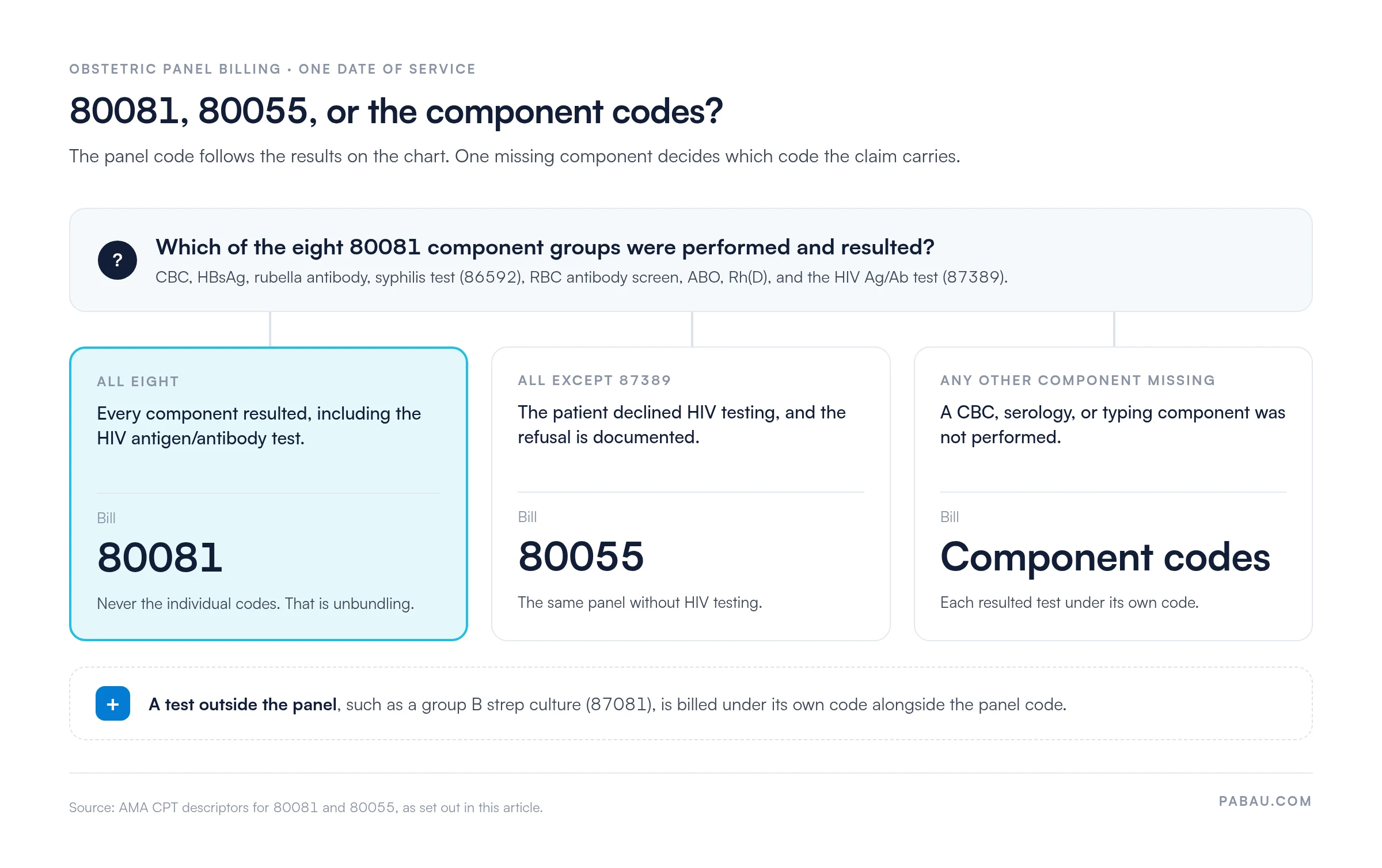
Every component must be performed and resulted to bill 80081. When only the HIV test (87389) is missing, the correct code is 80055, the same panel without HIV testing.
Let Pabau's smart automation suggest the right codes, reduce claim denials, and keep your practice compliant—effortlessly.
Automate repetitive tasks and focus on what matters most—your patients.
Reduce coding errors and ensure compliance with the latest regulations.
Clean claims, fewer denials, and faster reimbursements.
Powerful insights and reporting to help your practice thrive.
HIPAA compliant SOC 2 certified GDPR-compliant Trusted by 4,000+ clinics worldwide

CPT code 80081 is the obstetric panel with HIV testing, and it covers eight component groups. They are a CBC, HBsAg, rubella antibody, a syphilis test, an RBC antibody screen, ABO and Rh(D) typing, and the HIV Ag/Ab test.
80081 differs from CPT 80055 by exactly one component: the HIV Ag/Ab combo test (87389). If your practice omits HIV testing, bill 80055, not 80081.
Billing individual component codes when all panel tests were performed is an unbundling violation subject to NCCI edits and audit recovery.
Pabau’s practice management software sends the claim your team codes through Claim.MD, with eligibility checks and ERA remittances. The coding decision stays with your billers.
CPT code 80081 is the obstetric panel that includes HIV testing, one lab code for the eight test groups ordered at an initial prenatal visit. AAPC’s CPT 2016 lab preview confirms that 80081 differs from the older obstetric panel, 80055, only by adding the HIV test 87389. The American Medical Association maintains the CPT code set, and the official descriptor reads as follows.
Obstetric panel (includes HIV testing). This panel must include the following: Blood count, complete (CBC), automated and automated differential WBC count (85025 or 85027 and 85004) OR blood count, complete (CBC), automated (85027) and appropriate manual differential WBC count (85007 or 85009); hepatitis B surface antigen (HBsAg) (87340); antibody; rubella (86762); Syphilis test, non-treponemal antibody; qualitative (eg, VDRL, RPR, ART) (86592); antibody screen, RBC; each serum technique (86850); blood typing, ABO (86900) AND blood typing, Rh(D) (86901); HIV-1 antigen(s), with HIV-1 and HIV-2 antibodies, single result (87389).
That final item, the HIV Ag/Ab combo test, is what separates 80081 from its sibling code 80055.
The panel logic is binary. All listed components must be ordered and resulted before you may bill the panel code. Leave out the HIV test alone and the claim moves to 80055. Leave out any other component and you bill each resulted test under its own code. NCCI edits enforce this all-or-nothing rule, and it is a primary audit trigger for OB/GYN practices.
The 80081 obstetric panel with HIV contains eight distinct analyte groups. Each has its own CPT component code that applies when the panel requirement is not met.
80081 contains no urinalysis. When a urinalysis (81000 or 81003) is ordered at the same visit, it is billed separately under its own code. The syphilis component is the non-treponemal antibody test, 86592, and a quantitative titer is not part of the panel.
CPT 80055 is the obstetric panel without HIV testing. The only structural difference is the absence of 87389. Every other analyte requirement is identical.
The AAPC 2016 lab code article describes 80081 as an alternative to 80055 that adds 87389. So if a patient declines HIV testing and you document the refusal, bill 80055 for the remaining components. Billing 80081 when the HIV test was not performed creates an improper claim.
Document HIV test acceptance or refusal in the chart before the lab order is generated. If the patient declines, the refusal note triggers the automatic switch from 80081 to 80055 in a properly configured order set. A missing refusal note with a 80055 claim invites a medical necessity query from the payer.
Proper documentation is what keeps 80081 payable. Before the panel code goes on a claim, the chart must show the clinical indication and the ordering provider’s NPI. It must also show every component order and resulted value. These steps reflect standard prenatal billing practice and align with medical billing fundamentals for panel codes.
Payers require a diagnosis code that establishes why the panel was medically necessary. The Z34 series is the primary vehicle. Most MAC LCDs for obstetric panels accept Z34.xx without additional supporting codes for routine first-trimester visits. Confirm each Z code’s current status in our ICD-10-CM code reference before you submit.
Some commercial and managed Medicaid plans require Z11.4 as a secondary code. It applies when the HIV component is what moves the claim from 80055 to 80081. Check your MAC’s LCD and your state Medicaid bulletin annually, as these requirements change with CLFS updates.
Medicare pays lab services under the annual Clinical Laboratory Fee Schedule (CLFS), not the Physician Fee Schedule. Coverage for 80081 depends on medical necessity and your MAC’s policy, so Medicare does not pay every claim automatically.
Under PAMA, the CLFS publishes a single national rate for 80081 itself. That rate is not the sum of the component rates, and it is not adjusted by locality. The CMS Clinical Laboratory Fee Schedule files carry the current-year figure, and CMS updates them each January 1.
Check the current-year CLFS file before you quote a patient an expected out-of-pocket amount. Lab codes carry no RVUs, so physician fee schedule and RVU tools will not price 80081.
Unbundling is the practice of billing individual component codes when a panel code should have been used. For 80081, the AMA panel rule is absolute. When all listed components are performed on the same date of service, the panel code must be billed. Submitting the eight or nine individual analyte codes instead triggers NCCI edits and is treated as an overpayment subject to recovery. This is a core principle of revenue cycle management for laboratory billing.
There is one legitimate exception. A provider may order a test beyond the 80081 components on the same date. That additional test is billed with its own CPT code alongside 80081. The panel code covers only its enumerated components. A first-trimester screen ordered at the same time, such as cell-free DNA or nuchal translucency, uses separate CPT codes. The panel bundling rule does not affect it.
All three scenarios turn on one question: which components were performed and resulted on that date of service.
Denial patterns on 80081 are predictable. Understanding the root cause for each shortens the refile cycle. Structured denial management workflows turn these one-off recoveries into systematic prevention.
A correctly configured practice management system eliminates most 80081 denials before they occur. The key is building a standing prenatal panel order set that enforces the all-or-nothing panel rule at the point of care.
Practices using medical billing compliance protocols should include 80081 in quarterly internal audits. Sample 20 to 30 claims per quarter. Confirm that every billed 80081 has all its components resulted in the chart and a valid linked diagnosis code.
Run a monthly unbundling report on 85025, 86762, 87340, 86592, 86850, 86900, 86901, and 87389. Filter it to dates of service where any of them appears on the same claim as 80081. Any match means the panel code and a component were billed simultaneously. That is an NCCI violation that needs voiding before it triggers a payer audit.
Most 80081 errors start when a biller codes the panel without seeing every result. The order lives in one system, the lab results in another, and the claim goes out through a third.
Pabau, the practice management platform we build, keeps those steps on one patient record. In the US, your team orders Quest tests from the patient record, and Labcorp orders placed in Labcorp Link sync results back. Results import automatically, so the biller can see which components resulted before choosing 80081, 80055, or component codes.
Once your team has coded the claim, Pabau submits it as a CMS-1500/837P claim through Claim.MD. Eligibility checks run before submission, and ERA remittances and secondary claims come back to the same record. The coding decision stays with your billers.

Pabau imports Quest and Labcorp results into the patient record and sends the claim your team codes through Claim.MD. Eligibility checks and ERA remittances sit on the same record.

Choose the panel code from the results on the chart, not from the order. If all eight components resulted, bill 80081. If only the HIV test is missing, bill 80055, and bill component codes for any other partial panel.
The trade-off is timing. Holding the claim until every result posts delays payment by a few days, but it avoids the refile, the overpayment demand, and the audit flag. Pair that with a linked Z34 or Z3A code and a documented HIV decision, and 80081 claims rarely come back.
Book a demo to see how Pabau keeps lab results, eligibility checks, and claim status on one patient record for your prenatal billing.

Billing the hepatitis B screen on its own? CPT 87340 covers the HBsAg test when it is ordered outside a full obstetric panel.
Confused about how clearinghouses process lab claims? Medical claims clearinghouse guide explains how 837P files are validated, scrubbed, and forwarded to payers.
Want to understand the 837 file structure for lab submissions? 837 file overview breaks down the transaction set used for all professional claims, including obstetric panels.
CPT code 80081 is the obstetric panel with HIV testing. It includes a CBC with differential, ABO and Rh(D) typing, rubella antibody, and hepatitis B surface antigen. It also includes a syphilis test (86592), an RBC antibody screen, and the HIV antigen/antibody test (87389). All eight groups must be performed and resulted for the panel code to be billable.
CPT 80081 includes the HIV-1/HIV-2 antigen/antibody combination test (87389); CPT 80055 does not. Every other component in the two panels is identical. Bill 80081 when HIV testing is performed as part of the panel. Bill 80055 when the patient declines HIV testing or the clinical protocol omits it.
Medicare pays lab services under the Clinical Laboratory Fee Schedule (CLFS), and coverage depends on medical necessity and your MAC’s policy. The CLFS sets one national rate for 80081, updated each January 1, with no locality adjustment. Check the current-year CLFS file and your MAC’s diagnosis requirements before you bill.
The Z34 series (supervision of normal pregnancy) is the primary supporting diagnosis, with Z34.01 used most often for first-trimester panels. Z11.4 (encounter for HIV screening) is a secondary code required by some payers when the HIV component drives the choice of 80081 over 80055. Z3A gestational-week codes may also be required by specific MAC LCDs.