

HCPCS Code Q4175: Billing, coverage, and documentation guide
HCPCS Code Q4175: Code Description and Product Identity HCPCS Code Q4175 is the ...

Last Updated: Nov 20, 2026
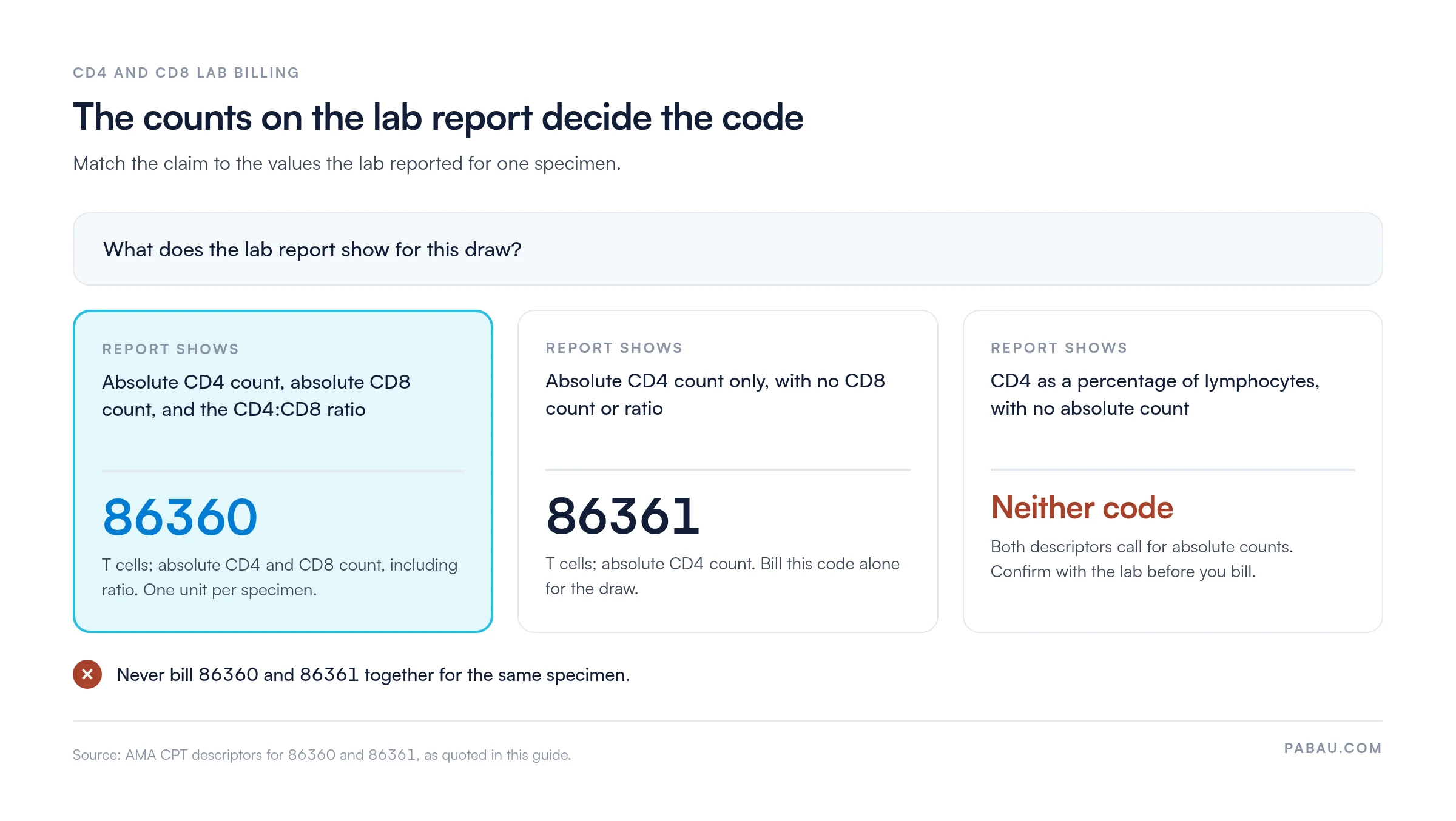
CPT code 86360 reports an absolute CD4 count, an absolute CD8 count, and the CD4:CD8 ratio from one blood specimen. The AMA descriptor reads "T cells; absolute CD4 and CD8 count, including ratio."
Coders often confuse it with 86361, which reports the absolute CD4 count alone. The counts on the lab report decide between the two codes, and neither descriptor names a platform or test method.
Most 86360 denials trace back to a few causes. The claim lacks a covered diagnosis, a repeat test falls outside the payer's frequency policy, or one draw is billed under both codes.
Let Pabau's smart automation suggest the right codes, reduce claim denials, and keep your practice compliant—effortlessly.
Automate repetitive tasks and focus on what matters most—your patients.
Reduce coding errors and ensure compliance with the latest regulations.
Clean claims, fewer denials, and faster reimbursements.
Powerful insights and reporting to help your practice thrive.
HIPAA compliant SOC 2 certified GDPR-compliant Trusted by 4,000+ clinics worldwide

CPT code 86360 reports the absolute CD4 count, the absolute CD8 count, and the CD4:CD8 ratio from one specimen.
Use 86361 when the lab reports only the absolute CD4 count, and 86360 when the CD8 count and the ratio are reported too.
Neither descriptor names a platform or test method, so the counts on the lab report decide the code.
B20 (HIV disease) and Z21 (asymptomatic HIV infection status) are the most common supporting diagnoses, alongside immunodeficiency codes.
Testing frequency limits vary by MAC and payer, so check the applicable policy before a repeat draw.
CPT code 86360 is a laboratory immunology code with the official AMA descriptor: “T cells; absolute CD4 and CD8 count, including ratio.” The AMA’s CPT code set places it in the 86000-series immunology section, alongside other lymphocyte enumeration codes. One unit of service represents a single specimen analyzed for absolute CD4 and CD8 T-lymphocyte counts, with the CD4:CD8 ratio reported.
The breadth of the result is the defining feature. 86360 applies when the lab reports all three values: the absolute CD4 count, the absolute CD8 count, and the ratio. 86361 applies when the lab reports the absolute CD4 count alone. Neither descriptor names an instrument platform or test method, so the lab report decides the code.
The absolute CD4 T-lymphocyte count is the number of CD4-positive helper T cells per cubic millimeter of blood, expressed as cells/mm³. Clinicians use it to assess immune function in HIV disease and to guide prophylaxis decisions. It also tracks treatment response over time.
Beyond HIV, the same test supports immunodeficiency workups in several other contexts. Each indication has its own ICD-10 coding implications, which the next section covers.
The order decides which values the lab reports. A clinician who needs only the CD4 count for staging or prophylaxis can order it alone. The lab then bills 86361 rather than 86360.
These three lymphocyte enumeration codes in the 86300 series are easy to mix up on HIV lab panels. The difference is what the lab reports. The same blood draw produces 86360 or 86361, depending on whether the CD8 count and the ratio appear on the report.
When a laboratory reports CD4 only as a percentage of total lymphocytes, neither 86360 nor 86361 fits. Both descriptors call for absolute counts, expressed in cells/mm³.
The CD4 percentage comes from the same flow cytometry panel, not the CBC differential, but a percentage alone meets neither descriptor. If the lab report shows only “CD4 25%,” confirm with the lab whether an absolute count was also reported before submitting 86360.
Pediatric HIV management often uses CD4 percentage rather than absolute count for staging. In those cases, the physician order and lab report should state which metric is being measured. A claim submitted under 86360 when only CD4% was reported can fail an audit. Each of the three report formats maps to one billing outcome, shown below.
Every CPT 86360 claim needs at least one covered ICD-10-CM diagnosis code that establishes medical necessity. For HIV monitoring, that is usually B20 for HIV disease or Z21 for asymptomatic HIV infection status. Payers cross-reference the diagnosis against their local coverage determination for immunology laboratory tests. Missing or non-covered ICD-10 codes are a leading cause of 86360 denials.
Always confirm the specific covered-diagnosis list in the applicable MAC’s LCD for immunology laboratory services. Covered codes vary by contractor and change over time, so treat the table above as common mappings rather than a universal rule. For a non-HIV workup, D84.9 fits only while the specific immunodeficiency type is still unknown.
Run an ICD-10 crosswalk check before submitting 86360 claims. Pull the active MAC LCD for immunology lab services and compare each patient’s listed diagnoses against the covered-code list. Catching a non-covered ICD-10 at pre-submission costs seconds; appealing a denial costs hours.
Medicare covers CPT 86360 when it is medically necessary for a beneficiary with a confirmed HIV-positive status or a clinical indication documented in the chart. Local coverage determinations govern coverage. The Medicare Administrative Contractor (MAC) for the laboratory’s jurisdiction issues them, not the MAC where the ordering physician practices.
Testing frequency is the next rule to check. NCD 190.13 addresses HIV viral-load testing and sets no CD4 or CD8 testing schedule. Frequency limits come from the MAC’s LCD or the plan policy, so check it before a repeat draw. When testing runs more often than that policy allows, the chart needs a documented clinical reason.
Medicare pays CPT code 86360 under the Clinical Laboratory Fee Schedule (CLFS), the payment system CMS uses for clinical lab tests. CMS sets a national payment limit for each test code. Under PAMA, that amount comes from the weighted median of private payer rates that laboratories report to CMS.
The CLFS has no RVUs and no facility or non-facility split, so the Physician Fee Schedule lookup tools do not price this code. Look up the current 86360 amount in the CMS quarterly CLFS files. Commercial payers set their own lab rates, so verify those in each payer contract.
Billing CPT code 86360 correctly takes three checks. Match the place-of-service code to the site where the test is performed, and apply modifiers only when the clinical record supports them. Submit one unit per specimen draw. Each of these elements is independently validated on the claim edit.
Most 86360 denials fall into five categories. Each has a specific root cause and a specific corrective action. The pattern across a practice’s claims shows fastest whether the problem lives in documentation, code selection, or the billing workflow.
A clean claim submission for 86360 starts with the chart. It must show the clinical indication, the ordering provider’s name and NPI, the confirmed HIV or immunodeficiency diagnosis, and the collection date.
For tests ordered more often than the payer frequency policy allows, the chart also needs a note on why more frequent monitoring is medically necessary. That note should name the clinical trigger. Common triggers are a new opportunistic infection, a CD4 count below a defined threshold, or a change in ART regimen.
Practices with structured medical billing compliance protocols for lab orders reduce audit exposure. They build these documentation checkpoints into the ordering workflow rather than relying on chart review after the fact.
Audit 86360 denials quarterly rather than claim-by-claim. Group denials by CARC code, isolate the top three denial reasons, and address each at the workflow level. A single process fix upstream prevents hundreds of individual re-submissions downstream. Use denial tracking reports in your claims management platform to surface patterns automatically.
Practices running denial management workflows across multiple payers should track the specific denial reason codes tied to 86360. They separate MAC-specific LCD issues, which need chart documentation fixes, from NCCI bundling edits, which need code-selection fixes.
CD4 and CD8 claims fail on details spread across the order, the lab report, the diagnosis, and the claim form. Pabau, a practice management and billing platform, holds the lab results, the diagnosis, and the claim on one patient record. The code on the claim can then match the counts the lab reported.
Pabau’s claims software for specialists builds the claim from the visit and the diagnosis already on the chart. Claims go out electronically through Claim.MD, which also checks eligibility and returns remittance data to the same record.
When a denial comes back, the remittance codes sit beside the claim. Your billers can see whether the diagnosis, the frequency, or the code choice caused it, and fix the workflow rather than one claim.

Pabau’s claims management software helps HIV care and immunology practices submit CPT 86360 claims accurately and track denial patterns before they become write-offs.

Settle the code at the order. Order the full panel only when the clinician needs the CD8 count and the ratio. When the CD4 count alone answers the clinical question, order and bill 86361. That single decision prevents the double-billing denial before the specimen reaches the lab.
Frequency is the rule worth writing down. Medicare sets no national CD4 schedule, so the limit that applies is the one in your MAC’s LCD or the plan policy. Build that limit into the order workflow, and record the clinical trigger whenever a draw comes early.
Book a demo to see how Pabau records lab results, diagnoses, and claims in one place for HIV care and immunology practices.

Need a full picture of clearinghouse claim submission? Claim.MD clearinghouse overview explains how the integration handles 837P claim formats, ERA remittances, and payer enrollment for US practices.
Seeing recurring denials you can’t resolve? Understanding the 837 file format covers how electronic claim data maps to payer edits and where common transmission errors originate.
Want to benchmark your lab billing performance? Best medical billing software for US practices compares platforms on clean-claim rates, denial management depth, and lab code handling.
CPT code 86360 covers an absolute CD4 count and an absolute CD8 count from one specimen, including the CD4:CD8 ratio. It is billed once per specimen. The descriptor names no instrument platform or test method.
CPT 86360 reports the absolute CD4 count, the absolute CD8 count, and the CD4:CD8 ratio. CPT 86361 reports the absolute CD4 count alone, without CD8 or the ratio. Neither descriptor names a platform, so the lab report decides the code. Bill one code per specimen, matched to the counts the lab reported.
The primary covered diagnoses are B20 (HIV disease) and Z21 (asymptomatic HIV infection status). D84.9 (immunodeficiency, unspecified) and D83.9 (common variable immunodeficiency) cover non-HIV immunodeficiency workups. Confirm covered codes against the active MAC LCD for your contractor before submitting.
Modifier -59 applies when 86360 is a distinct procedure on the same date as another immunology code that NCCI edits would otherwise bundle. The chart must document the clinical reason for ordering both. Modifier -91 applies when 86360 must be repeated on the same date for a medically necessary reason. A specimen rerun or quality control repeat does not qualify.
Medicare sets no national CD4 testing schedule. NCD 190.13 addresses HIV viral-load testing, not CD4 counts. Frequency limits vary by MAC and payer, so check the applicable LCD or plan policy. When testing runs more often than that policy allows, document the clinical reason, such as a new opportunistic infection or an ART regimen change.





