

CCSD code G5100: Bypass of duodenum billing guide
CCSD code G5100 bills a bypass that leaves the duodenum in place CCSD code G5100...

Last Updated: Oct 16, 2026
87536 is the CPT code for quantification of HIV-1 nucleic acid (viral load), including reverse transcription when performed. It reports how many copies of HIV-1 RNA are in a milliliter of plasma, for a baseline level and for antiretroviral therapy monitoring.
The code choice turns on the result type. A quantified viral load is 87536, while a detected or not-detected HIV-1 result is 87534 or 87535. Most denials trace back to an unsupported diagnosis code, testing outside guideline frequency, or a diagnostic test billed as a viral load.
Let Pabau's smart automation suggest the right codes, reduce claim denials, and keep your practice compliant—effortlessly.
Automate repetitive tasks and focus on what matters most—your patients.
Reduce coding errors and ensure compliance with the latest regulations.
Clean claims, fewer denials, and faster reimbursements.
Powerful insights and reporting to help your practice thrive.
HIPAA compliant SOC 2 certified GDPR-compliant Trusted by 4,000+ clinics worldwide

CPT code 87536 reports HIV-1 viral load, a quantified count of HIV-1 RNA, including reverse transcription when performed.
The coding choice is quantification versus detection. A detected or not-detected HIV-1 result is 87534 (direct probe) or 87535 (amplified probe).
B20 and Z21 are the primary diagnosis codes. Medicare covers viral load under NCD 190.13, with frequency set by current CDC/DHHS guidelines.
Pabau, the billing platform we build, submits 87536 claims through its Claim.MD integration and tracks each claim’s status, so billing teams spot denials quickly.
CPT code 87536 describes infectious agent detection by nucleic acid for HIV-1, quantification, including reverse transcription when performed. In practice, it is the HIV-1 viral load test. The American Medical Association owns and maintains CPT descriptors, so verify the current wording in the AMA CPT codebook for compliance purposes.
The test measures HIV-1 RNA copies per milliliter of plasma, reported as copies/mL and as log10 values. Labs run it on nucleic acid amplification platforms, most often real-time RT-PCR. As with any clinical lab test, the performing lab must hold a CLIA certificate that covers the assay.
87536 covers quantification of HIV-1 RNA from a plasma specimen. Specimen collection is not included, so the practice that draws the blood bills venipuncture separately under 36415.
Five related tests fall outside its scope, and each one has its own code:
The 87535 vs 87536 question is the most common miscoding risk on HIV-1 nucleic acid testing. The two codes answer different clinical questions. 87536 measures how much HIV-1 RNA is present, while 87535 and 87534 report only whether HIV-1 is present.
Code from the result the lab reports, as the grid below maps out. A copies/mL value is 87536. A detected or not-detected result is 87535, or 87534 when the method is a direct probe. NCD 190.13 states that viral load is not indicated as a diagnostic test, so a diagnostic workup billed as 87536 invites a medical-necessity denial.
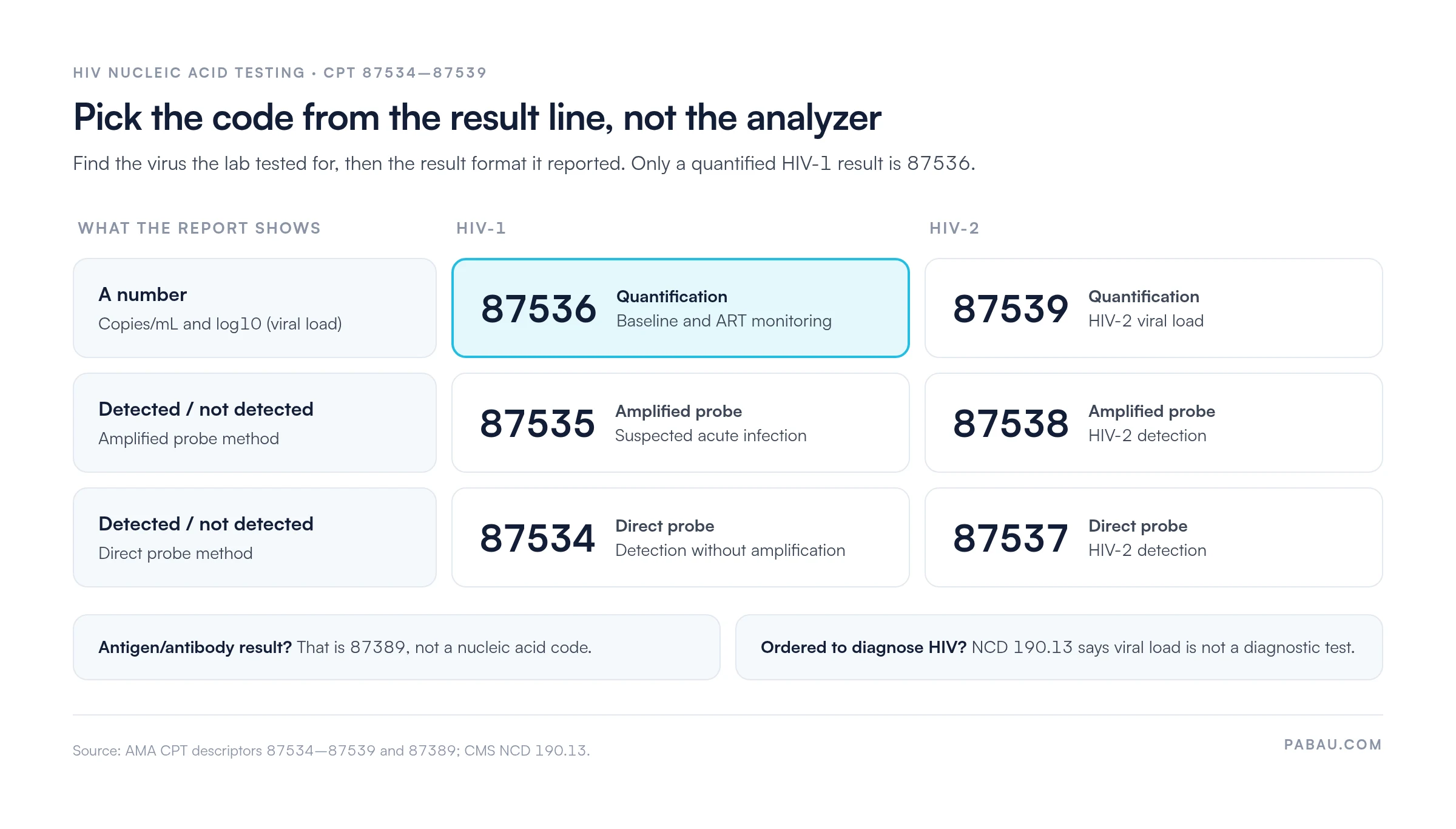
Read the result field before you pick a code. A number in copies/mL means 87536. A detected or not-detected line means 87535, or 87534 if the report names a direct probe method.
HIV panel orders often pair 87536 with neighboring HIV and STI codes. The table lists each one with the result type it reports.
Medical necessity documentation is where many 87536 claims fail. The diagnosis code on the claim must justify why the viral load test was ordered. For Medicare, the covered codes sit on the lab NCD code list for NCD 190.13, and an unlisted code triggers a denial.
The CDC/NCHS ICD-10-CM web tool is the authoritative lookup for current code descriptions. The codes below are standard pairings. Check them against the current NCD 190.13 code list for Medicare and against each commercial payer’s own policy.
B20 applies once a patient has ever had an HIV-related condition. Z21 applies to an asymptomatic patient with no such history. For established patients on antiretroviral therapy, add Z79.899 as a secondary code. Document the clinical indication explicitly in the chart note.
Medicare pays 87536 under the Clinical Laboratory Fee Schedule (CLFS), which CMS updates each year. Since 2018, CLFS amounts have been single national rates, so check the current year’s file rather than relying on a fixed dollar figure. The CMS Clinical Laboratory Fee Schedule page carries the current rate for 87536.
Coverage comes from NCD 190.13, a national coverage determination rather than a local MAC policy. It covers a baseline viral load in any patient with confirmed HIV infection and periodic monitoring to guide antiretroviral treatment. For an accurate baseline, it considers two specimens in a two-week period appropriate. It also states that viral load testing is not indicated for diagnosis.
Frequency rules for CPT code 87536 are not universal. They vary by payer and by clinical scenario:
Testing outside the payer’s accepted frequency without documented justification is a leading denial trigger. Attach the clinical rationale (new regimen, detectable viral load, treatment failure workup) to the prior authorization request. If the payer accepts supporting notes on the claim, include the rationale there too.
The modifier landscape for lab codes is narrower than for procedure codes. Several modifiers are commonly asked about but do not apply to 87536.
Modifier 91 is the one that catches billers off guard. A same-day rerun after a failed run, a lab error or a rejected specimen is not a separate service. Bill it once, without 91. Use 91 only when the clinician needs a second result on the same day.
Denials on 87536 cluster around six root causes, and most are preventable before submission. Tracking which cause recurs is where denial management on lab claims starts.
Run a monthly audit of your 87536 denial remittances. Group denials by CARC code (reason code on the ERA). If CO-97 (bundling) and CO-4 (incomplete/invalid modifier) account for more than 30% of denials, your modifier 91 and modifier 59 usage is the priority fix. If CO-50 (not medically necessary) dominates, review your ICD-10 pairing documentation process.
Who bills 87536 matters as much as how they bill it. Reference labs (POS 81), hospital outpatient labs (POS 22), and physician office labs (POS 11) each follow different billing rules.
Mismatching the POS code with the service location is a denial trigger in itself. Confirm the POS code on every 87536 claim matches where the specimen was processed, not where the patient was seen.
A clean 87536 claim depends on details settled before submission. These include the right result type, a covered diagnosis code, the performing lab’s CLIA number, and a testing frequency the payer accepts. Those checks belong to the coder and the ordering clinician.
Pabau handles what happens next, including for sexual health practices that run HIV care. Its time-saving claims management builds the CMS-1500 claim from the invoice, so nobody re-keys the charge. The Claim.MD integration then submits the claim electronically to thousands of US payers. Staff can also check a patient’s coverage in real time before the blood draw.
Claim status updates and electronic remittance advice flow back into Pabau, so a denied 87536 line shows up beside the invoice it belongs to. A clean claim on the first pass still beats a fast fix, because it avoids the appeal and the wait for payment.

Pabau submits lab claims through Claim.MD, checks patient eligibility in real time, and brings claim status and remittances back into one place. Your team sees denials sooner and spends less time in payer portals.

Code 87536 from the result the lab reports. A copies/mL viral load is 87536, and a detected or not-detected answer belongs to 87535 or 87534. Getting that choice right removes the most common source of rework on HIV lab claims.
For Medicare, anchor every claim to NCD 190.13. That means a covered diagnosis, monitoring that follows DHHS guidance, and a chart note explaining any extra test. Remember the trade-off: a viral load ordered to diagnose HIV fails medical necessity even when the code is correct.
Once the coding is settled, Pabau keeps the claim trail in one place. Our Claim.MD clearinghouse guide explains how that integration works. Book a demo to see how Pabau tracks your lab claims from submission to remittance.

Need to understand how clearinghouse submission works? Medical claims clearinghouse guide explains how electronic claim routing reduces denials on lab codes.
Dealing with ERA remittances after a denial? Electronic remittance advice overview covers how to read 835 files and identify CARC denial codes for 87536 appeals.
Want to verify payer eligibility before ordering the viral load test? Insurance eligibility verification outlines the coverage checks to run before the blood draw.
New to the claim cycle behind lab billing? What is medical billing walks through each step from charge capture to payment.
Auditing your lab claims for risk? Medical billing compliance covers the rules that keep coding and documentation defensible.
CPT code 87536 reports HIV-1 viral load, the quantity of HIV-1 RNA in plasma, including reverse transcription when performed. It is used for a baseline level once HIV is confirmed and for monitoring antiretroviral therapy. Results from the EDTA plasma specimen come back as copies/mL and log10 values.
CPT 87536 quantifies HIV-1 RNA and reports a viral load. CPT 87535 detects HIV-1 by amplified probe technique and reports whether the virus is present, without a quantity. Code from the result type the lab reports. A detected or not-detected result is 87535, or 87534 for a direct probe technique.
Yes. Medicare covers CPT 87536 under NCD 190.13, which covers a baseline viral load in confirmed HIV infection and periodic monitoring. Testing frequency should follow current CDC/DHHS antiretroviral guidelines, and the NCD states the test is not indicated for diagnosis. Payment comes from the Clinical Laboratory Fee Schedule.
Prior authorization requirements for CPT 87536 vary by payer and plan type. Traditional Medicare and most commercial plans covering ART monitoring do not require PA for routine viral load testing within frequency limits. Medicare Advantage plans and some Medicaid managed care organizations may require PA, particularly for testing above the standard frequency. Always verify PA requirements directly with the patient’s specific plan before ordering.



