

HCPCS Code E0272: Foam rubber mattress billing guide
HCPCS Code E0272: official descriptor and code overview HCPCS Code E0272 is the ...

Last Updated: Nov 6, 2026
Billable Code Specific Code
84479 is the CPT code for thyroid hormone (T3 or T4) uptake or thyroid hormone binding ratio (THBR). Both methods gauge thyroid hormone binding in the patient's serum, and the laboratory bills one unit whichever method it uses.
Paired with total T4 (CPT 84436), the result gives the free thyroxine index. Medicare pays the code at a national limit under the Clinical Laboratory Fee Schedule. Each claim needs a covered ICD-10-CM diagnosis documented by the ordering provider.
Let Pabau's smart automation suggest the right codes, reduce claim denials, and keep your practice compliant—effortlessly.
Automate repetitive tasks and focus on what matters most—your patients.
Reduce coding errors and ensure compliance with the latest regulations.
Clean claims, fewer denials, and faster reimbursements.
Powerful insights and reporting to help your practice thrive.
HIPAA compliant SOC 2 certified GDPR-compliant Trusted by 4,000+ clinics worldwide

CPT code 84479 covers two named procedures: Thyroid hormone (T3 or T4) uptake and thyroid hormone binding ratio (THBR). Either method is billed under this one code.
Paired with total T4 (CPT 84436), the result gives the free thyroxine index (FTI), and both codes can be billed separately on the same date.
Medicare pays 84479 at a national limit on the Clinical Laboratory Fee Schedule, with no professional component and no geographic adjustment.
Modifier 91 is required when the same test is repeated on the same patient and date for a new clinical result. Never use it for equipment reruns.
Pabau’s claims management software helps US practices track 84479 orders, attach the right ICD-10 codes, and submit clean claims through the Claim.MD clearinghouse.
CPT code 84479 is a quantitative laboratory test code for thyroid hormone (T3 or T4) uptake or thyroid hormone binding ratio (THBR). Both procedures measure the proportion of thyroid hormone binding sites occupied by thyroid hormones in the patient’s serum. Either one is billed under this single code, depending on the method the performing laboratory uses.
The code sits in the Pathology and Laboratory section of the CPT code set, within the Chemistry subsection (codes 82009-84999). It is billed by the laboratory that performs the test, not by the ordering physician. The ordering provider’s NPI must still appear on the claim to establish medical necessity.
Per the AAPC’s CPT code reference, CPT code 84479 describes the measurement of thyroid hormone binding and the resulting ratio. That ratio is combined with a total T4 result to compute the free thyroxine index (FTI), also called T7. This indirect calculation of free thyroid hormone was standard practice before direct free T3 and free T4 immunoassays became widely available.
T3 uptake and THBR measure the same biochemical property through slightly different methodologies, and the terms are often used interchangeably in clinical documentation.
Many payers now consider THBR and T3 uptake to be indirect, older-generation tests. Direct free T4 assays, billed under 84439, give the same clinical information more reliably. They have largely displaced 84479 in high-volume reference labs.
CPT code 84479 stays in use where practices panel-order thyroid tests for specific diagnostic contexts, or where ordering protocols haven’t moved to direct assays yet.
Payers require a covered ICD-10-CM diagnosis code linked to the claim line for CPT code 84479. The diagnosis must reflect a clinical indication documented in the ordering provider’s encounter note. The table below lists the most commonly accepted codes. Covered diagnoses vary, so check the Medicare MAC’s LCD or the commercial payer’s coverage policy.
Check current ICD-10-CM code descriptions via the CDC/NCHS ICD-10-CM web tool. Codes in the E00-E07 thyroid disorder range are the most widely accepted. When the note documents hypothyroidism without naming a type, E03.9 is the usual pairing. If the note documents a more specific thyroid condition, use that code instead of an “unspecified” default.
Medicare pays for CPT code 84479 under the Clinical Laboratory Fee Schedule (CLFS), not the Physician Fee Schedule. The CLFS sets a flat payment rate for the test, and there is no separate physician (professional) component for this code. Rates are national limits set by CMS and updated under PAMA, the Protecting Access to Medicare Act.
Use the CMS Clinical Laboratory Fee Schedule files to retrieve the current payment limit for 84479. The CMS Physician Fee Schedule lookup covers any evaluation and management visit billed alongside the order.
Rates change each January 1. Never rely on prior-year figures when submitting claims or projecting reimbursement. Pabau’s claims management software lets US practices reconcile expected versus paid amounts. It flags CLFS underpayments automatically from electronic remittance advice data.

Correct billing for CPT code 84479 means matching the place of service code, ICD-10 link, and ordering provider credentials before the claim reaches the clearinghouse. The following workflow applies to both independent labs and in-office laboratory settings.
Modifier 91 signals that the same clinical diagnostic laboratory test was repeated on the same patient on the same date of service. The repeat was needed for a new clinical result, not because of equipment failure or an inadequate specimen.
CPT code 84479 is often confused with neighboring thyroid codes, and a wrong code on the claim means a denial or an underpayment. The table below identifies the closest related codes and when each applies.
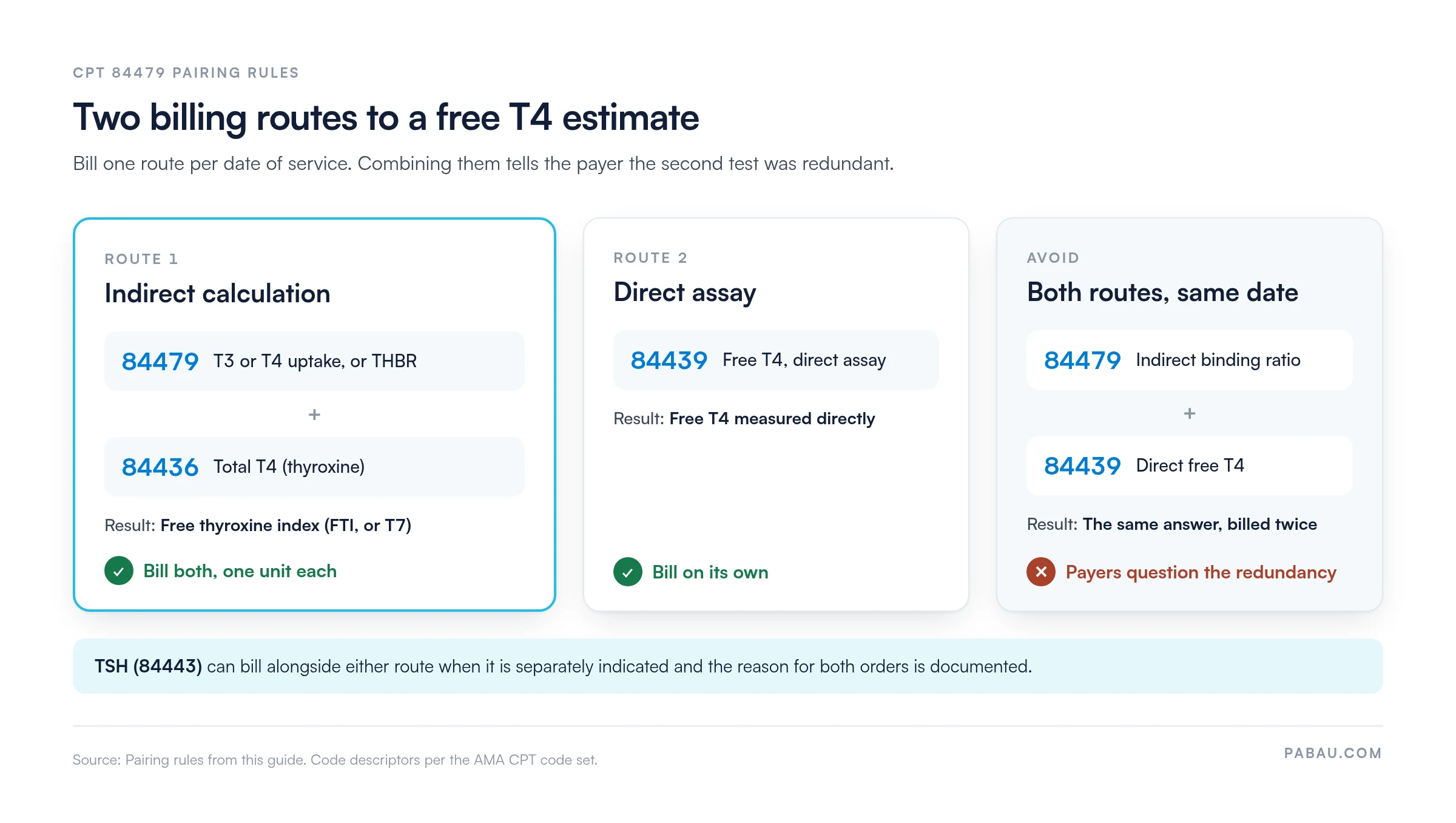
CPT code 84479 can be billed on the same claim as 84436 when the clinical intent is to calculate the free thyroxine index. No CMS Correct Coding Initiative (CCI) edit blocks billing the pair together, because both are needed to produce the FTI result. Each code is a distinct analyte measurement, reported with one unit.
Billing CPT code 84479 on the same date as CPT 84439 (free T4 direct assay) is clinically redundant and triggers payer scrutiny. The free T4 assay provides the same clinical information as the FTI calculated from 84479 and 84436. That makes it hard to document distinct medical necessity for both.
Some payers have CCI edits or coverage policies that deny 84479 when 84439 appears on the same date of service.
The diagram below maps the two billing routes to a free T4 estimate and the pairing payers push back on.
Denials for CPT code 84479 follow predictable patterns. Most can be resolved before submission with a structured pre-bill review. An effective denial management workflow catches each of these before the payer does.
If your practice bills many laboratory claims, compare the most common denial codes with the claim adjustment reason codes (CARCs) in your remittance data. Patterns across many claims point to the fix faster than chasing each rejection.
Medicare covers CPT code 84479 when the test is medically necessary and supported by a covered ICD-10-CM diagnosis code. Coverage is not automatic. The ordering provider must document the clinical indication, and the billed diagnosis must appear on the payer’s covered-indication list for thyroid testing.
Several commercial payers, including some BlueCross BlueShield plans, have issued medical policies that restrict CPT code 84479 to specific thyroid diagnoses. Others require the test to be ordered as part of a defined panel.
Some payers go further and classify THBR as a low-value or obsolete test. They decline to pay for it when a direct free T4 assay (84439) would give the same clinical information.
Before ordering or billing CPT code 84479 under a new payer, confirm coverage through the payer’s provider portal or with the lab benefits manager.
Before billing CPT code 84479 under a new commercial payer, pull the payer’s current coverage policy for thyroid disease testing. If the policy restricts THBR or prefers direct free T4, document why THBR was clinically necessary in that case. Otherwise, switch to CPT 84439. A five-minute coverage check costs far less than an appeal.
Documentation is the foundation of every successful CPT code 84479 claim. A claim that the medical record cannot support on audit becomes a recoupment.
The medical record must contain each of the following before a claim for CPT code 84479 is submitted.
Without a check before submission, an 84479 problem usually surfaces on the remittance. A biller then finds the missing NPI or the wrong diagnosis, corrects the claim and resubmits it weeks later.
Pabau moves those checks ahead of submission. The lab order, the ordering provider’s NPI and the linked ICD-10 code sit on the patient record. The claim is built straight from the encounter note. Claim.MD then validates required fields before the claim goes to the payer.
When the remittance comes back, Pabau compares the paid amount with the amount you expected. A short-paid or denied 84479 line gets flagged for follow-up instead of disappearing into a batch.

Pabau connects with Claim.MD to submit CPT code 84479 and related thyroid panel codes with the correct ICD-10 pairings, modifiers, and place of service. Reduce claim errors and track reimbursements in one workflow.

CPT code 84479 still gets paid, but only when the claim shows the indirect test was the right choice. Before you order it, check whether the payer’s policy prefers a direct free T4 assay. If it does, 84439 is usually the cleaner claim.
When 84479 is the right test, bill it with 84436 for the FTI and link the most specific thyroid diagnosis in the note. Keep modifier 91 for clinically needed repeats. That is the trade-off with an older test. It pays reliably when the paperwork is complete and stalls when it isn’t.
Book a demo to see how Pabau catches missing NPIs, wrong diagnoses and modifier errors on thyroid lab claims before they reach the payer.

Need to understand how clearinghouse claims submission works? Medical claims clearinghouse guide walks through how electronic claims reach payers and what happens at each validation step.
Comparing clearinghouse costs for lab claims? Claim.MD pricing and features covers the clearinghouse Pabau uses for US lab and clinical claims.
Want to understand the 837 file format behind electronic lab claims? 837 file guide explains the EDI transaction structure, including the claim loops that carry the ordering provider NPI and diagnosis codes.
Ordering TSH alongside THBR? CPT code 84443 covers billing the first-line thyroid screen, including when it pairs with other thyroid tests.
Billing total T3 in the same thyroid panel? CPT code 84480 explains the descriptor, reimbursement and documentation for total T3 testing.
CPT code 84479 covers thyroid hormone (T3 or T4) uptake testing and thyroid hormone binding ratio (THBR) measurement. The two methods measure the proportion of thyroid hormone binding sites occupied in the patient’s serum and produce the same clinical result. Both are billed under this single code.
CPT 84443 measures TSH (thyroid-stimulating hormone), the first-line test for thyroid dysfunction screening. CPT 84479 measures thyroid hormone binding ratio or T3 uptake. TSH testing has largely replaced THBR-based indirect calculations in routine thyroid workups. Today, 84479 is mostly ordered when an FTI calculation is needed alongside total T4.
Modifier 91 is required when CPT code 84479 is repeated on the same patient and date of service because a new clinical result is needed. It does not apply to a specimen failure or an equipment rerun. Bill the first test as 84479 and the repeat as 84479-91, with documentation of why the repeat was clinically necessary.
The most commonly accepted diagnosis codes are in the E00-E07 thyroid disorder range. They include E03.9 (hypothyroidism, unspecified) and E05.90 (thyrotoxicosis, unspecified without thyrotoxic crisis or storm). Covered codes vary by payer, so check the Medicare LCD or the commercial payer’s coverage policy before billing.
Generally no. CPT 84439 (free T4 direct assay) gives the same clinical information as the FTI calculated from CPT 84479 plus CPT 84436. That makes billing 84479 and 84439 on the same date clinically redundant. Some payers apply CCI edits or coverage policies that deny 84479 when 84439 appears on the same date.
Yes. CPT code 84479 remains a valid, billable code, but its clinical use has declined as direct free T4 and free T3 assays became standard. Some practices still use THBR-based calculations in specific diagnostic protocols. Medicare still covers the code when it is medically necessary and supported by a covered diagnosis.




