ICD-10 Code Z86.73: Personal history of TIA
ICD-10 Code Z86.73: Definition, descriptor, and code hierarchy ICD-10 Code Z86.7...

Last Updated: Nov 20, 2026
Billable Code Specific Code
E05.90 is the billable ICD-10-CM code for thyrotoxicosis, unspecified without thyrotoxic crisis or storm. It applies when labs or clinical findings confirm thyroid overactivity, no cause has been documented, and the patient shows no sign of thyroid storm.
The code fits a first endocrinology visit where TSH is suppressed and free T4 is raised but the workup is still pending. Once the record names Graves disease, a toxic nodule or another cause, switch to the matching E05 subcategory.
Let Pabau's smart automation suggest the right codes, reduce claim denials, and keep your practice compliant—effortlessly.
Automate repetitive tasks and focus on what matters most—your patients.
Reduce coding errors and ensure compliance with the latest regulations.
Clean claims, fewer denials, and faster reimbursements.
Powerful insights and reporting to help your practice thrive.
HIPAA compliant SOC 2 certified GDPR-compliant Trusted by 4,000+ clinics worldwide

E05.90 codes thyrotoxicosis of unspecified cause without thyrotoxic crisis, and it has been a valid, billable ICD-10-CM code from FY2016 through FY2027.
Use E05.90 only while the cause is undocumented. Once the record names Graves disease, a toxic nodule or another cause, switch to the matching E05 subcategory.
E05.91 is the companion code for the same presentation with thyrotoxic crisis or storm, and the two codes are never assigned together.
Most E05.90 denials trace back to missing TSH or free T4 results, or to a cause named in the note but missing from the code.
ICD-10 code E05.90 is the billable ICD-10-CM diagnosis code for thyrotoxicosis, unspecified without thyrotoxic crisis or storm. CMS’s FY2027 ICD-10-CM code files list it as billable for encounters from October 1, 2026 through September 30, 2027. Assign it when tests confirm thyroid overactivity, the note names no cause, and the patient shows no sign of thyroid storm.
The code sits in Chapter 4 of ICD-10-CM (Endocrine, nutritional and metabolic diseases, E00-E89). Its descriptor has not changed since the United States adopted ICD-10-CM in FY2016.
Understanding the hierarchy helps coders choose between E05.90 and its more specific siblings. The CDC/NCHS ICD-10-CM web tool shows the full path from chapter to billable code. To compare E05.90 with codes in neighboring categories, browse our ICD-10-CM codes library.
E05.90 is appropriate when the clinical record confirms thyroid overactivity but cannot yet support a specific etiology code. The ICD-10-CM Official Guidelines require the most specific code available. E05.90 is therefore correct only when no etiology is documented at the time of coding.
Presentations E05.90 appropriately captures:
E05.90 is the wrong code when documentation supports a more specific subcategory. If the note says “Graves disease” or “toxic multinodular goiter,” the unspecified code is a specificity error. It may then trigger payer scrutiny or a denial.
The E05 category carries Excludes1 notes that block simultaneous coding of chronic thyroiditis with transient thyrotoxicosis (E06.2) and neonatal thyrotoxicosis (P72.1). Excludes1 means the conditions on either side of the note are mutually exclusive, so they never appear on the same claim.
There are no Excludes2 notes directly on E05.90 itself.
Subclinical hyperthyroidism is a gray area, and coders disagree on whether it takes E05.90 or a symptom-only code. Without an explicit thyroid disorder diagnosis in the note, some payers prefer a lab-finding code over an unspecified disease code. When the physician documents “thyrotoxicosis” or “hyperthyroidism” as a diagnosis, E05.90 is appropriate even without a confirmed etiology.
E05.90 and E05.91 differ by one clinical element only, which is the presence or absence of thyrotoxic crisis (thyroid storm). E05.91 represents thyrotoxicosis, unspecified with thyrotoxic crisis or storm.
These two codes are never assigned together on the same claim, because the fifth character records one crisis status per encounter. For most outpatient endocrinology encounters, E05.90 is the default choice. Thyroid storm is a rare, life-threatening emergency that is almost always managed in an inpatient setting.
The E05 category contains more than a dozen billable codes. Per ICD-10-CM coding guidelines, coders must assign the highest-specificity code available. E05.90 is displaced by any of the following once the etiology is documented. The chart below shows how the cause and the crisis status combine into one code.
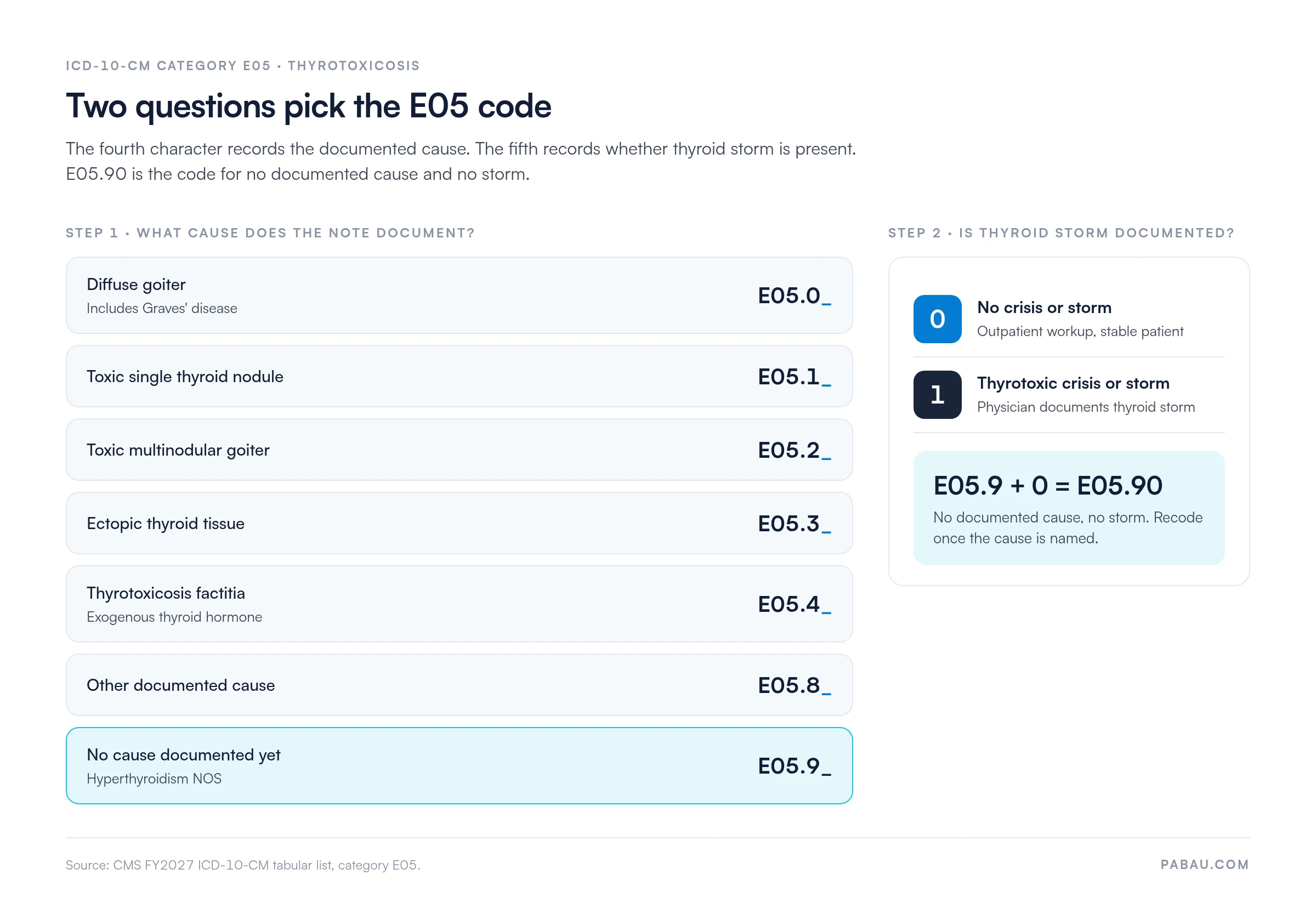
The table lists the official descriptor for each specific code and the documentation that should move you off E05.90. Knowing these codes prevents the specificity errors that lead to payer queries.
Run a documentation query before coding: search the visit note for terms like ‘Graves,’ ‘autoimmune thyroid,’ ‘TSH-receptor antibody,’ ‘multinodular,’ and ‘toxic adenoma.’ If any of these appear, the chart supports a specific E05 subcategory. Assigning E05.90 when etiology is documented is a specificity error that some Medicare Administrative Contractors flag during post-payment review.
Medical necessity for E05.90 rests on two elements. The note needs biochemical confirmation of thyroid overactivity, and it must show that no thyrotoxic crisis is present, either explicitly or through the encounter context.
Minimum documentation checklist:
Per the American Thyroid Association 2016 Hyperthyroidism Management Guidelines, suppressed TSH is the hallmark laboratory finding for thyrotoxicosis of any cause. Elevated FT4 or FT3 distinguishes overt thyrotoxicosis from the subclinical variant and strengthens the medical necessity argument for E05.90 on a claim.
E05.90 appears on claims alongside evaluation and management codes, thyroid function panels, and in some cases treatment procedure codes. In Pabau, the practice management platform we build, claims management software supports insurance billing and electronic claims for these visits.
The lab pair carries most of the medical-necessity weight. The TSH test bills as CPT 84443, and the free T4 that separates overt from subclinical disease bills as CPT 84439.
E05.90 claim denials cluster around two patterns: thin documentation and coding specificity errors. Effective denial management workflows for endocrinology practices monitor for both. Getting a clean claim out on the first attempt takes pre-submission checks on these failure points.
CMS and Medicare Administrative Contractors publish Local Coverage Determinations (LCDs) that govern medical necessity for thyroid function testing. E05.90 typically appears on covered-diagnosis lists for TSH and free T4 panels, but policies differ by MAC jurisdiction and are updated annually.
Key payer expectations for claims carrying E05.90:
Practices billing E05.90 through Pabau’s Claim.MD clearinghouse integration can run real-time eligibility checks and submit claims electronically before the claim leaves the practice. For a broader view of where clearinghouses fit, see our guide to medical billing fundamentals.
ICD-10 code E05.90 is valid for FY2025, FY2026 and FY2027. The code has been active and billable without revision since the United States adopted ICD-10-CM in October 2015 (FY2016). CMS publishes the ICD-10-CM tabular list and index each fiscal year, and E05.90 appears in every release without a deletion, revision or effective-date flag.
To verify E05.90 validity for a specific claim date, use the AAPC Codify ICD-10-CM lookup or the official CDC/NCHS web tool. Both reflect the current FY tabular list. When coding retrospectively, confirm that the service date falls within the code’s effective period.
Always confirm code validity against the fiscal year of the service date, not the claim submission date. A claim submitted in November 2026 for a service rendered in September 2025 must use codes valid for FY2025. The CMS ICD-10-CM tabular list archives are available on cms.gov for prior-year lookups.
On a typical thyroid workup, the coder reads the note and re-keys the diagnosis and lab codes into a billing tool. Coverage is then checked on a separate payer portal. Each hand-off is a chance for E05.90 to stay on the claim after the note has named Graves disease.
Pabau keeps the patient record, insurance details and claim in one system. US practices submit CMS-1500 and 837P claims through Claim.MD, run eligibility checks before the visit, and post ERA remittances back against the claim.
The coder works from the same record the clinician signed, so an updated diagnosis is in view before the claim goes out. When a remittance does come back denied, the team works it from the note that produced the claim.

Pabau links the patient record, eligibility checks and Claim.MD claim submission, so E05.90 encounters reach the payer with the documentation behind them.

Treat E05.90 as a working code. It is the right choice at the first thyroid visit, when labs show thyrotoxicosis and the cause is still open. It becomes the wrong one as soon as antibodies or imaging name the cause.
The habit that pays off is a code check at every follow-up. If the note now says Graves disease, a toxic nodule or factitia, the code changes with it. Cite the TSH and free T4 results in the assessment as well, and the two most common E05.90 denials stop happening.
Book a demo to see how Pabau keeps thyroid diagnoses, eligibility checks and claims in step for your endocrinology practice.

Need to understand how clearinghouse submission works for diagnosis codes? Medical claims clearinghouse guide explains the end-to-end electronic claim submission process for ICD-10-CM coded encounters.
Seeing recurring denials on thyroid and endocrine claims? Denial codes in medical billing covers CARC and RARC denial reason codes with resolution strategies for common payer rejections.
Want to verify eligibility before submitting E05.90 claims? Insurance eligibility verification outlines how payer checks before the visit reduce preventable denials.
Billing surgery while the cause is still unspecified? CPT code 60240 covers total thyroidectomy coding, documentation and the diagnoses that support it.
ICD-10 Code E05.90 is the billable diagnosis code for thyrotoxicosis, unspecified without thyrotoxic crisis or storm. It describes thyroid overactivity confirmed clinically or biochemically, where the cause has not been identified and no thyroid storm is occurring. It fits when TSH is suppressed and free thyroid hormones are raised. The workup has not yet shown Graves disease, a toxic nodule or another cause.
E05.90 is for thyrotoxicosis, unspecified without thyrotoxic crisis. E05.91 is for the same unspecified presentation with thyrotoxic crisis or storm. The only distinction is whether the physician has documented acute decompensation meeting thyroid storm criteria (fever, tachycardia, altered mental status). These two codes are never assigned together on the same claim.
E05.90 should be replaced as soon as the etiology is documented. If a subsequent visit note confirms Graves disease, E05.00 applies. If imaging shows toxic multinodular goiter, E05.20 applies. ICD-10-CM guidelines require the highest-specificity code available at the time of coding. Continuing to use E05.90 after etiology confirmation is a specificity error that can be flagged during post-payment audit.
Not precisely. Subclinical hyperthyroidism involves suppressed TSH with normal FT4 and FT3, meaning the clinical diagnosis of overt thyrotoxicosis has not been established. If the physician documents a thyrotoxicosis or hyperthyroidism diagnosis despite the subclinical picture, E05.90 is supportable. Sometimes the documentation shows only an abnormal lab finding, with no clinical diagnosis statement. In that case some payers and coding guidelines prefer a symptom or lab-finding code.
The most common denial reason is a specific E05 subcategory documented elsewhere in the record but not coded. Next come lab results that the clinical note never references, and an E/M level that the documented medical decision-making does not support. Checking the full note against the submitted code before submission prevents most of these.
Yes. E05.90 has been a valid, billable ICD-10-CM code without revision since FY2016. CMS lists it as active in the FY2026 and FY2027 tabular lists with no deletion or change flags. When coding retrospectively, check the service date’s fiscal year against the matching CMS ICD-10-CM release.