



CCSD code G5100: Bypass of duodenum billing guide
CCSD code G5100 bills a bypass that leaves the duodenum in place CCSD code G5100...

Last Updated: Oct 16, 2026

CPT Code 84439 is the AMA descriptor for thyroxine, free, meaning the unbound fraction of T4 rather than the total T4 measured by CPT 84436.
The 2026 national rate is approximately $8.82 under the Clinical Laboratory Fee Schedule, not the MPFS, and it varies by MAC jurisdiction.
Medicare does not cover routine asymptomatic thyroid screening under Part B, so 84439 needs a documented indication and an accepted ICD-10-CM code.
Practice management software like Pabau submits 84439 claims through Claim.MD, whose real-time claim validation and eligibility checks surface payer errors before submission.
CPT Code 84439 is the billing code for a free thyroxine (free T4) assay, which measures the fraction of T4 not bound to plasma proteins. The 2026 Clinical Laboratory Fee Schedule pays approximately $8.82 for it nationally. The order itself is usually placed correctly. The money is lost later, at the payer edits for medical necessity and same-date duplication.
This reference covers the official descriptor, the 2026 fee schedule, and medical necessity under NCD 190.22. It also sets out the ICD-10 codes payers accept, plus the reflex rules for billing 84439 with CPT 84443 (TSH). The documentation elements that keep claims clean come after that. The denial section is where high-volume thyroid panels leak the most revenue.
The American Medical Association maintains CPT Code 84439 under the descriptor Thyroxine; free. It represents the laboratory assay that measures free T4. That is the fraction of thyroxine circulating in blood that is not bound to plasma proteins such as thyroxine-binding globulin (TBG).
That distinction matters clinically. Total T4 (CPT 84436) measures all circulating thyroxine, bound and unbound. Free T4 reflects only the biologically active fraction available to tissues. It is therefore more accurate in patients with protein-binding abnormalities, including pregnancy, liver disease, certain medications, and familial dysalbuminemic hyperthyroxinemia. For most modern thyroid workups, free T4 has replaced total T4 as the preferred assay.
One terminology note. When documentation or orders use “FT4,” “free thyroxine,” or “unbound T4,” all three map to CPT Code 84439. Billing “free T4” and “thyroxine free” under different codes is an unbundling error that happens when lab orders are transcribed from different EHR templates.
CPT Code 84439 is paid under the Medicare Clinical Laboratory Fee Schedule (CLFS), not the Medicare Physician Fee Schedule (MPFS). RVU-based pricing does not apply, so an RVU lookup tool will not return a valid figure for this code. CMS sets CLFS rates annually under the Protecting Access to Medicare Act (PAMA) methodology, which ties lab payment to weighted median private-payer rates.
For 2026, the national rate for CPT Code 84439 is approximately $8.82. That is a single amount for every setting, because lab codes carry one CLFS rate rather than a facility and non-facility split. Verify the current figure in the official CMS CLFS rate file for your locality before you submit claims or update your chargemaster.
Commercial payers negotiate rates independently. Many use Medicare as a floor multiplier rather than the CLFS rate directly. Check your payer contracts for the allowed amount per plan, especially on high-volume thyroid panels where small per-unit differences compound quickly.
Medicare coverage of CPT Code 84439 is governed by National Coverage Determination (NCD) 190.22, Thyroid Testing. The NCD establishes that free T4 testing is covered when medically necessary to diagnose or treat a thyroid disorder. Individual MACs may publish Local Coverage Determinations (LCDs) that add restrictions on covered indications, frequency, or documentation. Verify the applicable LCD for your MAC before billing.
The clearest coverage rule concerns screening. Under Part B, Medicare does not pay for routine asymptomatic thyroid testing. Primary care practices run into this when 84439 sits in a standing panel attached to the annual wellness visit. A screening thyroid test in an asymptomatic patient with no relevant diagnosis is non-covered. It is denied, or billed to the patient with an ABN.
Confirm coverage for the specific patient before ordering, particularly under Medicare Advantage plans. Those plans may apply prior authorization requirements beyond the NCD and LCD rules that govern Medicare fee-for-service.
Check your MAC’s current LCD for CPT 84439 before the start of each calendar year. LCDs update independently of the national NCD. They can restrict covered indications or add frequency limits that are stricter than NCD 190.22. Novitas, CGS, WPS, and Palmetto each publish their thyroid testing LCDs in the CMS Coverage Database.
Payer acceptance of specific ICD-10-CM codes with CPT Code 84439 varies by payer and by MAC LCD. Use the CDC/NCHS ICD-10-CM web tool to verify that a code is still valid. The table below lists codes payers commonly accept. Label them “commonly accepted” in your chargemaster documentation rather than “always covered,” because individual payer policies differ.
CPT Code 84439 rarely stands alone in clinical practice. Knowing the full thyroid panel code set prevents unbundling errors and helps coders pick the right combination for each ordering scenario. The AAPC Codify CPT lookup tool verifies descriptors and crosswalks across the panel.
Billing CPT Code 84439 and CPT 84443 together on the same date is permitted. Both tests need to be medically necessary, each with a documented clinical indication. Co-billing is not automatically denied. The most defensible scenario is reflex testing, where an in-office or standing order protocol triggers free T4 once TSH falls outside the reference range.
Reflex testing from abnormal TSH is the standard clinical trigger for ordering free T4. Quest Diagnostics and LabCorp both offer cascade reflex protocols, where an out-of-range TSH result automatically generates the 84439 order. The billing documentation has to capture the abnormal TSH value and the clinical rationale for the reflex.
Practices that order TSH and free T4 together as a standing panel, rather than reflexively, need separate clinical justification documented for each code. Payers may request medical records to verify that both tests were independently necessary.
Many payers restrict same-date billing of CPT Code 84439 (free T4) and CPT 84436 (total T4). Ordering both on the same date reads as redundancy to payer edits, because free T4 already measures the clinically relevant fraction. Some payers pay one and deny the other. Others bundle both and pay only the lower-value code.
Frequency limitations are the second common denial trigger. Certain MAC LCDs cap how often free T4 can be ordered for a given diagnosis within a rolling period. A practice monitoring stable hypothyroidism with quarterly free T4 panels will hit that cap. Tracking your denial rate by denial codes across your payer mix shows which plans need attention first.
Those edits do not fire at random. A free T4 claim passes through five checks in a fixed order. The one it fails tells you whether to appeal, rebill, or bill the patient.
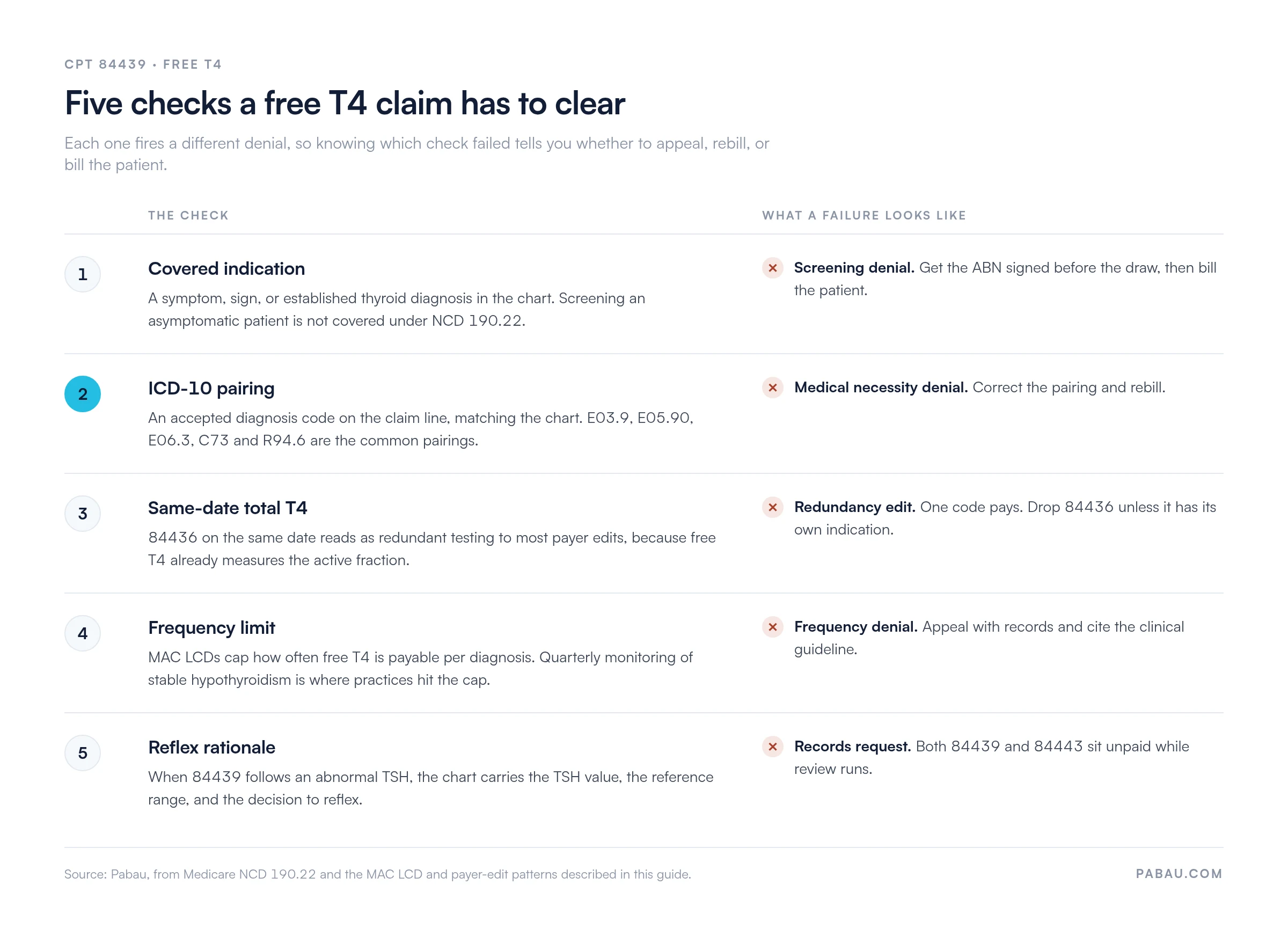
Payers reviewing claims for CPT Code 84439 look for specific elements in the medical record. Missing any one of them is enough to trigger a records request or an outright denial. Build these elements into the encounter template you use for every thyroid panel order.
Keep the lab order, the chart note, and the claim data aligned. A discrepancy between the diagnosis in the chart and the ICD-10 on the claim is a primary audit trigger. Submitting clean claims for lab codes means all three documents tell the same story.
Audit your EHR lab order templates for CPT 84439 at the start of each year. Confirm that the default ICD-10 pairings still match your MAC’s covered indications. Templates built years ago often carry outdated diagnosis codes that generate avoidable denials, and a 30-minute audit prevents months of rework.
Coding reference tools tell you what CPT 84439 is, then stop at the lookup. The billing workflow that follows is where the reimbursement is actually lost. Missing ICD-10 pairings, stale CLFS rates, and untracked denial patterns each erode payment on high-volume thyroid panels.
Practice management software like Pabau covers that stretch of the workflow. Pabau’s claims management software captures lab orders at the point of care and submits claims electronically through Claim.MD, our US clearinghouse partner. Claim.MD connects to thousands of US payers and handles CMS-1500 and 837P claims. Its real-time claim validation and eligibility checks surface payer-level errors while the claim is still cheap to correct.
For practices billing thyroid panels at volume, the reporting layer matters too. Tracking denials by code across your payer mix shows which plans enforce frequency limits. It also shows which apply the 84439 and 84436 same-date restriction, and where reflex documentation falls short. That data supports proactive appeal workflows instead of reactive claim reviews.

Pabau submits your thyroid panel claims through Claim.MD, whose real-time claim validation and eligibility checks surface payer errors before the claim leaves your practice.

CPT Code 84439 is one of the most frequently ordered lab codes in primary care and endocrinology, and one of the most consistently underdocumented. Three places account for most of the leak. They are the ICD-10 pairing, the same-date restriction with 84436, and the reflex documentation payers audit hardest.
At roughly $8.82 a test, no single 84439 denial is worth chasing on its own. The volume is what makes it worth fixing upstream. Audit your order templates against your MAC’s current LCD once a year. Most of the denial pattern then disappears before a claim is ever submitted.
Pabau submits thyroid panel claims through Claim.MD, where validation and eligibility checks run before the claim reaches the payer. If lab billing is costing you reimbursement, book a demo to see how it fits your existing workflow.

Need to understand how clearinghouse claim submission works end-to-end? Medical claims clearinghouse guide covers how claims route from provider to payer and where edits fire.
Getting Claim.MD-specific pricing questions from your billing team? Claim.MD pricing breakdown explains the clearinghouse cost model and what’s included.
Want to compare clearinghouse options before committing? Claim.MD vs Office Ally comparison covers the key differences for independent practices.
CPT Code 84439 is the billing code for a laboratory assay that measures free thyroxine (free T4). That is the unbound, biologically active fraction of T4 circulating in blood. Unlike total T4 (CPT 84436), free T4 is not affected by protein-binding changes from pregnancy, liver disease, or certain medications. That makes it the preferred assay for thyroid function assessment in most clinical scenarios.
The 2026 national rate for CPT Code 84439 is approximately $8.82 under the Clinical Laboratory Fee Schedule (CLFS). Rates vary by MAC jurisdiction. Verify the current-year figure in the official CMS CLFS rate file for your locality before you update a chargemaster or a billing estimate.
No. Medicare does not cover routine asymptomatic thyroid screening under Part B per NCD 190.22. CPT Code 84439 requires a documented clinical indication tied to a covered ICD-10-CM diagnosis. For a patient with no symptoms and no relevant diagnosis, issue an Advance Beneficiary Notice (ABN) before the test. The patient then knows they may be financially responsible.
The most common denials come from billing 84439 and 84436 (total T4) on the same date. Others come from a missing or unsupported ICD-10 code, ordering for an asymptomatic patient, exceeding a MAC LCD frequency limit, or thin reflex documentation. Most of these are preventable by auditing order templates and confirming ICD-10 pairings before the claim submits.



