84480 is the CPT code for triiodothyronine T3; total (TT-3), a serum lab test that measures bound and free T3 together. Medicare pays it under the Clinical Laboratory Fee Schedule when the claim carries a supporting ICD-10 diagnosis, such as E05.90 or R94.6.
Two sibling codes sit beside it: 84481 for free T3 and 84482 for reverse T3. The analyte named on the lab report decides which one you bill.
Related Information
Section
80047-89398 Pathology and laboratory
Subsection
82009-84999 Chemistry
Code range
84479-84482 Thyroid hormone (T3/T4) tests
Billable
No
Code also known as
total T3, TT-3, serum T3, T3 total
Save time. Improve accuracy. Get paid faster.
Automate coding with Pabau
Let Pabau's smart automation suggest the right codes, reduce claim denials, and keep your practice compliant—effortlessly.
Automate repetitive tasks and focus on what matters most—your patients.
Improve accuracy
Reduce coding errors and ensure compliance with the latest regulations.
Get paid faster
Clean claims, fewer denials, and faster reimbursements.
Grow with confidence
Powerful insights and reporting to help your practice thrive.
HIPAA compliant•SOC 2 certified•GDPR-compliant•Trusted by 4,000+ clinics worldwide
Key takeaways
CPT code 84480 covers total T3 (TT-3), which measures the bound and free fractions of serum triiodothyronine together.
Free T3 is billed with 84481 and reverse T3 with 84482, so the analyte on the lab report decides the code.
E05.90 (thyrotoxicosis, unspecified) and R94.6 (abnormal thyroid function study) are the most common pairings that support medical necessity.
Medicare pays 84480 under the Clinical Laboratory Fee Schedule, and the national limit is updated every year.
Pabau, the practice management platform we build, submits 84480 claims through Claim.MD and tracks each one until the payer responds.
CPT code 84480: definition and official descriptor
CPT code 84480 is the American Medical Association-maintained procedure code for measuring total serum triiodothyronine. The full official descriptor is: Triiodothyronine T3; total (TT-3).
Total T3 quantifies both the protein-bound fraction (primarily bound to thyroxine-binding globulin) and the small free fraction together. This differs from CPT 84481, which isolates only the free (unbound) fraction, and from CPT 84482, which measures reverse T3, a biologically inactive metabolite. Getting the right code starts with confirming exactly which T3 analyte the ordering provider specified on the requisition.
Attribute
Detail
CPT code
84480
Official descriptor
Triiodothyronine T3; total (TT-3)
CPT section
Pathology and Laboratory
Subsection
Chemistry
Specimen type
Serum or plasma
Methodology
Immunoassay (chemiluminescent or radioimmunoassay)
Medicare coverage
Yes, under Clinical Laboratory Fee Schedule (CLFS)
Clinical indications: when is triiodothyronine T3 total ordered?
Total T3 is ordered when a clinician needs to quantify the overall thyroid hormone load, particularly in scenarios where TSH alone is insufficient. These orders usually arrive alongside TSH and free T4.
The most commonly documented clinical indications are:
Suspected hyperthyroidism with suppressed TSH: total T3 confirms T3 thyrotoxicosis when free T4 is normal but TSH is low. That pattern is common in early Graves disease.
Monitoring T3 thyrotoxicosis: patients already diagnosed with hyperthyroidism require periodic T3 measurement to track treatment response; ICD-10 E05.90 (thyrotoxicosis, unspecified) applies.
Euthyroid sick syndrome evaluation: critically ill patients can have abnormal total T3 despite a normal TSH. ICD-10 E07.81 (sick-euthyroid syndrome) or E03.9 may be used depending on clinical context.
Post-thyroidectomy monitoring: following total or partial thyroidectomy, total T3 alongside TSH helps assess residual thyroid tissue function.
Evaluation of abnormal thyroid function studies: R94.6 fits when prior lab results are abnormal and the clinician is still investigating before a definitive diagnosis.
Total T3 is rarely ordered as a standalone initial screening test. TSH remains the first-line thyroid marker. CPT 84480 earns its medical necessity when TSH findings need clarification.
Covered ICD-10 diagnosis codes for CPT code 84480
Payers apply local coverage determinations (LCDs) to thyroid testing. The ICD-10 code must map directly to the clinical indication documented in the chart. Below are the codes most frequently accepted for CPT 84480. Confirm active status against the CDC/NCHS ICD-10-CM tool before billing, because codes are updated each October 1.
ICD-10 code
Description
Typical clinical scenario
E05.90
Thyrotoxicosis, unspecified without thyrotoxic crisis or storm
Suppressed TSH; total T3 elevated confirming thyrotoxicosis
E05.00
Thyrotoxicosis with diffuse goiter without thyrotoxic crisis or storm
Graves disease monitoring; T3 used to track disease activity
E03.9
Hypothyroidism, unspecified
Evaluating T3 conversion in patients on levothyroxine
E07.9
Disorder of thyroid, unspecified
General thyroid workup when a specific diagnosis is not yet confirmed
E07.81
Sick-euthyroid syndrome
Euthyroid sick syndrome in hospitalized or critically ill patients
R94.6
Abnormal results of thyroid function studies
Prior abnormal TSH or T4 result requiring further investigation
Z79.899
Other long-term (current) drug therapy
Monitoring patients on amiodarone, lithium, or other thyroid-affecting medications
Always verify the applicable LCD for your MAC region. Not every payer accepts all codes in the E00-E07 block for standalone total T3 ordering. Some require a documented reflex protocol or a prior TSH result in the chart.
CPT 84480 vs. CPT 84481 vs. CPT 84482: choosing the right code
The three T3 codes measure different analytes. Billing the wrong one generates a denial that no modifier can correct. The claim has to be resubmitted under the correct code with an updated requisition.
Code
Official descriptor
What is measured
Primary clinical use
84480
Triiodothyronine T3; total (TT-3)
Total T3 (bound + free fractions combined)
Confirm hyperthyroidism; monitor T3 thyrotoxicosis; post-thyroidectomy follow-up
84481
Triiodothyronine T3; free
Free (unbound) T3 fraction only
Assess bioavailable thyroid hormone when binding proteins are abnormal (pregnancy, liver disease)
84482
Triiodothyronine T3; reverse
Reverse T3 (rT3), the inactive metabolite
Evaluate euthyroid sick syndrome; suspected impaired T4-to-T3 conversion; certain integrative medicine protocols
A quick audit rule: if the lab report says “TT3” or “T3 total,” use 84480. If the report says “FT3” or “free T3,” use 84481. If it says “rT3” or “reverse T3,” use 84482. The codes are not interchangeable. NCCI does not bundle them, so all three can appear on the same claim. Each one still needs its own medical necessity documentation.
Companion codes billed with total T3
Total T3 is almost never the only code on a thyroid claim. Verify current NCCI edits at the AAPC Codify CPT lookup before submitting any code combination, as edit pairs change quarterly.
TSH:CPT 84443 is the most common companion. TSH is the first-line thyroid marker, and total T3 is added when TSH is suppressed and hyperthyroidism needs confirmation. These two codes are routinely billed together with no NCCI conflict, provided both tests were independently ordered and resulted.
Free T4:CPT 84439 is frequently ordered alongside total T3 in hyperthyroid workups to assess both thyroid hormones at once. Verify payer panel bundling rules before billing 84480 and 84439 together.
CPT 84436 (total T4): some practices order total T4 alongside total T3 in initial thyroid evaluations; coverage varies by MAC and payer LCD.
CPT 80091 or 80092 (thyroid panel): some payers auto-bundle individual thyroid codes into a panel code if the combination is submitted together. Check whether your payer’s edit logic converts a set of individual codes into a lower-paying panel before you submit unbundled.
Pro Tip
Before billing CPT 84480 with 84443, confirm the ordering provider’s requisition specifically lists both tests. Billing two codes from a single-test order is a compliance exposure. Document the rationale for each test separately in the chart.
Medicare reimbursement rate for CPT 84480
CPT 84480 is reimbursed under the CMS Clinical Laboratory Fee Schedule (CLFS), not the Physician Fee Schedule. The CLFS national limit is updated annually, so pull the current figure from the CMS CLFS file before quoting it.
A few billing realities to note for Medicare claims on 84480:
Assignment is mandatory: Medicare Part B laboratory claims must be submitted on assignment. The allowed amount is the payment ceiling; you cannot balance-bill a Medicare beneficiary for the difference.
ABN requirements: medical necessity can be borderline, for example total T3 for a patient with a normal TSH and no documented symptoms. In that case, issue an Advance Beneficiary Notice of Noncoverage (ABN) before the test is performed. Without an ABN, you cannot bill the patient if Medicare denies.
Performing lab NPI: the claim must identify the laboratory that performed the test. Ordering provider NPI alone is insufficient for lab claims.
Electronic claim submission: most providers must bill Medicare electronically in the 837P format. A clearinghouse such as Claim.MD routes the file to the payer and reports the claim’s status back to you.
Documentation requirements for CPT code 84480
Good medical billing documentation for a total T3 claim must answer five questions a payer or auditor will ask. Missing any one of them increases denial risk.
Who ordered the test? The ordering provider’s name and NPI must appear on the requisition and the claim. Referring and ordering providers are tracked separately under CLIA and Medicare Part B rules.
Why was it ordered? The chart note must document the clinical indication. That can be a specific symptom (palpitations, weight loss, heat intolerance), an abnormal prior lab result, or a diagnosed condition from the covered ICD-10 list. A note that says only “thyroid panel” without clinical context does not support medical necessity.
When was the specimen collected? The collection date drives the date of service on the claim. Discrepancies between the lab report date and the claim date of service trigger edits.
What did the result show? The lab report with the resulted value must be present in the chart. An ordered test with no resulted report is an incomplete encounter.
What was the clinical interpretation? At least one sentence in the encounter note should tie the total T3 result to the clinical decision. “Total T3 elevated at 280 ng/dL consistent with T3 thyrotoxicosis; increasing methimazole dose” is sufficient. A result filed with no provider interpretation leaves the chart without proof that the test shaped care.
Common denial reasons for CPT 84480 and how to fix them
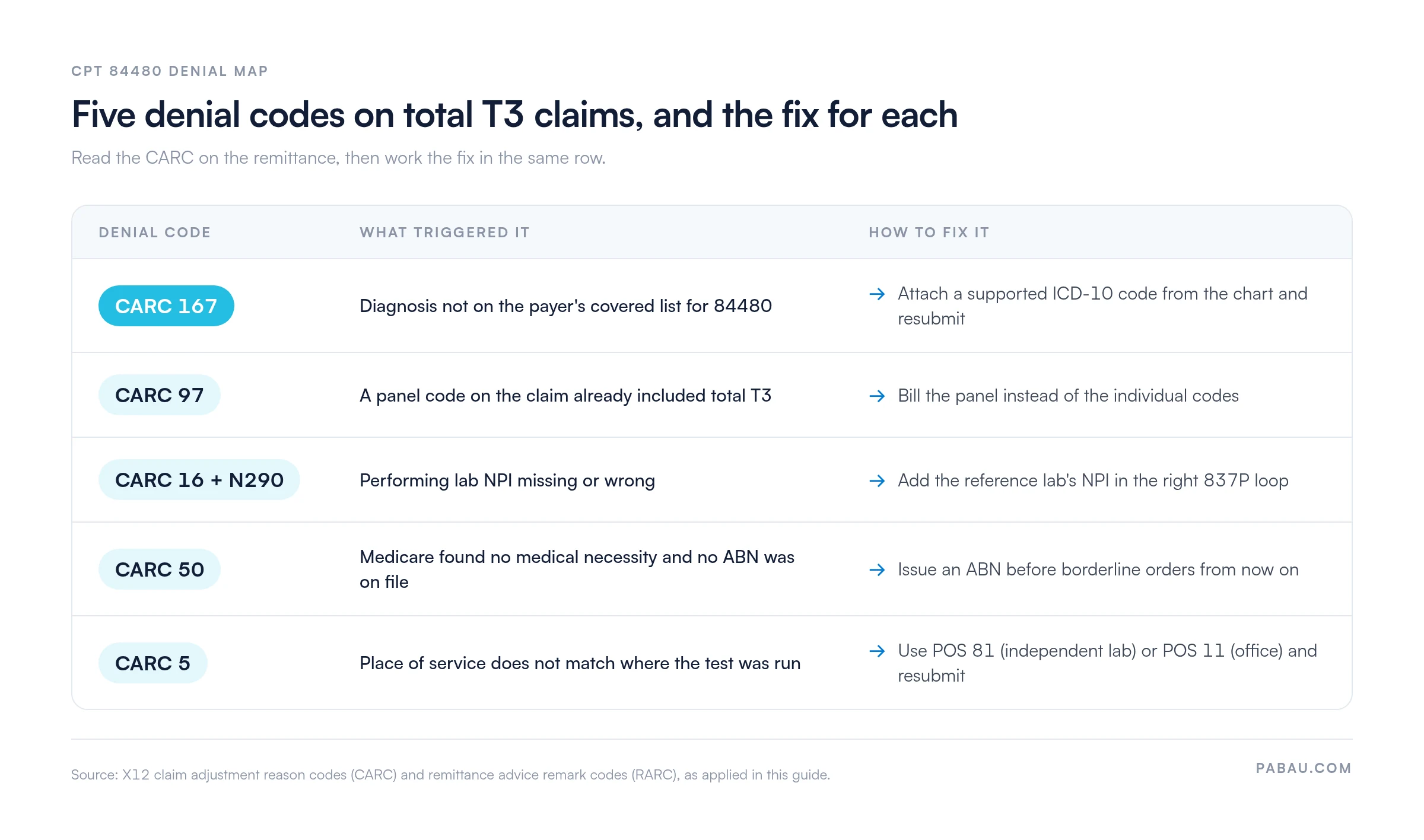
Thyroid lab claims have a predictable denial pattern. Solid denial management workflows catch most before submission. The map below pairs the five most common denial codes with their causes, and the list gives each fix.
Most 84480 denials trace to the diagnosis or the lab NPI rather than the code itself. Codes follow the X12 CARC and RARC lists.
ICD-10 does not support medical necessity (CARC 167): the diagnosis is not on the payer’s covered list for 84480. Fix: review the applicable LCD, pick a supported ICD-10 from the documented conditions, and resubmit. If none applies, check whether an ABN was issued before the order.
Service already included in a panel (CARC 97): 84480 was billed separately when a panel code already included total T3. Fix: check whether your payer bundles thyroid codes into a lower-paying panel, and if so, bill the panel.
Missing or incorrect performing lab NPI (CARC 16 with RARC N290): the claim carries the ordering provider’s NPI instead of the reference lab’s. Fix: enter the correct performing lab NPI in the appropriate loop of the 837P.
Non-covered service without ABN (CARC 50): Medicare denied for medical necessity and no ABN was on file. Fix: issue an ABN when the indication is ambiguous. The patient cannot be billed retroactively without a signed ABN.
Incorrect place of service (CARC 5): the place of service does not match where the test was run. Labs typically use POS 81 (independent laboratory) or POS 11 (office). Fix: confirm POS against the performing lab’s setting and resubmit.
These steps keep thyroid claims off the denial queue. They work best inside a wider medical billing compliance program.
Check the LCD before the order is placed. Your MAC’s LCD for thyroid testing lists exactly which ICD-10 codes are covered for 84480. Sharing this list with ordering providers during onboarding prevents the most common medical-necessity denial before it starts.
Verify modifier QW eligibility before applying it. Modifier QW designates a test as a CLIA-waived laboratory service. CPT 84480 is not typically a waived test under current CLIA categories; applying QW incorrectly triggers an edit. Confirm your CLIA certificate type and the current CMS waived-test list before using QW on any 844xx claim.
Check the panel bundling logic for your payer. Some commercial payers automatically crosswalk a combination of 84480, 84443, and 84439 into a lower-paying panel code. Submit a test claim or check your payer’s edit matrix before routinely billing these three codes together unbundled.
Carry the requisition’s diagnosis onto the claim. The ICD-10 code on the claim should match the one the ordering provider wrote on the requisition. Compare the two before submission, because a mismatch is a quick route to a CARC 167 denial.
Confirm the performing lab’s NPI is in your claims system. Reference labs have their own NPIs, and this information changes when labs are acquired or rebranded. A stale NPI in your system generates a consistent denial pattern that can take months to diagnose if you’re not checking it proactively.
Pro Tip
Run a monthly audit of your 844xx denials sorted by CARC code. If CARC 167 (medical necessity) appears more than three times in 30 days, the ordering provider’s documentation template likely needs a covered ICD-10 pre-population update.
How Pabau submits and tracks CPT 84480 claims
Many practices key the same thyroid order into three places: the chart, the lab requisition and the billing system. Each retyping is a chance for the diagnosis or the NPI on the claim to drift from what the provider documented.
Pabau keeps the encounter note, the invoice and the claim against one patient record. Its claims management software submits the claim through Claim.MD and tracks its status. Your team spots a rejected 84480 claim without logging in to a separate portal.
The result is fewer hand-offs between clinical and billing staff, and one place to work a denial once the EOB arrives.
Submit and track your lab claims in one place
Pabau sends your lab claims through Claim.MD and tracks each one. Thyroid test denials show up in the same system that holds the patient record.
Treat 84480 as a matching exercise. The analyte on the lab report picks the code, and the chart note picks the diagnosis. When both agree with the requisition, total T3 claims rarely come back.
The judgment call sits with borderline orders. An ABN takes a minute at the order, while skipping it leaves the practice holding a denied test it cannot bill. Book a demo to see how Pabau submits and tracks your lab claims through Claim.MD.
Continue your research
Need to understand how clean claims reduce thyroid billing rework?What makes a clean claim walks through the elements payers check before processing any lab submission.
Want a primer on how clearinghouses handle 837P submissions?Medical claims clearinghouse overview explains how electronic claims are validated and routed to payers.
Looking to reduce your practice’s overall denial rate?Revenue cycle management explained covers the end-to-end workflow from patient encounter to final payment.
Coding a hypothyroid patient’s T3 order?ICD-10 code E03.9 explains when unspecified hypothyroidism is the right diagnosis to attach.
Frequently asked questions
What does CPT code 84480 cover?
CPT code 84480 covers the laboratory measurement of total serum triiodothyronine (T3), including both the protein-bound and free fractions combined. It is used to evaluate thyroid hormone status, confirm hyperthyroidism, monitor T3 thyrotoxicosis, and assess thyroid function after thyroidectomy.
What is the difference between CPT 84480 and CPT 84481?
CPT 84480 measures total T3 (bound plus free fractions together), while CPT 84481 measures only the free (unbound) T3 fraction. Free T3 via 84481 is preferred when binding protein abnormalities, such as those seen in pregnancy or liver disease, may skew total T3 results.
What is the difference between CPT 84480 and CPT 84482?
CPT 84482 covers reverse T3 (rT3), a biologically inactive metabolite of T4 conversion, while CPT 84480 covers total T3, the active hormone. Reverse T3 is ordered in specific clinical contexts such as euthyroid sick syndrome or suspected impaired T4-to-T3 conversion, not as a general thyroid screen.
What is the TSH CPT code billed with 84480?
CPT 84443 is the code for thyroid-stimulating hormone (TSH), and it is the most common companion to CPT 84480. TSH is typically the first-line thyroid test, and total T3 is added when TSH is suppressed and hyperthyroidism needs confirmation. Both codes require independent medical necessity documentation.
Why would a claim for CPT 84480 be denied?
The most common reason is an ICD-10 code that is not on the payer’s covered-diagnosis list for 84480 (CARC 167). Claims also deny when a panel code already included total T3 (CARC 97). A missing or wrong performing lab NPI draws CARC 16 with RARC N290. A third trigger is a Medicare medical necessity denial with no ABN on file (CARC 50).