



CCSD code G5100: Bypass of duodenum billing guide
CCSD code G5100 bills a bypass that leaves the duodenum in place CCSD code G5100...

Last Updated: Oct 16, 2026

CPT Code 84443 reports thyroid stimulating hormone (TSH) measurement in serum or plasma, used to diagnose and monitor thyroid disorders.
The 2026 Medicare rate for CPT 84443 is $16.44 under the Clinical Laboratory Fee Schedule, a single national amount with no locality adjustment.
Medicare covers TSH testing up to two times a year in clinically stable patients under NCD 190.22, and more often when therapy changes.
Medical necessity needs a supported ICD-10-CM code such as E03.9, E05.90, or E06.3, matched to the indication in the clinical note.
Practice management software like Pabau automates ICD-10 pairing and claim submission for lab codes like 84443, reducing denials at the source.
CPT Code 84443 is the billing code for a quantitative thyroid stimulating hormone (TSH) test performed on serum or plasma. Medicare pays $16.44 for it under the Clinical Laboratory Fee Schedule. Denials on this code rarely come from the test itself. They come from a mismatched ICD-10 code, thin medical necessity documentation, or a modifier 91 applied to a repeat draw that does not qualify.
Getting 84443 paid is mostly a workflow question rather than a coding one. This reference covers the official descriptor, the clinical indications, and the ICD-10 pairings. It then works through 2026 Medicare reimbursement, NCD 190.22 coverage rules, documentation, modifiers, and related thyroid chemistry codes.
CPT Code 84443 is the code for measuring thyroid stimulating hormone (TSH) in serum or plasma to diagnose and monitor thyroid disorders. The code covers a quantitative chemistry test, billed once per specimen.
The 84443 CPT code description maintained by the American Medical Association (AMA) is deliberately short. The formal descriptor reads: Thyroid stimulating hormone (TSH). The descriptor names no indication, which is why the diagnosis code carries the entire medical necessity argument on a TSH claim.
TSH is produced by the anterior pituitary gland and regulates thyroid hormone synthesis. When TSH levels fall outside the reference range, the result signals dysfunction either at the thyroid gland (primary) or the pituitary (secondary). The test runs on a venous blood sample processed in a laboratory certified under the Clinical Laboratory Improvement Amendments (CLIA).
CPT 84443 sits within the Chemistry Procedures section of the CPT code set. The code is panel-eligible, so it can share a claim with related thyroid chemistry codes. Correct Coding Initiative (CCI) edits govern which of those pairings actually get paid.
Draw staff regularly ask what color tube TSH and T4 need, and the answer decides whether the specimen is usable. A gold-top serum separator tube is the standard draw for both analytes. Many labs also accept green-top lithium heparin plasma, and the UF Health Pathology Laboratories test directory lists exactly that pairing for third-generation TSH.
Confirm the requirement in your reference lab’s own catalog before the draw. A rejected specimen means a second visit and no billable test.
CPT Code 84443 is used to diagnose hypothyroidism and hyperthyroidism, monitor thyroid replacement therapy, and evaluate pituitary-related thyroid dysfunction. Ordering outside those indications without a documented rationale is a fast path to a medical necessity denial.
Accepted clinical scenarios include:
Screening TSH in an asymptomatic adult with no qualifying risk factor is not routinely covered by Medicare. Document the specific indication in the order and in the clinical note every time.
The ICD-10-CM codes most often paired with CPT 84443 are E03.9 for hypothyroidism, E05.90 for thyrotoxicosis, and E06.3 for autoimmune thyroiditis. Each has to match the indication the clinician actually documented, not the suspicion that prompted the draw.
Every CPT 84443 claim needs a supporting ICD-10-CM diagnosis code that justifies medical necessity. The table below lists the codes that carry most TSH claims. Verify each against our ICD-10-CM code library before billing, because the Centers for Medicare and Medicaid Services (CMS) updates the tables annually.
Each Medicare Administrative Contractor (MAC) publishes an 84443 covered diagnosis list. A code outside that list gets denied even when the test was clinically right. Use the most specific code the documentation supports. A mismatch between the clinical note and the billed ICD-10-CM code is a top trigger for audit flags.
Choosing an ICD-10 code for TSH screening under Medicare is the harder case. Screening qualifies only when a documented risk factor supports it, such as pregnancy, a pituitary disorder, or an autoimmune condition.
Z13.29 covers screening for a suspected endocrine disorder, and it is not a general-purpose substitute for a diagnostic code. When no risk factor is recorded, the claim needs a diagnostic code or an Advance Beneficiary Notice on file.
The 2026 Medicare rate for CPT 84443 is $16.44 under the Clinical Laboratory Fee Schedule. That amount is a single national rate, so it does not shift between localities. Private payer contracts routinely land somewhere different.
The CPT code for TSH is paid under the Clinical Laboratory Fee Schedule (CLFS), not the Physician Fee Schedule. That distinction matters because CLFS rates carry no work, practice expense, or malpractice RVU components.
Under the Protecting Access to Medicare Act (PAMA), each CLFS code carries one national payment amount with no geographic adjustment. CMS revises those amounts and publishes them in the CMS Clinical Laboratory Fee Schedule files.
Check the current CLFS file before you quote a patient a self-pay price. Contracted rates for the TSH CPT code often differ from Medicare by several dollars in either direction. Check in-network rates payer by payer rather than assuming the Medicare number holds.
Reconcile every remittance against that expected rate rather than spot-checking. An underpayment on a $16.44 test is easy to miss one claim at a time, and obvious across a quarter.
The laboratory that performs the test bills the 84443 CPT code, not the ordering provider. If your practice operates an in-house lab under a CLIA certificate, you may bill directly. If you send specimens to a reference lab, that lab bills the code and you bill the evaluation and management (E/M) visit. Billing 84443 for a test you did not perform is a compliance violation under OIG lab billing guidelines.
Medicare covers CPT 84443 under NCD 190.22 for diagnosis and monitoring of thyroid disorders, plus the screening indications each MAC’s local coverage determination allows.
CMS National Coverage Determination 190.22 governs Medicare coverage for thyroid testing, and it applies to 84436, 84439, 84443, and 84479 together. NCD 190.22 covers TSH testing for the following qualifying indications:
NCD 190.22 sets a frequency ceiling as well as a coverage list. CMS states that thyroid testing may be covered up to two times a year in clinically stable patients. More frequent testing is reasonable and necessary where thyroid therapy has been altered, or where signs of hyperthyroidism or hypothyroidism are noted.
That ceiling catches practices out on levothyroxine follow-up. A stable patient on a steady dose supports two covered TSH draws in a calendar year. A third draw needs the record to show the dose changed, or that new symptoms appeared. Without that note, the claim is a predictable denial rather than an unlucky one.
Beyond the NCD, each MAC may publish a Local Coverage Determination (LCD) that adds or restricts criteria within its jurisdiction. Check the LCD from your MAC before billing a screening TSH. That matters most for a patient who does not clearly meet one of the diagnostic categories above.
Working with a US clearinghouse that validates claims against payer-specific coverage rules before submission reduces downstream denials. Practice management software like Pabau passes CPT and ICD-10 codes through real-time validation against US payer policies before the claim reaches the MAC.
Six elements must be in the record before an 84443 claim goes out, from the ordering provider’s credentials to the performing lab’s CLIA number. Missing documentation causes more 84443 denials than any coding error.
Review your superbill workflow so ICD-10 codes are pulled from the clinical note automatically rather than typed in by billing staff. Manual re-keying at the billing stage is where diagnosis-to-claim mismatches most often start. Consistent documentation habits on lab orders cut audit risk noticeably.
Build a TSH order template in your EHR that pre-populates the clinical indication field and links directly to the ICD-10-CM code. When a clinician selects E03.9 in the diagnosis field, the template prompts documentation of specific symptoms. This single workflow change removes the most common documentation-related denial on 84443.
Clean documentation still produces denials when modifiers are misapplied. The issues below surface most frequently on 84443 claims.
Modifier 91 is the Repeat Clinical Diagnostic Laboratory Test modifier. It applies when the same test is medically necessary twice on one day, for distinct clinical reasons. It does not apply to specimen redraws, test failures, or confirmatory retesting of the same result.
Appending 91 to a routine follow-up TSH draw weeks later is a common error that invites payer scrutiny. A follow-up draw is a new date of service, not a same-day repeat. Verify against current CCI edits and your MAC’s modifier policy before appending 91 to any 84443 claim.
Tag 84443 denials with their reason codes so billing teams can read patterns across the claim population instead of working denials one by one. CO-4 covers a non-covered procedure and CO-50 a non-covered service. Tracking lab-code denials separately from E/M denials surfaces those patterns faster.
TSH alone answers most clinical questions, but thyroid function evaluation sometimes needs a second chemistry code. CPT code 84439 and CPT code 84436 are the two that appear most often alongside 84443. Knowing when each is appropriate, and how CCI edits apply, prevents bundling denials when several codes share a claim.
Which second code you reach for is decided by the TSH result itself, not by the panel a lab happens to offer. The reflex logic below traces that path from a TSH result to the code that follows it.
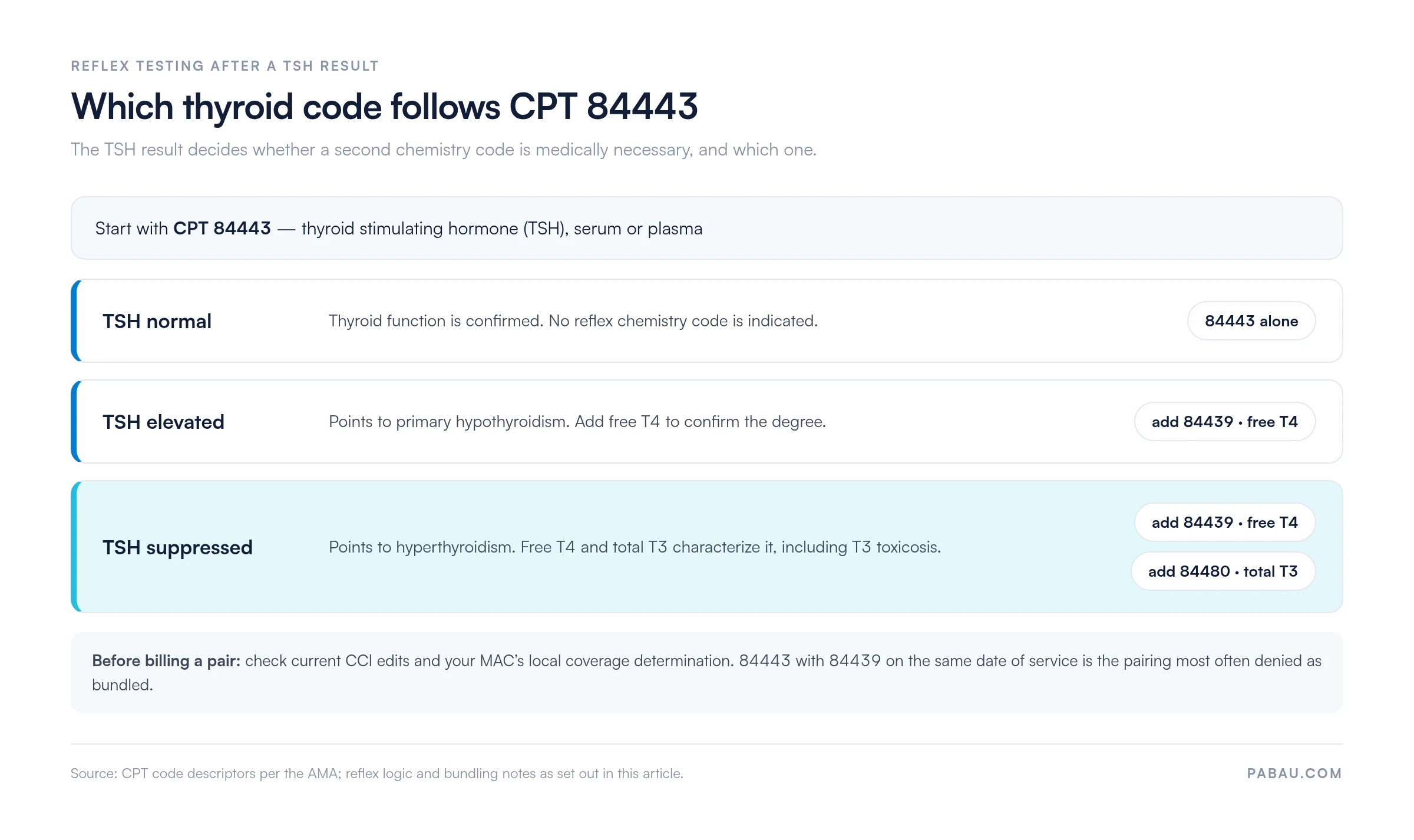
The pairing that matters most for billing is 84443 with CPT code 84439. When TSH is suppressed, measuring T4 is often medically necessary to characterize the degree of hyperthyroidism. Verify the payer’s CCI edit status for that pair before billing both on the same date of service. The AMA coding resources page gives subscribers access to the official CCI edit tables.
Run a quarterly audit of your 84443 claims billed alongside 84436 or 84439. Pull denial reason codes CO-97 (bundled service) and CO-B7 (provider not certified). If either appears at above 5% frequency on thyroid chemistry claims, a CCI edit or CLIA credential issue is almost certainly the cause.
Lab billing errors for codes like 84443 start at the front of the workflow, not in the billing department. A clinician picks a diagnosis in the chart and writes a lab order. That ICD-10 code then has to reach the claim without anyone retyping it. A paper requisition, a manual code lookup, or a disconnected billing module each break that chain.
Pabau’s software for billing teams links clinical documentation to claim generation. The diagnosis recorded in the patient’s chart drives the ICD-10 code on the submitted claim. Claims then go out through an integrated clearinghouse with real-time eligibility and coding validation, which catches problems before they reach the MAC.
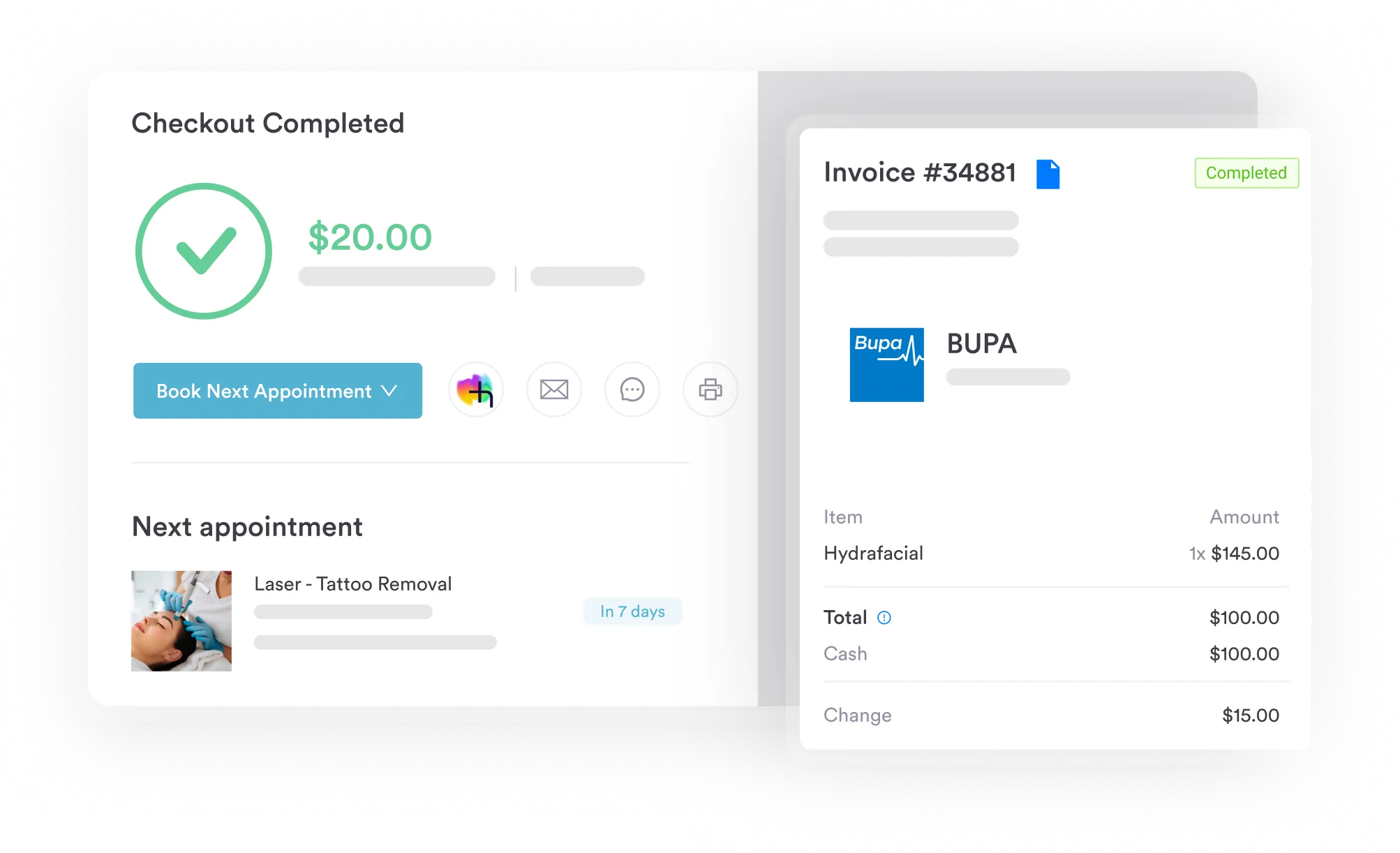
A hypothyroidism follow-up shows what that looks like end to end:
In practices we onboard, the chain almost always breaks at step two. The diagnosis is sitting in the note, and the claim gets its code from a second, manual lookup days later. That is the step worth removing first, because it never shows up on a denial report as its own cause.
For patients on ongoing levothyroxine therapy, automated recall workflows prompt TSH reorders at clinically appropriate intervals. Recalls spaced to the NCD 190.22 frequency rule keep monitoring current without stacking uncovered draws into one calendar year. Structured lab order templates then fill the clinical indication field on every recall.

Pabau connects your clinical documentation directly to claim submission, so ICD-10 codes from the clinical note flow automatically to the claim. See how it works for thyroid and other lab billing workflows.

CPT Code 84443 is a simple chemistry code with a fussy claim behind it. Three problems cause most denials. A mismatched ICD-10-CM code, thin medical necessity documentation, and a modifier 91 on a draw that was never a same-day repeat. The NCD 190.22 twice-yearly ceiling quietly causes a fourth.
All four are workflow problems wearing a coding costume. Fixing them in the order template and the claim pipeline recovers far more revenue than reworking denials one at a time. The trade-off is that workflow changes take a quarter to show up in your numbers, while a rework queue feels productive on the day.
Pabau’s integrated clean claim workflow connects the clinical note to claim submission, removing the manual re-entry that triggers most 84443 denials. Book a demo to see how your thyroid and lab claims would move through it.

Need to understand how clearinghouse validation reduces lab denials? Medical claims clearinghouse explained covers how electronic claim routing and real-time edits work before claims reach payers.
Handling coding denials for thyroid and other chemistry codes? Denial codes in medical billing maps the most common CARC codes and how to address them systematically.
Want to validate insurance eligibility before ordering TSH? Insurance eligibility verification explains real-time eligibility checks and how they prevent coverage-based denials on lab claims.
CPT Code 84443 is the billing code for thyroid stimulating hormone (TSH) testing performed on serum or plasma. Clinicians order the test to diagnose hypothyroidism and hyperthyroidism, monitor thyroid replacement therapy, and evaluate pituitary function affecting thyroid regulation.
The 2026 Medicare rate for CPT 84443 is $16.44 under the Clinical Laboratory Fee Schedule (CLFS). Under PAMA, CLFS codes carry a single national rate, so the amount does not change between localities. Private payer contracts often pay a different amount.
The codes most often paired with CPT 84443 are E03.9 (hypothyroidism, unspecified), E05.90 (thyrotoxicosis, unspecified), and E06.3 (autoimmune thyroiditis). Z79.899 covers long-term drug therapy monitoring, and C73 covers malignant neoplasm of the thyroid gland. Always use the most specific code supported by the clinical documentation.
Yes, Medicare covers CPT 84443 under NCD 190.22 for diagnostic evaluation and monitoring of thyroid disorders. Testing may be covered up to two times a year in clinically stable patients. More frequent testing is covered when thyroid therapy has been altered or new symptoms appear. Routine screening without a documented indication is not covered.
CPT 84443 measures TSH (thyroid stimulating hormone), the pituitary signal that controls thyroid output. CPT 84439 measures free thyroxine (T4), the circulating hormone the thyroid gland produces. TSH is the first-line test, and T4 is ordered as a follow-up when TSH is abnormal. Check CCI edits before billing both on the same date of service.
Yes. TSH testing is classified as moderate complexity under CLIA. The performing laboratory must hold a valid CLIA certificate at the moderate or high complexity level, and that CLIA number must appear on the claim. A laboratory operating under only a waiver certificate cannot perform or bill CPT 84443.



