HCPCS code Q4154: Biovance billing, Medicare rate and denial guide
HCPCS code Q4154: definition and code details HCPCS code Q4154 is a Level II cod...

Last Updated: Oct 6, 2026
84436 is the CPT code for Thyroxine; total, the lab test that measures total T4 in serum or plasma. The result combines the protein-bound and free fractions of thyroxine in one value.
The code sits in the Chemistry subsection of the Pathology and Laboratory section. Free T4 is billed separately with 84439, and TSH with 84443. Medicare pays 84436 under the Clinical Laboratory Fee Schedule.
Let Pabau's smart automation suggest the right codes, reduce claim denials, and keep your practice compliant—effortlessly.
Automate repetitive tasks and focus on what matters most—your patients.
Reduce coding errors and ensure compliance with the latest regulations.
Clean claims, fewer denials, and faster reimbursements.
Powerful insights and reporting to help your practice thrive.
HIPAA compliant SOC 2 certified GDPR-compliant Trusted by 4,000+ clinics worldwide

CPT Code 84436 covers total serum T4 only, not free T4 (84439) or TSH (84443).
No current CPT panel code bundles thyroid tests, so bill 84436 and each other thyroid test on its own line.
Medicare pays approximately $9-11 under the CLFS, so verify the current rate in the CMS fee schedule lookup.
Missing or unsupported ICD-10 codes are the leading denial trigger for 84436 claims.
Pabau’s claims management software checks eligibility and validates thyroid lab claims before submission.
CPT Code 84436 describes a quantitative laboratory assay measuring total thyroxine in serum. “Total” means the result combines the protein-bound fraction and the unbound (free) fraction in a single concentration value. The test uses immunoassay methodology at a CLIA-certified laboratory. It reports results in micrograms per deciliter (mcg/dL) or nanomoles per liter (nmol/L).
Clinicians order total T4 to screen for thyroid dysfunction, monitor replacement therapy in hypothyroid patients, and assess suspected hyperthyroidism. It often appears on requisitions alongside TSH (84443) as part of a routine thyroid workup. Per the CMS annual CPT/HCPCS code list, 84436 is a Chemistry subsection code within the Pathology and Laboratory section.
The code covers one analyte measured once per requisition: total thyroxine in serum or plasma. No other test is part of the descriptor.
Several adjacent tests get confused with 84436 because they share the “thyroxine” or “T4” label in everyday clinical conversation. Knowing what the code excludes prevents upcoding errors and duplicate-billing denials.
No current CPT panel code bundles thyroid tests. Thyroid panel code 80091 was deleted effective January 1, 2000, so 84436, 84443 and the other thyroid analytes are billed as individual components. A requisition for total T4 and TSH becomes two claim lines: 84436 and 84443.
Three CPT codes dominate thyroid laboratory billing, and misusing any one of them triggers a denial or NCCI edit. Free T4 goes to 84439 and TSH to 84443, so the analyte on the requisition decides the code. The table below maps each code to its analyte, clinical use, and same-day billing compatibility.
Payers interpret “T4” differently in benefit language. Some LCD policies require the ordering clinician to document why total T4 (84436) was chosen over the more commonly ordered free T4 (84439). Check the applicable MAC LCD before submitting both on the same claim.
Every claim for CPT Code 84436 must link to an ICD-10-CM diagnosis code that establishes medical necessity. Local Coverage Determinations (LCDs) from Medicare Administrative Contractors (MACs) define the approved diagnosis list. Commercial payers typically mirror or extend that list. The codes below appear on most MAC LCDs for thyroid function testing.
For a patient on levothyroxine, E03.9 is the usual pairing on a monitoring claim. LCD policies still vary by MAC jurisdiction. Novitas Solutions, CGS Administrators, Palmetto GBA, and Noridian each maintain separate LCDs for thyroid testing, and their approved ICD-10 lists differ. Look up the LCD in effect for the claim’s state before filing.
CPT Code 84436 is reimbursed under the Medicare Clinical Laboratory Fee Schedule (CLFS), not the Physician Fee Schedule. CMS updates the CLFS each January. Rates go stale, so use the CMS fee schedule lookup tool to confirm the current year’s allowed amount for your MAC region. For 2024-2025, the national Medicare allowed amount for 84436 has generally ranged between $9 and $11.
The performing laboratory must hold a CLIA certificate of the appropriate complexity level for an immunoassay. Billing a quantitative test without valid CLIA certification is grounds for claim denial and potential OIG audit exposure.
Check your MAC’s CLFS rates each January. Medicare lab fee schedule updates take effect January 1, and amounts can shift year-over-year based on market data. Submitting at last year’s charge and receiving a reduced CLFS payment can trigger write-off variances that accumulate across high-volume thyroid testing.
Payers require specific documentation elements before they pay an 84436 claim. Missing any one item is enough for a medical-necessity denial, even when the test was clinically appropriate. Reviewers look for these items on audit:
The National Correct Coding Initiative (NCCI) publishes quarterly edits that govern which code pairs can be billed together. For CPT Code 84436, five rules cover almost every same-day scenario.
Denial patterns for thyroid lab codes are predictable, so most of them can be prevented at charge entry rather than fixed on appeal.
Strong denial management workflows begin with categorizing each denial reason so you can track frequency and target root causes. Here are the most common reasons 84436 claims are denied, with resolution steps for each.
Each data element on an 84436 claim has a fixed box on the CMS-1500. The steps below reflect clean claim submission requirements for an independent laboratory billing Medicare for a T4 total ordered by an outpatient physician. The map shows where each element lands before the steps explain each box.
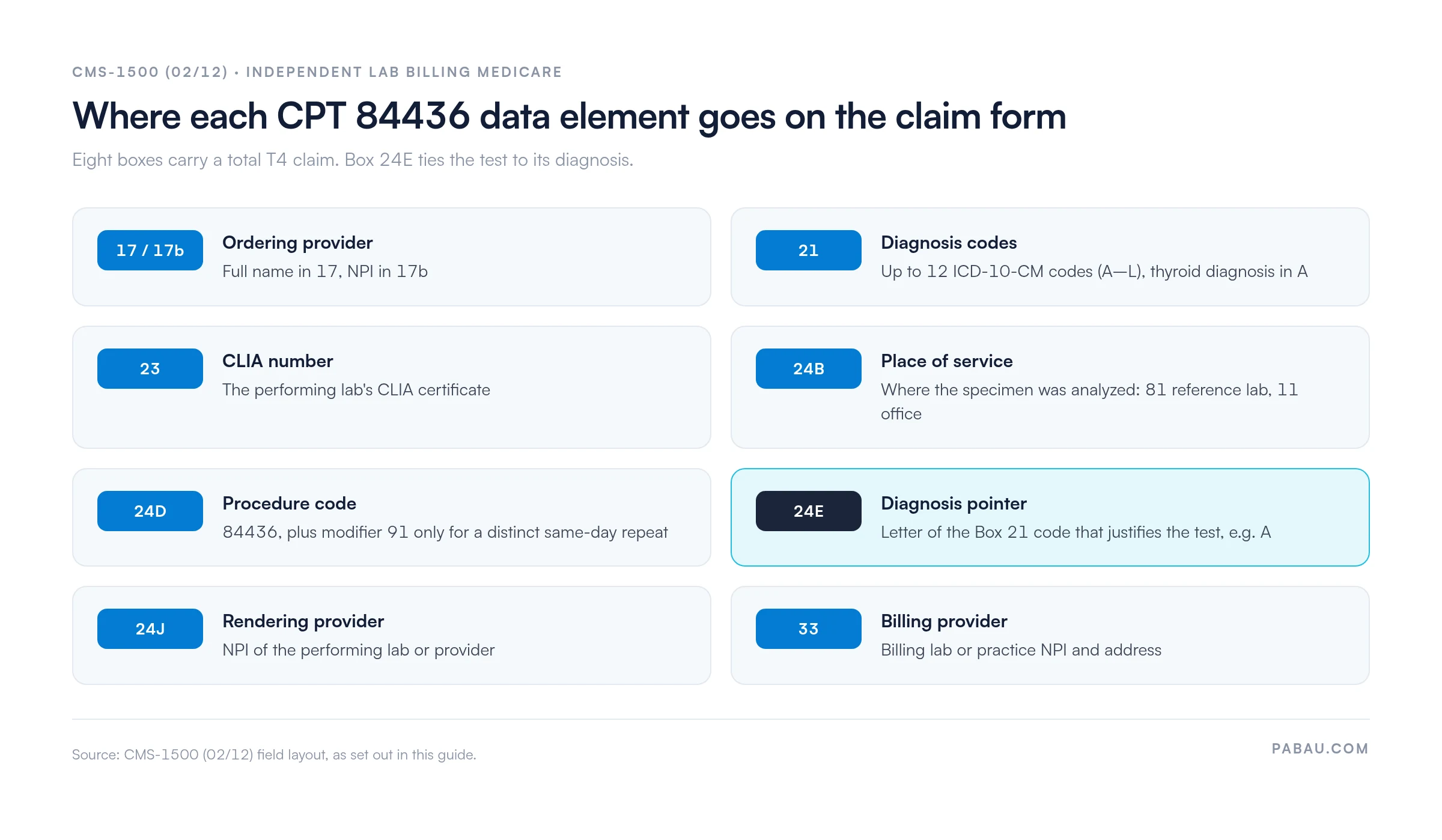
UB-04 filers (institutional claims from hospital outpatient labs) report revenue code 0300 (laboratory, general) in Form Locator 42 and 84436 in Form Locator 44. ICD-10 diagnoses go in Form Locators 67-67Q.
Run an eligibility verification for each patient before the T4 total specimen is collected, not after. Claim.MD’s real-time eligibility portal shows whether the patient’s plan covers thyroid function tests and where the deductible stands. It also tells you whether an ABN is needed before you draw the sample.
An 84436 denial usually starts at charge entry. Someone keys a diagnosis that isn’t on the LCD list, or bills total T4 when the requisition asked for free T4. Checked by hand, those errors only surface when the remittance comes back.
Pabau, the practice management platform we build, moves those checks ahead of submission. Its claims software for practices validates ICD-10 linkage, NCCI code pairs and CLIA enrollment at charge entry. Pabau’s integration with the Claim.MD clearinghouse runs real-time eligibility checks against more than 4,000 US payers before the claim goes out.
The outcome is fewer thyroid lab claims returned for a missing diagnosis or a mismatched code. Your billing team spends less time appealing a test that pays about $9 to $11.

Pabau’s claims management software validates ICD-10 linkage, NCCI edits, and CLIA enrollment status before your lab claims go out the door. See how practices reduce denials and accelerate reimbursement.

Treat 84436 as a code you get right before the specimen is drawn, not after the remittance arrives. At roughly $9 to $11 from Medicare, a single claim is rarely worth an appeal, so the pre-claim checks protect the revenue.
Start with a diagnosis your MAC’s LCD accepts, then confirm the analyte on the requisition matches the code. Bill each thyroid test on its own line, since no current panel code covers them.
If your team still checks LCD lists and NCCI tables by hand, automate that step first. Book a demo to see how Pabau catches 84436 coding errors before the claim reaches the payer.

Want to understand how medical billing workflows fit together? What is revenue cycle management explains the end-to-end process from patient registration through payment posting.
Dealing with insurance eligibility issues before lab orders? Insurance eligibility verification outlines how to confirm coverage before collecting specimens.
CPT Code 84436 is the AMA procedure code for total serum thyroxine (T4) measurement, with the official descriptor “Thyroxine; total.” It covers a single quantitative immunoassay of the combined bound and free T4 fraction in serum or plasma, performed at a CLIA-certified laboratory. It does not cover free T4 (CPT 84439) or TSH (CPT 84443).
CPT 84436 measures total thyroxine, which includes both the protein-bound and free fractions of T4. CPT 84439 measures only free thyroxine, the biologically active unbound fraction. The two codes are not interchangeable clinically or for billing. Using 84436 when the physician ordered a free T4 test is a coding error that may trigger a denial or an audit flag.
The T4 total CPT code recognized by Medicare is 84436. Medicare pays for it under the Clinical Laboratory Fee Schedule (CLFS). The allowed amount has generally ranged from $9 to $11 in recent years. The exact rate changes each January, so verify the current allowed amount using the CMS fee schedule lookup before billing.
Yes, CPT 84436 (T4 total) and CPT 84443 (TSH) can be billed on the same date of service. There is no NCCI pair edit between these two codes as of recent quarters. Both must be independently ordered and medically necessary. Verify the current quarter’s NCCI edit table before submitting, since edits are updated quarterly.
No. No current CPT panel code bundles thyroid tests, because thyroid panel code 80091 was deleted effective January 1, 2000. Bill 84436 as an individual component code. When 84443 or 84439 is ordered too, each goes on its own claim line.
Use modifier -91 when a patient needs a repeat T4 total on the same date of service. The reason must be clinically distinct and separately documented. Do not use -91 for confirmatory repeat testing or equipment malfunction. Modifier -59 applies when 84436 is billed alongside a code that triggers an NCCI edit and the record clearly documents a distinct service.