

HCPCS Code E0272: Foam rubber mattress billing guide
HCPCS Code E0272: official descriptor and code overview HCPCS Code E0272 is the ...

Last Updated: Nov 6, 2026
61886 is the CPT code for insertion or replacement of a cranial neurostimulator pulse generator or receiver with connection to two or more electrode arrays. It is the generator code for deep brain stimulation (DBS) systems where one generator drives two or more leads.
The code sits in the Surgery section of the American Medical Association's CPT code set, under Nervous System. Its single-array counterpart is CPT 61885, and the electrode arrays themselves are reported separately. A miscoded claim triggers denial or payer review.
Let Pabau's smart automation suggest the right codes, reduce claim denials, and keep your practice compliant—effortlessly.
Automate repetitive tasks and focus on what matters most—your patients.
Reduce coding errors and ensure compliance with the latest regulations.
Clean claims, fewer denials, and faster reimbursements.
Powerful insights and reporting to help your practice thrive.
HIPAA compliant SOC 2 certified GDPR-compliant Trusted by 4,000+ clinics worldwide

CPT code 61886 reports a cranial neurostimulator pulse generator connected to two or more electrode arrays, while 61885 covers a generator connected to one.
The electrode arrays are billed separately with 61863/61864 or 61867/61868, so 61886 never covers the leads themselves.
Prior authorization is required by virtually all major commercial payers, including Cigna, UnitedHealthcare and Highmark, while Medicare applies NCD 160.24.
Modifier 50 is not appended to 61886 because the descriptor already covers multiple arrays, and modifier 62 applies when two surgeons share the procedure.
Pabau, the practice management platform we build, handles electronic claim submission, eligibility checks and ERA retrieval for practices billing neurostimulator procedures.
CPT code 61886 has a precise official descriptor from the AMA. It reads “Insertion or replacement of cranial neurostimulator pulse generator or receiver, direct or inductive coupling; with connection to two or more electrode arrays.” In plain terms, it is the generator code for a deep brain stimulation (DBS) system in which one pulse generator drives two or more leads. “Two or more electrode arrays” is the phrase to confirm in the operative report before you assign the code.
The procedure is commonly called bilateral DBS implantation. A DBS system has three hardware components: The implantable pulse generator (IPG), the electrode leads, and the extension cables connecting them.
For bilateral DBS, leads are placed into targets on both sides of the brain, typically the subthalamic nucleus (STN) or the globus pallidus internus (GPi). They then connect to a single dual-channel IPG or to two separate IPGs implanted in the chest wall or abdomen. Only the single dual-channel IPG is reported with 61886.
The difference between CPT 61885 and CPT code 61886 is how many electrode arrays connect to the generator. CPT 61885 covers a generator connected to a single array, and 61886 requires two or more.
That means the hardware decides the code, not the number of brain targets. The Medtronic DBS coding and payment guide spells out both bilateral setups. Two single-array generators, one on each side, are reported as 61885-50. One dual-array generator connected to both leads is reported as 61886.
Staged surgeries follow the same logic. A session that places a single-array generator reports 61885, whether it is the first side or the second. A dual-array generator connected to both leads is reported with 61886 in the session where it goes in. The diagram below maps each hardware setup to its code.
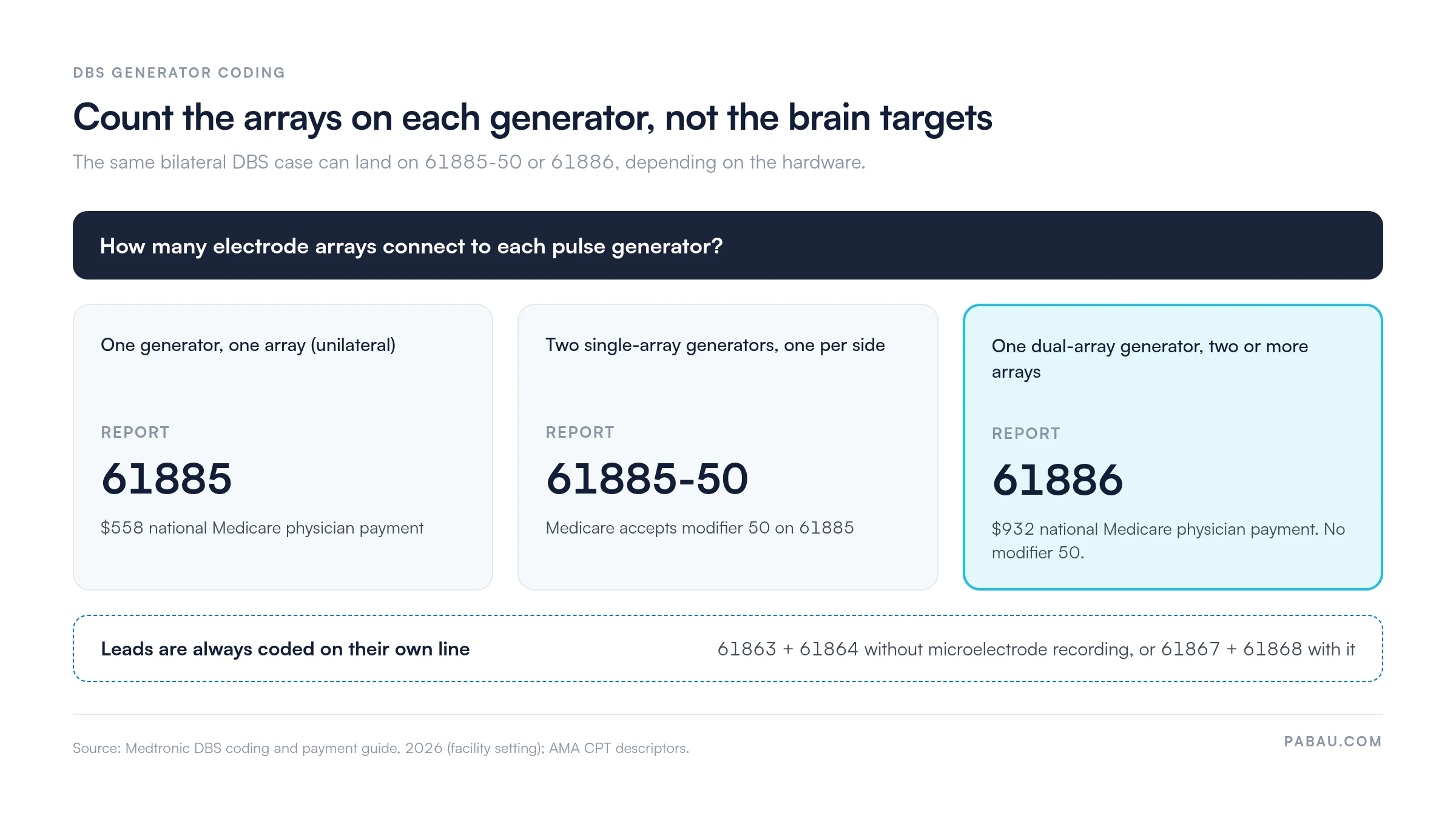
Operative report language to look for: Phrases like “dual-channel IPG connected to two electrode arrays” or “both leads connected to a single generator” confirm 61886. A report that describes one generator per lead maps to 61885, even when both hemispheres were treated.
CPT code 61886 never stands alone on a DBS claim. Coders need the full code family to avoid unbundling errors and wrong-code denials. Neighboring codes outside this family are in our CPT references for coders.
Responsive neurostimulation (RNS) devices, such as the NeuroPace system, use different implantation codes. RNS uses cortical or subcortical electrodes that respond to detected seizure activity rather than delivering continuous stimulation. Do not use 61886 for RNS implantation. RNS is FDA-approved for epilepsy, while DBS is approved for movement disorders and select other indications.
Every 61886 claim requires a supporting ICD-10-CM diagnosis code that reflects a payer-accepted indication. Payers cross-reference the diagnosis against their DBS medical policy to determine medical necessity before adjudicating the claim.
A diagnosis code outside the accepted list is a frequent reason 61886 claims are denied. Confirm ICD-10 code validity against the CMS ICD-10 codes page each fiscal year, because codes change annually. Parkinson’s disease shows why: Since October 1, 2023, G20 has been a non-billable header, so the claim needs a G20.- subcode.
Document failed conservative therapy in the medical record before submitting 61886. For Parkinson’s disease, payers typically require evidence that the patient had an adequate trial of carbidopa/levodopa. For essential tremor, document beta-blocker and primidone failures. Missing this documentation is a common reason prior authorization is denied before the claim is even submitted.
Documentation for CPT code 61886 must do two things: Confirm the procedure matches the code descriptor, and establish medical necessity for payer audit. The operative report alone is not sufficient, because the complete medical record must support the claim. Thorough records support medical billing compliance and reduce audit exposure for neurosurgery practices.
Prior authorization for CPT code 61886 is required by virtually every major commercial payer. The clinical complexity and high device cost of bilateral DBS draw close payer review. Complete insurance eligibility verification and confirm an active prior authorization before scheduling the procedure. A retroactive auth request after surgery rarely succeeds for a planned elective procedure.
Medicare reimburses CPT code 61886 under the Medicare Physician Fee Schedule (MPFS). Rates are updated annually and vary by geographic practice cost index (GPCI). Medtronic’s 2026 guide lists a national physician payment of $932 for 61886 in the facility setting, against $558 for 61885.
For claim submission or contract negotiations, take the current figure from the CMS Physician Fee Schedule lookup tool, not a prior-year number. The FastRVU RVU lookup tool shows work, practice expense, and malpractice RVUs for 61886 from current CMS data.
Modifier selection for CPT code 61886 is a frequent source of claim errors. The most important rule: Modifier 50 (bilateral procedure) does not apply, because the 61886 descriptor already covers two or more arrays. Appending it tells the payer’s system you are billing a second occurrence of a procedure that is already bilateral. That reads as an error and triggers review or denial.
Claims for CPT code 61886 fail for a predictable set of reasons, and most are preventable with a pre-submission review. A denial management workflow for neurostimulator procedures should flag each of the following before the claim goes out.
Build a 61886-specific pre-authorization checklist. Include the planned generator type and array count, plus the ICD-10 code checked against the payer’s DBS policy. Add the prior auth number and the documented failed conservative therapy. Run the checklist before every DBS case is scheduled, not after the surgery date is set.
Deep brain stimulation (CPT code 61886) and responsive neurostimulation (RNS) are both intracranial electrode procedures. They use different implantation codes and serve different patient populations, but the same 95983/95984 programming family applies to both. Coding one with the other’s implant code is a frequent error when operative reports are not carefully reviewed. The AAPC’s CPT coding reference lists the implantation and revision codes for each device type.
A 61886 claim depends on details spread across several places. The auth number sits in a payer portal, the array count in the operative note, and the diagnosis on the referral. Pulling them together by hand is where wrong codes and missing auth numbers slip through.
Pabau connects its claims tools to Claim.MD’s clearinghouse network. Your team runs eligibility checks before the surgery date, and each claim is scrubbed before it reaches the payer. An edit rejection gets caught in-house rather than at the payer.
After submission, Pabau’s neurology claims management tracks 61886 claim status, ERA retrieval, and denial reason codes in one workflow. That gives you the data to build a clean claim submission checklist specific to neurostimulator codes.

Pabau integrates with Claim.MD to handle electronic claim submission, real-time eligibility checks, and ERA retrieval for neurosurgery and neurology procedures, including CPT code 61886. See how it works for your practice.

CPT code 61886 is a high-complexity surgical code, and the decision that matters is made before the claim exists. Count the arrays on each generator in the operative note, and the choice between 61885, 61885-50 and 61886 settles itself.
Build your pre-authorization checklist around that count, the payer’s DBS diagnosis list, and failed-therapy documentation. Code the leads on their own lines every time, so the generator line never has to carry the whole procedure.
Want eligibility checks, claim scrubbing and ERA tracking in one place for your DBS cases? Book a demo to see how Pabau handles neurostimulator billing.

Need to understand how clearinghouse submission works for high-complexity CPT codes? Medical claims clearinghouse guide explains the end-to-end pathway from claim creation to payer adjudication.
Want to reduce denial rates across your neurology billing? Electronic remittance advice (ERA) guide covers how ERA data reveals systematic denial patterns before they compound.
Need a superbill that holds up for surgical claims? Superbill documentation guide walks through what a compliant superbill must contain for high-complexity neurosurgery claims.
CPT code 61886 covers insertion or replacement of the pulse generator with connection to two or more electrode arrays. Electrode placement is coded separately. It is the generator code for bilateral deep brain stimulation (DBS) when one dual-array generator drives both leads.
CPT 61885 covers a pulse generator connected to a single electrode array. CPT 61886 covers a generator connected to two or more arrays. Bilateral DBS with two single-array generators is reported as 61885-50, not 61886.
Yes, for virtually all commercial payers, including Cigna, UnitedHealthcare and Highmark. Medicare does not require prior authorization but applies the coverage criteria in National Coverage Determination 160.24. Medicaid prior auth requirements vary by state.
The most common denial reasons are missing or expired prior authorization and the wrong generator code (61885 vs 61886). Others include a diagnosis code outside the payer’s covered list and incomplete operative documentation. Billing 95983/95984 on the surgery date also trips an NCCI edit.
The main ICD-10-CM codes paired with CPT 61886 cover Parkinson’s disease, essential tremor, dystonia and OCD. For Parkinson’s disease, use G20.A1, G20.A2, G20.B1 or G20.B2, because G20 itself is a non-billable header. Essential tremor is G25.0, dystonia is G24.1/G24.2, and obsessive-compulsive disorder is F42.2, an HDE indication. The code must match the device’s FDA-approved indication.
CPT 61886 applies to deep brain stimulation, which delivers continuous open-loop stimulation for movement disorders. Responsive neurostimulation (RNS/NeuroPace) uses closed-loop stimulation triggered by seizure activity, and it has different implantation codes. Programming for both is reported with 95983/95984.




