

CCSD code G5100: Bypass of duodenum billing guide
CCSD code G5100 bills a bypass that leaves the duodenum in place CCSD code G5100...

Last Updated: Oct 16, 2026
61885 is the CPT code for inserting or replacing a cranial neurostimulator pulse generator or receiver connected to a single electrode array.
Report 61886 instead when two or more arrays connect to the generator, and payers commonly audit this distinction. The code is used for deep brain stimulation (DBS) and vagus nerve stimulation (VNS) generators. Prior authorization and an operative note that states the array count keep the claim payable.
Let Pabau's smart automation suggest the right codes, reduce claim denials, and keep your practice compliant—effortlessly.
Automate repetitive tasks and focus on what matters most—your patients.
Reduce coding errors and ensure compliance with the latest regulations.
Clean claims, fewer denials, and faster reimbursements.
Powerful insights and reporting to help your practice thrive.
HIPAA compliant SOC 2 certified GDPR-compliant Trusted by 4,000+ clinics worldwide

CPT code 61885 reports a cranial neurostimulator pulse generator connected to a single electrode array, while 61886 covers two or more arrays.
Modifier errors are a common cause of denial, so append -50, -LT or -RT only where the payer’s bilateral indicator allows it.
Medicare rates differ between facility and non-facility settings, so use the CMS Physician Fee Schedule tool for current locality-adjusted figures.
Pabau’s claims management software tracks neurostimulator claims from the eligibility check to denial follow-up across payers.
The official descriptor for CPT code 61885 comes from the American Medical Association (AMA) CPT code set. It reads:
“Insertion or replacement of cranial neurostimulator pulse generator or receiver, direct or inductive coupling; with connection to a single electrode array.”
In plain language, the code reports placing or swapping a pulse generator that connects to one electrode array at a brain or cranial nerve target. Typical cases are vagus nerve stimulation (VNS) generators and deep brain stimulation (DBS) generators for Parkinson’s disease and essential tremor.
The number of electrode arrays implanted during the procedure determines which code is correct. Coders must count the arrays documented in the operative report, not the number of generators or the number of anatomical targets.
The decision path below adds the two neighboring generator codes, so a spinal or peripheral case never lands on 61885 by mistake.
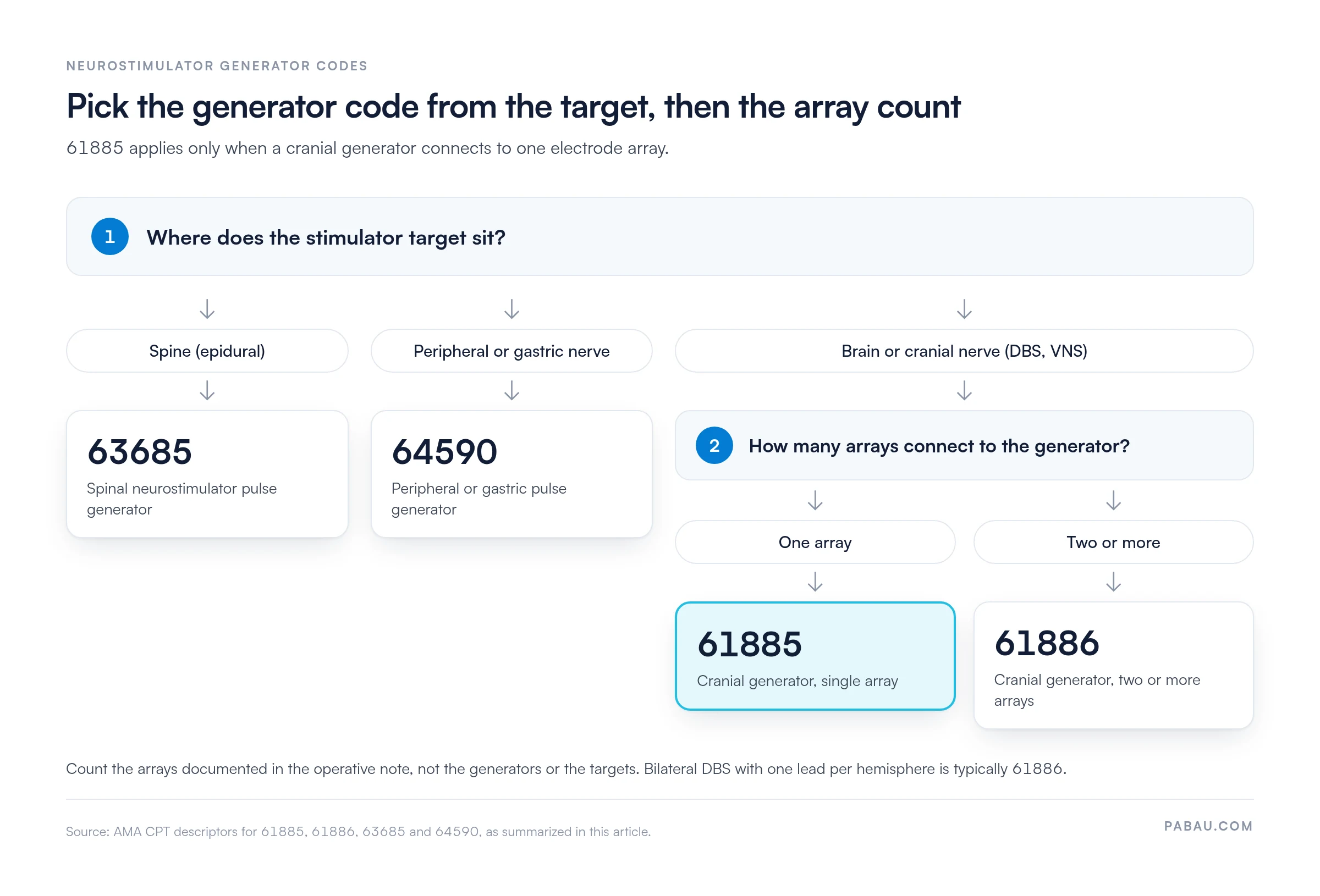
Upcoding from 61885 to 61886 when only one array is implanted is a recognized audit target. Downcoding from 61886 to 61885 in a bilateral DBS case leaves significant reimbursement on the table. The operative note must state the number of arrays explicitly.
61885 sits within a broader neurostimulator family. Spinal generators are reported with 63685 instead, and peripheral or gastric generators with 64590. Knowing which codes run alongside 61885, and which ones NCCI bundles, prevents both under-billing and compliance exposure.
The National Correct Coding Initiative (NCCI) reviews same-day billing of 95970, 95976-95977 or 95983-95984 with 61885. Its edits are updated quarterly, so check current tables before reporting programming codes on the implant date.
Modifier errors are a common cause of denial on 61885 claims. The generator is one device, so append -50, -LT or -RT only where the payer’s bilateral indicator allows it. The operative report must support whichever modifier is appended before the claim is submitted.
Audit your 61885 claims before submission. Confirm the code matches the number of arrays in the op note. Append -50, -LT or -RT only where the payer’s bilateral indicator allows it. A modifier the payer doesn’t expect triggers an automatic edit, and appeals take weeks.
Every 61885 claim must include a diagnosis code that establishes medical necessity. Payers and Medicare Local Coverage Determinations (LCDs) specify which ICD-10 codes support coverage for neurostimulator implantation.
LCD coverage criteria vary by Medicare Administrative Contractor (MAC). Confirm the specific ICD-10 codes listed in the applicable LCD before filing. For VNS, CMS National Coverage Determination (NCD) 160.18 governs Medicare coverage for drug-resistant epilepsy.
Medicare reimbursement for CPT code 61885 differs between facility and non-facility settings. Neurostimulator implantation is a surgical procedure, so it is overwhelmingly performed in a hospital or ambulatory surgery center. There, the facility fee absorbs the practice expense relative value units (RVUs).
Rates are adjusted annually through the Medicare Physician Fee Schedule (MPFS) and vary by geographic locality. Use the CMS Physician Fee Schedule lookup tool for current locality-adjusted figures. FastRVU’s 2026 RVU lookup breaks the total into work, practice expense, and malpractice RVUs.
Most commercial payers and Medicare Advantage plans require prior authorization for CPT code 61885. Medicare fee-for-service coverage is governed by NCD 160.18 (for VNS) and MAC-level LCDs for DBS. Failing to secure authorization before the procedure is a common cause of denial.
Thorough insurance eligibility verification before scheduling heads off authorization denials. A well-run prior authorization process also collects the supporting documentation most payers want. That includes the diagnosis history, failed conservative treatments, and the prescribing physician’s attestation.
An incomplete operative report is a common route to a 61885 denial. The op note must capture every element that connects the procedure to the code.
Producing a clean claim submission for a neurostimulator implantation takes more supporting documentation than most surgical codes. Treat the paperwork as a chain. Each link, from the pre-op authorization through the op note to the claim form, must hold.
Denials for 61885 cluster around a handful of recurring errors. Addressing each one before submission costs less than working appeals. Strong denial management workflows flag these patterns by payer, so practices can fix systemic issues instead of chasing single claims.
Review medical billing denial codes to read the claim adjustment reason codes (CARCs) attached to 61885 rejections. They show whether a denial is a coverage, coding or documentation issue, and each needs a different appeal strategy.
Build a pre-submission checklist specific to 61885. Confirm the array count from the op note and check that the code matches it. Then check any modifier against the payer’s bilateral indicator, attach the PA number, and verify the ICD-10 code in the LCD. Running it before every claim catches each error in the table above before a payer does.
On a 61885 case, the PA number, the op note and the claim often live in three different systems. Each handoff is a chance to lose the array count or the authorization.
Pabau, the practice management platform we build, keeps those pieces on one patient record. Its claims management software tracks facility and non-facility reimbursement variances across payers. Claims go out electronically through the Claim.MD clearinghouse, which connects to thousands of US payers.
Real-time eligibility checks run before the procedure date, so coverage problems surface while there is still time to fix them. The result is fewer claims bounced for a missing PA number or a mismatched code.

Pabau’s claims management workflow handles neurostimulator billing from eligibility check through ERA posting. See how it works for surgical practices.

Every 61885 claim turns on one fact: How many arrays connect to the generator. Get that count into the op note in plain words. The code choice, the modifier decision and the audit defense all follow from it.
The trade-off is front-loaded work. Confirming the PA number, the bilateral indicator and the LCD diagnosis before submission takes minutes, while an appeal takes weeks.
Pabau tracks prior authorizations and op note documentation, then submits claims through Claim.MD to thousands of US payers. Book a demo to see how Pabau handles neurostimulator billing from authorization to payment.

Need to understand how clearinghouse claim submission works? Claim.MD clearinghouse guide explains how electronic claim routing connects practices to thousands of US payers.
Want to reduce surgical claim denials systematically? Electronic remittance advice (ERA) workflows covers how ERAs surface denial patterns across procedure codes so you can fix root causes, not just individual claims.
Billing the device as well as the implant? HCPCS code C1767 covers the non-rechargeable neurostimulator generator that facilities report alongside the procedure.
Placing a new lead along with the generator? HCPCS code L8680 explains how each implantable neurostimulator electrode is billed.
Need a ready-made authorization request? Medical prior authorization form gives you a template for the diagnosis history and attestation payers ask for.
CPT code 61885 covers the insertion or replacement of a cranial neurostimulator pulse generator or receiver connected to a single electrode array. It is used for deep brain stimulation (DBS) and vagus nerve stimulation (VNS) generators with one array.
61885 is reported when a single electrode array is connected to the pulse generator. 61886 is reported when two or more electrode arrays are connected. Bilateral DBS implantation typically requires 61886 because a lead is placed in each hemisphere.
Append -50, -LT or -RT only where the payer’s bilateral indicator allows it, because the generator is one device. Use -62 when two surgeons each perform a distinct component. Both surgeons must document their contributions separately in the operative note.
Yes, most commercial payers and Medicare Advantage plans require prior authorization for CPT 61885. Medicare fee-for-service coverage is governed by NCD 160.18 for VNS and MAC-level LCDs for DBS. Always verify with the specific payer before scheduling the procedure.
Same-day billing of 95970, 95976-95977 (cranial nerve) or 95983-95984 (brain) with 61885 is subject to NCCI bundling edits. Programming codes are generally reported on a separate programming visit, not on the implantation date. Check current NCCI edit tables before submitting both on the same claim.
The operative report must document the device manufacturer, model and serial number, plus the number of electrode arrays placed (explicitly “single array”). It also records the anatomical target and laterality, intraoperative testing results, and whether the procedure is a new insertion or a replacement. Missing any of these elements is a common cause of denial.



