

ICD-10 Code R63.4: Abnormal weight loss
ICD-10 code R63.4: Definition, billability and code structure ICD-10 code R63.4 ...

Last Updated: Nov 13, 2026
Billable Code Specific Code
G20.A1 is the billable ICD-10-CM code for Parkinson's disease without dyskinesia, without mention of fluctuations. It fits a patient whose provider documents Parkinson's disease with no dyskinesia and no OFF episodes. It is also the code for Parkinson's disease NOS.
The code has been valid since October 1, 2023, when the FY2024 update made plain G20 a non-billable category. Two findings in the note change it. Dyskinesia moves the code to G20.B, and OFF episodes move it to G20.A2. Dementia doesn't change it and is added as a separate F02 code.
Let Pabau's smart automation suggest the right codes, reduce claim denials, and keep your practice compliant—effortlessly.
Automate repetitive tasks and focus on what matters most—your patients.
Reduce coding errors and ensure compliance with the latest regulations.
Clean claims, fewer denials, and faster reimbursements.
Powerful insights and reporting to help your practice thrive.
HIPAA compliant SOC 2 certified GDPR-compliant Trusted by 4,000+ clinics worldwide

G20.A1 is the billable ICD-10-CM code for Parkinson’s disease without dyskinesia, without mention of fluctuations, valid since October 1, 2023.
Two documented facts pick the G20 code. Dyskinesia moves it to G20.B, and OFF episodes move it to G20.A2.
Tremor is not dyskinesia, so a patient with a marked resting tremor can still be coded G20.A1.
Dementia plays no part in choosing A1 or A2. Report it as an additional F02 code, listed after the G20 code.
G20.C carries an Excludes1 note against G20.A1 and every G20.A and G20.B code, so it is never a fallback for confirmed Parkinson’s disease.
ICD-10 code G20.A1 covers Parkinson’s disease without dyskinesia, without mention of fluctuations. The CDC’s FY2027 ICD-10-CM tabular list also places Parkinson’s disease NOS here, so a plain “Parkinson’s disease” diagnosis lands on G20.A1. The patient has no documented dyskinesia and no documented OFF episodes.
Check the current-year descriptor in the CDC/NCHS ICD-10-CM browser tool before you load the code into a pick list or charge sheet.
Since the FY2024 update, plain G20 is a category header and can’t go on a claim. Every Parkinson’s disease claim now needs one of four billable codes, and two yes-or-no questions get you there.
The matrix shows how the two answers combine.
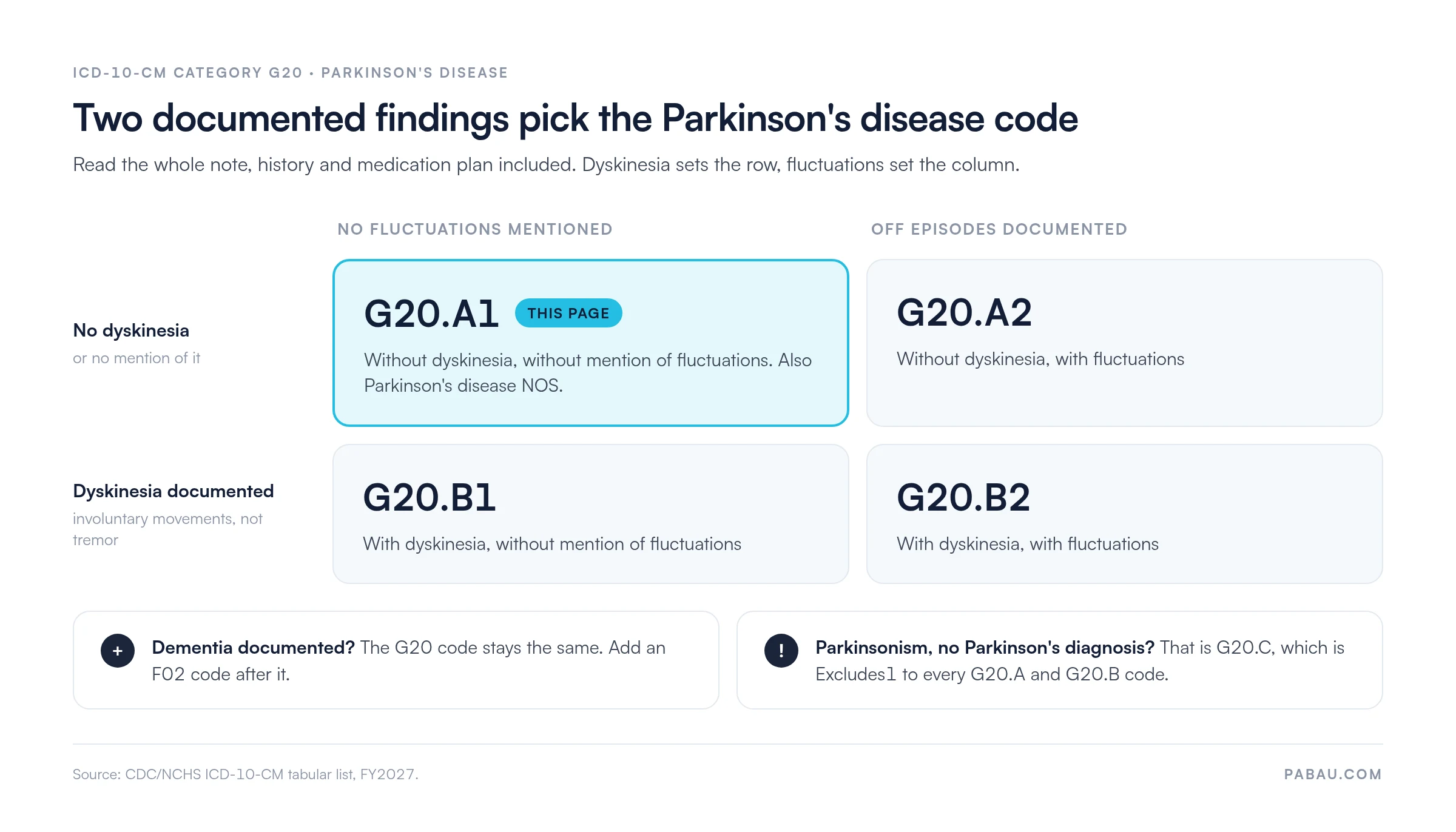
Run them in this order as a quick Q&A with the note in front of you:
G20.A1 and G20.A2 both describe Parkinson’s disease without dyskinesia. The only split is fluctuation status. G20.A2’s inclusion term reads “with OFF episodes”, while G20.A1 reads “without mention of OFF episodes”.
An OFF episode is a stretch when the benefit of levodopa fades and symptoms such as slowness, stiffness or tremor come back. It often happens before the next dose is due.
Look for it outside the assessment line, too. Providers often record it in the history or the medication plan. Typical phrases are “wearing off 45 minutes before each dose” or “adding a dose to cover OFF periods”.
When the note says “motor complications” or “wearing off” but never confirms fluctuations or OFF episodes, query the provider. Don’t pick G20.A2 on inference alone.
Dyskinesia here means involuntary writhing or jerking movements, most often caused by long-term levodopa. Tremor is part of the disease itself. A note that documents “resting tremor” therefore keeps the patient in G20.A.
Only explicit documentation of dyskinesia, or levodopa-induced dyskinesia, moves the code to G20.B1 or G20.B2. The G20.B subcategory also carries an Excludes1 note for drug induced dystonia (G24.0-), so those two can’t be reported together.
Category G20 carries a “use additional code, if applicable” note for dementia and mild neurocognitive disorder. The F02 code adds the cognitive picture, and the G20 code stays the one the motor findings support.
The ICD-10-CM index shows it plainly. “Dementia, in, Parkinson’s disease” points to G20.A1, with F02.80 as the manifestation code. F02 is a manifestation code with a “code first” note, so it’s always listed after the G20 code.
The fourth character of F02 carries severity:
The last character adds behavior: 0 for none, 1- for behavioral disturbance, 2 for psychotic disturbance, 3 for mood disturbance and 4 for anxiety. Severe dementia with psychotic disturbance is F02.C2, and moderate dementia with anxiety is F02.B4.
Two related diagnoses sit elsewhere. Mild neurocognitive disorder takes an F06.7- code. Neurocognitive disorder with Lewy bodies is G31.83, which the G21 secondary parkinsonism category lists as Excludes1.
Here is what the FY2026 and FY2027 tabular lists print for this category. Notes that other sites attach to G20, such as Excludes1 for G21, G22 or G25, are not in the official text.
That last note matters most. G20.C is for a provider who documents parkinsonism without diagnosing Parkinson’s disease. It can’t be reported with G20.A1, and it’s not a fallback when dyskinesia or fluctuation status is unclear. Query the provider instead.
Drug-induced parkinsonism belongs in G21, with G21.11 for neuroleptic induced and G21.19 for other drugs. The choice between G20 and G21 rests on the cause the provider documents.
Take an illustrative patient, a 68-year-old on carbidopa-levodopa, seen by the same neurologist over two years.
Each code matches what that day’s note says. A change from A1 to A2 to B2 is expected as the disease progresses, provided each note explains it.
A clean G20.A1 claim rests on four documented points. Each one maps to a word in the descriptor or a code you might add.
Add one line to your Parkinson’s visit template: “Parkinson’s disease, confirmed. Dyskinesia: none. Motor fluctuations or OFF episodes: none reported. Cognition: intact.” Providers edit the line when findings change, and the coder reads the code straight from it.
Most G20 problems trace back to a stale code list or a coder reading only the assessment. The table pairs each one with its fix. For broader workflows, see our guide to denial management in healthcare.
When a denial does land, the medical billing denial codes reference explains the CARC and RARC behind it.
In the CMS-HCC V28 model, G20.A1 maps to HCC 199, Parkinson and Other Degenerative Disease of Basal Ganglia. G20.A2, G20.B1, G20.B2 and G20.C map to the same HCC, per the CMS risk adjustment model files.
Picking A1 over A2 won’t change the HCC, but it still matters. Risk adjustment audits compare the code with the note, and a mismatched subcode is an audit finding.
HCCs reset each calendar year. The diagnosis must be documented and coded from a face-to-face visit at least once a year to count. For the wider picture, see our guide to revenue cycle management.
Before the year closes, run a report of every Parkinson’s patient and check each has a G20 code from a face-to-face visit this year. Flag any switch between A1, A2, B1 and B2 that no note explains.
Most G20 errors start between the note and the claim form. The coder re-types a diagnosis, an old pick list still offers plain G20, or a dementia code lands in the wrong slot.
Pabau, the practice management and billing platform we build, pulls the diagnosis on the patient record onto the claim. Its ICD-10-CM lookup lists the five billable G20 codes with their descriptors. The claim won’t send until required fields, such as member ID and authorization code, are complete.
In the US, claims go through Claim.MD, with eligibility checks before the visit and ERA remittances posted back after it. A denied Parkinson’s claim then shows up on the record you already work from. See Pabau’s claims management software for the full workflow.

Pabau carries the diagnosis from the patient record onto the claim and checks required fields before it sends. US claims go through Claim.MD, with eligibility checks and ERA remittances.

G20.A1 is the right code far more often than its long descriptor suggests. It covers any confirmed Parkinson’s disease without dyskinesia or OFF episodes, including Parkinson’s disease NOS.
If you change one habit, make it reading the medication plan before you code. That’s where wearing off and dyskinesia tend to hide, and they’re the only two findings that move the code. Leave dementia to its own F02 line.
Book a demo to see how Pabau carries the right Parkinson’s code from the note to a clean claim.

Need to understand how clearinghouse submission works for ICD-10 claims? Medical claims clearinghouse guide covers how clearinghouses validate ICD-10 codes before payer adjudication.
Looking for a primer on the full billing cycle behind neurology claims? What is medical billing explains the end-to-end process from encounter to payment posting.
Want to understand 837 file submission for ICD-10 diagnosis codes? 837 file guide covers how diagnosis codes are structured in electronic claim submissions.
No. Age at onset doesn’t change the code. Young-onset Parkinson’s disease is coded by dyskinesia and fluctuation status like any other case, so G20.A1 fits when both are absent.
Code the Parkinson’s disease by its current status and add Z96.82 for the neurostimulator. For a programming visit, list Z45.42 first, then the G20 code.
G23.1, not a G20 code. Progressive supranuclear palsy has its own code, so don’t report it as G20.A1, even when the note calls it parkinsonism.
Yes. The ICD-10-CM guidelines treat any qualified healthcare practitioner who is legally accountable for the diagnosis as the provider. The same dyskinesia and fluctuation documentation applies.
No. G20.A1 is a complete code at five characters. Electronic claims drop the decimal point and send it as G20A1.



