

HCPCS Code L0472: Hyperextension TLSO billing guide
HCPCS code L0472: Official descriptor and device definition HCPCS code L0472 des...

Last Updated: Nov 5, 2026
49999 is the CPT code for an unlisted procedure on the abdomen, peritoneum and omentum.
It sits at the end of the digestive system range (40490-49999) and covers open procedures that no listed CPT code describes. Laparoscopic and robotic-assisted work in the same region goes to its sister code, 49329. Every 49999 claim travels with an operative report, a special report and a comparable code, because the payer prices it by hand.
Let Pabau's smart automation suggest the right codes, reduce claim denials, and keep your practice compliant—effortlessly.
Automate repetitive tasks and focus on what matters most—your patients.
Reduce coding errors and ensure compliance with the latest regulations.
Clean claims, fewer denials, and faster reimbursements.
Powerful insights and reporting to help your practice thrive.
HIPAA compliant SOC 2 certified GDPR-compliant Trusted by 4,000+ clinics worldwide

CPT code 49999 reports an open procedure on the abdomen, peritoneum or omentum when no listed CPT code describes it.
Laparoscopic and robotic-assisted procedures in the same region go to 49329, so check the approach before anything else.
Every 49999 claim needs an operative report, a special report and a comparable code that the payer uses to set the price.
Medicare lists 49999 as carrier-priced with no RVUs and a YYY global period, so the MAC prices each claim by hand.
Omentectomy, intra-abdominal tumor excision and HIPEC all have listed codes, so they rarely belong on 49999.
CPT code 49999 is the unlisted procedure code for open surgery on the abdomen, peritoneum and omentum. Its official AMA descriptor reads Unlisted procedure, abdomen, peritoneum and omentum. You report it when the surgeon did something in that region that no listed CPT code describes.
The peritoneum is the thin membrane that lines the abdominal cavity and covers most abdominal organs. The omentum is a fold of that tissue draped over the intestines. Work on either one, done open and without a matching code, lands on 49999.
Unlisted codes are slow to pay, so 49999 is the code you reach for last, never first. A hard case that already has a listed code gets that code, with modifier 22 if the work ran well beyond typical. Before you assign 49999, confirm all four of these points:
Several procedures in this region feel unusual enough for 49999, yet they carry their own codes. Check these before you build a special report:
What is left for 49999 is narrower than most coders expect. Typical cases are open peritoneal or omental procedures that fall outside those codes, or a technique performed for the first time at a hospital. The table below sorts the common scenarios.
The costliest mix-up in this range is billing 49999 for a case that belongs on 49329. Both codes cover the same anatomy. The difference is the approach, and payers reject 49999 on a laparoscopic case because 49329 exists for exactly that.
The three questions below put the checks in the order a coder should ask them.
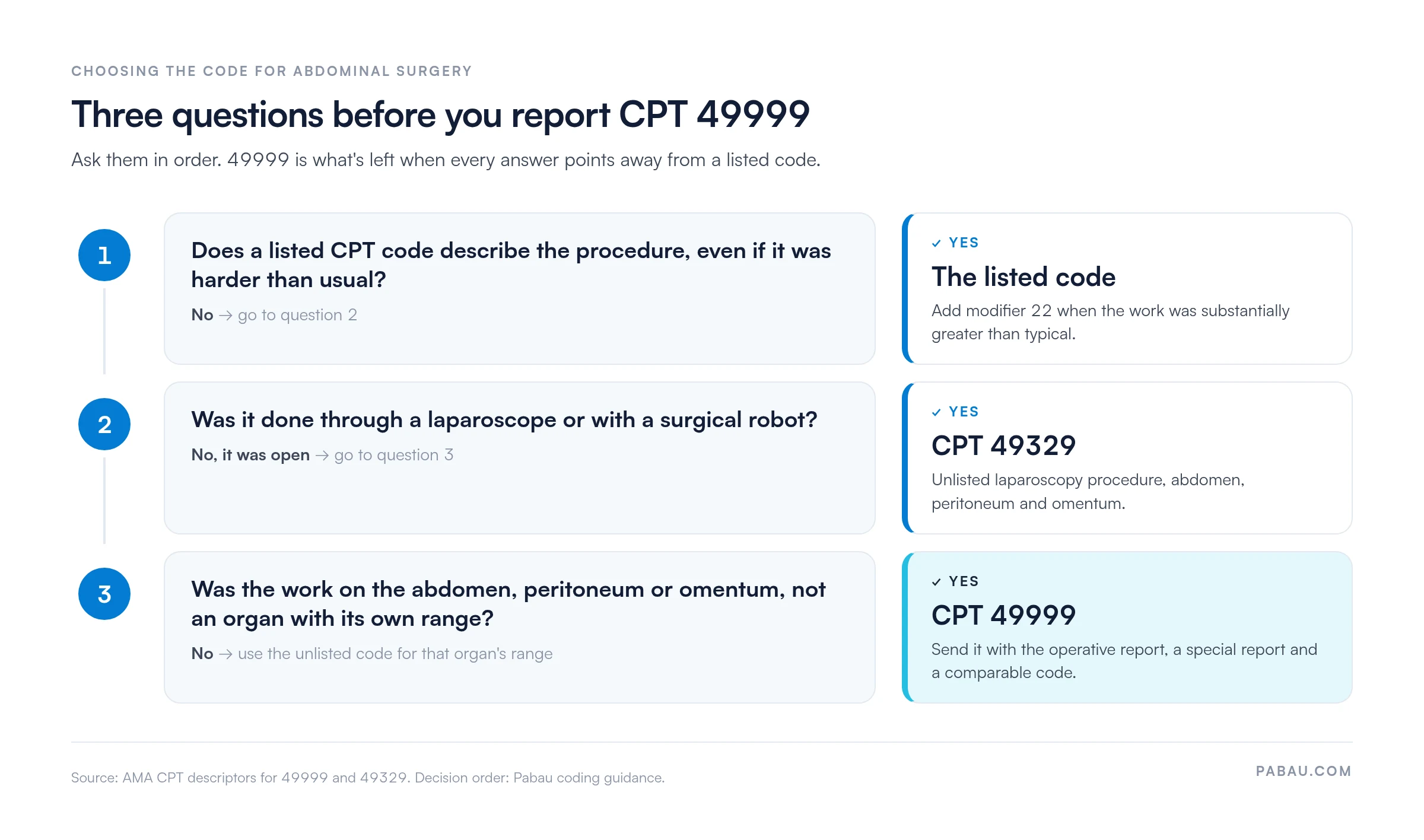
Quick check: If the operative report mentions a laparoscope, trocars, ports or a surgical robot, stop. CPT code 49999 doesn’t apply. Route the claim to 49329 and build the special report around that code instead.
An unlisted code can’t be priced from a table, so the payer prices it from your paperwork. Every claim needs the full package below before it goes out. Good medical billing compliance treats this list as fixed, not optional.
CPT guidelines ask for a special report with any unlisted code. It should describe the nature, extent and need for the procedure, plus the time, effort and equipment it took. Most coders build it around these points:
Attach the special report to the claim. Without it, most payers deny or pend a 49999 claim at the first review.
Here is the sequence that keeps an unlisted claim moving. Skipping a step, prior authorization above all, tends to end in a denial you can’t easily reverse.
Most rework on unlisted claims traces back to something that could have been caught at the desk. Tick each item before the claim leaves the practice:
CPT code 49999 has no RVUs and no national payment rate. It appears in the CMS Physician Fee Schedule with status C, which means the Medicare contractor sets the price claim by claim.
The payer starts from the comparable code’s rate. It then adjusts for differences in complexity, time or technique that the special report describes.
Use FastRVU’s 2026 RVU lookup to compare RVUs and fee schedule rates for candidate comparable codes. The comparable code is the biggest single lever on what 49999 pays. Pick a weak match and the payment drops with it.
Once the claim is adjudicated, check the electronic remittance advice to see what the payer paid against the comparable code rate. An unexplained reduction may justify a redetermination request.
Select a comparable established CPT code that is procedurally similar to what was performed, not just similar in anatomical site. A code from the same organ region with a very different complexity profile leads the payer to price 49999 too low. Document the specific similarities in the special report.
CPT code 49999 accepts standard surgical modifiers. The table below covers the four you are most likely to need, with the documentation each one requires.
Modifier 53 applies when the surgeon starts a procedure coded as 49999 but has to stop because continuing would put the patient at risk. Typical triggers are hemodynamic instability after incision, adhesions or anatomy that make safe completion impossible, and anesthesia complications.
The operative report must record where the procedure stopped, why, and what was done before that point. Payment for a discontinued procedure is usually a fraction of the comparable code’s fee, so confirm the payer’s reduction policy before you submit.
Payers can’t auto-adjudicate an unlisted code, so 49999 is denied more often than listed surgical codes. Most denials trace back to one of six causes.
A solid denial management workflow fixes them before the claim goes out. When a remittance does come back, denial codes tell you exactly what the payer objected to.
Prior authorization for CPT code 49999 depends on the payer and plan. Medicare has no blanket requirement for this code, but Medicare Advantage plans may impose one. Commercial payers often require it for any unlisted code, and many state Medicaid programs make it a condition of coverage.
Many payers ask for the comparable code on the authorization request, because 49999 has no code-specific policy. Follow each payer’s policy, and include the special report narrative and the clinical indication.
Confirm the authorization number before the procedure date. Retain the documentation per your payer contracts and state law.
Medicare has no automatic coverage determination for CPT code 49999. Each claim goes to the Medicare Administrative Contractor (MAC) for manual pricing and a medical necessity review. Most MAC jurisdictions publish no local coverage determination (LCD) for this code.
Without an LCD, the claim stands on its documentation. The MAC weighs it against CMS coverage principles and the CPT rules for unlisted codes.
Three factors improve your odds: a detailed special report, a well-matched comparable code and specific ICD-10 codes. MACs approve more readily when the record shows the procedure was necessary, technically complex and not described by any listed code. Vague, templated special reports are the most common reason MACs reduce or deny these claims.
Every CPT code 49999 claim needs ICD-10-CM codes that establish medical necessity for the peritoneal or omental work. A weak diagnosis code can sink the claim in medical necessity review even when the rest of the package is complete.
The codes below pair most often with 49999.
Check each pairing with the AAPC’s CPT code search and its ICD-10 crosswalk tools. Then choose the most specific code the record supports, such as K65.0 over K65.9 when the documentation names generalized peritonitis.
On a typical day, a billing team retypes patient and procedure details into the claim. Then it hunts for missing fields after a rejection and phones payers for status updates. On an unlisted code, that admin competes for time with the special report, which is the part that decides the payment.
Pabau, the practice management platform we build, takes that admin off the desk. Its claims management software pre-fills the claim from the patient record and offers CPT and ICD-10 lookup libraries. It validates required claim fields before submission, then sends the claim through Claim.MD.
Eligibility checks, ERA posting and claim-status tracking sit in the same system. Your coders spend their time on the comparable code and the special report, so the claim goes out complete the first time.

Pabau pre-fills claims from the patient record, checks required fields before submission and tracks every claim’s status. Your team spends its time on the special report instead of the paperwork.

Treat 49999 as a claim you argue for, not one you simply submit. The coder’s work is done when a reviewer could price the procedure from the special report alone, without calling the practice.
That standard takes more time up front, and it pays back in fewer pends and appeals. Get the approach right, rule out the listed codes, and spend your effort on the comparable code, because that choice sets the payment.
Want claims that leave complete and are easy to track once they go out? Book a demo to see how Pabau handles claims for complex surgical procedures.

Was the procedure done laparoscopically? CPT code 49329 covers the unlisted laparoscopy code for the same anatomy and how to bill it.
Need a listed open code to compare against? CPT code 49000 explains billing for exploratory laparotomy, the baseline open abdominal procedure.
Need to understand how unlisted code denials are classified? Denial codes in medical billing maps common CARC and RARC codes to the documentation problems that triggered them.
Want the claim workflow end to end? What is revenue cycle management covers the process from eligibility check through remittance posting.
Submitting claims through a US clearinghouse? Medical claims clearinghouse explains how clearinghouse scrubbing works and what gets caught before a claim reaches the payer.
CPT code 49999 reports an open procedure on the abdomen, peritoneum or omentum when no listed CPT code describes it. Every claim needs a special report and a comparable code.
No. Robotic-assisted abdominal surgery is coded as laparoscopy, so an unlisted robotic procedure goes to 49329. Some commercial payers also accept HCPCS S2900 as an add-on for the robot, but Medicare does not pay it.
Use 49255 for an omentectomy performed as a separate procedure. When the omentum is removed during certain cancer resections, the main procedure code may already include it.
Open excision of intra-abdominal tumors uses 49203-49205, chosen by the size of the largest tumor. HIPEC is reported with 96547 for the first 60 minutes and 96548 for each extra 30 minutes.
It has no RVUs. Medicare lists it as carrier-priced, status C, with a YYY global period, so the MAC sets both the payment and the global days.
There is no universal comparable code for 49999. Pick the listed code closest in work, time and technique, and justify the choice in the special report.



