HCPCS Code V2629: Ocular prosthesis billing guide
HCPCS Code V2629: Definition, descriptor, and code attributes HCPCS Code V2629 i...

Last Updated: Nov 6, 2026
49203 is the CPT code for open excision or destruction of intra-abdominal tumors, cysts, or endometriomas, with the largest tumor 5 cm or less. It covers peritoneal, mesenteric, and retroperitoneal lesions.
The AMA deleted 49203 effective January 1, 2025, and replaced it with 49186-49190. Those codes are banded by the sum of the maximum lengths of all tumors or cysts excised. 49203 stays valid for dates of service through December 31, 2024, so check the service date before you code the claim.
Let Pabau's smart automation suggest the right codes, reduce claim denials, and keep your practice compliant—effortlessly.
Automate repetitive tasks and focus on what matters most—your patients.
Reduce coding errors and ensure compliance with the latest regulations.
Clean claims, fewer denials, and faster reimbursements.
Powerful insights and reporting to help your practice thrive.
HIPAA compliant SOC 2 certified GDPR-compliant Trusted by 4,000+ clinics worldwide

CPT code 49203 covered open excision or destruction of peritoneal, mesenteric, or retroperitoneal tumors, cysts, or endometriomas, with the largest tumor 5 cm or less.
The AMA deleted 49203, 49204, and 49205 effective January 1, 2025, and replaced them with 49186-49190.
The pre-2025 family was sized by the largest single tumor. 49186-49190 are banded by the added-up greatest length of each tumor removed.
Payment follows the date of service, so 49203 is valid through December 31, 2024, and invalid for services from January 1, 2025.
Pabau’s claims management software submits CMS-1500 claims through Claim.MD, checks patient coverage, and matches ERAs back to submitted claims.
CPT code 49203 is the open excision or destruction of intra-abdominal tumors, cysts, or endometriomas, with the largest tumor 5 cm or less. That is how the American Medical Association descriptor reads. It covers primary and secondary (metastatic) lesions that are peritoneal, mesenteric, or retroperitoneal. However, the AMA deleted the code as of January 1, 2025, and services from that date are reported with 49186-49190.
Three body zones fall within scope, and cysts and endometriomas arising in any of them are included:
“Open” here means a traditional laparotomy incision. No dedicated laparoscopic code exists for this work, so CPT guidance directs coders to report a laparoscopic excision with the unlisted laparoscopy code 49329. So billing 49203 for a laparoscopic case misuses the code and invites a denial.
Laparoscopic fulguration or excision of lesions of the ovary, pelvic viscera, or peritoneal surface keeps its own code, 58662. In fact, the 2025 update left that code unchanged.
No. The AMA deleted CPT code 49203, along with 49204 and 49205, as of January 1, 2025. Five new codes, 49186-49190, replaced the whole group. The ACS Bulletin summarized the change in its January 2025 roundup of general surgery coding updates.
The new codes are banded by the sum of the greatest length of every tumor or cyst excised, measured in situ:
Payers apply the code set by date of service, not by the date the claim is filed. For example, a claim carrying 49203 for a service on or after January 1, 2025, fails front-end edits as an invalid code. That rejection happens before any clinical review. Therefore, the fix is a corrected claim rather than a medical-necessity appeal.
For services through December 31, 2024, 49203 is still the right code, even on a claim filed later. In contrast, for services from January 1, 2025, add up the greatest length of each lesion in the op report and pick the matching 49186-49190 band.
Flag any superbill, charge ticket, or EHR encounter template that still carries CPT 49203, 49204, or 49205. A single deleted code in a charge master can generate dozens of rejections before anyone finds the cause. Audit charge templates after every annual CPT update, rather than waiting for a denial to surface.
Before 2025, the 49203-49205 group covered the same anatomy and approach and was split only by the diameter of the largest single tumor. Under that pre-2025 rule, the size came from the largest individual lesion, not the combined size of every lesion removed.
For example, take a surgeon who excises three peritoneal implants measuring 2 cm, 3.5 cm, and 4 cm. Under the pre-2025 rule, the largest is 4 cm, so the case coded to 49203. In contrast, under 49186-49190, the same lesions add up to 9.5 cm, which falls in 49187. The chart below runs that case through both rules.
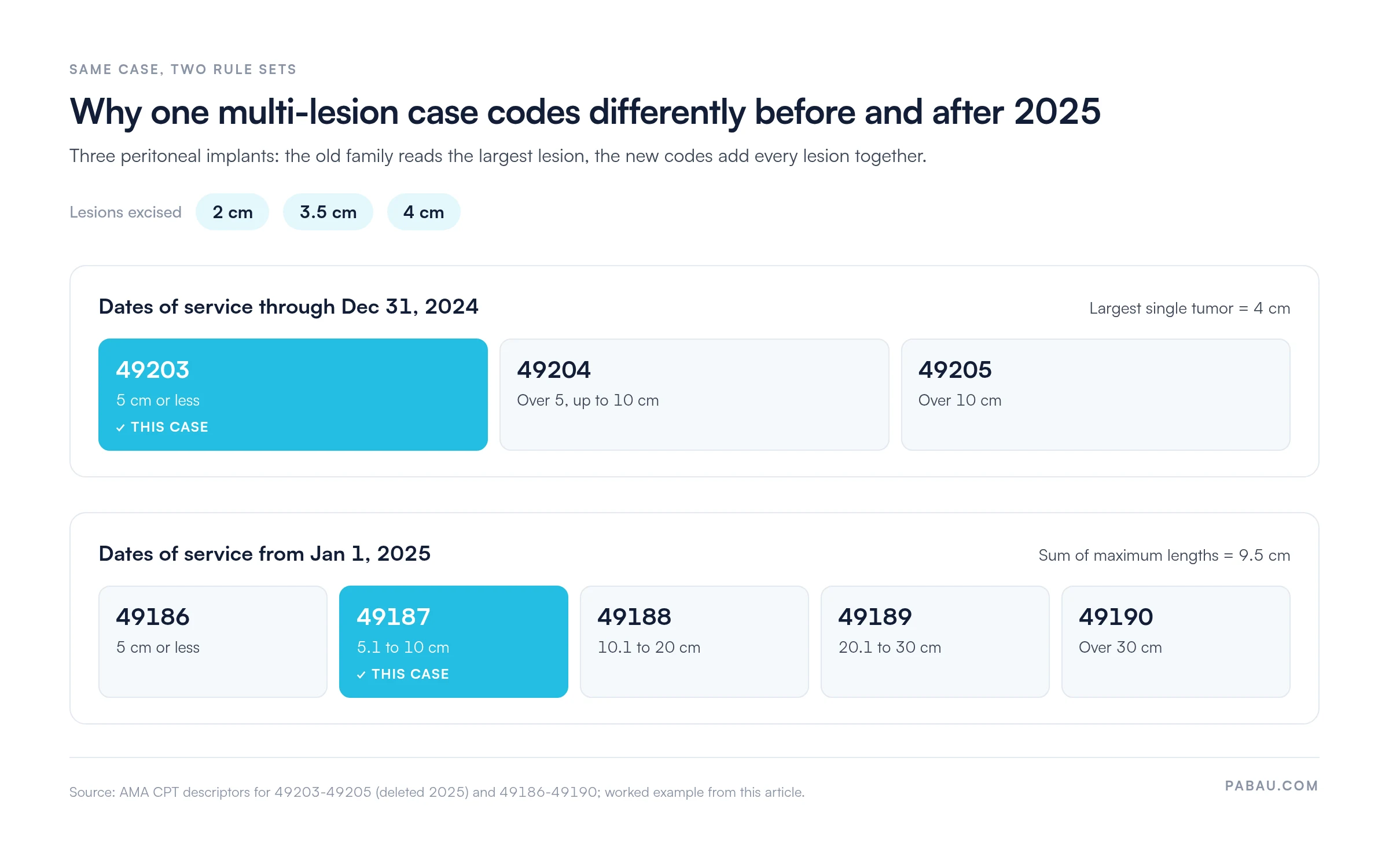
All three codes were deleted as of January 1, 2025. As a result, a size from a pre-2025 note doesn’t map one-to-one onto the new codes, because 49186-49190 add up every lesion rather than reading the largest one.
Every 49203 claim stands or falls on the op report. In fact, payers read it to confirm the size band, the approach, and medical necessity, and thin records are a common reason these claims are denied.
The op report needs each item below to support a 49203 claim and keep it a clean claim:
Modifiers don’t change the procedure, but they change how the payer processes the claim. Indeed, a wrong or missing modifier on CPT code 49203 is a common denial trigger, often for co-surgery and multi-procedure encounters.
Modifier -22 carries the highest audit risk. Payers want detailed records behind the complexity claim, and a one-line note that the case was “complex” won’t do. Instead, describe exactly what made the procedure harder than the standard descriptor expects.
Medicare pays CPT code 49203 under the Medicare Physician Fee Schedule (MPFS), which assigns three RVU components. They cover physician work, practice expense (overhead), and malpractice. The CMS Physician Fee Schedule lookup tool is the authoritative source for current and historical payment rates by code, locality, and year.
Payment follows the date of service. 49203 is valid for dates of service through December 31, 2024. Thus, its MPFS rates apply to those services even when the claim is filed later. However, for dates of service from January 1, 2025, the code is invalid, so pull rates for 49186-49190 from the same CMS lookup.
Payment varies between facility and non-facility settings. The non-facility rate (office setting) is higher because its practice expense RVU covers the doctor’s overhead. In contrast, the facility rate (hospital or ASC) is lower because the facility bills separately for resources. So confirm the setting before comparing rates.
Open intra-abdominal tumor excision is often elective or semi-elective, so commercial payers and many Medicaid programs expect prior approval before surgery. Otherwise, the payer can deny the claim on medical-necessity grounds even when the coding is correct.
Approval rules vary by payer and by contract, so check with each payer before scheduling. In general, most requests for open intra-abdominal tumor excision ask for:
Medicare does not require prior approval for most inpatient surgical procedures, but Medicare Advantage plans may set their own rules. Therefore, check the plan contract, not the base Medicare policy.
CPT code 49203 claims have a predictable denial profile. In fact, most rejections fall into one of six categories, each with a specific corrective action.
Good denial management workflows track denials by code, payer, and category, which surfaces systematic problems before they compound. In short, a single wrong code in a charge template produces the same denial on every claim until someone catches it.
Sorting by CARC denial codes shows whether a denial is code-level, documentation-level, or approval-level. Indeed, each category has a different resolution path.
Review your ERA/835 remittance files weekly and sort denials for CPT 49203 and its family by CARC code. CO-181 (procedure code invalid on the date of service) points straight at a deleted code. Clusters of CO-4 (procedure code inconsistent with modifier) or CO-16 (claim lacks information) point to documentation or modifier problems. Fix those at the source rather than appealing each claim individually.
Many surgical practices still bill from paper superbills and charge templates built before 2025. As a result, rejections for a deleted code turn up days later in a payer portal, disconnected from the patient record.
Pabau, the practice management platform we build, includes claims management software for US practices. It submits CMS-1500 claims to thousands of US payers and checks patient coverage before the procedure is scheduled.
Claims travel through the Claim.MD clearinghouse, and ERAs are matched back to submitted claims. A denied 49203 line shows up against the claim and patient it belongs to. As a result, your team can correct and send again without hunting through remittance files.

Pabau submits CMS-1500 claims through Claim.MD to thousands of US payers, checks eligibility before surgery, and matches ERAs back to submitted claims. Your billing team spends its time on exceptions instead of chasing remittances.

Treat 49203 as a date-of-service question. Services through December 31, 2024, still bill under 49203 and the largest-tumor rule. In contrast, services from January 1, 2025, need the summed tumor length and a code from 49186-49190.
The fix that pays off first sits upstream. First, purge 49203-49205 from charge templates and superbills, and ask surgeons to record the greatest length of every lesion. That adds a line to the op note, but in return one measuring habit supports both rule sets.
Want claims, eligibility checks, and ERAs handled in one system? Book a demo to see Pabau’s surgical billing workflow.

Need to understand how clearinghouse edits catch errors before payers see them? How medical claims clearinghouses work explains the front-end edit process and what gets caught at each validation stage.
Looking to benchmark your denial rate for surgical codes? Revenue cycle management fundamentals covers how to track denial rates, days in AR, and clean-claim percentages as operational KPIs.
Want a walkthrough of 837P claim files for CPT procedures? 837 file structure and submission covers the EDI transaction format, loop requirements, and how to read a rejection response.
New to the billing side of surgical practice? What is medical billing walks through the process from patient encounter to payment.
CPT code 49203 is the open excision or destruction code for intra-abdominal tumors, cysts, or endometriomas up to 5 cm. It covers peritoneal, mesenteric, and retroperitoneal lesions, both primary and secondary. The code requires an open approach. It was deleted effective January 1, 2025, and replaced by 49186-49190.
CPT code 49203 has been deleted. The AMA removed it, along with 49204 and 49205, effective January 1, 2025, and replaced the family with 49186-49190. Payment follows the date of service. 49203 stays valid for services through December 31, 2024, and fails front-end edits as an invalid code for services from January 1, 2025.
Under the pre-2025 rule, the three codes differed only by the diameter of the largest single tumor. 49203 covered 5 cm or less, 49204 more than 5 cm up to 10 cm, and 49205 more than 10 cm. All three were deleted effective January 1, 2025. Their replacements, 49186-49190, add up the maximum lengths of all lesions instead. Three lesions of 2, 3.5, and 4 cm now total 9.5 cm and code to 49187.
The usual modifiers are -22 for increased complexity, -51 for multiple procedures on the same day, and -59 for a distinct service under NCCI edits. Use -62 when two surgeons each perform a distinct part, and -80 for an assistant surgeon. Modifier -22 carries the highest audit risk. Append it only when the operative report documents what made the case harder than the descriptor contemplates.