CCSD code F4810: Open salivary gland biopsy billing guide
CCSD code F4810 is an open biopsy of a salivary gland lesion CCSD code F4810 is ...

Last Updated: Oct 5, 2026
CPT code 49000 is the procedure code for exploratory laparotomy, the open surgical exploration of the abdominal cavity, reported with or without biopsy. One phrase in the AMA descriptor governs how it gets paid, and that phrase is “separate procedure”.
That designation bundles the code into most abdominal surgeries performed in the same session. It stands alone only when the exploration was the whole operation, or a distinct service in its own right. Get the call wrong and the line denies, which sends the claim straight back to your desk.
What follows is the rule set behind each call, from modifier choice to the ICD-10 pairing. It ends with a check you can run in a couple of minutes.

CPT code 49000 reports exploratory laparotomy or celiotomy, with or without biopsy, and carries the AMA’s separate procedure designation.
That designation bundles 49000 into most concurrent abdominal procedures under NCCI edits, so it rarely stands alone on a surgical claim.
Modifier -59, or an X-modifier such as -XU, unbundles 49000 only when the operative note documents a distinct exploration.
Place of service, the ICD-10 pairing and the 90-day global period are the details that most often sink an otherwise clean claim.
Practice management software like Pabau pre-fills the CMS-1500 from the record and submits through Claim.MD, its US clearinghouse partner.
CPT 49000 describes exploratory laparotomy, exploratory celiotomy with or without biopsy(s), and the AMA marks it as a separate procedure. The surgeon opens the abdominal wall and examines the organs directly.
The code sits in the digestive system section of the CPT set, which the American Medical Association maintains.
The parenthetical “(separate procedure)” is the phrase that decides payment. It marks 49000 as a component of more extensive abdominal work. When the exploration is the only procedure, or serves a distinct purpose, you can report it on its own. Otherwise it belongs to the larger operation and gets no line of its own.
49000 fits when the surgeon opens the abdomen mainly to look inside it. That happens when preoperative imaging is inconclusive, or when an emergency needs direct visualization before anyone can pick an intervention. It is not a catch-all for abdominal surgery that happens to start with an incision.
Six clinical pictures support reporting the exploratory laparotomy code on its own:
The exploration may take in direct palpation of organs, tissue biopsy, washout and drain placement. All of that sits inside the code. If the surgeon then performs a definitive abdominal procedure in the same session, that procedure is reported separately and 49000 bundles into it.
A modifier tells the payer that a service was altered in a way that matters clinically. On 49000 the choice carries extra weight, because the separate procedure designation creates a default presumption of bundling that a modifier has to overcome.
Check modifier applicability with your Medicare Administrative Contractor before submission. MAC policies on acceptable circumstances for -59 and the X-modifiers vary. Some have issued Local Coverage Determinations that narrow when 49000 can be unbundled at all.
The National Correct Coding Initiative, known as NCCI, is the CMS program that sets procedure-to-procedure edit pairs. Those pairs decide which codes bundle by default.
49000 shows up as a component code against a long list of abdominal procedures. Put it next to one of them with no modifier and the line is denied.
The underlying principle is simple. If a surgeon opens the abdomen to perform an appendectomy, a bowel resection or a colostomy, the laparotomy incision is inherent to that procedure. Billing 49000 on top of it is unbundling.
The chart below is the test to run before the charge is entered.
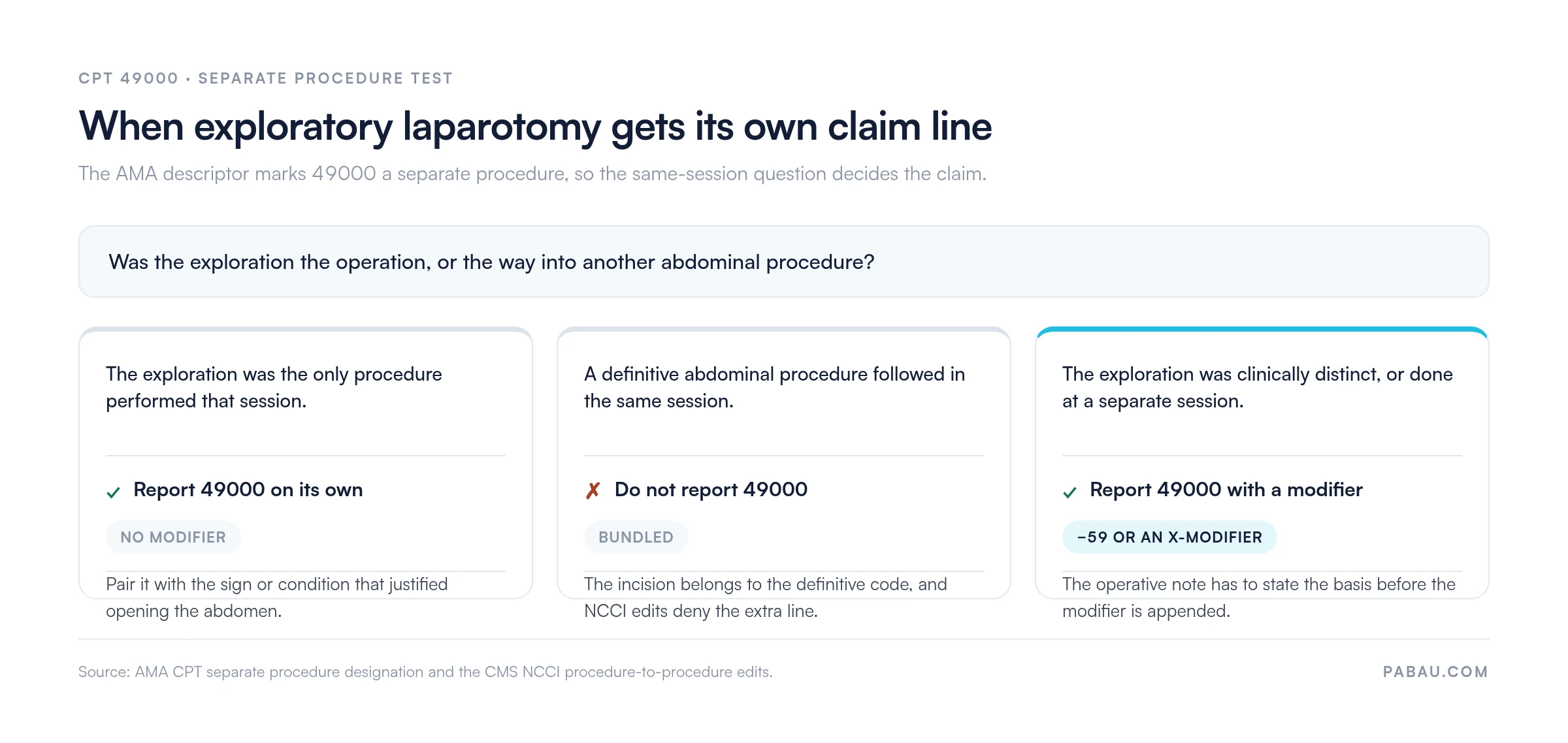
NCCI edits are updated quarterly, so a pairing that cleared last spring may not clear now. Check the current table on the CMS NCCI edits page before you submit a claim carrying 49000 and another abdominal code.
Run a quarterly NCCI check on your top 10 abdominal code combinations. Download the current procedure-to-procedure file from CMS, filter for 49000 as a column-two code, and update your charge capture templates. Any pairing that needs a modifier then gets flagged before the claim goes out, not after.
Medicare builds the payment from the Resource-Based Relative Value Scale. The code’s work, practice expense and malpractice relative value units are multiplied by the annual CMS conversion factor. That figure is then adjusted by the Geographic Practice Cost Index for your locality.
Because dollar amounts shift every year and differ by region, no fixed 2026 figure belongs in a guide like this one. Pull the current rate from the CMS physician fee schedule lookup before you quote payment to a surgeon or post an expected amount.
49000 carries separate facility and non-facility rates, as every surgical code on the CMS schedule does.
The facility rate applies in a hospital or an ambulatory surgical center, where the site carries the overhead. The non-facility rate is higher because it repays the provider for overhead in an office setting.
In practice, exploratory laparotomy happens in a hospital or an ASC. Put place of service 11 on a 49000 claim and it will draw medical review, or an outright denial. The procedure needs a surgical suite and general anesthesia.
Confirming the site code is a 10-second check with a large payoff.
Medical necessity for 49000 rests on the ICD-10-CM code you pair with it. Pick the one that matches the indication the surgeon documented, rather than the pairing you used last time.
Vague diagnosis codes are a common trigger for a payer request for the operative report, and for the rework cycle that follows.
These six cover most 49000 claims, and the full ICD-10 library for coders covers the rest. Pairing 49000 with R10.9, unspecified abdominal pain, when a more specific diagnosis is documented, is a coding error rather than a shortcut.
Validate the pairing against your MAC’s Local Coverage Determination and the AAPC CPT-to-ICD-10 crosswalk.
The operative report is the document that carries 49000. Payers and Recovery Audit Contractors pull it during prepayment and post-payment review, precisely because the separate procedure designation makes the code audit-prone. A thin note is the fastest route to a denial or a recoupment demand.
Surgeons dictate for the chart and coders read for the claim, so the two rarely line up on their own. These seven elements are what close the distance:
Unbundled surgical claims draw audit attention, and 49000 sits squarely in that group. A practice with steady 49000 volume should audit its own operative reports against submitted claims once or twice a year. Better to find the mismatch before a payer does.
Two questions separate 49000 from its neighbors. Was the approach open or laparoscopic, and was the purpose exploration or treatment? Answer both and the choice is usually obvious.
The table below covers the five codes that generate the most crossover on general surgery and trauma claims.
Use 49000 for an open exploration and 49320 for a laparoscopic one. The approach drives the choice, regardless of the clinical intent behind it. Both carry a separate procedure designation, and neither substitutes for the other.
Conversions come up often. When a laparoscopic exploration becomes an open procedure in the same session, report the open code alone. Add -22 only where the operative note supports substantially more work than usual. Reporting both 49000 and 49320 for one session needs an NCCI check and a documented clinical basis first.
A 49000 claim passes through six stops between the operating room and the remittance. A denial almost always traces back to one of them. Knowing which one failed tells you whether to fix a process or fix a note.
Stops two and three are where 49000 gets lost. A clearinghouse rejection comes back fast and cheap. An NCCI denial lands weeks later, once the global period clock has already been running. Reversing it takes a rework cycle plus supporting documentation.
49000 carries more audit exposure than an average surgical code, thanks to the separate procedure designation and the complex encounters it turns up in. Six errors account for most of the denials.
Most 49000 denials are catchable at the desk. Work through this list while the charge is still open, the same way you would with any other clean claim checklist.
A box left unticked is worth a five-minute conversation with the surgeon. That beats reworking the claim a month later, with a payer already holding the file.
Build one rule into your billing workflow. When 49000 is entered alongside any abdominal CPT code, the charge should stop. The coder then confirms modifier status and attaches the operative report before the charge releases. That single prompt catches most unbundling errors before submission.
Every checkpoint above is manual, and each one is a place where a surgical claim stalls. Practices running charge capture from spreadsheets and a separate coding reference tend to spot the pattern on a monthly AR report. By then the rework has piled up.
Practice management software like Pabau shortens the trip from the record to the claim form. Its claims software for practices pre-fills the CMS-1500 from the encounter, so the CPT code attached to the service lands on the charge line. The ICD-10 slots are seeded from the recorded problem list.
Two more pieces matter for a code like 49000. Pabau carries ICD-10-CM and CPT/HCPCS lookup libraries, refreshed with each official release, so a coder can confirm a descriptor without leaving the claim. Required fields are validated before the send button unlocks, which heads off the format rejections at stop five.
In the US, claims go out through Claim.MD, Pabau’s clearinghouse partner, with real-time eligibility checks, claim status tracking and remittance posting. Modifier choice stays with the coder, and so does reading the NCCI table. Pabau moves the claim once those calls are made.

Pabau pre-fills the CMS-1500 from the record and submits through Claim.MD, with eligibility checks, claim tracking and remittance posting in one place. See how the billing workflow handles a 90-day global code.

One judgment decides a 49000 claim. Was the exploration the operation, or the way into another one? The surgeon answers that in the operative note, and the coder either finds the answer there or does not.
So the work that pays off sits upstream of the claim. Agree with your surgeons on what a same-session exploration has to say in the note, then hold the charge until it says it. A modifier appended to a thin note may survive the first pass and fail the audit, which is the worse of the two outcomes.
If your denials cluster on surgical lines, look at the handoff between the OR and the billing desk before you look at the coding. Book a demo to see how Pabau carries a coded surgical charge from the record through to Claim.MD.

Want to see how claims move from code to payment? Revenue cycle management explained covers the full billing cycle, from eligibility check through to remittance posting.
Need to confirm coverage before surgery? Insurance eligibility verification sets out how to check benefits and cut authorization-related denials before the procedure date.
Getting denials on your surgical claims? Denial codes in medical billing explains the common CARC and RARC codes and what each one needs for appeal.
Worried about unbundling exposure? Medical billing compliance walks through the rules auditors apply and the internal checks that keep a practice clear of them.
Sitting on a backlog of denied lines? Denial management in healthcare shows how to triage, appeal and prevent repeat denials across a surgical caseload.
Yes. The code pays for the exploration itself, so a negative laparotomy is still billable when the note documents the indication and the findings. Report the sign or symptom that justified surgery, such as R10.0 for acute abdomen, rather than a condition that was never confirmed.
It can. 49000 carries a 90-day global period. An E/M service on the day of or the day before surgery needs modifier -57 on the E/M line. That modifier tells the payer the visit produced the decision to operate. Without it, the visit is treated as part of the global package.
49002 reports reopening a recent laparotomy, so it applies when the abdomen is opened again within the original surgery’s global period. 49000 is the first exploration. An unplanned return to the operating room for a related problem also usually takes modifier -78 on the claim.
Emergency explorations do not wait for authorization, and payers handle them under notification rules instead. Scheduled cases, such as a staging or second-look laparotomy, often do need approval from a commercial payer. Check the payer’s emergency admission policy and its notification window before the claim goes out.