CPT Code 27425: Lateral retinacular release billing guide
CPT Code 27425: Official descriptor and procedure overview CPT code 27425 is def...

Last Updated: Nov 16, 2026
49905 is the CPT add-on code for an intra-abdominal omental flap. It is reported with the primary procedure that needed the flap, on the same claim, and never on its own.
The surgeon moves the greater omentum on its vascular pedicle to cover or reinforce a site, such as an anastomosis or exposed mesh. As an add-on, 49905 carries a ZZZ global period and takes no modifier 51. The descriptor names no approach, so confirm a laparoscopic flap against AMA CPT guidance before billing it.
Let Pabau's smart automation suggest the right codes, reduce claim denials, and keep your practice compliant—effortlessly.
Automate repetitive tasks and focus on what matters most—your patients.
Reduce coding errors and ensure compliance with the latest regulations.
Clean claims, fewer denials, and faster reimbursements.
Powerful insights and reporting to help your practice thrive.
HIPAA compliant SOC 2 certified GDPR-compliant Trusted by 4,000+ clinics worldwide

CPT code 49905 is an add-on code for an intra-abdominal omental flap, so it is always reported with a primary procedure on the same claim.
The descriptor names no surgical approach, so check AMA CPT guidance before reporting a laparoscopic flap, where an unlisted code may apply.
Medicare’s 2026 values are 6.38 work RVUs and 9.43 total RVUs, the same in facility and non-facility settings.
As an add-on, 49905 carries a ZZZ global period that follows the primary procedure, and it never takes modifier 51.
Pabau’s claims management software captures codes, submits claims through Claim.MD, and returns eligibility checks and ERA remittances.
CPT code 49905 reports an intra-abdominal omental flap, and it is an add-on code reported only with the primary procedure that needed the flap. CMS values it with a ZZZ global period, as the 2026 fee schedule data for 49905 shows, so it rides on the primary code’s package.
The surgeon mobilizes the greater omentum and keeps it on a vascular pedicle. The flap then moves to a target site within or next to the abdominal cavity. The American Medical Association (AMA) owns the CPT code set and publishes the descriptor.
Surgeons use the omentum because it carries a strong blood supply and fills dead space well. Typical reasons include reinforcing a bowel anastomosis, covering exposed mesh, treating a chronic sternal wound infection, and supporting a pelvic reconstruction after cancer surgery.
The 49905 line covers the work of building and placing the flap. Each step below is part of that one service, so none of them gets a line of its own.
The 49905 descriptor does not name an approach, and no source we checked confirms a laparoscopic option. Confirm with AMA CPT guidance before reporting a laparoscopic flap, because an unlisted code such as 49999 may apply instead.
If a laparoscopic case converts to open in the same session, report the open approach. Document the reason for conversion in the operative note.
Picture a colorectal surgeon who resects a segment of bowel and wraps the new anastomosis in an omental flap. The claim carries two lines with the same date of service. The resection is the primary line, and 49905 sits beneath it.
The layout below shows what each line carries, and why the add-on line has so little of its own.
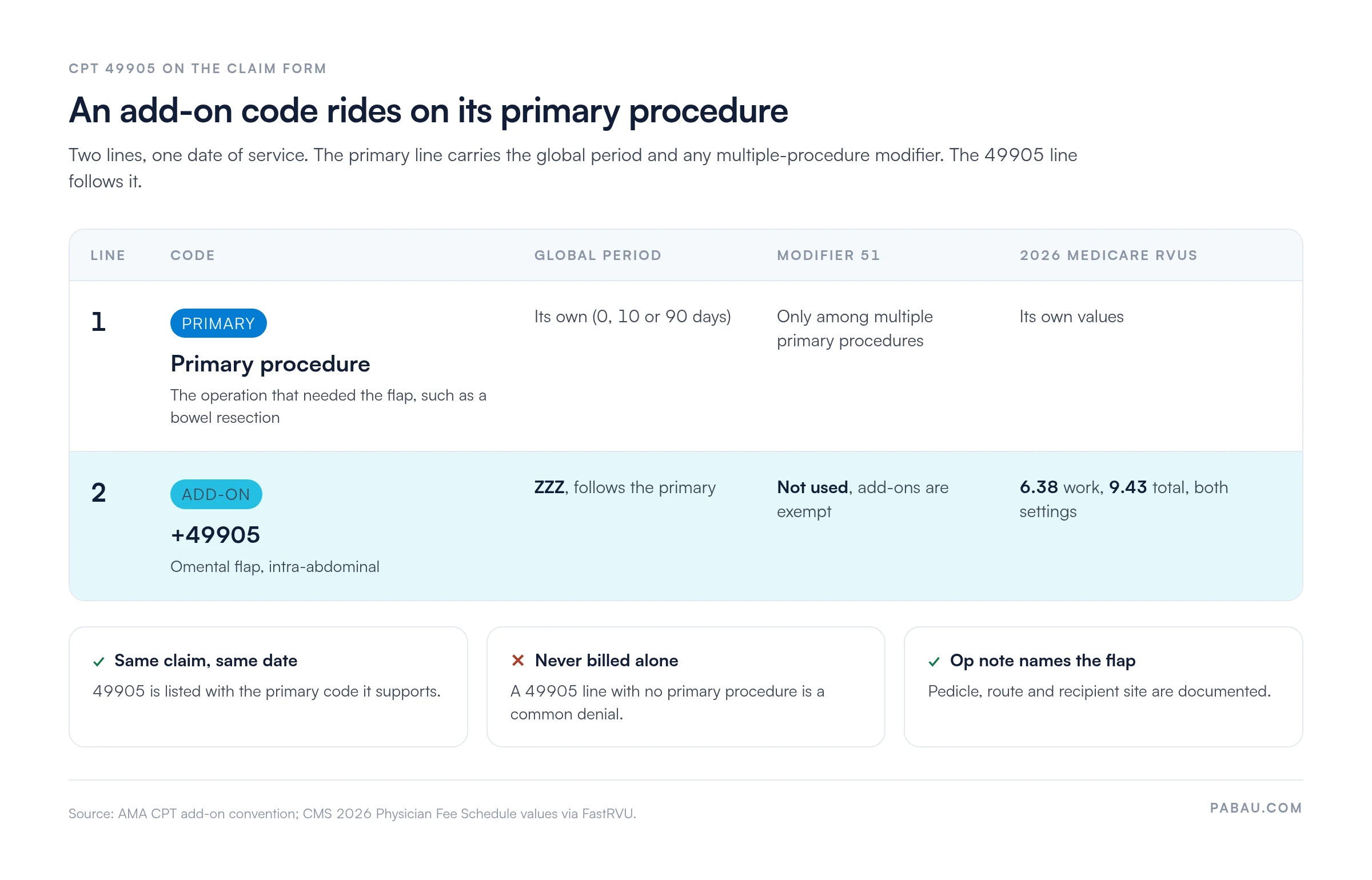
Medicare treats the pairing as a payment condition. Under its add-on code edits, an add-on is eligible for payment only when an acceptable primary code is also eligible. So when the primary line denies, expect the 49905 line to deny with it.
The National Correct Coding Initiative (NCCI) sets the bundling pairs for 49905, and CMS updates them every quarter. Check the current edits before billing.
These services normally bundle into the flap and should not be billed on their own:
Other work can be reported separately when it is distinct and documented. Modifier 59 or an XS/XU modifier may apply, depending on payer policy.
Check the NCCI table for every code on a 49905 claim before it goes out. A bundling conflict caught at charge entry takes minutes to fix, while a denial takes weeks.
Several abdominal codes look close to 49905 but describe different work. The table sets out what separates each one.
The exploratory laparotomy code, 49000, is the most common wrong pick. It fits when the surgeon opens the abdomen to look, without moving tissue. When a flap is built, 49905 must be listed with the primary procedure that needed it.
A thin operative report is the fastest route to a 49905 denial. “Omental flap performed” is not enough, so make sure the note covers each point below.
ICD-10-CM codes must establish medical necessity. Common pairings include wound disruption (T81.31XA, T81.32XA), infection following a procedure (T81.40XA to T81.49XA, by depth), and an anastomotic leak (K91.89). Confirm current codes in the CDC/NCHS ICD-10-CM web tool before submission.
Medicare has no national coverage determination specific to 49905, so coverage sits with the Medicare Administrative Contractor (MAC) in each jurisdiction. Check your MAC’s coverage database for a local policy before you submit.
Commercial plans vary and change often. Treat a non-emergency 49905 case as likely to need authorization, and request it for the primary procedure and the flap together. A clear prior authorization process keeps both codes on the same approval.
The Centers for Medicare & Medicaid Services (CMS) values 49905 under the Medicare Physician Fee Schedule (MPFS). For 2026 the code carries 6.38 work RVUs and 9.43 total RVUs, and the values are the same in facility and non-facility settings.
Rates update every January, so verify them in the CMS Physician Fee Schedule lookup tool before quoting them. The FastRVU lookup tool gives a quick work, PE, and MP breakdown.
Modifier choice works differently on an add-on line. The table below summarizes the modifiers that come up with 49905 and what each one needs. A superbill template that lists 49905 under its common primary procedures keeps the pairing visible at charge entry.
Most 49905 problems are visible before the claim leaves the building. Run through these checks at charge entry, in this order.
Denials for 49905 cluster around a few avoidable problems. Match each one against the denial codes in medical billing your payer returns, so you know which fix applies.
Give every 49905 claim a two-step review before it goes out. First confirm the primary procedure is on the same claim, then check the NCCI edits for every code pair.
For appeals and tracking by denial reason, a steady denial management routine turns repeat 49905 denials into a pattern you can fix.
Most billing teams find out a 49905 line went out alone when the denial comes back. By then the operative note is weeks old, and someone has to rebuild the claim by hand.
Pabau, the practice management platform we build, keeps the charge, the patient record, and the claim in one place. Its claims management tools capture the procedure codes, run eligibility checks, and submit claims through Claim.MD.
ERA remittances come back to the same record, so your team sees the primary and add-on lines paid, or denied, side by side. Problems surface in days, not at month end.

Pabau captures procedure codes, runs eligibility checks and submits claims through Claim.MD. ERA remittances post back to the patient record, so a denied 49905 line is visible fast.

Treat 49905 as half of a pair. If the primary procedure, the operative detail, and the diagnosis pointer are right, the add-on line rarely causes trouble.
The habit worth building is a primary-code check at charge entry, before NCCI and before modifiers. It catches the most common 49905 denial at the cheapest point to fix it.
Book a demo to see how Pabau keeps surgical claims and their remittances on one patient record.

Coding the exploration, not the repair? CPT code 49000 covers exploratory laparotomy billing and when it stands alone.
No CPT code fits the abdominal work? CPT code 49999 explains how to report an unlisted abdomen, peritoneum or omentum procedure.
Want fewer denials across your surgical claims? Denial management in healthcare covers tracking, categorizing and appealing denied claims by CARC code.
Mapping where add-on payments land? Revenue cycle management walks through the process from eligibility checks to payment posting.
Planning authorization for elective surgery? The prior authorization process sets out a step-by-step workflow for getting approvals before the procedure.
Omentoplasty is a broad term for any surgery that uses the omentum. An omental flap is one type, where the omentum moves on its blood supply to a new site. Tacking it in place is omentopexy, a different code.
The 49905 line usually denies too. Medicare pays an add-on only when an acceptable primary code is also eligible for payment. Fix and resubmit the primary line first.
Search the code in the CMS Physician Fee Schedule lookup tool and select your Medicare locality. The tool applies the local geographic adjustment to the national RVUs.
General, colorectal, and oncologic surgeons report it most often. Urologists and plastic surgeons also use it when an omental flap supports a pelvic or wound reconstruction.
Not a separate one. Point the 49905 line to the diagnosis that explains why the flap was needed, which is often the same one supporting the primary procedure.