

HCPCS Code Q4185: Cellesta flowable amnion billing guide
HCPCS Code Q4185: definition and official descriptor HCPCS Code Q4185 is the Lev...

Last Updated: Nov 20, 2026
Billable Code
44799 is the CPT code for unlisted procedure, intestine. It is reported when no specific code in the 44005-44799 Intestines (Except Rectum) range describes the procedure performed.
The code has no fixed RVU or Medicare fee. Payers price it by report, from the operative report, a letter of medical necessity, and a comparable CPT code the biller names. That comparable code sets the allowed amount.
Let Pabau's smart automation suggest the right codes, reduce claim denials, and keep your practice compliant—effortlessly.
Automate repetitive tasks and focus on what matters most—your patients.
Reduce coding errors and ensure compliance with the latest regulations.
Clean claims, fewer denials, and faster reimbursements.
Powerful insights and reporting to help your practice thrive.
HIPAA compliant SOC 2 certified GDPR-compliant Trusted by 4,000+ clinics worldwide

CPT code 44799 covers unlisted procedures of the intestine only, not colon or rectum procedures (those use CPT 45399).
No fixed RVU or Medicare fee schedule amount exists for 44799; payment is determined by the comparable CPT code the biller identifies.
Every 44799 claim requires three documents: operative report, letter of medical necessity, and a named comparable CPT code with rationale.
Missing documentation is the primary denial trigger. Pabau’s claims management software keeps the clinical record and the 837P claim in one system.
CPT code 44799 is the unlisted procedure code for the intestine, and its official descriptor reads “Unlisted procedure, intestine.” AAPC’s CPT 44799 entry files it under Other Procedures on the Intestines (Except Rectum), for new or unusual intestinal procedures with no assigned code. It is the last code in the 44005-44799 subsection. This guide focuses on the small intestine (the duodenum, jejunum, and ileum), because colon procedures have their own unlisted code, 45399.
“Unlisted” in the CPT system means no existing code accurately describes the procedure performed. The AMA keeps unlisted codes for novel, rare, or emerging procedures that have no dedicated descriptor yet. Reporting one is correct coding, but it sends the claim into manual review at every payer.
Use CPT code 44799 when a procedure involves the small intestine and no specific CPT code in the 44005-44799 range matches what was performed. The deciding factor is the absence of a more precise code, however complex the procedure was.
Clinical scenarios where 44799 is appropriately reported include:
The “no specific code exists” standard is strict. Before defaulting to 44799, the coder reviews the full 44005-44799 range. No existing code, with or without an applicable modifier, may describe the procedure accurately. Reporting 44799 when a specific code exists is a coding error.
The boundary that matters most for 44799 is anatomical. Procedures on the colon, rectum, or anus take different unlisted codes, as do the neighboring digestive organs in the table below.
Submitting 44799 for a colonic procedure when 45399 is the correct code is a material coding error. Payers cross-reference the operative report against the code billed, and an anatomical mismatch triggers both a denial and a potential compliance flag.
Coders most frequently confuse 44799 and 45399 because both describe unlisted GI surgical procedures and both sit at the end of their respective numeric ranges. The only difference is anatomy.
When the operative site crosses anatomical boundaries (e.g., a procedure involving both small bowel and colon), report the code that reflects the primary surgical site. Document the anatomical extent explicitly in the operative report to support whichever code is billed.
Incomplete documentation causes more 44799 denials than any other problem, so every claim needs three core documents before it goes out. Building medical billing compliance into the documentation stage stops those denials before they happen.
Selecting the comparable code is the most consequential step in a 44799 submission because payers use it to calculate payment. Follow this sequence:
Example LMN language: “CPT code 44799 is reported for a laparoscopic intestinal plication performed for superior mesenteric artery syndrome. The procedure most comparable in work and physician effort is CPT 44202 (Laparoscopy, surgical; enterectomy, resection of small intestine, single resection and anastomosis). Both involve laparoscopic access and small bowel manipulation, though the plication technique employed here has no specific existing descriptor.”
Had the same plication been done through an open incision, the comparable reference would be 44120. That is the open-approach code for a single small bowel resection with anastomosis.
Medicare does not publish a fixed fee or RVU value for CPT code 44799. The CMS Physician Fee Schedule lists 44799 as a “by report” code. Each claim is reviewed and priced individually, based on the comparable code and the documentation submitted. Medicare Administrative Contractors (MACs) apply their own pricing determinations, so allowed amounts can vary by jurisdiction.
Key Medicare-specific requirements for 44799 claims:
Routing claims through a medical claims clearinghouse checks that the 837P transaction and its attachments reach the payer in the right format. That cuts technical rejections before the claim reaches clinical review.
The National Correct Coding Initiative (NCCI) edits apply to unlisted procedure codes including 44799. Because 44799 has no fixed column 1/column 2 edit pairings published for a known procedure, NCCI conflicts arise when:
Modifier 22 (increased procedural services) on 44799 tells the payer the procedure involved substantially more work than the comparable code alone suggests. The documentation must then quantify that additional work, typically through operative time, complexity of dissection, or unusual circumstances.
Payment for 44799 is entirely comparable-code-dependent. No published RVU or fee schedule entry exists for this code. Payers follow a “by report” methodology:
This makes the comparable code selection a direct driver of revenue. A well-documented LMN naming an appropriately complex comparable code earns a higher allowed amount than a vague submission referencing a simpler procedure. The flow below shows where that choice enters the claim, and where it decides the payment.
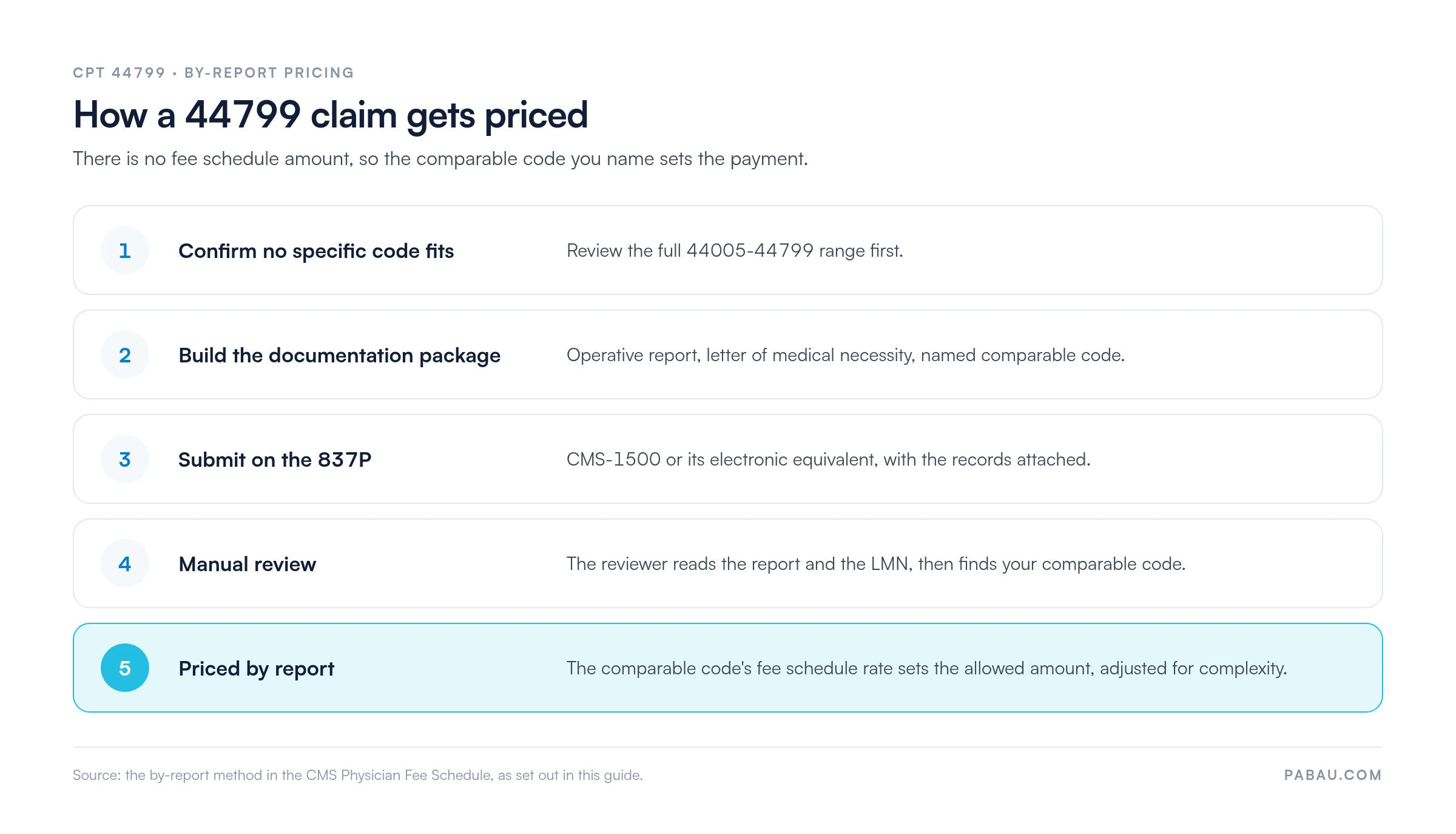
Commercial payers and Medicare Advantage plans each apply their own contracted rates to the comparable code. Medicare FFS MACs use their local fee schedule for the referenced comparable code. Reimbursement takes longer than for standard CPT codes because unlisted claims require manual pricing.
Electronic claim status and electronic remittance advice (ERA) show billers when a 44799 claim has been priced, without a call to the payer. Sound revenue cycle management keeps these claims inside the practice’s normal cash-flow routine, so each one is no longer a one-off exception.
Denials on 44799 follow predictable patterns, and a pre-submission documentation review prevents most of them. Structured denial management workflows catch them before submission, so the claim pays on the first pass instead of going to appeal.
Medicare FFS generally does not require prior authorization for unlisted procedure codes, including 44799. However, commercial payers and Medicare Advantage plans frequently do. Because 44799 falls outside the standard fee schedule and triggers manual pricing, many plans treat it as high-risk. They require advance approval whatever the specific procedure is.
Verify prior authorization requirements per individual plan before the procedure date, not at billing. Contact the plan’s provider services line using the specific CPT code (44799) and the anticipated comparable code together. Documenting the authorization number and representative name protects against post-service denial on PA grounds.
Before submitting a 44799 claim, run a five-point check. Confirm the operative report is attached and the LMN is signed by the performing physician. Check that the comparable CPT code is named with a written rationale. Verify the ICD-10-CM codes against the clinical indication, and record the prior authorization number if one was required.
The 44799 billing workflow is longer than a standard surgical claim, but each step is predictable. Following this sequence turns a high-denial code into a manageable submission.
A 44799 claim usually stalls in the handoff between the surgeon’s notes and the billing team. Billers chase the operative report, retype details into the claim form, and track by-report claims in a spreadsheet while pricing takes weeks.
Pabau, the practice management platform we build, keeps the clinical record and the claim in one system. Its claims software for specialists sends US claims as CMS-1500/837P through the Claim.MD clearinghouse. It also runs eligibility checks and posts ERA remittances against the patient record.
Prior authorization codes, dates, and sessions are tracked on the patient’s case, with a warning when one is missing. Billers see each pending 44799 claim’s status from the same place, so a stalled claim surfaces before the timely filing window closes.

Pabau sends 837P claims through the Claim.MD clearinghouse, tracks prior authorizations on the case, and posts remittances against the patient record. Unlisted code claims stay visible from submission to payment.

The payment on a 44799 claim is decided before the claim is submitted. The comparable code named in the letter of medical necessity sets the allowed amount. The operative report is what makes that comparison credible to a reviewer.
So choose the comparable code with the surgeon, match it to the approach used, and state the rationale in one specific sentence. A claim built that way gives the reviewer what they need to price it without a records request. Book a demo to see how Pabau keeps operative notes, prior authorizations, and claims in one place for surgical billing teams.

Need a clearinghouse that handles unlisted CPT submissions? How Claim.MD clearinghouse works explains the 837P attachment process and ERA handling for by-report codes.
Want to understand how payers interpret claim denials? What is medical billing breaks down the full claim lifecycle from charge capture through payment posting.
Looking for the superbill format for unlisted procedure documentation? Superbill guide covers how to structure the charge document that accompanies unlisted code claims.
CPT code 44799 is the unlisted procedure code for the intestine. It is used when no existing CPT code in the 44005-44799 range accurately describes the intestinal procedure performed. It is a “by report” code with no fixed fee schedule value.
Use CPT code 44799 only after confirming that no code in the 44005-44799 range describes the procedure performed, with or without a modifier. If any specific code fits, that code takes priority over the unlisted code.
Every CPT code 44799 claim requires three documents. The first is a complete operative report describing the anatomical site and each procedural step. The others are a physician-signed letter of medical necessity and a named comparable CPT code, with a rationale for the choice.
Yes, Medicare covers CPT code 44799 when medical necessity is established and documentation requirements are met, but no fixed fee schedule amount exists. Each MAC prices the claim individually from the comparable CPT code and the documentation submitted. Reimbursement varies by jurisdiction and by the comparable code the biller names.
The most common denial reasons for CPT code 44799 are a missing operative report and an LMN that names no comparable CPT code. Others are ICD-10-CM codes that do not support the procedure, and missing prior authorization from commercial or Medicare Advantage plans that require it.
CPT code 44799 covers unlisted procedures of the small intestine (duodenum, jejunum, ileum), while CPT code 45399 covers unlisted procedures of the colon and rectum. Both are “by report” codes requiring the same documentation, but anatomical site determines which code is correct. Using 44799 for a colonic procedure is a coding error.
Prior authorization requirements for CPT code 44799 vary by payer. Medicare FFS generally does not require prior authorization for unlisted codes, but commercial plans and Medicare Advantage plans frequently do. Verify per plan before the procedure date, not at billing.
Identify a comparable CPT code by searching the 44005-44799 range for codes matching the same anatomical site, procedural approach (open vs. laparoscopic), and complexity level. The LMN must name the comparable code and explain in writing why it is the closest analogy; vague comparisons are rejected by payer reviewers.





