HCPCS Code G0163: Skilled nursing observation and assessment
What is HCPCS Code G0163? HCPCS Code G0163 is a deleted Level II code for skille...

Last Updated: Oct 15, 2026

CPT code 58662 covers laparoscopic fulguration or excision of lesions on the ovary, pelvic viscera, or peritoneal surface, by any method.
Medicare values 58662 at 19.36 total RVUs, which pays $646.64 nationally at the CY2026 conversion factor of $33.4009.
Diagnostic laparoscopy 49320 is the endoscopic base code for 58662, so it never pays as a separate line.
Pair 58662 with the most specific N80 code the operative note supports, because unspecified N80.9 invites medical necessity denials.
Practice management software like Pabau submits and tracks 58662 claims through Claim.MD, with eligibility checks and ERA posting.
CPT code 58662 is a surgical laparoscopy code for fulguration or excision of lesions of the ovary, pelvic viscera, or peritoneal surface, by any method. It is the code gynecologic surgeons reach for after excising or fulgurating endometriosis implants laparoscopically. Medicare values it at 19.36 total RVUs, which comes to $646.64 nationally in CY2026.
Endometriosis affects roughly 10% of reproductive-age women and girls worldwide, according to the World Health Organization. That volume is why 58662 turns up so often in gynecology claim files.
This reference covers the descriptor, clinical indications, ICD-10 pairings, modifiers, the CY2026 RVU components and payment, the multiple-endoscopy rule, and documentation requirements. Every payment figure here comes from the CMS physician fee schedule relative value file.
Four clinical scenarios support reporting 58662. Each one needs documentation that the surgeon fulgurated or excised something, not simply that the pelvis was inspected. Laparoscopy with visualization only does not meet the threshold.
Coding laparoscopy for endometriosis means choosing the most specific ICD-10-CM code the operative findings support. A coder who defaults to an unspecified endometriosis code risks a medical necessity denial from any payer whose local coverage determination names particular N80 subcategories.
Payer systems cross-reference the procedure code against the submitted diagnosis. The codes below are the pairings that come up most often for 58662. Read the full descriptors in our ICD-10-CM code reference before you submit.
The N73.6 and N99.4 pair trips up more adhesiolysis claims than any other row in that table. N73.6 covers adhesions that follow infection, and its Excludes1 note sends postprocedural adhesions to N99.4. Coding a patient with prior pelvic surgery to N73.6 puts the wrong story on the claim.
The N80 series also rewards site specificity. Coders who reach for N80.9, endometriosis unspecified, invite denials from payers that enforce diagnosis lists in their coverage policies. When the note records laterality, code to the most specific subcategory it supports.
Modifier choice decides whether the claim processes cleanly or lands on an edit. Four modifiers come up most often in gynecologic laparoscopy, and each carries its own documentation threshold.
Modifier 22 draws audit attention whenever the operative note offers a complexity statement and no numbers. Payers want the lesion count, the additional operative time, and the surgeon’s account of what made the case harder than usual.
Modifier 59 gets the same scrutiny. Reach for it only when none of the more precise X modifiers, XE, XS, XP or XU, describes the distinction you are documenting.
Medicare pays 58662 at $646.64 nationally in CY2026, before any geographic adjustment. That figure is 19.36 total RVUs multiplied by the standard conversion factor of $33.4009. Clinicians who qualify as advanced APM participants are paid at $33.5675, which comes to $649.87.
There is no separate office rate to chase. CMS flags the non-facility practice expense for 58662 with an NA indicator, meaning the procedure is rarely or never performed outside a facility. Both settings therefore price at the same 19.36 RVUs.
Geographic practice cost index adjustment is where the number really moves. Filed in Arkansas, the same claim allows $584.85. Filed in Alaska, it allows $821.36. That is a spread of $236 on identical work, and it is why a national average makes a poor payment benchmark.
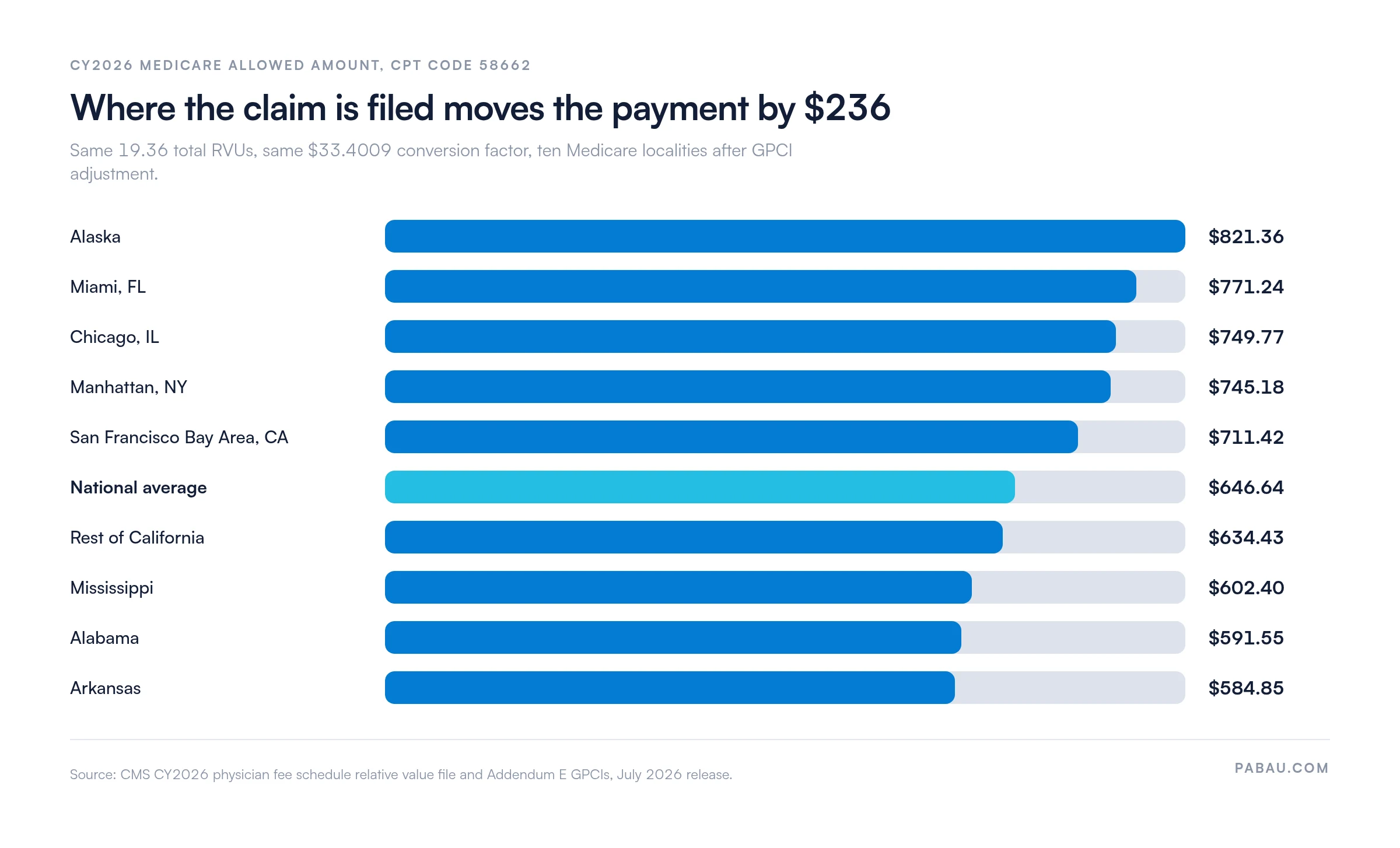
Check your own locality against the CMS physician fee schedule look-up tool before you set an expected payment. Commercial contracts often price as a percentage of the Medicare allowed amount, so the locality figure drives those too.
Payment for 58662 comes from three relative value components, added together and multiplied by the conversion factor. The values below are the CY2026 figures published in the CMS relative value file.
The work RVU carries a documented time split of 0.09 pre-operative, 0.84 intra-operative and 0.07 post-operative. That distribution is what makes the 90-day global period defensible. It also explains why a follow-up visit inside those 90 days is rarely billable on its own.
CMS revises the conversion factor every year in the physician fee schedule final rule, and it revised the RVUs for this code upward for CY2026. Re-check both against the current CMS relative value file at the start of each calendar year.
The National Correct Coding Initiative, known as NCCI, maintains edit pairs that stop two codes being billed together without a modifier. Several gynecologic laparoscopy codes hit an edit against 58662, and unbundling is among the most heavily audited issues in gynecology billing.
CMS updates the NCCI edit files every quarter. A pair that accepted a modifier override last quarter can become a hard bundle in the next release. A practice working from a static internal rule sheet invites overpayment demands at audit.
CMS assigns 58662 a multiple procedure indicator of 3 and names 49320 as its endoscopic base code. Those two data points explain most of the payment surprises on gynecologic laparoscopy claims, and neither one appears in the code descriptor.
Indicator 3 means the standard 50% multiple-procedure reduction does not apply inside the family. Instead, the payer prices the highest-valued endoscopy in full, then pays each additional one at its own value minus the base code value. The family is ranked before it is compared with the other procedures performed that day.
Most of the 58660 to 58679 range shares the same base code. That is why 58662 with 58660 or 58661 prices differently from 58662 with a hysterectomy. And when an endoscopy is reported with only its own base procedure, the base procedure is not paid at all. That is the rule behind every 49320 denial.
Run 58662 through your clearinghouse edit checker before every batch submission. A modifier 59 override that no operative note entry supports is the most common trigger for a gynecology claim audit. Record the separate anatomical site and the clinical indication for every use of 59, not just the appended code.
An operative note that omits the method or the location of lesion destruction is the fastest route to a medical necessity denial. Payers read the note against the descriptor. Fulguration in the code and biopsy in the note is a straight denial.
Standardizing the note across every surgeon in the practice removes the variation that produces inconsistent claim outcomes. Practices with a laparoscopy template built into the chart hold up better under payer review than those working from free text.
58662 sits inside a family of laparoscopic gynecologic codes. Picking the right one means matching the documented procedure to the descriptor, and the global periods differ enough to matter for post-operative billing.
The adhesiolysis code in that table, 58660, covers gynecologic adhesions. Freeing intestinal adhesions laparoscopically is reported with CPT code 44180, a separate procedure code that rarely bills alongside a larger laparoscopy.
Fulguration also appears in the descriptor for laparoscopic sterilization. An operative note describing fulguration of the oviducts points to 58670, which covers the tubes rather than lesions of the ovary or peritoneum.
Denials on this code cluster into five patterns, and each one is preventable before the claim leaves the practice.
A clearinghouse edit check catches the 49320 pairing before the payer sees it, which is cheaper than working a corrected claim afterwards. Rework costs more staff time per claim than a first-pass clean submission, and it delays the payment by a full adjudication cycle.
A gynecology practice billing 58662 usually runs the claim through three systems. The operative note lives in the chart, the claim is keyed into a clearinghouse portal, and the remittance is reconciled in a spreadsheet. Every handoff is somewhere a 90-day global period or a locality rate gets lost.
Claims tools for surgeons in Pabau, our practice management platform, close that loop. Claims go out to Claim.MD from the same record that holds the appointment, the note and the diagnosis, so no one retypes the codes.
From there the workflow is one screen. Pabau runs the eligibility check before the patient arrives and tracks each claim’s status after submission. When payment lands, it posts the electronic remittance advice against the invoice. So your biller sees which 58662 claims paid the locality rate you expected, without exporting a report.

Pabau’s claims management connects to Claim.MD, so 58662 claims go out from the record that already holds the note and the diagnosis. Eligibility checks, claim status and ERA remittance posting sit in the same workflow.

Two numbers do most of the work on a 58662 claim. The endoscopic base code, 49320, tells you what will never pay as a second line. The multiple procedure indicator of 3 tells you how a second laparoscopy in the same family gets priced.
Neither of those appears in the code descriptor, which is why so many practices discover them from a remittance instead of a fee schedule. Pull the relative value file once a year, note your own locality’s allowed amount, and the surprises mostly stop.
The remaining work is documentation, and that stays a habit rather than a system. Is your practice chasing 58662 claims across a chart, a portal and a spreadsheet? Book a demo to see how Pabau submits and tracks them from one record.

Need the base code that 58662 absorbs? CPT code 49320 sets out what diagnostic laparoscopy covers and why it never bills as a separate line.
Billing adhesiolysis on its own? CPT code 58660 covers laparoscopic lysis of adhesions, the code most often reported in the same session as 58662.
Hysterectomy in the same case? CPT code 58571 explains the total laparoscopic hysterectomy rules that decide which procedure leads the claim.
Managing denials across several surgical codes? Denial management in healthcare explains how to build an appeals process that recovers revenue from preventable rejections.
Reconciling what the payer sent? Electronic remittance advice breaks down how to read an ERA file and match payments against the rate you expected.
CPT code 58662 is a surgical laparoscopy code covering fulguration or excision of lesions of the ovary, pelvic viscera, or peritoneal surface by any method. It is the primary code for laparoscopic endometriosis excision, and it also covers laparoscopic ovarian cyst excision and peritoneal lesion destruction. It does not cover diagnostic laparoscopy alone, and it does not cover removal of the adnexa.
Medicare values 58662 at 19.36 total RVUs for CY2026. At the standard conversion factor of $33.4009, that pays $646.64 nationally before geographic adjustment. Clinicians who qualify as advanced APM participants are paid at $33.5675, or $649.87. Locality adjustment moves the allowed amount from $584.85 in Arkansas to $821.36 in Alaska.
No. CMS names 49320 as the endoscopic base code for 58662. A base procedure is never paid separately when only its own family is reported. Billing 49320 as a second line alongside 58662 denies automatically, and no modifier overrides that edit.
The operative note must name each lesion site treated, the method of destruction or excision, and both the pre-operative and post-operative diagnoses. Add the lesion count, the size and the operative time whenever modifier 22 is appended. Record any specimen sent to pathology, since the laboratory service is coded separately.
No. CMS flags the non-facility practice expense for 58662 with an NA indicator, which means the procedure is rarely or never performed outside a facility. Both settings price at the same 19.36 total RVUs, so there is no office premium to chase.