

CPT Code 30801: Superficial turbinate ablation billing guide
CPT Code 30801: Official descriptor and procedure overview The American Medical ...

Last Updated: Nov 27, 2026
49010 is the CPT code for exploration, retroperitoneal area, with or without biopsy(s) (separate procedure). In this open operation, the surgeon reflects the parietal peritoneum to inspect the space behind it. That space holds the kidneys, ureters, aorta and inferior vena cava. A biopsy taken there is included.
The separate-procedure label matters most. If the surgeon goes on to a definitive retroperitoneal procedure in the same session, 49010 is bundled into it and isn't reported. Billed alone, it pays only when the operative note proves retroperitoneal entry. That note and the NCCI bundling table are where a 49010 claim is won or lost.
Let Pabau's smart automation suggest the right codes, reduce claim denials, and keep your practice compliant—effortlessly.
Automate repetitive tasks and focus on what matters most—your patients.
Reduce coding errors and ensure compliance with the latest regulations.
Clean claims, fewer denials, and faster reimbursements.
Powerful insights and reporting to help your practice thrive.
HIPAA compliant SOC 2 certified GDPR-compliant Trusted by 4,000+ clinics worldwide

CPT 49010 reports open exploration of the retroperitoneal area, with or without biopsy, as a separate procedure.
Foreign-body removal is not part of 49010, and removal from the peritoneal cavity is reported with 49402.
49010 is bundled into any definitive retroperitoneal procedure in the same session, such as open abscess drainage (49060).
The operative note must document entry into the retroperitoneum, or the claim maps to 49000 on audit.
Modifier 59 can unbundle 49010 only when the NCCI modifier indicator is 1 and the note supports a distinct service.
CPT code 49010 reports an open exploration of the retroperitoneal area, with or without biopsy. The AMA’s CPT Editorial Panel maintains the code set. 49010 sits in its Surgery section, among the incision codes for the abdomen, peritoneum and omentum (49000-49084).
The official descriptor reads “exploration, retroperitoneal area, with or without biopsy(s) (separate procedure).” Three features define the code:
49010 has no foreign-body component. Removing a foreign body from the peritoneal cavity is a different service, reported with 49402. Opening the abdomen to drain a peritoneal abscess is also coded separately, with CPT code 49020.
The boundaries below keep claims clean. Each row follows from the descriptor or from the separate-procedure rule.
These two codes sit one number apart, but they describe different spaces. Coders who default to 49000 whenever a note says “exploratory laparotomy” can miss a retroperitoneal entry documented later in the report.
When both spaces are entered in one session, document each entry, indication and finding separately. Even then, NCCI edits and payer policy may still bundle one code.
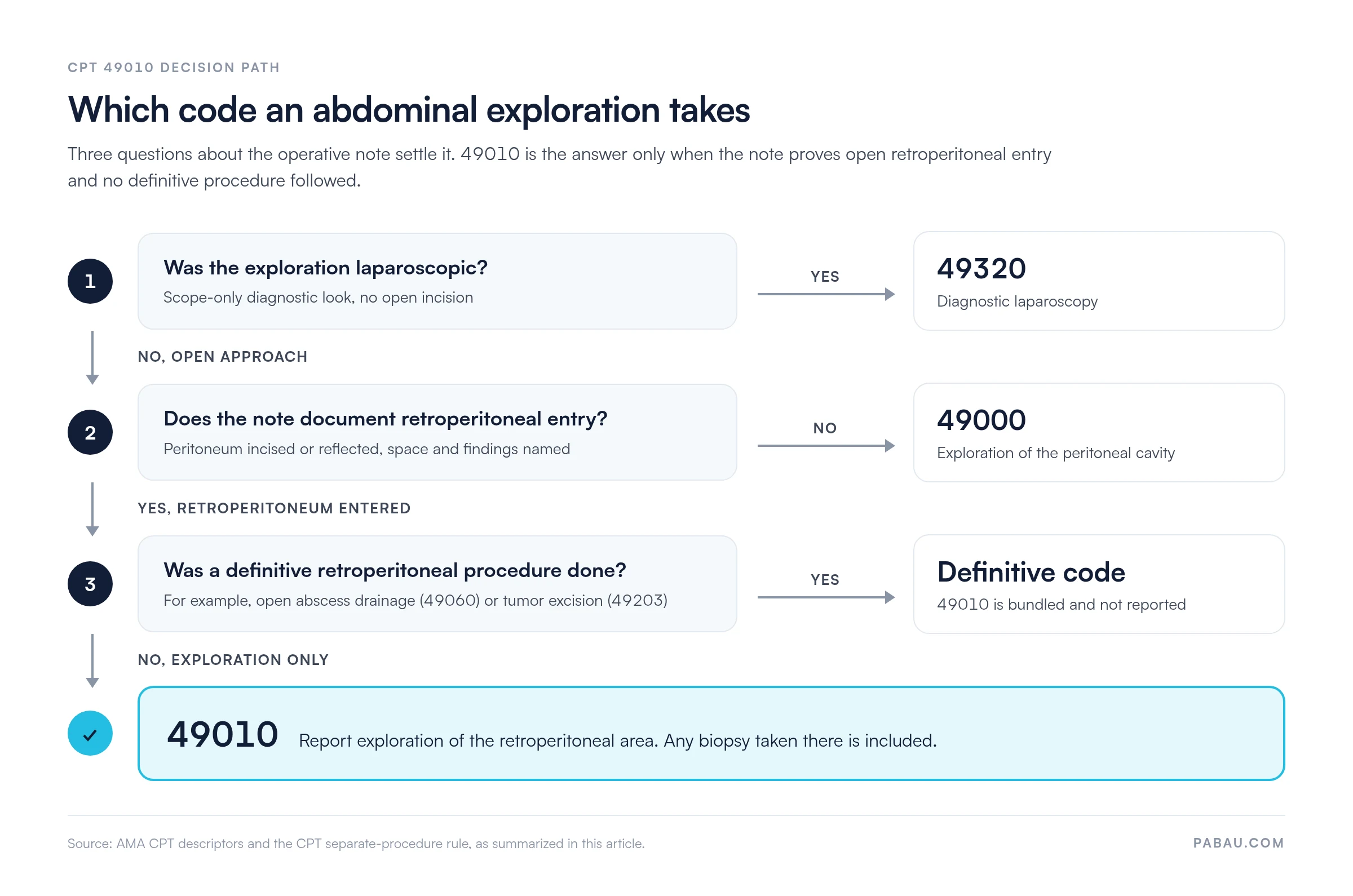
The decision path below shows how three questions about the note settle the choice.
Matching the note to the code is easier when you know what the surgeon did. A 49010 operative note should show each of these steps.
Take an illustrative case. Imaging shows a retroperitoneal mass, and the surgeon performs an open exploration to sample it. The note documents reflection of the posterior peritoneum, the mass’s location and two core biopsies. Nothing else is done, so the claim carries 49010 alone.
Now change one detail. The frozen section suggests a resectable tumor, and the surgeon removes it in the same session. The exploration becomes part of the excision, reported with 49203 or its size-based siblings. 49010 then drops off the claim.
The diagnosis follows the pathology in both versions. A malignant retroperitoneal tumor supports C48.0, while a benign soft-tissue tumor supports D20.0.
Payer audits on 49010 target notes that don’t prove retroperitoneal entry. A clean claim for this code starts with an operative note that contains the following.
Run this check on every 49010 claim before it leaves the practice. Each step maps to a denial reason covered later in this guide.
Modifier choice on 49010 often decides whether the claim pays. Each modifier carries its own documentation requirement, and payers audit it closely.
Every 49010 claim needs a diagnosis code tied to the documented reason for retroperitoneal entry. The code reflects what the surgeon found or set out to assess, not a generic abdominal complaint.
ICD-10-CM codes are updated every October 1. Verify these codes against the current fiscal year before submission.
CMS sets 49010 payment through the Medicare Physician Fee Schedule (MPFS). Each code carries work, practice expense and malpractice relative value units (RVUs). Total RVUs, adjusted for locality and multiplied by the annual conversion factor, give the dollar amount.
Rates change every January 1 and vary by locality, so no figure is printed here. Use the CMS Physician Fee Schedule Look-Up Tool for current rates in your MAC jurisdiction. The FastRVU lookup tool shows the RVU breakdown with geographic adjustments applied.
Authorization rules for 49010 vary by payer, plan design and whether the surgery is emergent or elective. Never assume one rule covers your whole payer mix.
NCCI edits bundle 49010 into definitive retroperitoneal procedures performed in the same session. That makes bundling the denial to plan for first.
Each NCCI edit carries a modifier indicator of 0 or 1. With 0, no modifier overrides the bundle. With 1, modifier 59 or an X modifier may override it when the note supports a distinct service. Confirm the current indicator in the quarterly NCCI table before advising surgeons.
The table pairs the most common 49010 denial reasons with the fix, drawing on standard denial management practice.
When a 49010 claim comes back denied, the claim adjustment reason code on the remittance names the problem. Our reference on medical billing denial codes explains each one.
Run a quarterly audit of all 49010 claims billed alongside definitive abdominal procedure codes. Pull the NCCI edit table for each co-billed pair and confirm the modifier indicator before resubmitting any denied claim. Appeals citing modifier -59 on a zero-indicator edit will not pay and may draw additional scrutiny.
Surgical billing teams often work 49010 claims by hand. Someone checks eligibility on a payer portal, chases the authorization number by phone and keys the claim once the note is signed. Each handoff is a chance for the auth number or the diagnosis to fall off.
Pabau, a practice management platform with built-in claims management software, keeps those steps on the patient’s case. It runs eligibility checks before the surgery date and tracks the prior authorization alongside the booking.
Claims go out electronically as CMS-1500 (837P) files through Claim.MD, and ERA remittances come back to the same record. Your coders still own the 49010 decision, but fewer claims stall on a missing auth number or lapsed coverage.

Pabau runs eligibility checks, tracks prior authorizations on the case and sends claims through Claim.MD. ERA remittances come back to the same record, so a denial surfaces quickly.

CPT 49010 rewards a narrow reading. It’s an exploration code, and it holds up only when the note proves retroperitoneal entry and no definitive procedure followed. When either condition fails, the answer is 49000, 49320 or the definitive procedure code.
So catch it in review, not in appeals. Read the note for the retroperitoneal entry before coding, and check the NCCI pair before billing. Two minutes before submission costs far less than weeks of rework after a denial.
Book a demo to see how Pabau tracks authorizations and sends surgical claims through Claim.MD.

Coding the peritoneal side instead? CPT code 49000: Exploratory laparotomy billing guide covers the open exploration code that sits one number below 49010.
Comparing clearinghouses for surgical claims? Claim.MD vs Office Ally compared breaks down how each handles 837P submissions, ERA processing and denial tracking.
Working a denied claim back from the remittance? Understanding electronic remittance advice explains how ERA 835 files map denial reason codes to each line item.
Checking coverage before the surgery date? Insurance eligibility verification shows how eligibility checks flag authorization needs and coverage problems before the case.
Linking the note, codes and charges on one form? What is a superbill walks through the form that ties CPT and ICD-10 codes to each encounter.
Yes. The descriptor reads with or without biopsy(s), so retroperitoneal tissue sampled during the exploration is included. Don’t report a separate biopsy code for the same site.
No. 49010 describes exploration only and has no foreign-body component. Removal of a foreign body from the peritoneal cavity is reported with 49402.
Diagnostic laparoscopy is reported with 49320. 49010 is an open procedure, so it never applies to a scope-only exploration.
49010 carries a 90-day global period. Routine postoperative visits in that window are included, and an unrelated return to the operating room needs modifier 79.
Not for the same retroperitoneal space. Open drainage of a retroperitoneal abscess is reported with 49060, which includes the exploration. 49010 stands alone only when no definitive procedure follows.




