

HCPCS Code Q4185: Cellesta flowable amnion billing guide
HCPCS Code Q4185: definition and official descriptor HCPCS Code Q4185 is the Lev...

Last Updated: Nov 20, 2026
58953 is the CPT code for bilateral salpingo-oophorectomy with omentectomy, total abdominal hysterectomy and radical dissection for debulking in ovarian malignancy.
It describes open cytoreductive surgery for ovarian, tubal or primary peritoneal cancer, with the hysterectomy, adnexal removal and omentectomy bundled into the one code. When pelvic and limited para-aortic lymphadenectomy is also performed, the correct code is 58954. Without radical dissection for debulking, the resection is reported with 58956.
Let Pabau's smart automation suggest the right codes, reduce claim denials, and keep your practice compliant—effortlessly.
Automate repetitive tasks and focus on what matters most—your patients.
Reduce coding errors and ensure compliance with the latest regulations.
Clean claims, fewer denials, and faster reimbursements.
Powerful insights and reporting to help your practice thrive.
HIPAA compliant SOC 2 certified GDPR-compliant Trusted by 4,000+ clinics worldwide

CPT code 58953 describes bilateral salpingo-oophorectomy, omentectomy, total abdominal hysterectomy, and radical dissection for debulking of ovarian malignancy.
Omentectomy is bundled into 58953 under NCCI edits and is not reported alone for the same operative session.
Lymphadenectomy is not part of 58953. When pelvic and limited para-aortic lymphadenectomy is also performed, the code is 58954.
58956 is a resection code without radical dissection for debulking, and 58952 covers debulking when no hysterectomy is performed.
Pabau’s claims management software submits and tracks claims through Claim.MD, so your billing team can follow each 58953 claim to payment.
CPT code 58953 describes bilateral salpingo-oophorectomy with omentectomy, total abdominal hysterectomy, and radical dissection for debulking in ovarian malignancy. It is a Category I code in the AMA’s CPT code set, which the CPT Editorial Panel maintains. It sits within the Female Genital System section of the CPT Surgery chapter (56405-58999), under the Ovary subsection, in the 58950-58958 ovarian-malignancy resection series.
The procedure is performed by a gynecologic oncologist in an operating room setting. It also addresses ovarian, fallopian tube, or primary peritoneal carcinoma that has spread beyond the ovaries. The surgical goal is cytoreduction, which means removing as much visible tumor as possible to leave minimal residual disease.
CPT code 58953 is a bundled surgical package. In short, four core components are included in the single reported unit of service.
Thus, the operative note must document all four components. If no hysterectomy was performed, for example in a patient with a prior hysterectomy, the debulking is reported with 58952 instead. The absence of any other bundled component also moves the claim to an adjacent code, as the matrix below shows.
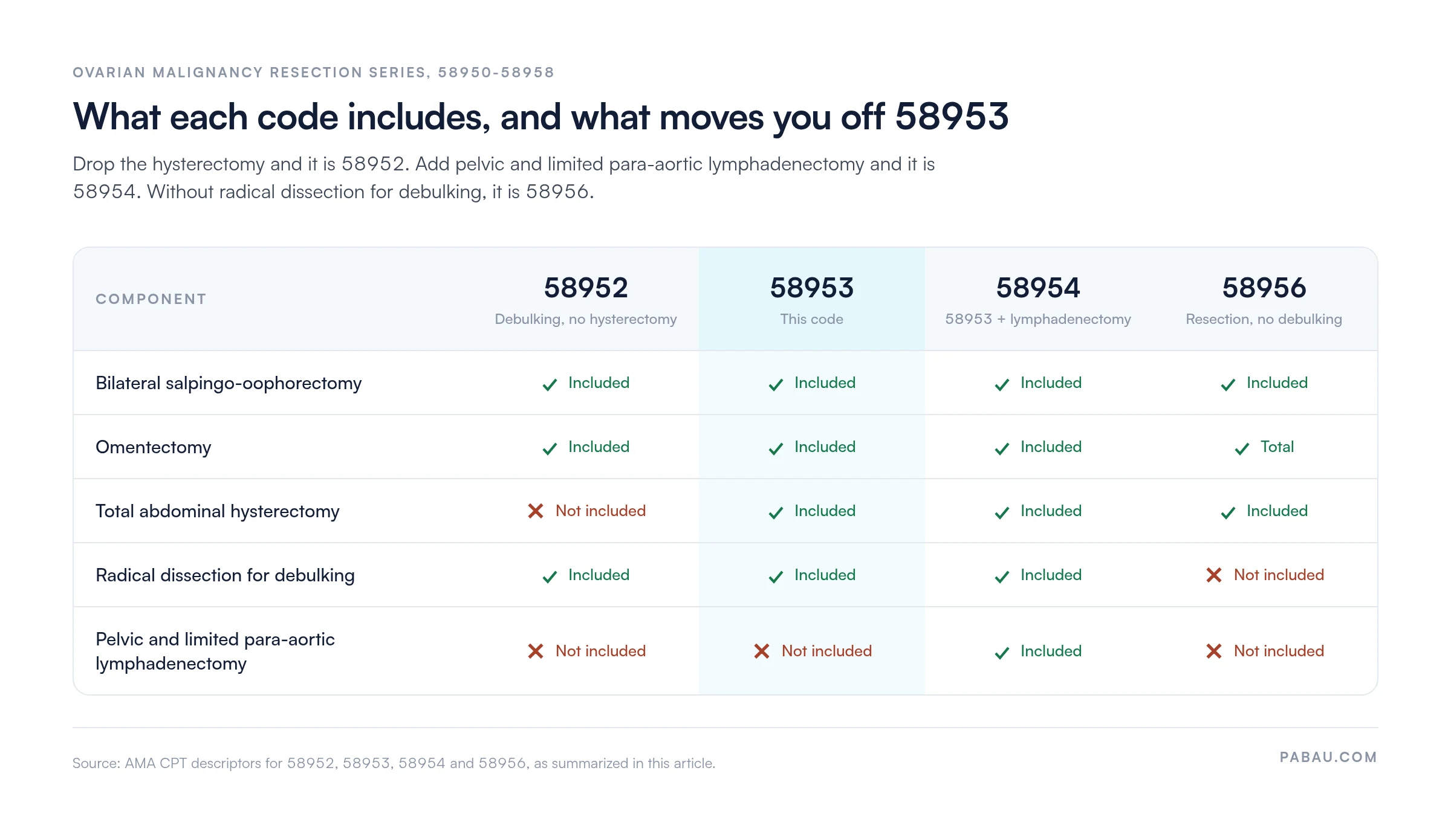
So each element of the operative note below maps to one of those components or to the malignancy indication.
Documentation drives medical necessity and audit defense. For this reason, the operative report must include each of the following elements to support a 58953 claim.
Check the operative note against these five elements before you submit the claim. A note that lists the surgical steps but leaves out residual disease volume or malignancy intent gives an auditor no basis for the debulking claim.
Several procedures performed during the same operative session as a debulking procedure cannot be reported alone with 58953. Indeed, billing them alone triggers National Correct Coding Initiative (NCCI) bundling edits, claim denials, and post-payment audit risk.
CMS updates NCCI edits quarterly. But the table above reflects standard bundling principles. Finally, check the current column one/column two edit pairs for 58953 against the CMS NCCI edits before you submit.
CPT 58953 and CPT 58956 share the hysterectomy, the adnexal removal and the omentectomy, so the choice turns on one component. In short, 58953 includes radical dissection for debulking, and 58956 does not.
CPT 58953 applies when the procedure includes radical dissection to debulk a malignancy. Typical examples are large peritoneal tumor resection and multi-organ adhesiolysis. Also, the malignancy must be documented as the operative indication, and the debulking intent must appear in the operative note. When pelvic and limited para-aortic lymphadenectomy is also performed, the code is 58954 instead. Cervical cancer surgery follows a different path. A laparoscopic radical hysterectomy with pelvic lymphadenectomy and para-aortic sampling is reported with laparoscopic code 58548.
CPT 58956 describes bilateral salpingo-oophorectomy with total omentectomy and total abdominal hysterectomy for malignancy. It is also a resection code with no debulking component. It fits a staging or resection surgery where the clinical picture calls for no cytoreductive dissection beyond the uterus, adnexa, and omentum.
The decision rule is short. If the operative note documents peritoneal stripping, bowel serosal resection, or diaphragm resection performed to achieve cytoreduction, 58953 applies. Instead, if the surgery removed the uterus, adnexa, and omentum without that dissection, 58956 is the correct code. Add pelvic and limited para-aortic lymphadenectomy to a 58953 procedure and the code becomes 58954.
Beyond 58956, several adjacent codes differ from 58953 by surgical approach, indication, or included components. The table sets the two closest debulking codes, 58952 and 58954, beside the laparoscopic alternatives.
Surgical approach is the first discriminator. CPT code 58953 is an open abdominal procedure, so a laparoscopic debulking does not qualify. Then malignancy and debulking intent are the second. 58661 and 58571 are reported for a range of indications, benign disease included. 58953 requires a documented ovarian, tubal, or primary peritoneal malignancy.
Medical necessity for CPT code 58953 is supported by an ICD-10-CM malignancy diagnosis code. First, choose it from the ICD-10-CM diagnostic codes, and make sure it reflects an active malignancy of the ovary, fallopian tube, or peritoneum.
ICD-10-CM codes are updated each October 1. So verify listed codes against the current edition before billing. When disease in both ovaries is documented, C56.3 is preferred over pairing C56.1 and C56.2, which can trigger edit flags. Verify current code status using the CDC/NCHS ICD-10-CM web tool.
CPT code 58953 accepts several surgical modifiers, each with specific documentation and payer rules.
Modifier -22 carries the highest audit risk. Because 58953 already reflects a high-complexity procedure, payers expect documentation that shows the work far exceeded even a typical debulking case. So submit the operative note with the first claim rather than waiting for a request.
An operative report that lists the procedures performed but does not capture the clinical context will not survive a medical necessity audit. Thus, the documentation checklist below reflects what payers expect for CPT code 58953 claims.
CPT code 58953 carries a high work RVU (wRVU) value in line with its complexity as an extended major gynecologic oncology surgery. But exact Medicare payment rates are updated each year under the Medicare Physician Fee Schedule (MPFS) and vary by geographic location.
So use the CMS Physician Fee Schedule lookup tool to retrieve current year facility and non-facility payment rates for 58953 by Medicare Administrative Contractor (MAC) locality. For a quick RVU lookup with geographic adjustment, the FastRVU 2026 calculator provides work, PE, and MP RVU values with the Medicare conversion factor.
CPT code 58953 carries a 90-day global surgical period (indicator: 090) under CMS rules. Routine post-operative care related to the debulking is included in the surgical fee for 90 days after the procedure date. So it cannot be billed alone.
Checking electronic remittance advice after each ERA posting shows when payers apply global period denials to visits or procedures that are payable alone. In fact, catching them early speeds up appeals on misapplied global edits.
Set a 90-day calendar alert from the surgery date for each 58953 case. Flag every visit booked within that window for global review before coding. A routine post-op visit billed as a standard E&M while the 90-day window is still open will be denied.
Medicare fee-for-service does not require prior authorization for CPT code 58953. But Medicare Advantage plans and commercial payers often do. Also, rules vary by plan year and payer contract.
Teams that run traditional Medicare and commercial authorizations side by side need a firm grasp of medical billing fundamentals across payer types.
CPT code 58953 claims draw close payer review because of the code’s complexity, its RVU value, and the number of bundled components. Thus, each denial type needs its own appeal approach.
A structured denial management workflow catches these patterns before they become write-offs. So tracking denial reasons by code shows whether the problem is documentation, code choice, or payer behavior. Documentation covers medical necessity and -22 denials. Code choice covers swaps among 58952, 58953, 58954 and 58956, and payer behavior covers authorization and global period misapplication. A clean claim on the first pass, with the operative note attached, heads off the most common 58953 denial triggers.
A 58953 claim leans on a stack of records: the operative note, pathology, staging imaging, and often a prior authorization. After filing, billing teams still have to follow it through payer edits, denials, and remittances, often across several systems.
Pabau, the practice management platform we build, includes medical billing software that submits and tracks claims through Claim.MD. Also, eligibility checks and ERA remittances run through the same connection. Each claim’s status sits in one place, so the team sees which 58953 claims are paid, pending, or denied.
Code choice stays with your coders and the operative note. Instead, what changes is the follow-up. A denied 58953 claim shows up in the claims list, so the appeal can start while the case is still fresh.
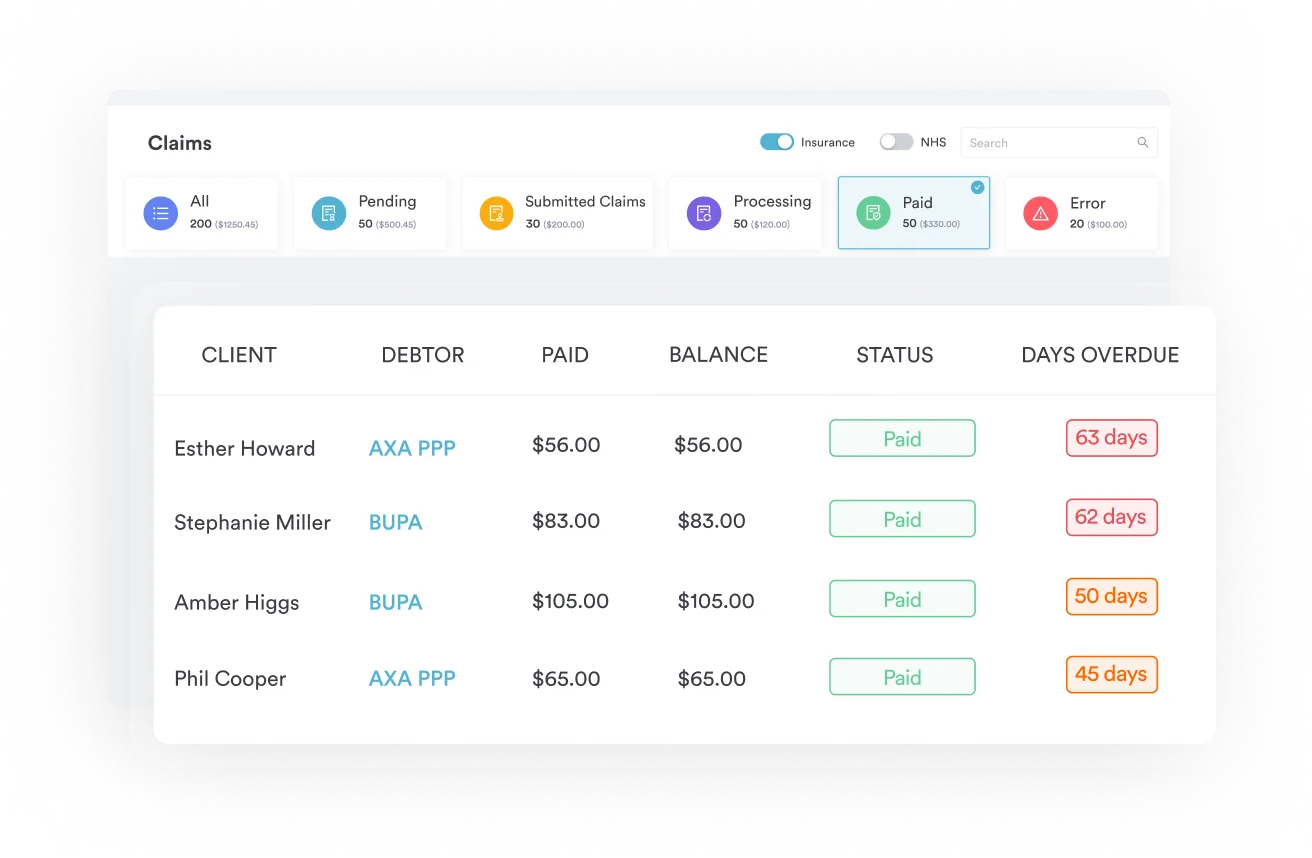

Pabau’s claims management software submits and tracks claims through our Claim.MD integration. Your team sees each 58953 claim’s status, from submission to remittance, in one place.

Code 58953 from the operative note, not from how complex the case felt. In fact, the note has to show radical dissection for debulking, a hysterectomy, and no lymphadenectomy before 58953 beats 58952, 58954, or 58956.
The trade-off is a few minutes before filing. A coder who checks the note against those components and attaches it to the first claim avoids the slower path. In short, that path is a corrected claim, an appeal letter, and a second wait for payment on a 90-day global procedure.
Pabau submits and tracks those claims through Claim.MD, so your team always knows where each one stands. Book a demo to see how it fits your gynecologic oncology billing workflow.

Need help managing claim submissions for complex surgical codes? Claim.MD clearinghouse guide explains how Pabau’s US clearinghouse integration handles 837P submissions and ERA remittances for high-value surgical codes.
Looking to understand the full revenue cycle behind gynecologic oncology claims? Revenue cycle management overview walks through the end-to-end billing process from eligibility verification to payment posting.
Want to reduce denials across your surgical code set? Denial codes in medical billing covers common CARC denial reason codes and how to build a systematic appeal workflow.
CPT code 58953 covers bilateral salpingo-oophorectomy, omentectomy, total abdominal hysterectomy, and radical dissection performed for cytoreductive debulking of ovarian malignancy. All four components are bundled into the single code and cannot be reported separately.
CPT 58953 requires a radical dissection component for cytoreduction of advanced malignancy (peritoneal stripping, extended tumor resection). CPT 58956 covers bilateral salpingo-oophorectomy with total omentectomy and hysterectomy without radical dissection for debulking. It is typically used for earlier-stage disease or staging surgery. When pelvic and limited para-aortic lymphadenectomy is added to the debulking, report 58954 instead. The operative note must document radical dissection to support 58953 over 58956.
The primary diagnosis codes are C56.1 (right ovary), C56.2 (left ovary), C56.3 (bilateral ovaries), C56.9 (unspecified ovary), C57.00-C57.02 (fallopian tube malignancy), and C48.1 (peritoneal malignancy). Use C56.3 for bilateral disease rather than pairing C56.1 and C56.2. Avoid uncertain behavior or personal history codes, which will not establish medical necessity.
Yes. Omentectomy is a named component of the CPT 58953 surgical package and is bundled under NCCI edits. Reporting a separate omentectomy code on the same operative date as 58953 will trigger an NCCI bundling edit and denial. Void the separately reported omentectomy code and resubmit with only 58953.
Medicare payment rates for CPT 58953 are updated annually under the Medicare Physician Fee Schedule and vary by geographic locality. Use the CMS MPFS lookup tool (cms.gov) or the FastRVU calculator to retrieve current year facility payment rates for your MAC region. Never rely on static published figures, which go stale after each October/January MPFS update.





