CCSD code H4430: Examination of rectum under anaesthetic
CCSD code H4430 pays for the examination alone CCSD code H4430 is the UK private...

Last Updated: Oct 20, 2026
Billable Code Specific Code
43244 is the CPT code for esophagogastroduodenoscopy, flexible, transoral; with band ligation of esophageal or gastric varices. It covers the full upper GI survey plus rubber band ligation of the varices, reported as a single unit of service.
The code it is most often confused with is CPT 43243, which treats the same varices by injection sclerotherapy. NCCI edits bundle the two when both are reported for the same session.
Let Pabau's smart automation suggest the right codes, reduce claim denials, and keep your practice compliant—effortlessly.
Automate repetitive tasks and focus on what matters most—your patients.
Reduce coding errors and ensure compliance with the latest regulations.
Clean claims, fewer denials, and faster reimbursements.
Powerful insights and reporting to help your practice thrive.
HIPAA compliant SOC 2 certified GDPR-compliant Trusted by 4,000+ clinics worldwide

CPT 43244 covers EGD with rubber band ligation of esophageal or gastric varices, which is distinct from injection sclerotherapy under CPT 43243.
NCCI edits bundle 43244 and 43243, so billing both for the same session without a documented distinct site triggers a denial.
2026 Medicare payment varies by place of service, with separate facility and non-facility rates in the CMS Physician Fee Schedule.
The operative note must record the procedure name, band count, variceal location, clinical indication and findings to support a clean claim.
Pabau’s claims management software pre-fills GI claims from the patient record and checks required authorization details before submission through Claim.MD.
CPT code 43244 describes esophagogastroduodenoscopy, flexible, transoral; with band ligation of esophageal or gastric varices. The procedure covers the full diagnostic survey of the upper gastrointestinal tract plus the therapeutic component of deploying rubber bands to ligate varices. According to the American Medical Association’s CPT code set overview, the diagnostic survey is bundled into the code and may not be reported separately.
The clinical context is typically portal hypertension secondary to liver cirrhosis or hepatic disease. Varices form when elevated portal pressure forces blood into fragile submucosal veins of the esophagus and stomach. Band ligation is the preferred endoscopic intervention for both active hemorrhage (emergent setting) and prophylactic obliteration of high-risk varices (elective setting).
The endoscopist advances a multi-band ligator through the working channel and aspirates each varix into the cap. A rubber band deployed at the base cuts off its blood supply.
For billing, 43244 is a complete code. The introduction of the endoscope, the diagnostic inspection, and the therapeutic ligation are all included in a single unit of service.
CPT 43244 bundles the full upper GI survey with the band ligation. You cannot report a separate diagnostic EGD under CPT 43235 in addition to 43244 for the same encounter. Per CMS Medicare Coverage Database guidance on upper GI endoscopy billing, incidental examination of other areas during the same procedure should not be reported separately.
The following services are bundled into 43244 and cannot be billed independently:
Services that may be separately reportable (subject to NCCI edits and payer policy):
CPT 43244 uses band ligation, while CPT 43243 uses injection sclerotherapy. Both treat esophageal or gastric varices endoscopically, but they are different therapeutic techniques. NCCI edits bundle them when both are performed in the same session. Billing 43244 and 43243 for the same encounter without a modifier triggers an automatic edit and denies the secondary code.
ASGE acknowledges that some gastric variceal cases need both techniques at distinct sites in the same session. In that case, append modifier -51 to the secondary code. The operative note must describe each technique, the distinct variceal locations treated, and the clinical rationale for both approaches.
CPT 43244 sits within the upper GI endoscopy code family (43235-43259). Selecting the wrong code from this range is a common source of claim rejections. The key principle: Always report the most comprehensive code that describes the complete service performed.
Always query the AAPC Codify CPT lookup or the official NCCI Policy Manual before billing an adjacent EGD code with CPT 43244 in one encounter. NCCI edits update quarterly.
Two further codes in the 43235-43259 range describe separate interventions. An endoscopic ultrasound with fine needle aspiration is reported as 43242, and removal of an ingested foreign body is 43247. Check the NCCI edits before pairing either code with 43244 on one claim.
Run a pre-submission NCCI edit check for every EGD claim that includes more than one procedure code. Bundling conflicts involving 43243, 43239, and 43235 are among the most common automated denial triggers for upper GI endoscopy claims. Build this check into your billing workflow before the claim leaves the practice.
Modifier selection for CPT 43244 claims depends on the clinical scenario and payer requirements. Applying the wrong modifier, or omitting one when required, causes payment reduction or outright denial.
Medicare does not recognize modifier -51 for facility-based EGD claims in all settings. Verify the specific payer’s modifier policy and whether the claim routes as professional or technical component billing.
The 2026 Medicare reimbursement rate for CPT 43244 varies by place of service. Facility rates apply when the procedure is performed in a hospital outpatient department (HOPD) or ambulatory surgical center (ASC). Non-facility rates apply in an office, though the procedure’s acuity puts most band ligation in a facility setting.
Retrieve current 2026 rates directly from the CMS Physician Fee Schedule lookup tool. Rates shift annually with the conversion factor update, and geographic locality adjustments apply. The table below shows the RVU components that drive payment.
The electronic remittance advice (ERA/835) returned after adjudication shows the exact allowed amount, any CARC denial reason, and the payer’s adjustment codes. That gives billers a precise trail for reconciling each 43244 payment against the expected rate.
Prior authorization requirements for CPT 43244 vary by payer and plan type. Medicare fee-for-service does not require prior authorization for 43244, but Medicare Advantage plans frequently do. Most commercial payers treat band ligation as a managed procedure requiring pre-certification when performed electively.
Always verify authorization requirements with the individual payer before scheduling an elective banding session. Running insurance eligibility verification before the procedure date confirms both coverage and whether a PA number is required. For emergent procedures (active variceal hemorrhage), most payers allow concurrent or retrospective review. The clinical timeline must still be documented clearly in the medical record.
Medical necessity for CPT 43244 is typically supported by these clinical indications:
Medical necessity also depends on pairing the CPT code with a matching ICD-10-CM diagnosis code on the claim. Commonly linked diagnoses include I85.01 (esophageal varices with bleeding), I85.11 (secondary esophageal varices with bleeding), and I85.00/I85.10 (esophageal varices without bleeding, for prophylactic cases). A diagnosis that does not match the documented indication is both a compliance risk and a denial trigger.
A clean 43244 claim rests on a procedure note that contains every element payers use to adjudicate the claim. Vague operative reports are one of the most common reasons this code is denied.
The procedure note must include all of the following to support a clean claim:
The superbill generated at encounter close should reflect the CPT code, the ICD-10-CM linkage, the place of service, and the attending provider NPI. Submitting through an 837P claim file ensures all required data elements are electronically structured before the claim reaches the clearinghouse.
CPT 43244 denials cluster around a predictable set of causes. Understanding each one lets a biller fix the root problem rather than repeatedly reworking the same claim.
Each cause starts at a specific step between scheduling and submission, which tells you who on the team owns the fix.
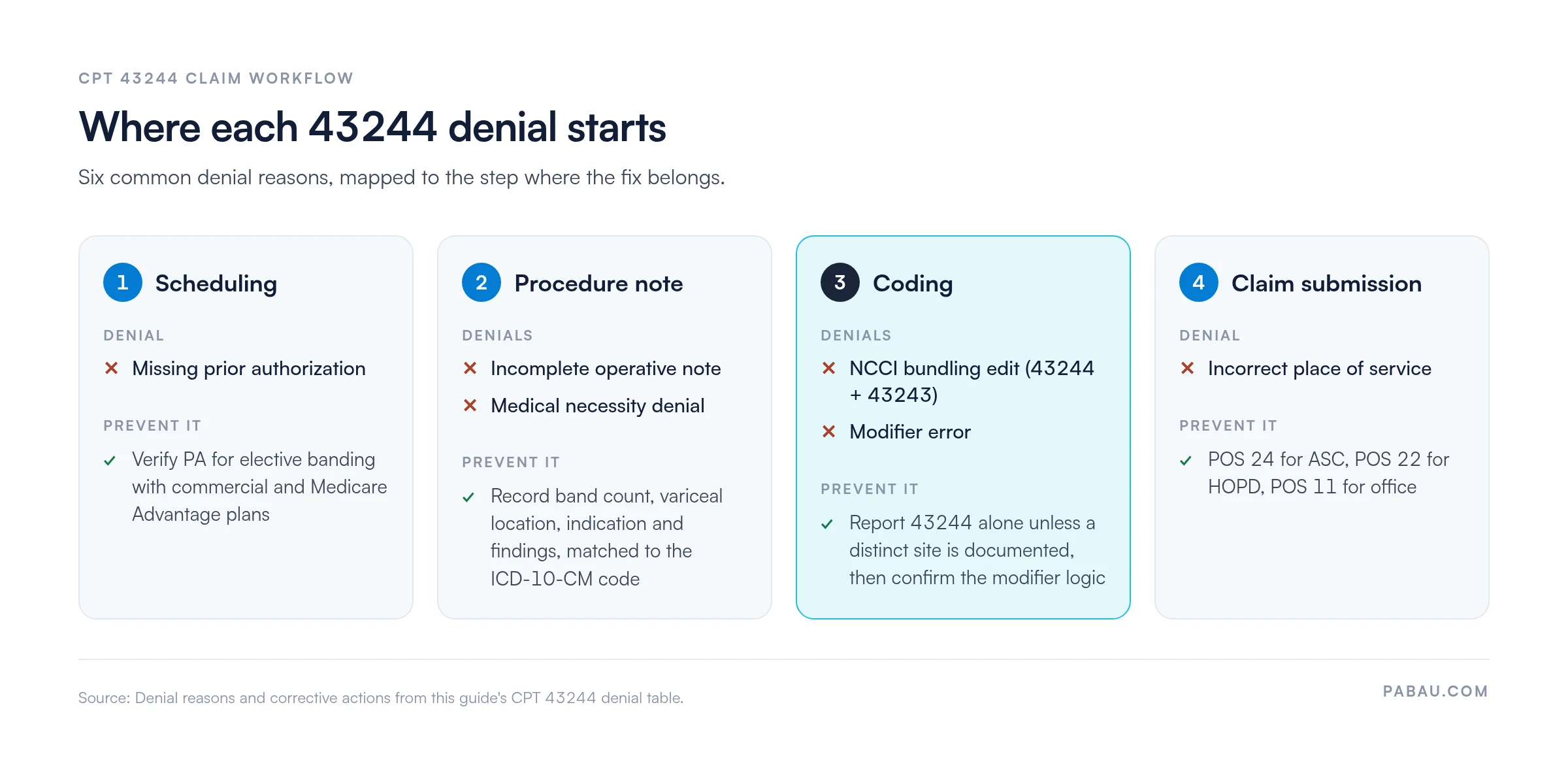
A structured denial management process for GI endoscopy claims tracks the CARC codes returned on the ERA. Two come up most on NCCI-related 43244 denials. CARC 97 means the payment is included in the allowance for another service already adjudicated. CARC 4 means the procedure code is inconsistent with the modifier, or a required modifier is missing.
Reviewing medical billing denial codes systematically lets your team separate payer errors from coder errors and route each denial to the right fix.
Anesthesia code 00813 covers anesthesia for upper GI endoscopic procedures, including esophagoscopy, gastroscopy, and duodenoscopy. The anesthesia provider reports it separately when an anesthesiologist or CRNA delivers monitored anesthesia care (MAC) or general anesthesia for a 43244 case.
The key billing distinction: If a separate anesthesia professional provides MAC or general anesthesia, they bill 00813 under their own NPI. Moderate (conscious) sedation given by the performing gastroenterologist is a different case. Since CPT 2017, it is no longer valued into 43244 and is reported separately when documented. Report 99152 for the first 15 minutes and 99153 for each additional 15 minutes. Medicare requires HCPCS G0500 in place of 99152 for GI endoscopy.
When the anesthesia provider submits 00813 for a 43244 case, the claim must match the gastroenterologist’s claim. That means the same date of service, facility, and procedure reference. A mismatch in any of these fields triggers a coordination-of-benefits hold or automated edit. Confirm that both claims use matching CPT 43244 as the surgical procedure reference.
In many GI practices, a 43244 claim is pieced together from three places. The PA number sits in the scheduling system and the band count in the operative note. Then the claim gets keyed into a clearinghouse portal by hand.
Pabau, the practice management platform we build, keeps those pieces on one patient record. Its claims software for gastroenterologists pre-fills each claim with the patient, treatment and insurer details already on file. Validation checks confirm that required details, such as the authorization code, are filled in before the claim goes out.
Claims go to payers through Claim.MD, our integrated US clearinghouse, and real-time eligibility checks run before the banding session. Each claim is tracked from pending to paid, and ERA remittances are posted so billing and claims stay in sync. Your billers can spend their time on the denials that need a coder’s judgment.

Pabau pre-fills GI claims from the patient record, checks eligibility and authorization details, and submits through Claim.MD. See how it works for endoscopy practices.

Most of what decides a 43244 claim happens before the scope goes in. Confirm authorization for every elective banding session. Agree with the endoscopist that each note records the band count, the variceal location, and the indication.
At the coding stage, treat 43244 as the whole service. Adding 43235 or 43243 for the same session invites an NCCI edit unless the note documents a distinct site. The trade-off is time. A pre-submission check adds minutes per claim, and a denial can hold the payment for weeks.
Book a demo to see how Pabau keeps GI endoscopy claims complete before they reach the payer.

Need to understand how clearinghouse submission works end to end? How a medical claims clearinghouse works explains how claims are validated and routed to payers, and what clearinghouse plans cost.
Want to reduce rework from incomplete claim data? Medical billing fundamentals covers the billing cycle from coding to reimbursement, and the coding errors that delay payment.
Weighing Claim.MD as your clearinghouse? Claim.MD clearinghouse review explains what it does, how it works, and what it costs.
Took a biopsy during the same EGD? CPT code 43239 walks through billing for EGD with biopsy, single or multiple.
Removed a polyp by snare in the same session? CPT code 43251 covers billing for EGD with snare polypectomy.
CPT code 43244 covers esophagogastroduodenoscopy (EGD) with band ligation of esophageal or gastric varices. It reports the full upper GI endoscopic survey and the therapeutic rubber band ligation as a single unit of service. It does not include injection sclerotherapy, which is reported under CPT 43243 and is subject to NCCI bundling restrictions in the same session.
No, not for the same site and session without modifier justification. NCCI edits bundle CPT 43244 (band ligation) and CPT 43243 (injection sclerotherapy) when both treat the same variceal site in one encounter. When both techniques are used at distinct anatomical locations with separate clinical justification, append modifier -51 to the lower-value code. Document each technique and location explicitly in the operative report.
Medicare reimbursement for CPT 43244 depends on place of service: Facility rates (for HOPD or ASC) are lower than non-facility rates. Both adjust by geographic locality using the GPCI multiplier. Retrieve the current 2026 rate from the CMS Physician Fee Schedule lookup tool at cms.gov. Rates change with the annual conversion factor update and vary by Medicare Administrative Contractor (MAC) jurisdiction.
The most common modifiers for CPT 43244 are -51, -22, -52, -59 or an X-modifier, and -76 or -77. Modifier -51 marks the secondary code when 43243 is also reportable. Modifier -22 covers extensive hemorrhage that takes significantly more work, and -52 covers a procedure stopped before completion. Modifier -59, XE or XS flags a second EGD code at a separate anatomical site. Modifiers -76 and -77 report a same-day repeat by the same or a different physician. Apply each one only when the clinical documentation supports its scenario.
The top five denial reasons for CPT 43244 are NCCI bundling conflicts, missing prior authorization, medical necessity denials, incorrect place-of-service codes, and modifier errors. Bundling conflicts usually mean 43244 and 43243 were billed together without a modifier. Medical necessity denials usually trace back to an incomplete operative note. Most are preventable with pre-submission NCCI edit checks, PA verification at scheduling, and a documentation checklist covering band count, variceal location, and clinical indication.
Yes. CPT 43244 is subject to National Correct Coding Initiative (NCCI) edits. The most significant one prevents billing it alongside CPT 43243 and CPT 43235 for the same session. CMS updates NCCI edits quarterly, and Medicare and many commercial payers enforce them. Check the current NCCI Policy Manual or edit table before submitting any claim that pairs 43244 with another EGD code.
The most commonly linked ICD-10-CM codes for CPT 43244 are I85.01 (esophageal varices with bleeding) and I85.11 (secondary esophageal varices with bleeding). For prophylactic cases, coders use I85.00 (esophageal varices without bleeding) or I85.10 (secondary esophageal varices without bleeding). Gastric variceal ligation uses I86.4 (gastric varices). Confirm that the code matches the documented indication in the operative report, and check payer LCD policies when applicable.