CPT Code 62284: Injection procedure for myelography
CPT Code 62284: official descriptor and procedure overview The American Medical ...

Last Updated: Oct 19, 2026
C1772 is the HCPCS Level II code for infusion pump, programmable (implantable). It reports the implanted pump device only, on a hospital outpatient facility claim, and not the implantation procedure, catheter, or drug.
The code turns on programmability. If a clinician can adjust the pump's flow rate with an external programmer after implantation, report C1772. A permanent pump with a fixed flow rate is C1891 instead.
Let Pabau's smart automation suggest the right codes, reduce claim denials, and keep your practice compliant—effortlessly.
Automate repetitive tasks and focus on what matters most—your patients.
Reduce coding errors and ensure compliance with the latest regulations.
Clean claims, fewer denials, and faster reimbursements.
Powerful insights and reporting to help your practice thrive.
HIPAA compliant SOC 2 certified GDPR-compliant Trusted by 4,000+ clinics worldwide

HCPCS Code C1772 reports the programmable implantable infusion pump device only. A permanent non-programmable pump is C1891, and swapping the two leads to a denial.
C1772 is a facility-only code, paid under the OPPS in the hospital outpatient setting. On an inpatient stay, the device cost is typically bundled into the DRG.
Most payers, including many Medicare Advantage plans, require prior authorization before implantation. A missing authorization is the leading denial reason for C1772 claims.
Add modifier -KX when the claim meets the LCD criteria. Without it, the payer has no signal that medical necessity was established.
The operative report should name the pump’s manufacturer and model number, because that is what proves programmability at audit.
HCPCS Code C1772 is defined in the Level II code set as “Infusion pump, programmable (implantable).
” The Centers for Medicare and Medicaid Services (CMS) maintains this C-code specifically for hospital outpatient reporting under the Outpatient Prospective Payment System (OPPS). C-codes are temporary HCPCS codes for devices and new technologies. They give hospitals a distinct way to report those items, including for pass-through payment.
A programmable implantable infusion pump is a titanium-housed device surgically placed beneath the skin, typically in the abdomen. It delivers medication (most commonly an opioid, baclofen, or ziconotide) through an intrathecal catheter directly into the spinal fluid.
What defines a programmable pump is that it can be adjusted from outside the body. A clinician uses a wireless programmer to change the drug delivery rate, schedule, or mode without reopening the surgical site. That external adjustability is what separates C1772 from C1891, its non-programmable counterpart.
According to CMS’s HCPCS Level II code maintenance guidance, C-codes like C1772 are for hospital outpatient reporting only. They aren’t billable on professional claims from individual physicians, so the device cost goes on the facility claim (UB-04), not the CMS-1500.
C1891 covers the permanent non-programmable implantable infusion pump. C1772 covers the programmable version. The two codes are not interchangeable, and reporting C1891 for a programmable device (or the reverse) leads to a denial or a post-payment audit.
A non-programmable pump delivers drug at a flow rate built into the device. To change the dose, the clinician empties the reservoir at a refill visit and refills it with a different drug concentration. A temporary non-programmable implantable pump has its own code, C2626, so confirm the device is permanent before reporting C1891.
The table below sets the two codes side by side, from the descriptor to the follow-up visit codes each one pairs with.
In practice, two questions settle which pump code applies, and the answers should come from the operative report rather than from memory.
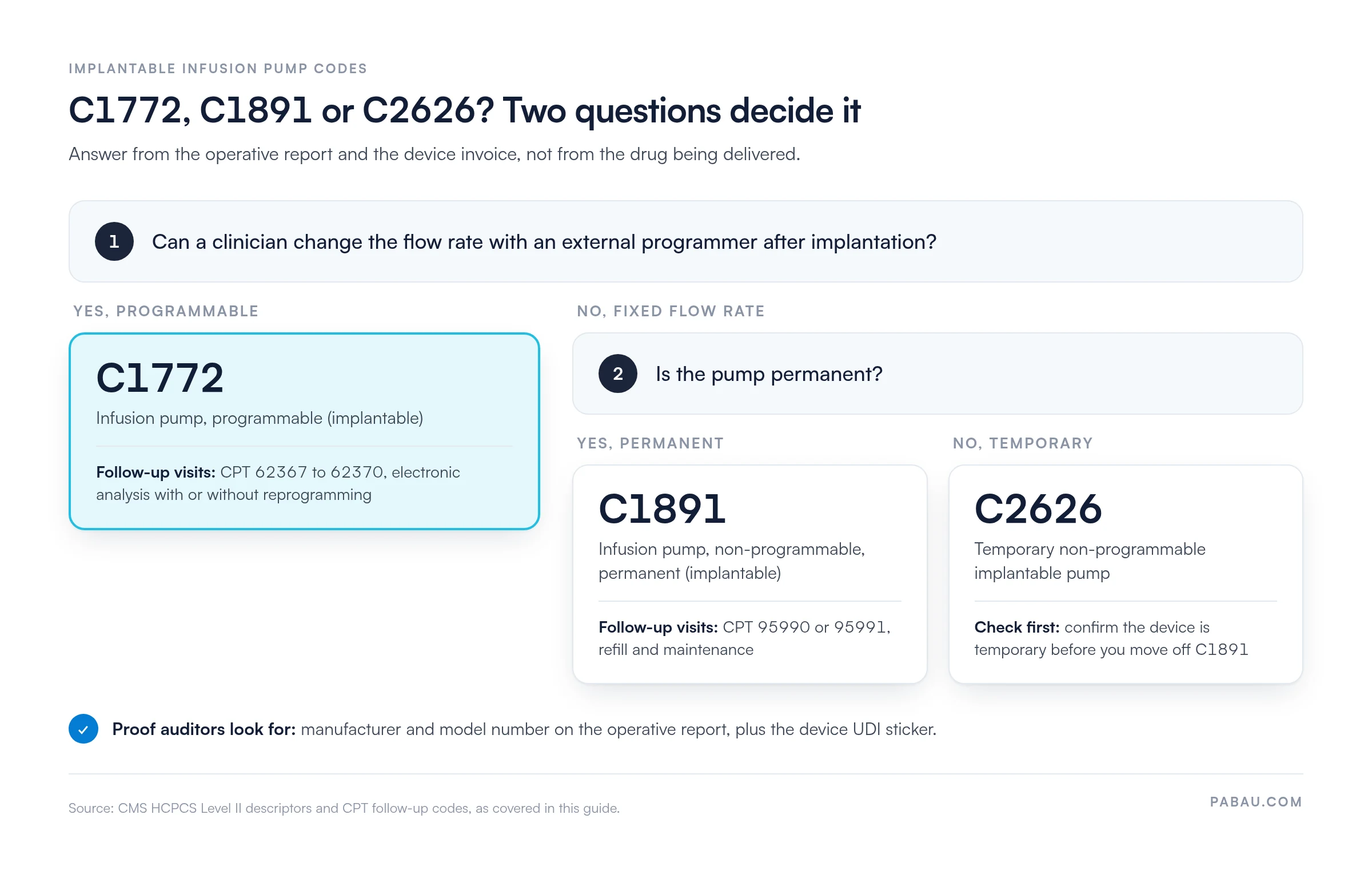
The clinical documentation must explicitly state whether the implanted pump is programmable. The operative report and device invoice or sticker should confirm the manufacturer and model number, which unambiguously identifies programmability. Auditors look for this confirmation when reviewing C1772 claims. You can verify the current HCPCS descriptors using the AAPC Codify HCPCS lookup tool.
C1772 covers the programmable pump device itself only. It does not cover the implantation procedure, the intrathecal catheter, drug fills, or reprogramming visits. Each of those components requires a separate billing code. The catheter, for example, is usually reported with CPT 62350 when it’s placed without a laminectomy.
Placing the pump is billed separately, with CPT 62362 covering implantation of a programmable device.
The drug delivered through the pump is billed separately using the appropriate HCPCS J-code (for example, J2270 for morphine sulfate or J0475 for baclofen). Never fold the drug cost into the C1772 line item, because a drug charged inside the device line is a common audit trigger.
Medicare covers the programmable implantable infusion pump when the claim meets the conditions in CMS Billing and Coding Article A56695. The associated Local Coverage Determination (LCD) applies too. Coverage isn’t automatic. The patient must meet specific clinical and procedural criteria before the device qualifies for reimbursement.
CMS requires all of the following to be documented before approving a C1772 claim:
Medicare Advantage plans may apply stricter criteria than traditional Medicare. Verify coverage requirements for each plan separately. Checking eligibility and plan criteria before the implant is scheduled prevents the most costly denials.
Most payers require prior authorization for HCPCS Code C1772 claims before the device is implanted. Traditional Medicare may not always require a formal pre-authorization request, but the claim is subject to post-payment medical review against the LCD. Medicare Advantage plans, commercial insurers, and BCBS policies typically mandate prior authorization.
When submitting a prior authorization request, include:
Timelines vary by payer, but most commercial plans require submission 5 to 14 business days before the scheduled procedure. Failing to secure authorization before implantation is the single most common reason C1772 claims are denied. Make a documented pre-auth check a mandatory step in the surgical scheduling workflow.
Inadequate documentation is the second leading cause of C1772 claim denials. Every element in the list below must be in the patient record before the claim is submitted. Auditors from CMS contractors review these items when a C1772 claim triggers a medical review request.
A missing item is hard to recover once the patient has gone home and the surgeon has moved on. Capture each element in a structured form at the point of care, instead of chasing records after a claim is flagged.
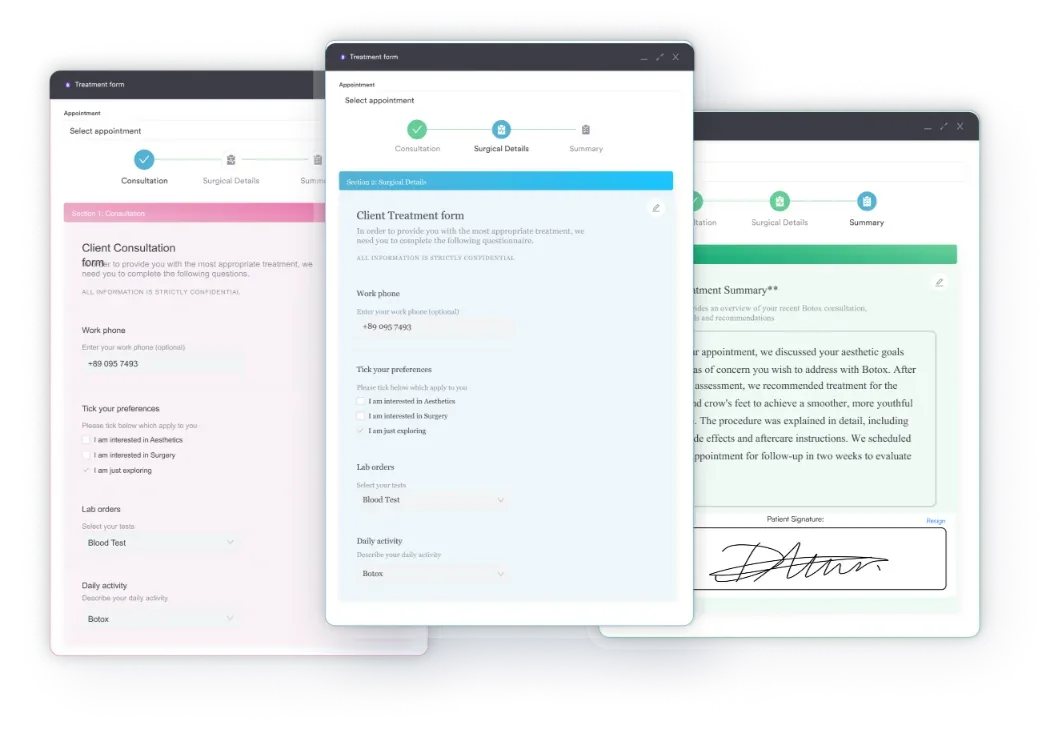
A clean superbill ties the C1772 device code to the correct diagnosis and procedure codes in one document. That simplifies claim review and lowers the risk of a documentation-triggered denial.
Attach the device UDI sticker directly to the operative report at the time of surgery. Auditors most often flag C1772 claims where the device serial number is missing or can’t be verified.
The billing rules for HCPCS Code C1772 change significantly depending on the care setting. Most coders encounter C1772 in the hospital outpatient context, but implant procedures are sometimes performed inpatient, and the reimbursement logic differs entirely.
For outpatient claims, the facility submits C1772 on the UB-04 alongside the relevant CPT implantation codes. The 837 electronic claim file should carry the correct Type of Bill (TOB) code confirming the outpatient hospital setting. Submitting C1772 on a professional claim form is a structural error that results in rejection before adjudication.
Reimbursement for HCPCS Code C1772 under Medicare’s OPPS is determined by the Ambulatory Payment Classification (APC) assignment CMS makes in the annual OPPS final rule. Because OPPS rates update each January, the payment rate for C1772 changes annually and varies by geographic wage index. Relying on a year-old rate table is a common planning error for surgical programs budgeting implant procedure costs.
For current Medicare rates, look up C1772 in CMS’s quarterly OPPS addenda, which list each code’s status indicator and APC. Commercial payers negotiate their own rates, and those rates are rarely public.
Facilities billing C1772 regularly should reconcile expected against actual payment on each claim, using electronic remittance advice (ERA) data. That catches underpayments and incorrect APC assignments quickly.
Modifiers signal clinical context to the payer and determine whether the claim processes under covered or non-covered rules. Using the wrong modifier (or omitting a required one) on a C1772 claim triggers an automatic denial or a payment reduction.
Modifier -KX is the most commonly missed modifier on C1772 claims. When a claim subject to an LCD shows C1772 without -KX, the adjudicator cannot confirm that coverage criteria were met. The claim is then denied for lack of medical necessity. Check current modifier requirements against CMS Billing and Coding Article A56695 before each submission cycle. Modifier guidance is updated alongside LCD revisions.
C1772 claims carry high reimbursement values, which makes them a priority target for payer review. Understanding the most frequent denial patterns lets billing teams build pre-submission checklists that catch errors before the claim reaches the payer. When a claim does come back, this reference on medical billing denial codes explains what the payer’s reason code means.
Getting a C1772 claim right on the first submission spares the billing team an appeal and resubmission cycle on one of its highest-value lines.
Facilities billing HCPCS Code C1772 need every required document on file before the claim goes out, rather than after a denial arrives. Practice management software like Pabau includes claims management software that builds coding checks into that workflow. The result is fewer missing modifiers, mismatched diagnosis codes, and incomplete device records.
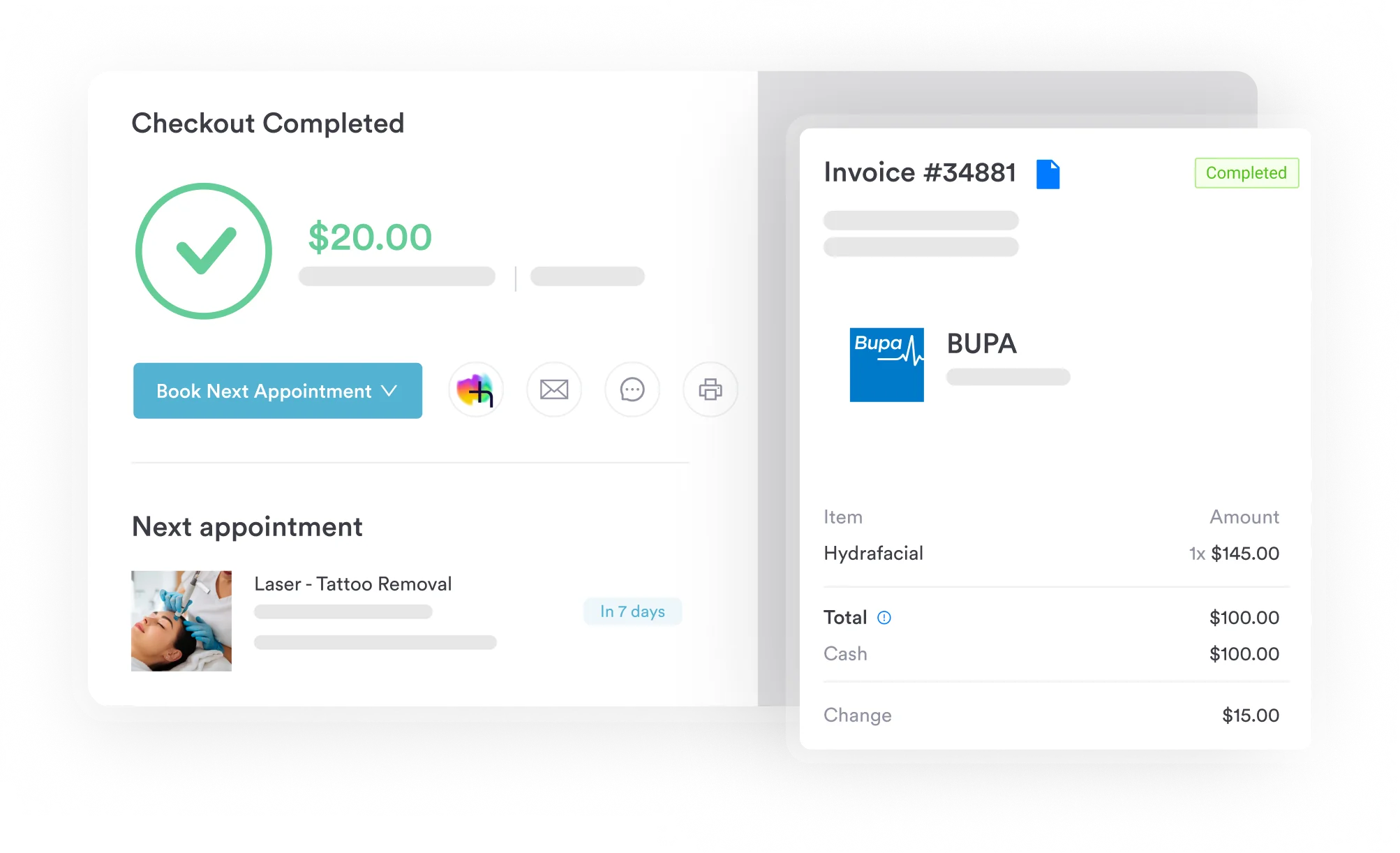
Pabau’s digital forms capture operative notes, device invoices, trial results, and physician orders in a consistent format, tied to the patient record. When a claim goes to audit, the timestamped records are already in one place, so answering the payer’s request takes minutes instead of days.
For teams handling a high volume of implant claims, Pabau’s reporting shows denial trends and clean claim rates over time. A monthly review tells you whether C1772 denials are falling, and which step in the workflow to fix if they aren’t.

Pabau helps healthcare facilities capture complete device documentation, track modifiers, and submit clean HCPCS claims the first time. See how it works for high-value implant billing.

Move the two checks that decide most C1772 claims out of billing and into scheduling. Confirm from the device paperwork that the pump is programmable, and confirm the prior authorization is on file, before the patient is booked for surgery.
By the time a coder sees the claim, both problems are far harder to fix. The trade-off is a few minutes of front-end checking on every implant case. That costs less than a single appeal on a device line this large.
Book a demo to see how Pabau keeps implant documentation, authorizations, and claims in one place for your billing team.

Need a framework for managing claim rejections systematically? Denial management strategies in healthcare covers the end-to-end process for tracking, appealing, and preventing payer denials across device and procedure codes.
Want to understand how ERA data reveals underpayments? Reading electronic remittance advice explains how to interpret ERA files to reconcile OPPS payments and catch APC assignment errors.
Building a cleaner pre-submission process? Submitting a clean claim outlines the elements every high-value HCPCS claim must include before it reaches the payer.
Pulling device, procedure, and diagnosis codes into one document? What a superbill includes walks through each field a clean superbill needs.
Sending C1772 claims electronically? The 837 claim file explained shows how the electronic claim is structured and where setting details like the Type of Bill sit.
HCPCS Code C1772 covers a programmable implantable infusion pump. It covers the device only, not the implantation procedure, drug, catheter, or subsequent refill visits. It is a Level II HCPCS C-code used exclusively on hospital outpatient facility claims under the OPPS payment system.
C1891 describes a permanent non-programmable implantable infusion pump, which delivers drug at a flow rate built into the device. C1772 describes a programmable pump whose delivery rate, schedule, or mode a clinician can adjust externally after implantation. Reporting C1891 for a programmable device is a coding error that leads to denial.
Yes, most payers require prior authorization before the programmable pump is implanted. Traditional Medicare subjects claims to post-payment medical review against the LCD rather than a formal pre-auth process. Medicare Advantage plans and commercial insurers typically mandate prior authorization 5 to 14 business days before the procedure.
The most important modifier is -KX, which confirms the claim meets LCD coverage criteria and signals documented medical necessity. Modifier -GA applies when an ABN has been signed and coverage is expected to be denied. Modifier -GY is used when the item is statutorily excluded from Medicare. Modifier -59 is used when a distinct procedural service distinction is needed to avoid NCCI bundling edits.
The leading denial reasons are missing prior authorization, reporting C1891 instead of C1772, and omitting modifier -KX. Claims are also denied for insufficient medical necessity documentation, such as missing trial results or conservative treatment history. Another cause is billing C1772 separately on an inpatient claim, where it is bundled into the DRG. Folding the drug cost into the device line item also triggers denials.
In hospital outpatient settings, C1772 is billed on the UB-04 under the OPPS and reimbursed via APC payment, with possible pass-through status for the device. In inpatient settings, the device cost is typically bundled into the DRG payment, meaning C1772 cannot be billed as a separate line item. Physicians cannot bill C1772 on a professional 1500 claim form in any setting.