CPT Code 62284: Injection procedure for myelography
CPT Code 62284: official descriptor and procedure overview The American Medical ...

Last Updated: Oct 19, 2026
B4088 is the HCPCS Level II code for a gastrostomy/jejunostomy tube, low-profile, any material, any type, each. It covers the button-style feeding tube that sits flush with the skin, billed per tube as a DME supply under Medicare's enteral nutrition benefit.
A tube that protrudes above the skin bills as B4087 instead. Extension sets and adapters fall under the daily supply kit codes (B4034-B4036), and Medicare covers one tube every three months.
Let Pabau's smart automation suggest the right codes, reduce claim denials, and keep your practice compliant—effortlessly.
Automate repetitive tasks and focus on what matters most—your patients.
Reduce coding errors and ensure compliance with the latest regulations.
Clean claims, fewer denials, and faster reimbursements.
Powerful insights and reporting to help your practice thrive.
HIPAA compliant SOC 2 certified GDPR-compliant Trusted by 4,000+ clinics worldwide

HCPCS Code B4088 covers a low-profile (button-style) gastrostomy or jejunostomy tube. A standard-profile tube bills as B4087.
Medicare Part B covers B4088 under the DME benefit when enteral feeding is expected to last 90 days or more and functional impairment is documented.
Every Medicare claim line for B4088 needs the KX modifier to confirm the coverage criteria are met. Leaving it off is the top denial trigger.
Medicare covers one gastrostomy/jejunostomy tube every three months, so an earlier replacement needs a documented clinical reason.
Practice management software like Pabau tracks modifier requirements and flags incomplete documentation before claims are submitted.
HCPCS Code B4088 is the Level II supply code for a low-profile gastrostomy or jejunostomy tube, billed one unit per tube.
Its official CMS descriptor reads: Gastrostomy/jejunostomy tube, low-profile, any material, any type, each.
The code sits within the HCPCS Level II B-range maintained by the Centers for Medicare & Medicaid Services (CMS). That range covers enteral and parenteral therapy supplies billed as durable medical equipment (DME).
CMS sets the Medicare allowable for B4088 by state in the DMEPOS fee schedule, which it updates each January. Pull the rate for your state from the current quarterly file before you bill.
Each unit of service is one low-profile tube, so bill per tube supplied rather than per encounter. LCD L38955 caps coverage at one gastrostomy/jejunostomy tube every three months.
B4088 covers a low-profile gastrostomy or jejunostomy tube of any material (silicone or polyurethane) and any internal retention type (balloon or non-balloon). The defining characteristic is the low-profile design: the tube sits flush with the skin surface rather than protruding. That is why it is sometimes called a “button” tube.
Several items used alongside the tube are not part of B4088. Each one belongs to a different code or allowance.
The chart below sorts each enteral item into its code, starting with the one question that separates B4088 from B4087.
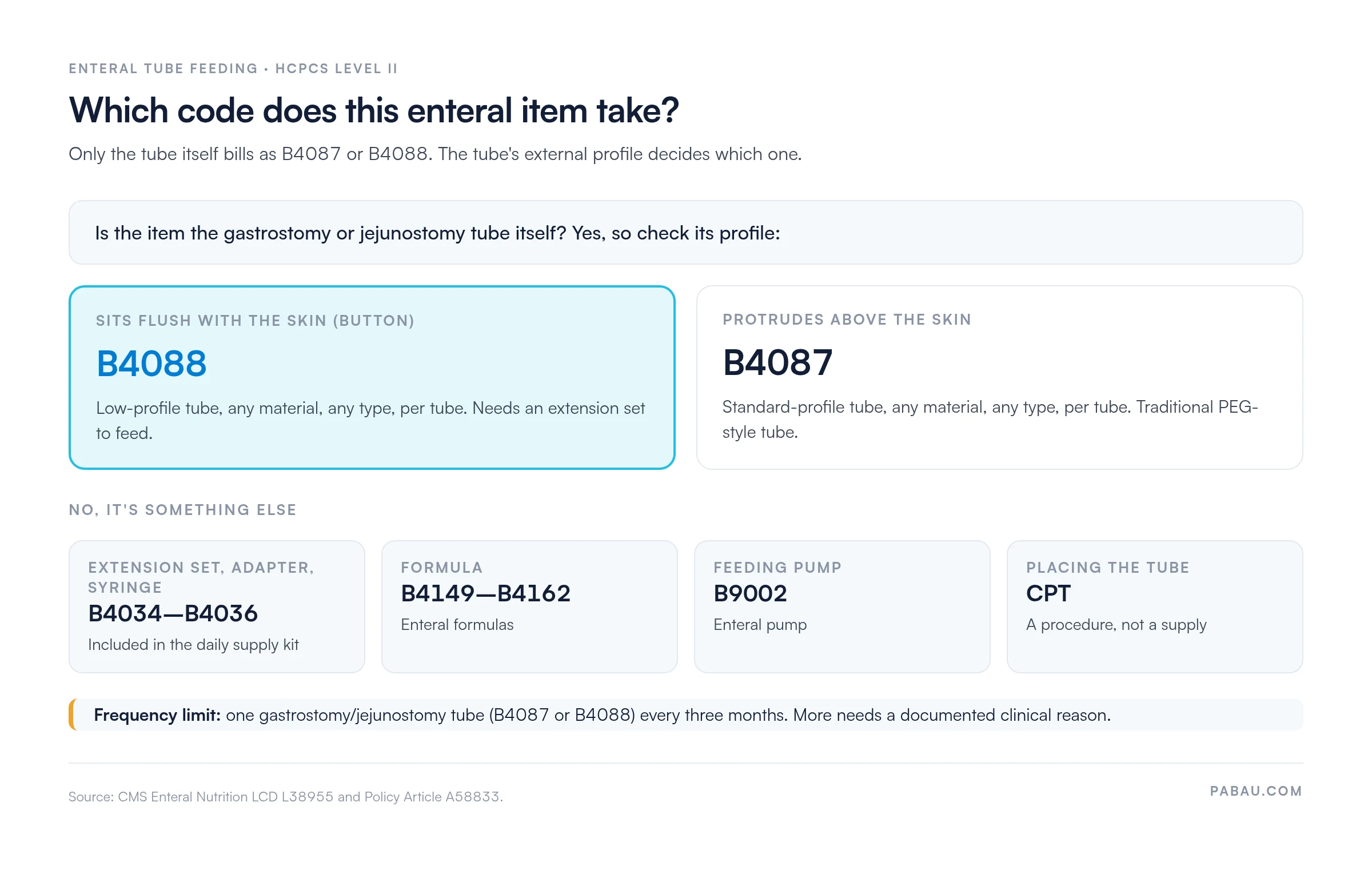
B4087 covers the standard-profile (non-low-profile) gastrostomy or jejunostomy tube. B4088 covers the low-profile version. This is the most consequential coding decision for DME suppliers billing tube replacements, and miscoding in either direction triggers a denial.
The physician order must specify the tube type. If the order says “low-profile G-tube” or “button tube,” B4088 is correct. If it describes a standard PEG replacement, the tube bills as B4087.
Billing one code for the other’s product creates a denial and a compliance risk. Check the tube model number against the manufacturer’s product catalog before you pick the code.
B4088 is the final code in the enteral feeding supplies range. Knowing its neighbors keeps billers from picking the wrong supply code when a patient receives several enteral items. The AAPC HCPCS Level II lookup provides a searchable index for the full B-range.
Eight modifiers can apply to HCPCS Code B4088 claims, and KX matters most. Suppliers add it only when every coverage criterion in LCD L38955 is met, and a Medicare claim line without it is denied. When the criteria aren’t met, the line takes GA, GY or GZ instead.
In practice, most Medicare claims for B4088 will carry KX as the primary modifier. Add NR if the tube is being supplied as new within a rental context. The remaining modifiers (EY, GK, GL, KB) address specific compliance and upgrade scenarios rather than routine supply replacement.
Check modifier definitions against current CMS DMEPOS guidance each year, because CMS refines them in annual updates. Dedicated claims management software checks modifier requirements on each claim line before submission.
Medicare Part B covers B4088 under the DME enteral nutrition benefit when the patient has a permanent or long-term enteral feeding need. That need must be expected to last at least 90 days, with a documented functional impairment of the alimentary tract. CMS Policy Article A58833 and Local Coverage Determination L38955 (Enteral Nutrition) govern these requirements.
The three core coverage conditions that must all be present and documented are:
CMS discontinued the Certificate of Medical Necessity (CMN) and the DME Information Form (DIF) for dates of service from January 1, 2023. That includes CMS-10126, the enteral and parenteral nutrition form. No replacement form exists, and claims that still carry CMN or DIF data are rejected.
The order and the medical record now carry the medical necessity case. A CMN only matters for claims with dates of service before 2023.
ICD-10-CM diagnosis codes that commonly support medical necessity for B4088 include dysphagia (R13.1x) and malnutrition (E40-E46). Neurological conditions affecting swallowing, such as cerebrovascular disease sequelae (I69.x), also qualify, as do gastroesophageal conditions preventing adequate oral intake.
The diagnosis code must reflect the underlying condition causing the need for tube feeding, not merely the tube placement itself. Always cross-reference against the ICD-10 codes listed in the current version of LCD L38955 and Policy Article A58833 before submitting.
B4088 claims need a documentation package that spans the ordering physician and the DME supplier. Keep it current for as long as the patient is tube fed, because one missing element can trigger a denial or a post-payment audit.
The documentation checklist divides into two categories: what the physician must provide and what the supplier must retain.
Capture the tube type, the order date and the medical record status at intake, before the claim is built. Then confirm the physician’s file and the supplier’s file are both current before you bill.
Under the standard Medicare Part B DME benefit, B4088 is not currently listed as a mandatory prior authorization item at the national level. CMS has expanded its prior authorization program for certain high-cost or frequently abused DMEPOS categories.
Enteral tube supply codes, including B4088, have historically not been on that mandatory list. Check the beneficiary’s eligibility and plan requirements before each supply episode.
Three situations can still bring prior authorization or supplier rules into play:
The DME MAC for the beneficiary’s jurisdiction publishes current coverage articles and prior authorization requirements. Check your jurisdiction’s site directly (Noridian for A and D, CGS for B and C), because requirements can change with each CMS program update.
B4088 denial patterns are consistent across DME MACs, and a structured pre-submission review prevents most of them. Start that review at order verification, before the tube ships.
Reviewing denial codes alongside each remittance shows your team the specific remark code driving the denial. The broad denial category alone won’t tell you what to fix. The electronic remittance advice (ERA/835) carries the CARC and RARC codes that name the reason and point to the corrective action.
Clean B4088 claims depend on checks made at order intake. A biller who only sees the claim after the tube ships can’t fix a vague order.
At order intake, ask the prescribing physician to specify the tube by model number or explicitly state ‘low-profile’ in the order. A verbal order that says only ‘G-tube replacement’ is not sufficient to code B4088 and will require a call-back before billing.
A clearinghouse with built-in HCPCS edits catches many modifier and code errors before the claim reaches the DME MAC. A clean claim on B4088 requires the correct code, the KX modifier, and a valid ICD-10 paired diagnosis.
The claim also needs a complete order backed by the medical record, plus a delivery record. All five must be present before the claim is batched.
Most DME billing teams check B4088 claims by hand. Someone reads the order, confirms the tube is low-profile and adds KX. Then they trust the medical record is on file if the DME MAC asks.
Practice management software like Pabau keeps the order, the diagnosis codes and the claim in one patient record. Its claims management tools track modifier requirements and flag incomplete documentation before a claim is submitted.
The result is fewer B4087 and B4088 mix-ups, fewer missing-KX denials and less rework once the remittance arrives.

Pabau’s claims management tools help DME suppliers and healthcare practices track modifier requirements, order details and missing records, so B4088 claims go out clean.

B4088 billing turns on one physical fact: whether the tube sits flush with the skin. Settle that in writing at order intake, and the code, the KX modifier and the three-month replacement window all follow from it.
The trade-off is a little time up front. A call-back to the physician before shipping takes minutes, while a denied claim costs a resubmission and sometimes an appeal. Book a demo to see how Pabau keeps enteral tube orders, modifiers and records together so B4088 claims go out right the first time.

Billing the supply kit that goes with a button tube? HCPCS Code B4034 covers the daily syringe-fed supply allowance, including extension tubing.
Feeding by pump instead of syringe? HCPCS Code B4035 explains the pump-fed supply kit and how it pairs with the tube code.
Need to understand how denials are tracked and resolved? Denial management in healthcare explains the workflow from CARC code identification through appeal resolution.
Want to see how ERA files drive denial analysis? Electronic remittance advice covers 835 file structure and how to extract CARC and RARC codes for DME claims.
Looking for a broader billing compliance framework? Medical billing compliance requirements outlines the documentation and audit-readiness standards that apply across DME and enteral nutrition billing.
HCPCS Code B4088 is the DME supply code for a low-profile (button-style) gastrostomy or jejunostomy tube, billed per unit. It covers any material and any internal retention type. DME suppliers use it when they replace or furnish a low-profile G-tube or J-tube. The patient receives long-term enteral nutrition under the Medicare Part B DME benefit.
Eight modifiers apply to B4088. KX confirms medical necessity criteria are met and is required on every Medicare claim. NR means new when rented, BA links the tube to parenteral enteral nutrition services, and BO flags orally administered nutrition. EY means no physician order is on file, and GK pairs with a GA or GZ modifier. GL marks a medically unnecessary upgrade at no charge, and KB marks a beneficiary-requested upgrade with a signed ABN. KX is the highest-stakes modifier and must appear on every routine Medicare claim for this code.
B4087 covers a standard-profile gastrostomy or jejunostomy tube that protrudes above the skin surface. B4088 covers a low-profile (button-style) tube that sits flush with the skin. The clinical distinction is the tube’s external profile. Bill B4087 when the physician order specifies a standard PEG-style tube and B4088 when the order specifies a button or low-profile tube. Billing the wrong code is a coding error that triggers a denial and creates a compliance risk.
Yes, Medicare Part B covers B4088 under the DME enteral nutrition benefit. The patient needs a functional impairment of the alimentary tract and an enteral feeding need expected to last at least 90 days. A physician order must be on file, with a medical record that supports it. CMS discontinued the Certificate of Medical Necessity (CMN) for dates of service from January 1, 2023, so none is needed. Coverage is governed by CMS Policy Article A58833 and LCD L38955. Medicare Advantage plans may have additional requirements.
Traditional Medicare Part B does not currently list B4088 as a mandatory prior authorization item at the national level. However, state Medicaid programs and Medicare Advantage plans frequently require prior authorization for enteral tube supplies. Always verify with the specific payer before shipping, and check whether the beneficiary is in a competitive bidding area where only contracted suppliers may bill.
The most common denial reasons are a missing KX modifier, a missing or incomplete order, and the wrong code. That usually means B4087 billed when a low-profile tube was supplied. Claims also fail when the ICD-10 code is not on the LCD L38955 covered list or the clinical notes do not document medical necessity. Replacing a tube early without supporting documentation exceeds the frequency limit and triggers a denial too. Most B4088 denials are preventable with a pre-submission documentation review.
Diagnosis codes that commonly support B4088 medical necessity include dysphagia codes (R13.10-R13.19) and protein-energy malnutrition codes (E40-E46). Neurological conditions affecting swallowing, such as sequelae of cerebrovascular disease (I69.x series), also qualify. The underlying condition causing the need for tube feeding must be coded, not merely the tube placement. Always cross-reference against the current covered diagnosis list in LCD L38955 before submitting, as the list is updated periodically.