CPT Code 62284: Injection procedure for myelography
CPT Code 62284: official descriptor and procedure overview The American Medical ...

Last Updated: Oct 19, 2026
A4740 is the HCPCS Level II code for a shunt accessory for hemodialysis, any type, billed one unit per item. It covers the connectors, clamps, caps and wraps that attach to or protect an arteriovenous shunt during dialysis. Medicare pays for it inside the dialysis facility's bundled end-stage renal disease payment, not as a separate line.
The items around the shunt carry their own codes. A4750 covers a single arterial or venous blood tube, A4755 a combined tubing set, and A4690 the dialyzer. A4651 and A4652 cover microcapillary tubes and their sealant.
Let Pabau's smart automation suggest the right codes, reduce claim denials, and keep your practice compliant—effortlessly.
Automate repetitive tasks and focus on what matters most—your patients.
Reduce coding errors and ensure compliance with the latest regulations.
Clean claims, fewer denials, and faster reimbursements.
Powerful insights and reporting to help your practice thrive.
HIPAA compliant SOC 2 certified GDPR-compliant Trusted by 4,000+ clinics worldwide

A4740 is an active HCPCS Level II supply code for a hemodialysis shunt accessory, any type, billed per item.
Blood tubing (A4750, A4755), dialyzers (A4690) and microcapillary tubes (A4651, A4652) carry their own codes and never go under A4740.
Medicare pays A4740 inside the ESRD PPS bundled payment to the dialysis facility, for in-center and home patients alike.
Where a payer pays A4740 as a separate line, KX signals documentation is on file and GA flags a signed waiver.
N18.5, N18.6, Z99.2, Z49.31 and Z49.32 are the supporting ICD-10 codes that establish medical necessity.
HCPCS Code A4740 is the code for a shunt accessory used in hemodialysis, billed one unit per item.
Its official descriptor is “Shunt accessory, for hemodialysis, any type, each.” The Centers for Medicare and Medicaid Services maintains it in the annual HCPCS Level II file.
The code is active for 2026. It sits in the A4206-A8004 medical and surgical supplies range of HCPCS Level II, which covers items that CPT codes don’t describe.
The phrase “any type, each” is deliberate. CMS uses it to group a range of shunt accessory components under one code instead of keeping a separate code per variant. Each item dispensed equals one billed unit. Billing ten units for a single accessory overstates the claim, and payer auditors flag it routinely.
A4740 covers discrete shunt accessory components that support hemodialysis access. These are items attached to, or used with, an arteriovenous shunt during a dialysis session. The “any type” qualifier means the code applies whatever the accessory’s design, provided the item is a shunt accessory and not a separately coded supply.
Several commonly confused supply items have their own HCPCS codes. Billing A4740 for any of these produces a miscode that payer edit logic detects:
A shunt accessory connects or protects the arteriovenous access point that lets blood circulate through the dialysis circuit. Without an intact, properly accessorized shunt, a hemodialysis session can’t proceed safely. Build the record before you bill, because a missing order or delivery receipt is grounds for denial on review.
The patient record must contain all four of the following before A4740 is billed:
The four records only protect the claim when they describe the same item and quantity, as the chain below shows.
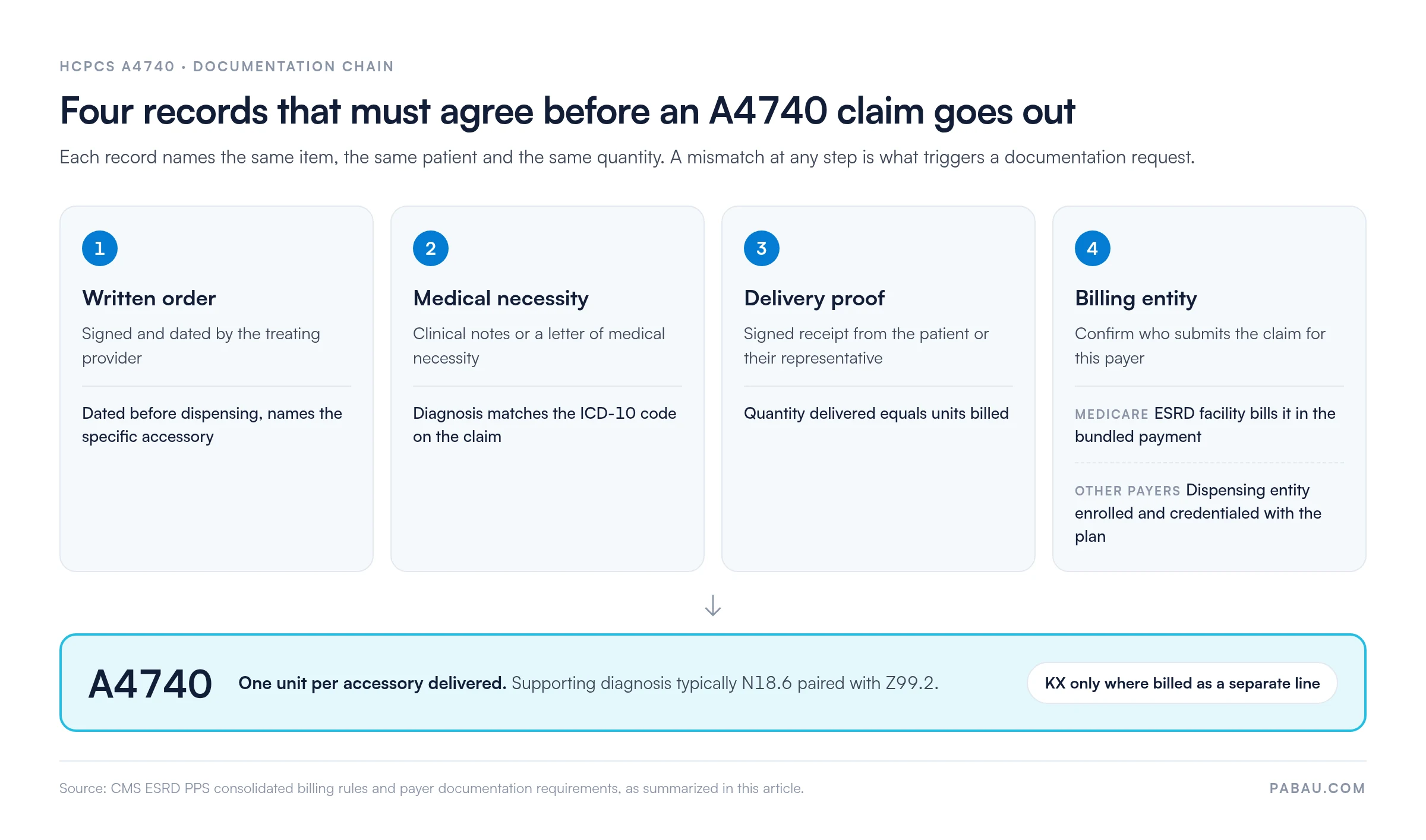
If any record in the chain is missing, hold the claim until it’s on file. Sending it early only invites an additional documentation request.
Document the specific shunt accessory item name in the order, not just a category description. ‘Shunt accessory’ alone is insufficient for medical necessity review. Name the component (e.g., ‘AV shunt end cap, dialysis access’) so the written order, delivery receipt, and claim descriptor align. Mismatches between the order and the claim are a leading cause of A4740 additional documentation requests.
Several hemodialysis supply codes are easy to confuse with A4740. All of them are used in dialysis, so the physical item dispensed is what decides the code.
The most consequential confusion is between A4740 and A4750. Blood tubing carries its own code because it’s a distinct, higher-volume supply. Billing tubing under A4740, or a shunt accessory under A4750, fails a code-specific edit at the payer. That isn’t a medical necessity denial, so the fix is a corrected claim rather than an appeal.
Medicare doesn’t pay A4740 as a separate line item. Section 153(b) of the Medicare Improvements for Patients and Providers Act (MIPPA) ended Method II home dialysis billing from January 1, 2011. Under Method II, a durable medical equipment (DME) supplier billed home dialysis supplies directly to Medicare.
Shunt accessories now sit inside the end-stage renal disease (ESRD) Prospective Payment System bundled payment. That holds whether the patient dialyzes in the facility or at home. The ESRD facility submits the claim and receives the bundled payment, so there’s no separate A4740 fee to collect from Medicare.
CMS’s consolidated billing list names the dialysis concentrates alongside shunt accessories. A DME supplier claim for acetate concentrate solution under A4708 is denied by that same bundling rule.
Practice management software like Pabau keeps each supply claim tied to its invoice and patient record. Its claims management software pre-fills claims from that record and runs validation checks in the background, so missing details surface before submission.
For Medicare, the care setting doesn’t change who gets paid for A4740. The ESRD PPS, in place since 2011, bundles renal dialysis supplies into one payment to the dialysis facility. That includes shunt accessories for in-center and home patients. The payer is what changes the answer, as the table below shows.
Don’t send a separate A4740 claim to the DME Medicare administrative contractor (DME MAC) for a Medicare dialysis patient. The item is already paid through the facility’s bundled payment, so the separate claim is denied. The denial reason code won’t always make that bundling logic explicit. Check the current CMS ESRD program guidance for the policy year before you set up supply billing.
Medicare, Medicaid and commercial payers each set their own documentation requirements for an A4740 claim. Meeting them before submission takes far less time than answering additional documentation requests afterward. A pre-submission checklist built around the rules below catches them at the cheapest point.
Medicaid coverage of A4740 varies by state. Some states follow Medicare’s ESRD bundling by reference. Others pay dialysis supplies through their own fee schedules or require prior authorization above a set quantity.
Check with the state Medicaid agency before billing, because assuming Medicare rules apply creates overpayment risk. Run an eligibility check at the start of each supply period. It confirms whether the plan pays home dialysis supplies separately, bundles them into the facility rate or routes them through a managed care organization.
Commercial plans often require prior authorization for durable medical equipment, prosthetics, orthotics and supplies (DMEPOS). Most major payers set authorization thresholds by quantity or episode value rather than reviewing code by code.
For home hemodialysis patients on a commercial plan, get written authorization before dispensing A4740 items beyond the plan’s threshold. Keep the authorization reference number in the claim file. It’s the first document a utilization management reviewer requests in a post-service audit.
Every A4740 claim needs a supporting ICD-10-CM diagnosis code that establishes medical necessity for a hemodialysis shunt accessory. The diagnosis on the claim must match the condition documented in the medical record.
The codes below are the standard supporting diagnoses, and an unrelated or vague code is a leading denial trigger. Check current validity in the CDC/NCHS ICD-10-CM web tool before each submission cycle.
N18.6 and Z99.2 together are the most common pairing for home hemodialysis A4740 claims. N18.5 is the appropriate primary diagnosis when the ESRD stage is confirmed. That applies until the Z99.2 status code is added to the active problem list.
Billing teams handling dialysis accounts see a predictable set of A4740 denials, and most are preventable before submission. The table below maps each denial to its root cause and the corrective action that resolves it.
Knowing the specific medical billing denial codes tied to supply claims helps billing teams decide which denial types to fix first. The bundling denial is the highest-dollar category, because one setting error repeats across every claim in the affected billing run.
Getting the unit count, modifier and timing right on A4740 claims prevents the most avoidable payment delays. The guidance below applies where a payer pays A4740 as a separate line, since Medicare folds it into the ESRD bundled payment. Check it against that payer’s policy before you act on it, because modifier rules can change between plan years.
Report one unit of A4740 for each discrete shunt accessory dispensed. The descriptor says “each,” so one accessory is one unit. Three clamps can go out as three one-unit lines or as one line for three units. Either way, the quantity must match the delivery documentation exactly.
KX is the standard modifier for separately paid A4740 claims with complete documentation. GA and GZ are waiver scenarios, and pre-dispense eligibility and coverage checks should keep them rare. Review the electronic remittance advice after each payment cycle to confirm the payer is processing KX as expected. Before submission, the KX modifier, the ICD-10 diagnosis code and the delivery date must all line up.
Set a reminder 30 days before each payer’s fee schedule update, typically January 1. Use it to check the A4740 allowable with every plan that pays it separately. Many payers pay the lower of your billed charge or the allowable, so a charge set below the new rate leaves money unpaid. For Medicare patients, the item sits in the facility’s ESRD PPS bundle, so there’s no separate rate to track.
Many dialysis billing teams keep written orders in one system, delivery receipts in another and claim status in a clearinghouse portal. When an A4740 claim comes back, someone has to rebuild the paper trail by hand before they can correct it.
Pabau puts the patient record, the invoice and the claim in one place. Claims pre-fill with the patient, treatment and insurer details already in the record. Background validation checks then flag missing details, such as membership numbers or authorization codes, before the claim goes out.
In the US, claims go straight to Claim.MD, with real-time eligibility checks and ERA remittance posting through the same connection. Each claim shows whether it’s pending, submitted, processing, paid or in error, so a returned supply line gets chased the day it comes back.

Pabau pre-fills supply claims from the patient record and checks for missing details before submission. Track every A4740 line from submission to payment in one dashboard.

Treat A4740 as a payer-and-item question before it becomes a coding question. Confirm who pays and whether that payer bundles dialysis supplies, as Medicare does under the ESRD PPS. Then confirm the item is a shunt accessory and not tubing, a dialyzer or a microcapillary tube.
Put those two checks into the intake workflow and the four supporting records follow naturally. Leave them to the denial queue and you end up correcting the same claim twice.
Book a demo to see how Pabau keeps orders, delivery records and claims together for dialysis supply billing.

Need a framework for reducing dialysis supply claim errors? What is medical billing explains the claim lifecycle from encounter to payment posting.
Handling repeated denials across supply codes? Submitting a clean claim outlines the pre-submission checks that cut first-pass denials for HCPCS supply codes.
Want to see how Medicaid and commercial payers differ from Medicare? Medical billing compliance requirements covers payer-specific documentation obligations across coverage types.
Working a backlog of returned dialysis claims? Denial management in healthcare sets out a process for sorting, correcting and preventing denials.
Checking coverage before each supply period? Insurance eligibility verification walks through the checks that confirm a plan covers the item before you dispense it.
HCPCS Code A4740 covers shunt accessories for hemodialysis, any type, billed per item dispensed. Covered items include shunt connectors, clamps, caps and wraps used with arteriovenous shunt access during dialysis. It does not cover blood tubing (A4750 or A4755), microcapillary tubes (A4651), tube sealant (A4652), dialyzers (A4690) or the dialysis machine itself.
A4740 covers shunt accessories such as connectors, clamps and caps. A4750 covers a single arterial or venous blood tube for hemodialysis, and A4755 covers the combined set. They are distinct supply items with distinct codes and can’t be used interchangeably. Billing blood tubing under A4740 fails a code-specific edit at the payer.
Yes, but not as a separate payment. Since January 1, 2011, Medicare has paid dialysis supplies such as A4740 inside the ESRD PPS bundled payment to the dialysis facility. That applies to in-center and home hemodialysis alike. The facility submits the claim, and a separate DME supplier claim for the item is denied.
KX is the standard modifier when a payer pays A4740 separately and the written order and medical necessity documentation meet its criteria. GA applies when a liability waiver has been signed because coverage is uncertain. GZ applies when denial is expected and no waiver was obtained. None of the three applies to Medicare’s bundled ESRD payment.
The primary supporting ICD-10-CM codes are N18.5 (chronic kidney disease, stage 5), N18.6 (end-stage renal disease), and Z99.2 (dependence on renal dialysis). Z49.31 (encounter for adequacy testing for hemodialysis) may also apply. The diagnosis must be documented in the patient record and match the code on the claim.
The most common reasons are a missing written order and a missing or invalid ICD-10 diagnosis code. Billing Medicare separately for a dialysis patient, whose supplies sit in the ESRD PPS bundle, is another. A missing KX modifier and a wrong code, such as A4750 billed as A4740, account for the rest. The ESRD bundling denial is the highest-dollar error category for dialysis billing teams.