HCPCS code V2599: Other type contact lens billing guide
What is HCPCS code V2599? HCPCS code V2599 is the Level II supply code for a con...

Last Updated: Oct 20, 2026
38571 is the CPT code for laparoscopy, surgical, with bilateral total pelvic lymphadenectomy. The surgeon removes the pelvic lymph nodes on both sides through keyhole ports, usually to stage a gynecologic or urologic cancer.
Three neighboring codes describe nearly the same surgery. 38570 covers retroperitoneal node sampling only, 38572 adds peri-aortic sampling, and 38573 adds a full staging set. Choosing among them comes down to what the op note shows was removed, and from which side.
Let Pabau's smart automation suggest the right codes, reduce claim denials, and keep your practice compliant—effortlessly.
Automate repetitive tasks and focus on what matters most—your patients.
Reduce coding errors and ensure compliance with the latest regulations.
Clean claims, fewer denials, and faster reimbursements.
Powerful insights and reporting to help your practice thrive.
HIPAA compliant SOC 2 certified GDPR-compliant Trusted by 4,000+ clinics worldwide

CPT code 38571 reports a laparoscopic bilateral total pelvic lymphadenectomy, with no peri-aortic sampling.
CPT code 38570 is retroperitoneal node sampling, so it never stands in for a pelvic dissection.
Lead with the specific cancer code, such as C54.1 or C61, and let the op note prove both sides were cleared.
Common 38571 denials trace back to the wrong code in the series, a missing bilateral note or a bundled 49320.
CPT code 38571 reports a surgical laparoscopy in which the surgeon removes the pelvic lymph nodes on both sides. The official descriptor reads “Laparoscopy, surgical; with bilateral total pelvic lymphadenectomy.” Surgeons mostly use it to stage cervical, endometrial, prostate and bladder cancers.
Two words carry the code. “Bilateral” means the left and right pelvic sidewalls were both dissected. “Total” means the node basins were cleared, not just sampled. Those basins typically include the obturator, external iliac and internal iliac (hypogastric) groups.
The American Medical Association maintains the CPT code set and these descriptors. The series sits in the Surgery section, under Hemic and Lymphatic Systems, in the laparoscopy subsection for lymph nodes (38570-38589).
The fastest way to pick a code in this series is to read the op note and answer a short run of questions in order. The flow below maps each answer to its code.
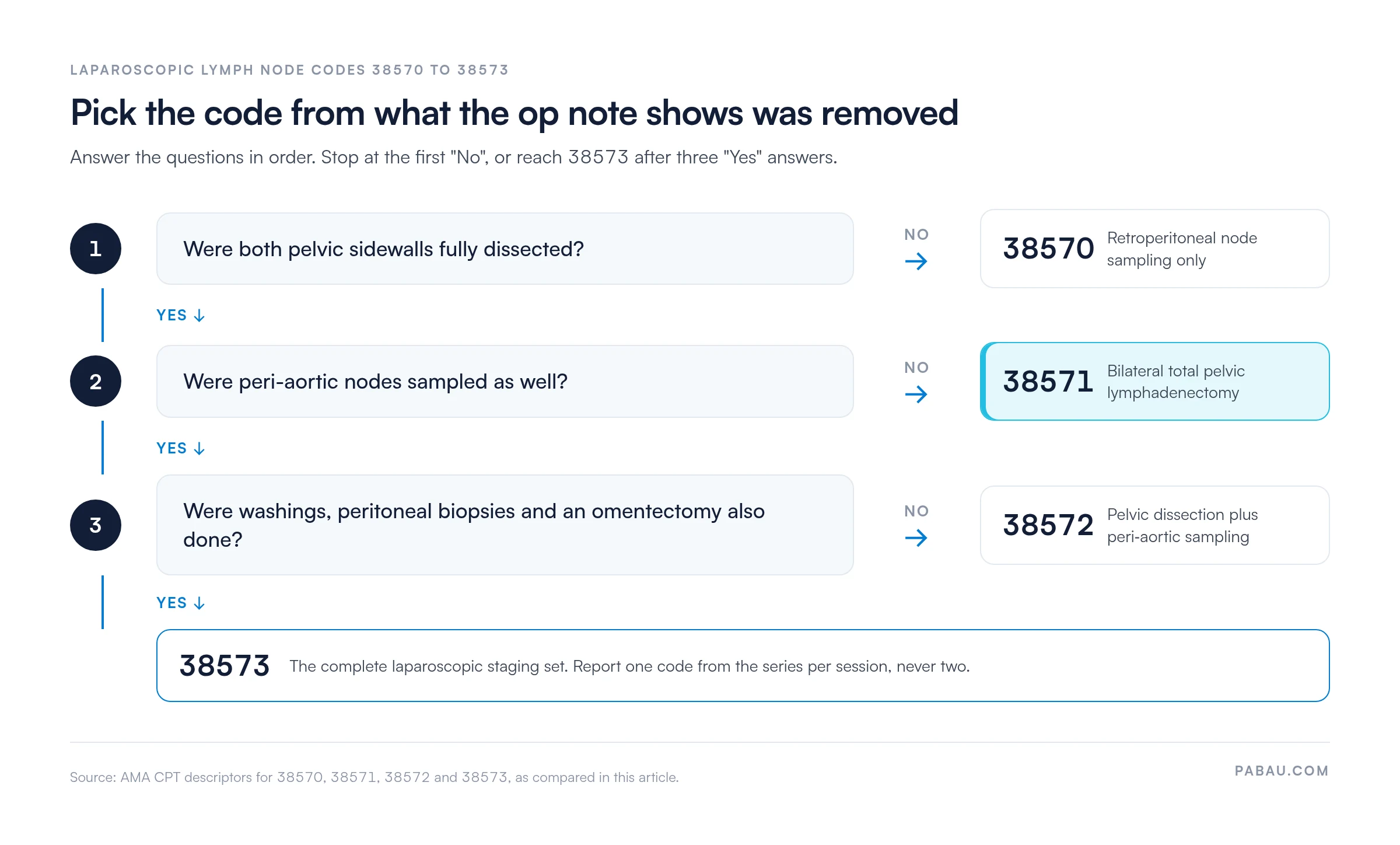
Were only retroperitoneal nodes sampled? Use 38570. It covers sampling, single or multiple, with no pelvic dissection at all.
Were both pelvic sidewalls fully dissected, and nothing more? Use 38571. This is the pure pelvic lymphadenectomy.
Did the surgeon also sample peri-aortic nodes? Use 38572. It already contains the 38571 work, so it replaces 38571 rather than joining it.
Did the case also include washings, peritoneal biopsies and an omentectomy? Look at 38573. It describes the complete laparoscopic staging set.
Report one code from this series per session. Because 38572 already includes 38571, billing both describes the same dissection twice. Likewise, pelvic dissection plus peri-aortic sampling is 38572, not 38571 plus 38570. Check the CMS NCCI edits for any other pairing you plan to report.
Knowing the surgical steps helps you check that the op note supports 38571. Each step below should be traceable in the note.
If the note skips the bilateral detail or never names the basins, a payer can argue the billed code doesn’t match the work.
Flag any op note that says only “pelvic lymph node sampling.” Sampling does not describe a total lymphadenectomy, so query the surgeon before you code 38571.
The op note is the evidence for both the code and the medical necessity. Check it for these six details before the claim goes out.
Medical necessity for 38571 rests on the cancer being staged or treated. Endometrial cancer cases usually carry C54.1, and prostate cancer cases carry C61. The table lists the pairings you will see most often.
Code to the highest specificity the record supports. If the note says the right ovary, report C56.1, not C56.9. For ambulatory surgery, the ICD-10-CM Official Guidelines say to code the diagnosis the surgery was performed for. A confirmed postoperative diagnosis takes priority over the preoperative one.
Ovarian cancer staging often reaches beyond the pelvis. Before you settle on 38571 for a C56 case, check whether the note supports 38572 or 38573 instead.
Most 38571 claims need no modifier at all. These four situations are the exceptions worth knowing.
The -51 rule above is Medicare’s standard multiple-surgery rule for procedures with a multiple-procedure indicator of 2. It is set out in Chapter 12, section 40.6 of the Claims Processing Manual. Check the indicator for 38571 in the fee schedule lookup.
If the surgeon could dissect only one side, the descriptor isn’t met. Some payers accept 38571 with modifier 52 for reduced services, with a note explaining why. Confirm the payer’s policy before you submit it that way.
We don’t print RVUs or payment figures here, because CMS updates them every January. The CMS Physician Fee Schedule lookup gives the current values in a few steps.
The facility’s own payment is separate. Hospitals are paid under the outpatient or inpatient system, and ASCs under the ASC payment system.
Seeing the full path helps you spot where a claim tends to stall.
These are the errors behind most rework on this code, along with the fix for each. The most frequent bundling slip is adding 49320, the diagnostic laparoscopy that a surgical laparoscopy already includes.
When the same denial keeps returning on 38571 claims, look at the process behind them. An op note template that never names both sides is a common culprit. A denial management workflow helps you sort those patterns from one-off errors. It also helps to know the denial codes that show up on your remittances.
Each quarter, list every 38571 denial from the past 90 days and group them by CARC code. If several share one code, fix the process behind it instead of appealing claims one at a time.
A claim that passes these checks is far more likely to be a clean claim on first submission.
Coding 38571 correctly happens in the op note and the coder’s review. The slow part comes next: sending the claim and chasing what comes back.
Pabau, the practice management platform we build, sends claims to payers electronically, with US claims routed through our Claim.MD integration. Each claim keeps its status on record, so your team sees what was paid and what was denied.
Our claims management software also keeps denials in one place. When 38571 claims keep coming back for the same reason, you can see the pattern and fix it at the source.

Pabau submits your claims electronically and keeps every denial in view, so your team can follow up quickly. See how surgical practices use it day to day.

Before any 38571 claim leaves the practice, read the op note against the four codes in the series. Neighboring codes differ by a single node group, so the wording of the note settles which code the payer sees.
Make that check part of charge entry on every case. It costs a few minutes, and it catches wrong-code and bundling errors before a payer turns them into rework and resubmissions.
Book a demo to see how Pabau tracks your surgical claims from submission to payment.

Worried about audits on high-value surgical codes? Medical billing compliance guide covers the audit and documentation standards that prevent recoupment on high-value surgical procedures.
Submitting claims through a clearinghouse for the first time? How medical claims clearinghouses work explains the 837P transaction flow, payer enrollment, and real-time eligibility checking.
Getting ERA responses you can’t interpret? Electronic remittance advice explained breaks down CARC and RARC denial codes so your billing team can respond to 38571 denials correctly.
Yes, when the hysterectomy code does not already include the node work. The total laparoscopic hysterectomy codes, 58570-58573, do not include lymphadenectomy. So 38571 can go on the same claim, subject to NCCI edits and multiple-surgery rules. A laparoscopic radical hysterectomy, 58548, already includes bilateral total pelvic lymphadenectomy and para-aortic sampling. Don’t add 38571 to 58548.
Yes. CPT has no separate robotic code for this procedure, so a robotic-assisted case is reported with the laparoscopic code. Some commercial payers also accept HCPCS S2900 for the robotic system. Medicare does not pay S codes, so leave S2900 off Medicare claims.
No. 38571 is a standalone code, not an add-on. It can be the only procedure on a claim. It can also be billed with a primary procedure, such as a laparoscopic radical prostatectomy (55866), subject to NCCI edits.