

CCSD code XR940: Radiology billing guide for UK private practice
CCSD code XR940 is a UK private healthcare radiology procedure code used to bill...

Last Updated: Nov 26, 2026
38572 is the CPT code for laparoscopic bilateral total pelvic lymphadenectomy with peri-aortic lymph node sampling, single or multiple. Surgeons use it mainly to stage cervical, endometrial and ovarian cancer in one laparoscopic session.
The code needs both parts in the operative report. If the note confirms the pelvic dissection but never says peri-aortic nodes were sampled, the claim drops to 38571 and pays less. Under the 2026 Medicare fee schedule, 38572 carries a 10-day global period and pays about $826 nationally. Getting the wording right protects that payment, and the sections below cover documentation, modifiers, bundling and denials.
Let Pabau's smart automation suggest the right codes, reduce claim denials, and keep your practice compliant—effortlessly.
Automate repetitive tasks and focus on what matters most—your patients.
Reduce coding errors and ensure compliance with the latest regulations.
Clean claims, fewer denials, and faster reimbursements.
Powerful insights and reporting to help your practice thrive.
HIPAA compliant SOC 2 certified GDPR-compliant Trusted by 4,000+ clinics worldwide

CPT code 38572 covers a laparoscopic bilateral total pelvic lymphadenectomy plus peri-aortic lymph node sampling, and the operative report must name both.
Without documented peri-aortic sampling, the claim only supports 38571, while added washings and an omentectomy move it up to 38573.
Leave modifier -50 off, because the descriptor already says bilateral.
Medicare treats 38572 as a 10-day global procedure (indicator 010) that pays about $826 nationally in 2026.
Most denials trace back to vague peri-aortic wording, a benign diagnosis code or a missing prior authorization number.
CPT code 38572 is the laparoscopic code for removing the pelvic lymph nodes on both sides and sampling the peri-aortic nodes in one session. The AMA’s CPT code set describes it as Laparoscopy, surgical; with bilateral total pelvic lymphadenectomy and peri-aortic lymph node sampling (biopsy), single or multiple.
You’ll see it most often in gynecologic oncology. Surgeons use it to stage cervical, endometrial and ovarian cancer before deciding on further treatment. The descriptor isn’t sex-specific, though, so urologic cancer staging can use it too.
CPT 38572 covers two separate operative steps, both done laparoscopically in the same session. Confirm both are documented before you choose it over the lower 38571.
Step 1: Bilateral total pelvic lymphadenectomy. The surgeon removes lymph nodes from both sides of the pelvis. That includes the external iliac, obturator and hypogastric (internal iliac) chains. “Total” means the named nodal groups are fully cleared, not sampled.
Step 2: Peri-aortic lymph node sampling (biopsy), single or multiple. The surgeon enters the retroperitoneal space above the pelvis and biopsies one or more nodes next to the aorta. This is a sampling, not a full dissection. The node count varies, but the operative report must name the peri-aortic region.
Why do surgeons combine the two? Each staging decision depends on how far the cancer has spread:
Four laparoscopic codes cover this anatomy, and they differ by how much node work the surgeon did. Peri-aortic sampling is what separates 38572 from 38571. Staging steps beyond the nodes are what separate it from 38573. The AAPC’s CPT code lookup lets you compare the official descriptors side by side.
In practice, you choose the code by reading the operative report in order. The decision flow below shows where each question sends the claim.
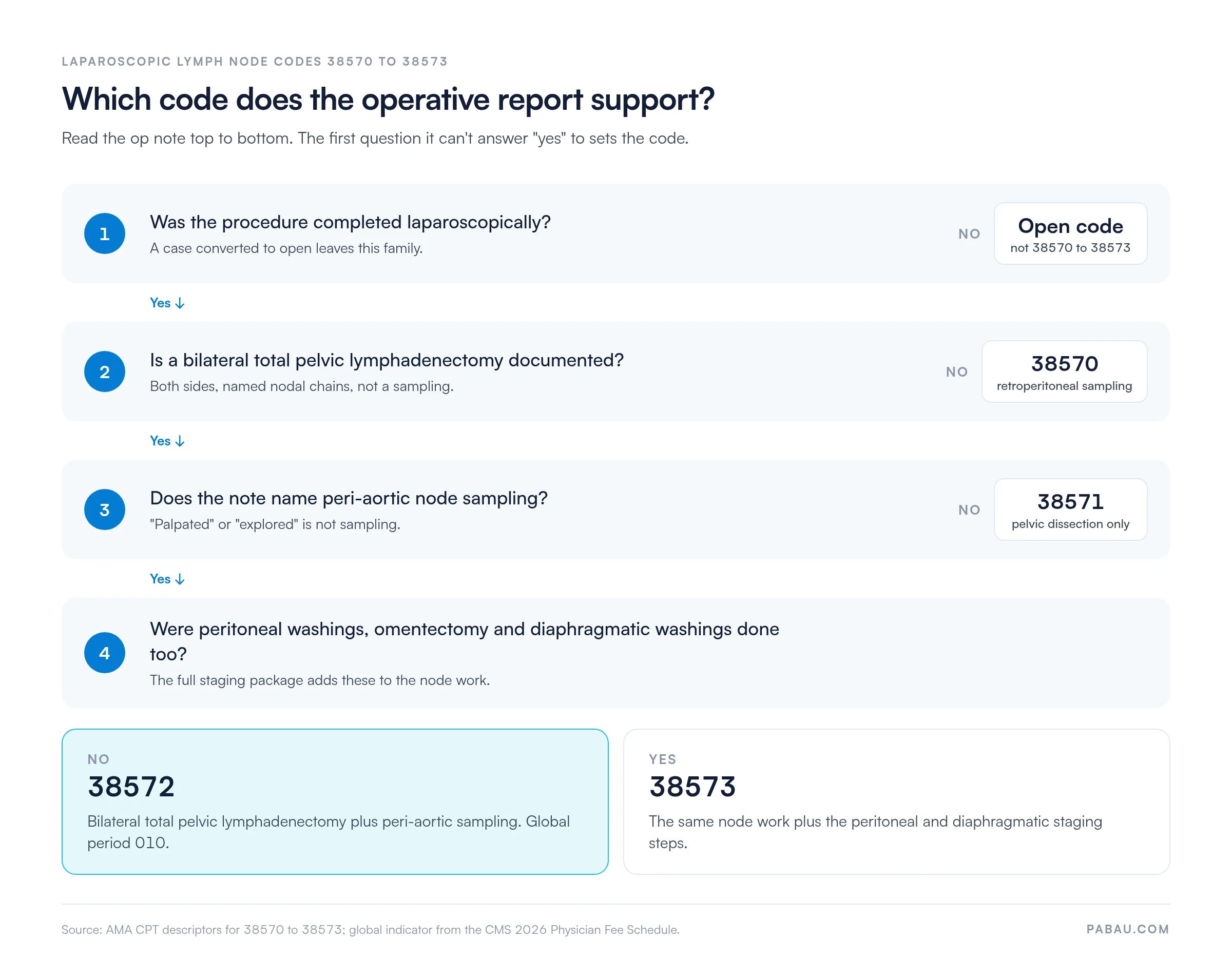
The coding rule: If the surgeon documents only the pelvic dissection, bill 38571. If both steps are documented, bill 38572. Never upgrade because peri-aortic sampling “should have” happened clinically.
Payers reviewing 38572 look for specific wording in the operative report. A clean claim submission needs the first four elements below stated outright, not implied. The fifth is optional but helps.
The usual weak spot is a detailed pelvic dissection followed by “para-aortic nodes palpated” or “retroperitoneum explored.” Neither phrase describes sampling, so that report supports 38571 only.
Ask your surgeons to close every 38572 operative report with one standard line: ‘Bilateral total pelvic lymphadenectomy was completed. Peri-aortic lymph node sampling was performed with [number] nodes submitted to pathology.’ That single line prevents most downcodes on this code.
Some modifiers are already accounted for in the 38572 descriptor, and others apply only in specific situations. Here’s how each one plays out.
Modifier -50 is the most common modifier error on this code. Because “bilateral” is part of the descriptor, payers read -50 as a claim for two bilateral procedures. They may deny it or recoup the payment later.
CPT 38572 carries a 10-day global period (CMS global indicator 010). The surgical payment covers the day of surgery plus 10 postoperative days.
Within that window, routine wound checks, suture removal and related follow-up evaluation and management (E/M) visits aren’t billed separately. Three situations still allow separate reporting:
Under the 2026 Medicare Physician Fee Schedule, 38572 carries 15.21 work RVUs and 24.72 total RVUs. At the $33.4009 conversion factor, that’s about $826 nationally. The facility and non-facility rates are the same for this code.
Your locality adjusts that national figure up or down. Check the CMS fee schedule lookup for your Medicare Administrative Contractor before quoting a rate to surgeons. The FastRVU 2026 RVU lookup is a quick cross-check for work, practice expense and malpractice RVUs.
The National Correct Coding Initiative (NCCI) decides which codes can sit beside 38572 on a claim. The rule that matters most is simple. Don’t bill 38571 with 38572 for the same patient on the same date of service.
CPT 38572 already includes the bilateral pelvic dissection that 38571 describes. Billing both would pay the pelvic work twice, and no modifier unbundles that pair.
Two pairings come up in almost every staging case. Sentinel mapping is reported with 38900, so confirm 38572 is on its parent list first. A same-session total laparoscopic hysterectomy is often 58571, which has its own edit to check. NCCI edits update quarterly, so check the pair when you bill, not from memory.
Medical necessity for 38572 rests on a diagnosis that justifies lymph node staging. Payers expect a confirmed or suspected malignancy as the primary diagnosis, usually gynecologic. Endometrial cancer, C54.1, is the most common pairing.
A diagnosis-procedure mismatch is one of the leading denial reasons on 38572. Submit it with a benign code, such as an ovarian cyst without malignancy, and expect a medical necessity denial. Make sure the ICD-10 code on the claim matches the pathology or the working diagnosis in the record.
Prior authorization rules for 38572 vary by payer and plan. Here’s the usual pattern:
Once you have the authorization, enter the number in Box 23 of the CMS-1500. A claim sent without a required number will deny, however appropriate the surgery was.
Most 38572 problems start upstream of billing. This is the path a clean claim follows, and where each step tends to stall:
Each denial pattern on 38572 has its own fix. If you log denials by reason code in a denial management workflow, the root cause shows up quickly. It’s usually documentation, coding or payer policy.
Once a quarter, pull every 38572 claim from the previous three months. Sort the denials by reason and see whether documentation or coding drives most of them. For most gynecologic oncology practices, tightening the operative report wording has the biggest payoff.
Surgical billing teams often rebuild a 38572 claim by hand from the op note, the pathology report and the authorization email. Each handoff is a chance to drop the authorization number or the right diagnosis.
Pabau, a practice management platform with built-in claims management for practices, builds the CMS-1500 from the patient record. The CPT code on the service lands on the charge line, and ICD-10 slots fill from the recorded problem list. The authorization code is tracked on the case, with a warning when one is missing.
In the US, claims go out through Claim.MD, with eligibility checks before the surgery date and ERA remittances posted back afterward. Your team then spots an underpayment at the 38571 level from the remittance instead of a spreadsheet.

Pabau builds the CMS-1500 from the patient record, checks required fields such as the authorization number, and submits US claims through Claim.MD. Your team spends less time reworking denied staging claims.

CPT 38572 pays only when the operative report names the peri-aortic sampling, so treat the dictation template as your first billing control. Fix it once with your surgeons and the 38571 downcodes largely stop.
The trade-off is speed. A coder who holds a claim to query the surgeon loses a few days, but saves a slow appeal and a lower payment. With a 10-day global and about $826 at stake, that wait is usually worth it.
Book a demo to see how Pabau helps your billing team send complete staging claims and track every remittance.

Submitting claims electronically for surgical procedures? How Claim.MD clearinghouse works with Pabau explains the 837P submission process for complex surgical codes.
Building a denial recovery process for your practice? Electronic remittance advice (ERA) explained covers how to read ERA files and pull out denial reason codes.
Need a framework for surgical billing? Revenue cycle management guide outlines the workflow from procedure to payment posting.
It covers a laparoscopic bilateral total pelvic lymphadenectomy plus peri-aortic lymph node sampling in one session. Both parts must appear in the operative report, or the claim drops to 38571.
CPT code 38572 has a 10-day global period (CMS indicator 010). It covers the day of surgery plus 10 postoperative days. Unrelated visits take modifier -24, and a return to the OR takes -78.
No CPT code exists for the robotic approach, so a robotic case is reported with 38572. Some commercial payers accept HCPCS S2900 alongside it, but Medicare doesn’t pay S2900.
Report the open procedure instead of 38572, based on the approach that finished the case. The abandoned laparoscopy isn’t billed separately when the conversion happens in the same session.
Yes, when both components are documented. The descriptor isn’t sex-specific, so urologists report it too. The diagnosis then comes from the cancer being staged, such as C61 for prostate cancer.



