CCSD code G5100: Bypass of duodenum billing guide
CCSD code G5100 bills a bypass that leaves the duodenum in place CCSD code G5100...

Last Updated: Oct 16, 2026

CPT code 24076 covers excision of a subfascial soft tissue tumor of the upper arm or elbow area, measuring less than 5 cm.
Depth comes from the operative note and size comes from the pathology report, and both must be in the record before the claim goes out.
A subfascial tumor of 5 cm or greater moves to CPT code 24073, not 24077, which covers radical resection instead.
CMS assigns 24076 a total of 15.6 RVUs, and the practice expense RVU is the same in facility and non-facility settings.
Practice management software like Pabau flags NCCI conflicts at entry and attaches documentation checklists, so fewer claims come back denied.
CPT code 24076 covers the excision of a subfascial soft tissue tumor measuring less than 5 cm, in the upper arm or elbow area. The official descriptor reads: Excision, tumor, soft tissue of upper arm or elbow area; subfascial, e.g., intramuscular; less than 5 cm.
Three qualifiers decide whether 24076 is the right choice: depth, size, and anatomic site. Each one has to appear in the record before the claim is submitted.
Understanding the descriptor language protects against both upcoding and undercoding.
One point catches coders out. Excision and radical resection are separate procedures with separate codes, so a larger tumor does not push 24076 into the 24077 range.
The most common error in this family is picking a code from incomplete documentation of either depth or size. The table below covers the full excision and radical resection set for the upper arm and elbow. The same depth and size logic drives CPT code 21554 in the neck and thorax.
Depth is confirmed by the operative note, where the surgeon describes the dissection plane, and by the pathology report. Size is the greatest tumor dimension recorded at the time of excision. Both belong in the medical record before the claim is submitted.
Modifiers change how a payer reads the code without changing the procedure itself. For CPT code 24076, four modifiers cover the majority of billing scenarios.
Modifier -22 carries the highest audit risk. Appending it without an operative note that explains the added complexity is an Office of Inspector General (OIG) red flag. Use it sparingly and document thoroughly.
Laterality is the quieter risk. The same -LT and -RT requirement applies across upper extremity surgery, including shoulder procedures such as CPT code 23462.
Medical necessity for CPT code 24076 rests on a diagnosis code that matches the pathology finding. Benign and malignant neoplasm codes are not interchangeable, so the ICD-10 you submit has to reflect the pathology report conclusion.
When a pairing is rejected, the remittance advice names the reason. Our guide to denial codes explains how to read those remark codes and what to correct before resubmitting.
Selecting C49.12 when pathology shows a benign tumor is a coding error that can trigger a medical necessity denial. In some cases it also invites a fraud audit. Reconcile the ICD-10 against the final pathology report before you submit.
Medicare pays for CPT code 24076 by multiplying its Relative Value Units (RVUs) by the CMS conversion factor, then adjusting for geographic locality. The figures below are national values. Use the CMS Physician Fee Schedule lookup tool to find the locality-adjusted rate for your practice.
RVU values are revised annually. Confirm the current figures in the AAPC entry for 24076 or the CMS fee schedule before you quote rates.
Many office-based procedures pay more in the non-facility setting, because the practice absorbs the overhead. CPT code 24076 is an exception worth knowing. CMS assigns it the same practice expense RVU in both settings, so the physician’s total RVU does not move with place of service.
That does not make the place-of-service code optional. It still determines whether the hospital or ambulatory surgery center can bill its own facility claim alongside the surgeon’s Part B claim. Submitting the wrong one is a claim integrity issue CMS audits, so confirm it before submission.
The National Correct Coding Initiative (NCCI) sets code-pair edits that CMS updates quarterly. Certain codes are bundled with CPT code 24076, so Medicare will not pay for both on the same claim unless specific conditions are met.
Pairs change with every update cycle, which is why medical billing compliance means rechecking the edit tables each quarter rather than once a year.
Key NCCI considerations for 24076:
Rehabilitation after the excision sits outside that global package. It is billed on its own claim by the physical therapy provider, under therapy codes rather than surgical ones.
Incomplete documentation drives more denials and post-payment audits on soft tissue excision codes than any other factor. Payers and CMS auditors expect the elements below in the record for every claim billed under CPT code 24076.
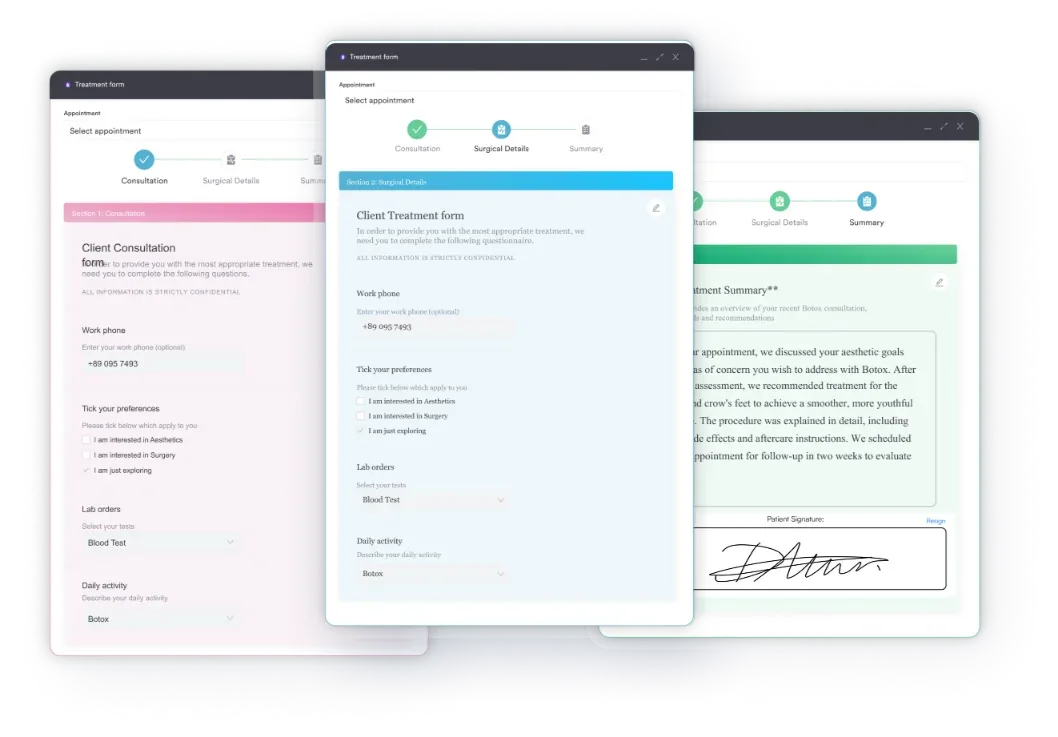
Using digital intake and operative forms that prompt for each element reduces the chance of missing information at the point of care. Well-structured digital medical forms standardize that capture across the practice.
Run a documentation audit quarterly on a random sample of CPT code 24076 claims. Pull 10 records and check that each operative note states tumor depth, tumor size in centimeters, and laterality. A single missing element is enough for a payer to reclassify the code or deny the claim outright.
These are the four mistakes auditors flag most often on CPT code 24076 claims, drawn from AMA coding resources and NCCI compliance patterns.
Each of these is caught by the same habit: reading the operative note against the descriptor before the claim goes out. That check is also what turns a first submission into a clean claim.
Orthopedic and sports medicine practices billing this code hit the same three friction points. Bundling conflicts surface late, and operative notes reach the biller with an element missing. Place-of-service coding is left to whoever happens to be on the claim that day.
Practice management software like Pabau moves those checks upstream. Codes are validated against the NCCI edit tables at entry. A conflict with 24076 shows up as a flag before submission, not as a denial 30 days later. Our claims management software handles that validation step.
Documentation templates can be built to prompt for tumor depth, size, laterality, and approach as the surgeon closes the note. Connecting those notes to billing through EHR integration removes the manual transcription step where detail usually goes missing.
The result is a shorter feedback loop. Errors are caught on the day of the procedure, by the person who can still fix them. Nobody is left reconstructing an incomplete note a month later.

Pabau validates codes against NCCI edit tables, flags bundling conflicts, and prompts for the documentation payers ask for. Orthopedic and surgical practices submit cleaner claims the first time.

Most 24076 problems are not coding problems. They are documentation problems that surface at the coding stage, once the operative note is finished and the surgeon has moved on.
So the useful work happens earlier. Fix the note template so depth, size, and laterality cannot be left blank, and most of this article stops being relevant to your practice. Keep the size threshold straight while you are at it: 5 cm or greater means 24073, and 24077 is a different operation altogether. The clearinghouse validates structure before the payer validates content, which is why an electronic claim can fail twice.
The trade-off is a few extra seconds at the end of each case, against the weeks a suspended claim costs. Book a demo to see how Pabau validates surgical codes and captures operative documentation before the claim goes out.

Coding a tumor excision outside the arm? CPT code 21602 applies the same depth and size logic to the chest wall.
Billing a biopsy rather than an excision? CPT code 20250 covers open biopsy, a separate procedure family with its own documentation rules.
Need a diagnosis code for the upper arm? ICD-10 code S46.191A shows how laterality and encounter type change the code you submit.
Billing orthopedic hardware procedures too? CPT code 20690 walks through external fixation billing, RVUs, and the modifiers payers expect.
Billing a gene amplification test? Mdm2 gene amplification billing guide covers how CCSD code 0021G bills the Mdm2 gene amplification test in UK private practice.
CPT code 24076 covers surgical excision of a subfascial soft tissue tumor of the upper arm or elbow area, measuring less than 5 cm. Subfascial means the tumor sits deep to the fascia, usually within muscle. The code sits in the Musculoskeletal System section of the CPT code set. Both tumor depth and tumor size must be documented in the operative and pathology records.
CPT 24075 is the subcutaneous code for tumors under 3 cm, and CPT 24076 is the subfascial code for tumors under 5 cm. A subfascial tumor of 5 cm or greater is CPT 24073. Depth is confirmed by the operative note and size by the pathology report, and both are needed before you select a code.
No. CPT 24077 describes radical resection of a tumor of the upper arm or elbow area, measuring less than 5 cm. That is a different procedure from an excision. A subfascial excision of 5 cm or greater is reported with CPT 24073. Radical resection of 5 cm or greater is CPT 24079.
The most common are -22 for increased procedural services and -51 for multiple procedures on the same date. Modifier -59 marks a distinct procedural service that unbundles an NCCI pair. Modifiers -LT and -RT record laterality, which Medicare and many commercial payers require on upper extremity codes.
D21.12 is the most common pairing, covering lipomas and fibromas confirmed on pathology. M79.821 is used pre-authorization while pathology is pending, and C49.12 applies only once malignancy is confirmed. The ICD-10 you submit must match the final pathology report rather than the pre-operative working diagnosis.
Yes. NCCI bundles routine closure codes and anesthesia add-ons into 24076, so they cannot be billed separately. Some combinations can be unbundled with modifier -59 when a distinct clinical service is documented. The edits update quarterly, so check the current CMS NCCI Policy Manual each billing cycle.
You need an operative note stating subfascial or intramuscular depth, the tumor’s greatest dimension in centimeters, the anatomic site and laterality, and the surgical approach. A final pathology report confirming the tissue diagnosis is also required. Missing any one element can cause a denial, a code reclassification, or a post-payment recovery.