Pabau Engage inbox

Pabau Engage is here: every patient conversation in one inbox.

Learn more
CCSD Code

CCSD code M0510 – Open pyeloplasty billing guide


Code Definition

M0510 is the CCSD code for open pyeloplasty, the open surgical reconstruction of the renal pelvis that relieves pelviureteric junction (PUJ) obstruction. It covers every open technique, including the Anderson-Hynes dismembered repair, and sits in Chapter 12 under Kidney/Renal Pelvic.

UK private insurers such as Bupa, AXA Health and Aviva use M0510 for claims submitted through Healthcode, and their schedules band it as Major. Laparoscopic and robotic pyeloplasty bill under M1080, M1090 or M1091 instead, and none of those codes can share a claim with M0510.

Group
12 Urinary system and male reproductive organs
Category
Kidney / Renal Pelvic
Complexity
Major
Billable
No
Code also known as
open renal pelvis reconstruction, pelviureteric junction repair, PUJ repair surgery, Anderson-Hynes pyeloplasty, dismembered pyeloplasty
Save time. Improve accuracy. Get paid faster.
Automate coding with Pabau

Let Pabau's smart automation suggest the right codes, reduce claim denials, and keep your practice compliant—effortlessly.

  • AI-powered code suggestions
  • Real-time compliance checks
  • Faster claims, fewer denials
Why practices choose Pabau
Save hours every week

Automate repetitive tasks and focus on what matters most—your patients.

Improve accuracy

Reduce coding errors and ensure compliance with the latest regulations.

Get paid faster

Clean claims, fewer denials, and faster reimbursements.

Grow with confidence

Powerful insights and reporting to help your practice thrive.

HIPAA compliant SOC 2 certified GDPR-compliant Trusted by 4,000+ clinics worldwide

Key takeaways

Key takeaways

CCSD Code M0510 covers open reconstruction of the renal pelvis, including the Anderson-Hynes dismembered repair and the Foley Y-V plasty.

M0510 applies to open surgery only, because laparoscopic and robotic pyeloplasty bill under M1080, M1090 or M1091.

The CCSD schedule lists M1080, M1090 and M1091 as unacceptable combinations with M0510, so none of them can share its claim.

Most UK private insurers expect pre-authorisation, with imaging evidence and the clinical indication submitted before the procedure date.

Pabau’s claims management software pulls the patient and authorisation details already on file into Healthcode-ready CCSD invoices.

CCSD Code M0510: Overview and official descriptor

CCSD Code M0510 is the code for open pyeloplasty, the open surgical reconstruction of the renal pelvis that relieves pelviureteric junction (PUJ) obstruction. Its official descriptor is “Open pyeloplasty”, and it sits in Chapter 12 of the CCSD schedule, under Kidney/Renal Pelvic.

The Clinical Coding and Schedule Development Group maintains the schedule, and the major UK private medical insurers bill against it. Insurer fee schedules band M0510 as a Major procedure. The setting is inpatient or day-case, depending on patient complexity and surgeon preference.

FieldDetail
CodeM0510
Official descriptorOpen pyeloplasty
Code systemCCSD (Clinical Coding and Schedule Development)
Specialty chapter12 Urinary system and male reproductive organs (Kidney/Renal Pelvic)
Typical settingInpatient or day-case
Complexity bandMajor (insurer fee schedules)
Bilateral casesThe CCSD schedule has no modifiers. Laterality sits in the code descriptor and chapter rules, so check the insurer’s rule for a bilateral open case.
Primary submission routeHealthcode (UK private healthcare billing clearinghouse)

What CCSD Code M0510 covers

M0510 covers every open surgical approach to reconstructing the renal pelvis. That includes the Anderson-Hynes dismembered pyeloplasty, the most widely performed technique, plus the Foley Y-V plasty and the Culp-DeWeerd spiral flap. The boundary the code draws is the approach, so M0510 applies only when the surgeon operates through an open incision.

Laparoscopic pyeloplasty bills under M1080, and robotic-assisted pyeloplasty under M1090 or M1091.

The scope of M0510 also extends to the peri-operative steps that are integral to the reconstruction. A JJ stent placed as part of the pyeloplasty, intraoperative nephrostomy management and drain placement are generally treated as components of the procedure. Bundling rules still vary by insurer, so confirm them with the payer before submitting additional codes.

M0510 does not cover purely endoscopic procedures (endopyelotomy), stone removal from the renal pelvis (pyelolithotomy), or partial or total nephrectomy. Each carries its own CCSD code, and open removal of kidney stones bills under M0610. Submitting M0510 for any of these procedures risks claim rejection or audit.

Clinical indications: When open pyeloplasty is performed

Open pyeloplasty is performed to relieve obstruction at the ureteropelvic junction (UPJ), the point where the renal pelvis narrows into the ureter. The operative note must state the clinical indication clearly, as insurers use this to validate medical necessity when processing M0510 claims.

The most common indications documented in support of M0510 claims include:

  • UPJ obstruction (also called PUJ obstruction or pelviureteric junction obstruction): The primary indication. Obstruction may be intrinsic (narrowing of the junction itself) or extrinsic (caused by a crossing lower-pole renal vessel).
  • Symptomatic hydronephrosis: Dilatation of the renal collecting system secondary to outflow obstruction, confirmed on imaging (ultrasound, CT urogram, or MAG3 renogram).
  • Failed endopyelotomy: When a prior endoscopic procedure has not resolved the obstruction, open pyeloplasty is the standard salvage operation. The operative note should state the prior procedure explicitly.
  • Crossing vessel requiring transposition: A lower-pole vessel can cause the obstruction. The open approach lets the surgeon transpose the vessel and reconstruct the junction in one operation.
  • Paediatric UPJ obstruction: Open pyeloplasty remains a preferred approach in neonates and young children. It suits cases where anatomy or size makes minimally invasive surgery technically difficult.

Each indication maps to a diagnosis code that must accompany the M0510 procedure claim. Without a paired diagnosis code that reflects one of these conditions, claims are likely to be queried or denied on medical-necessity grounds.

Surgical techniques billed under M0510

CCSD Code M0510 encompasses all recognised open pyeloplasty techniques. The CCSD schedule has no modifiers, so the code itself has to match the approach recorded in the operative note. The table below outlines the principal approaches and their coding status.

TechniqueAlso known asCoding under M0510Notes
Anderson-Hynes dismembered pyeloplastyDismembered pyeloplastyYes – primary M0510 techniqueMost commonly performed technique; ureter is completely detached and re-anastomosed. Supported by BAUS clinical guidelines.
Foley Y-V plastyY-V pyeloplasty; non-dismembered pyeloplastyYes – bills under M0510Ureter is not fully detached. Used when the junction is high-insertion or funnel-shaped. Confirm coverage with individual payer.
Culp-DeWeerd spiral flapSpiral flap pyeloplastyYes – bills under M0510Reserved for cases with long ureteric strictures. Operative note must describe the flap technique explicitly.
Laparoscopic pyeloplastyKeyhole pyeloplasty; minimally invasive pyeloplastyNo – bills under M1080 (unilateral)Do not bill as M0510. CCSD gives laparoscopic pyeloplasty its own code, and M1080 cannot share a claim with M0510.
Robotic pyeloplastyRobot-assisted pyeloplasty; da Vinci pyeloplastyNo – bills under M1090 (unilateral) or M1091 (bilateral)Robotic pyeloplasty has dedicated codes. Submitting M0510 for a robotic case is a miscoding error that risks rejection and audit.

The most common miscoding error in this category is submitting M0510 for a laparoscopic or robotic procedure. CCSD gives minimal-access pyeloplasty its own codes, and the approach in the operative note decides which one applies.
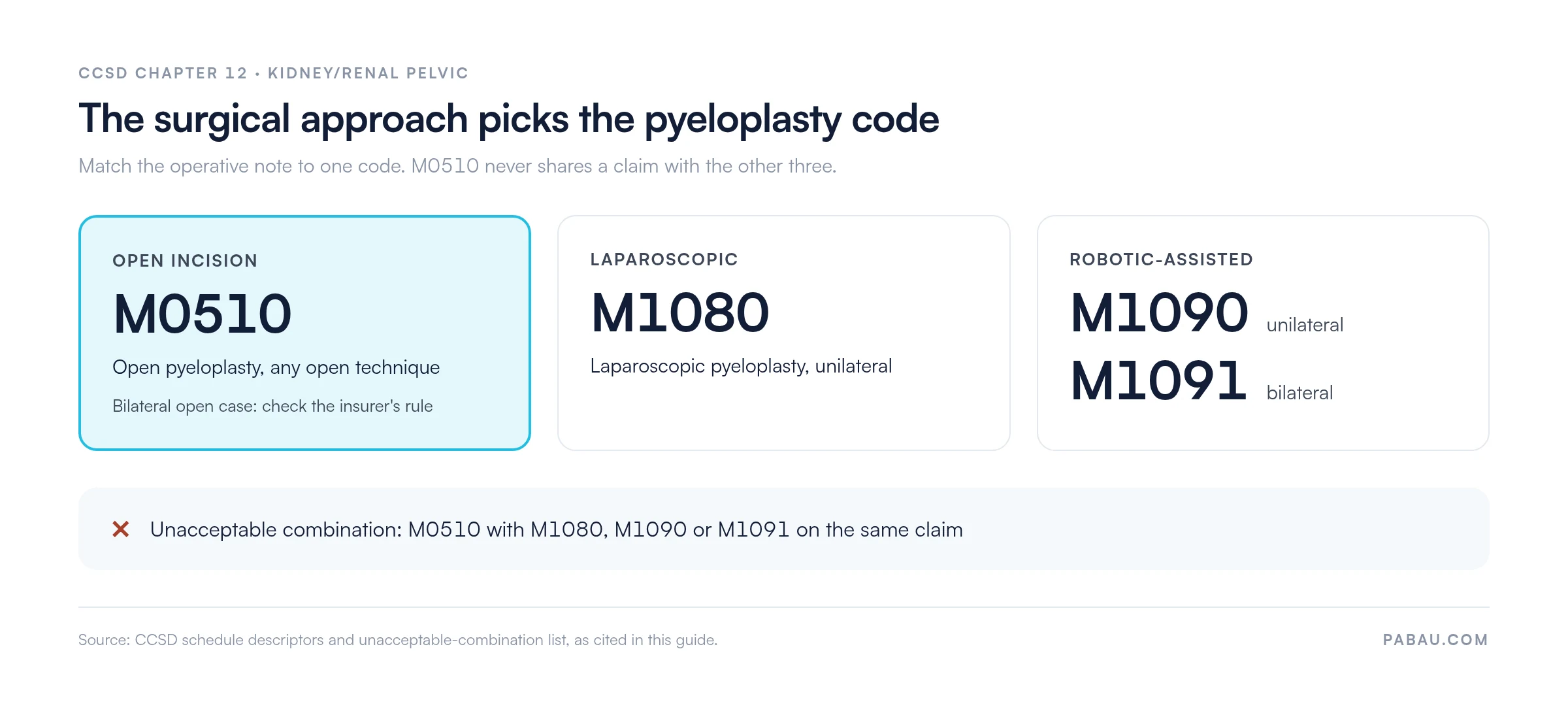
Decision diagram of CCSD pyeloplasty codes by surgical approach
Each pyeloplasty approach has one code, and M0510 cannot share a claim with the other three. Drawn from the CCSD descriptors and unacceptable-combination list.

The table below maps M0510 against the codes most frequently confused with it.

CodeDescriptorKey distinction from M0510
M0510Open pyeloplastyReference code – open surgical approach only
M1080Laparoscopic pyeloplasty – unilateralMinimal-access approach. Never interchangeable with M0510, and an unacceptable combination with it on one claim
M1090Robotic assisted pyeloplasty – unilateralRobotic pyeloplasty has dedicated codes, M1090 (unilateral) and M1091 (bilateral). Unacceptable combination with M0510
M1091Robotic assisted pyeloplasty – bilateralBilateral robotic case. Unacceptable combination with M0510
Pyelolithotomy code (verify in current CCSD schedule)Pyelolithotomy (stone removal from renal pelvis)Stone removal, not junction reconstruction; a different operative intent
Nephrectomy codes (verify in current CCSD schedule)Partial or total kidney removalKidney removal; never appropriate when reconstruction is the operative intent

Check stone-removal and nephrectomy codes in the current CCSD schedule before you submit, as the CCSD Group updates codes and descriptors periodically. Our library of CCSD codes for billers covers neighbouring kidney procedures code by code.

How to document an open pyeloplasty for CCSD Code M0510 billing

An M0510 claim will be supported or rejected based on the operative note. Insurers reviewing a queried claim look for specific clinical details, and a vague operative summary is the fastest route to denial. The checklist below reflects what Bupa, AXA Health and other major UK private payers typically require.

  1. Surgical approach confirmed as open: The note must state explicitly that the procedure was performed via an open incision. Name the incision type, such as a flank, loin or midline incision. This is the single most important element for M0510 coding.
  2. Technique named: Record the specific technique used (Anderson-Hynes dismembered pyeloplasty, Foley Y-V plasty, etc.). Payers and coders cannot infer the technique from the code alone.
  3. Clinical indication documented: State the indication (UPJ/PUJ obstruction, hydronephrosis, failed endopyelotomy, crossing vessel) and reference the pre-operative imaging that confirmed it.
  4. Intraoperative findings recorded: Note the degree of dilatation, the anatomy of the obstruction, and any crossing vessels identified and managed.
  5. Stent or drain placement noted: If a JJ stent or nephrostomy drain was placed, record this. Even if bundled and not separately billed, its presence must appear in the operative record for completeness.
  6. Closure and specimen details: Record closure technique, any drain left in situ, and whether tissue was sent for histology.

Once the operative note is complete, the practice manager or billing administrator submits M0510 with the paired diagnosis code and any co-billable CCSD codes. The claim goes through Healthcode, the UK private healthcare billing clearinghouse.

Pro Tip

Before submitting, run a final check against three elements. The operative note states the open approach explicitly, the technique is named, and a paired diagnosis code reflects UPJ obstruction or hydronephrosis. Missing any one of these is the most common cause of M0510 claim rejection at first submission.

Pre-authorisation requirements for M0510

Most UK private health insurers require pre-authorisation before open pyeloplasty proceeds. Requirements change without notice, so the guidance below reflects general practice at publication. Confirm current requirements directly with the payer before proceeding, and see our Bupa CCSD codes guide for Bupa’s own submission rules.

InsurerPre-auth required?Clinical information typically requestedSource
BupaLikely required (confirm with the Bupa provider portal)Referral letter, imaging reports (ultrasound, CT urogram, MAG3 renogram), clinical indication, proposed techniqueBupa code search
AXA HealthConfirm via AXA provider portalClinical justification, referral details, relevant imaging; AXA may require MDT-level discussion for complex paediatric casesAXA Health specialist forms portal
AvivaConfirm via Aviva provider guidelinesReferral documentation, diagnosis confirmation, expected length of stayAviva procedure guidelines
Vitality HealthConfirm via Vitality fee finderClinical notes, imaging evidence, proposed CCSD codeVitality fee finder
HealixConfirm via Healix fee scheduleProcedure details, clinical indication, expected setting (inpatient/day-case)Healix fee schedule

Key rule: Pre-authorisation is obtained before the procedure date, not retrospectively. A claim submitted without an authorisation reference number, in cases where the insurer requires one, will almost certainly be rejected at first adjudication. Document the authorisation reference in the patient file and include it on the Healthcode invoice submission.

Billing M0510 alongside other CCSD codes

Open pyeloplasty claims frequently include additional codes for the anaesthetist, assistant surgeon and intraoperative procedures. Knowing which codes are co-billable, which are bundled into M0510 and which need payer confirmation saves time in the appeals process.

The CCSD schedule lists M1080, M1090 and M1091 (the laparoscopic and robotic pyeloplasty codes) as unacceptable combinations with M0510. They should not appear on the same claim.

  • Anaesthetic CCSD codes: The anaesthetist bills separately using the appropriate anaesthetic code, calculated on time units according to CCSD anaesthetic rules. This is billed by the anaesthetist’s practice, not the surgeon’s, and does not conflict with M0510.
  • Assistant surgeon codes: Open pyeloplasty often needs a surgical assistant because the dissection is complex. The assistant may bill a percentage uplift under the relevant CCSD assistant-surgeon rules. Confirm current percentages with the insurer before billing.
  • JJ stent insertion: A stent inserted as an integral step of the reconstruction is generally considered part of M0510. Do not bill it separately. However, if the stent insertion is performed as a staged procedure on a different date, it may warrant its own code. Confirm bundling rules per payer before adding a stent code to the same claim as M0510.
  • Intraoperative imaging / fluoroscopy: Fluoroscopy may be used to confirm stent position or assess the anastomosis. Check the CCSD schedule for the applicable imaging code, and confirm whether the insurer permits co-billing alongside M0510.
  • Post-operative nephrostomy management: A nephrostomy tube may be placed during the procedure and managed afterwards under a separate clinical episode. That later management may be billable with the relevant CCSD code. Document the clinical rationale clearly.

Common reasons M0510 claims are denied

M0510 claims are denied for predictable, preventable reasons. Build each corrective action below into your pre-submission checklist.

  • Missing or expired pre-authorisation: The most common cause. Submitting without a valid authorisation reference, where the insurer requires one, means automatic rejection. Corrective action: Appeal with the reference number, issue date and payer confirmation. If pre-auth was not required, request written confirmation from the insurer and attach it.
  • Approach miscoding (open billed for laparoscopic or robotic case): Insurers cross-reference the code against the operative note. A laparoscopic or robotic note submitted under M0510 is rejected and may trigger a wider audit. Corrective action: Submit the correct minimal-access code (M1080, M1090 or M1091) with a corrected operative note.
  • Insufficient operative-note detail: The note must name the open approach, the technique and the clinical indication. Without all three, it will not support M0510 on appeal. Corrective action: Request a supplementary operative summary from the surgeon and resubmit.
  • Bilateral procedure not claimed to the insurer’s rule: Bilateral pyeloplasty is rare but occurs in paediatric cases and bilateral UPJ obstruction. The CCSD schedule has no modifiers, because laterality sits in the code descriptor and chapter rules. A single M0510 line for a bilateral case can lead to underpayment or denial of one side. Corrective action: Check the insurer’s bilateral rule before the procedure.
  • Diagnosis code mismatch: M0510 without a companion diagnosis code for UPJ/PUJ obstruction or hydronephrosis fails medical-necessity review. Corrective action: Add the diagnosis code and resubmit.
  • Unbundled codes triggering a bundling edit: The insurer may treat a JJ stent or imaging code as bundled within M0510, so the extra line is denied. Corrective action: Remove the bundled code, and appeal if documentation supports a separately billable episode.

Paediatric open pyeloplasty and CCSD Code M0510

Open pyeloplasty is common in paediatric urology, because UPJ obstruction is one of the most frequently diagnosed urological conditions in neonates and infants. Many paediatric urologists still prefer the open Anderson-Hynes approach in young children, as it allows direct visualisation and precise anastomosis in a small operative field.

M0510 applies to open pyeloplasty regardless of patient age. The descriptor has no age qualifier, and the CCSD schedule has no separate paediatric pyeloplasty code. The billing process still differs in practical respects:

  • Paediatric anaesthetic co-billing: Neonatal and paediatric anaesthesia is typically billed with age-adjusted time units. The anaesthetist should confirm whether the insurer applies a paediatric uplift, as this is insurer-specific.
  • Insurer coverage for children: Some corporate policies do not automatically cover dependants. Confirm the child is covered before proceeding and before submitting M0510. If in doubt, contact the insurer’s pre-authorisation team.
  • Longer operative time documentation: Paediatric cases typically take longer because of smaller anatomical structures. If anaesthetic time well exceeds the adult norm, document the operative complexity to help avoid queries on the anaesthetic component.
  • Post-operative stent management: Children tolerate indwelling JJ stents less well, so many paediatric surgeons use an externally draining stent removed without a further procedure. A second procedure (stent removal under general anaesthetic) generates a separate CCSD code and claim. Do not bundle it into the M0510 submission.

Seek payer-specific guidance before submitting paediatric claims, starting with the insurer’s pre-authorisation team, and document it in the patient file. Record the child’s policy details, the authorisation reference and any insurer-specific coding guidance received before the procedure.

How Pabau supports clean M0510 claims through Healthcode

Open pyeloplasty claims fail on paperwork more often than on the code itself. The authorisation reference sits in an email, the operative note in another system, and someone keys the invoice into Healthcode by hand.

Pabau, the practice management platform we build for private practices, keeps those pieces on one patient record. Its claims software for surgeons pulls the patient, insurer and authorisation details already on file into the invoice and sends it to Healthcode. Your team then tracks each claim’s status without leaving Pabau.

Digital consent and pre-operative forms sit on the same record, so a queried claim can be answered from one place. Your billing team spends less time chasing rejected urology claims.
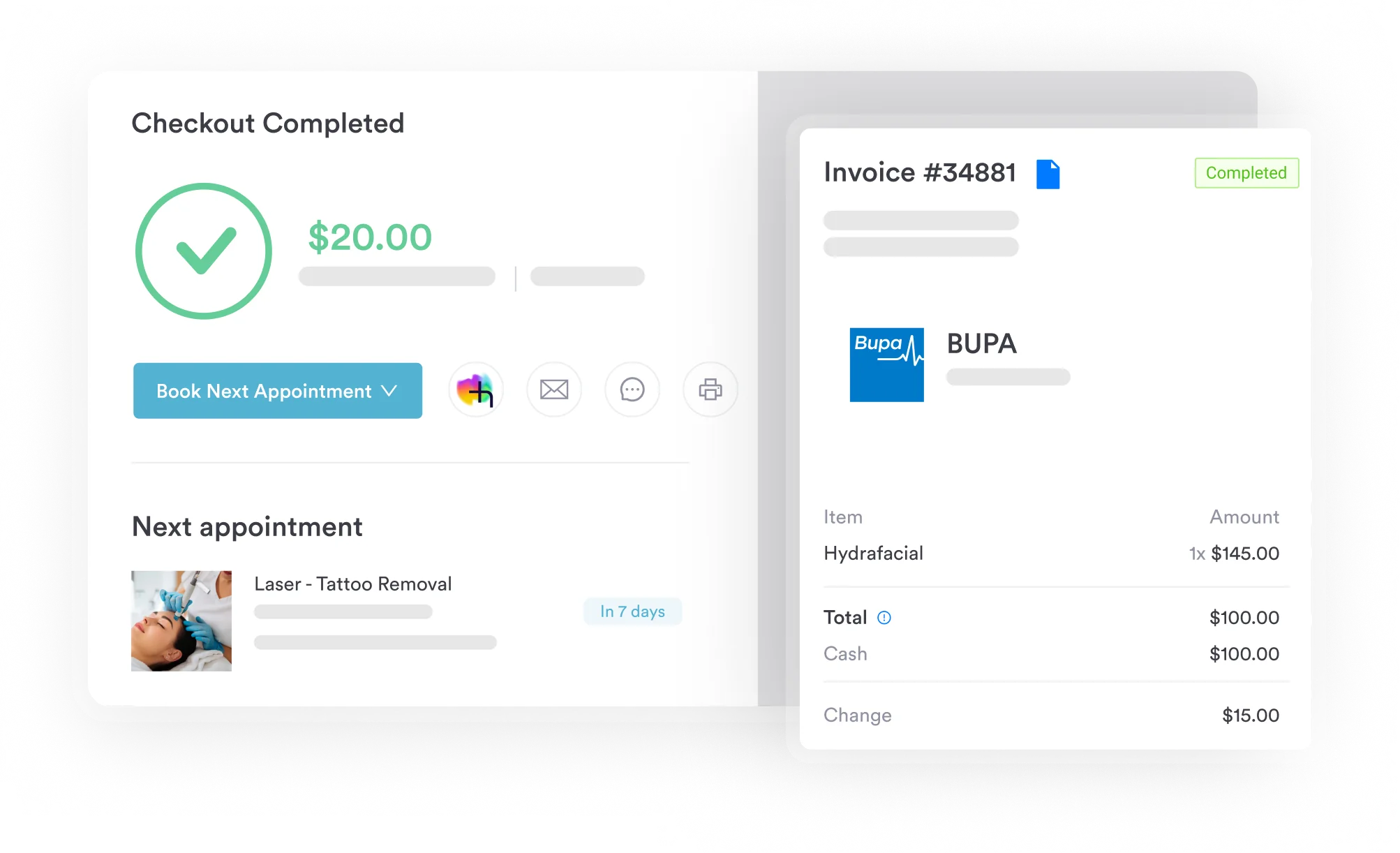
Pabau claims management screen sending a private insurer invoice to Healthcode
Pabau’s claims screen sends the M0510 invoice to Healthcode with the insurer and authorisation details already on file, so fewer claims bounce.

Manage CCSD billing from a single system

Pabau keeps the operative note, the authorisation reference and the CCSD-coded invoice on one patient record. Claims go to Healthcode with the detail insurers expect.

Pabau clinic management software dashboard

Conclusion

M0510 is one of the more straightforward CCSD codes to assign, because the surgical approach decides it. The risk sits in the claim around it: a missing authorisation reference, a vague operative note, or a minimal-access code on the same invoice.

Build those three checks into the booking stage rather than the billing stage. Send each claim with the authorisation, an explicit open approach and no M1080, M1090 or M1091 line. The insurer then has little reason to query it.

Book a demo to see how Pabau keeps urology claims, authorisations and operative records together for Healthcode submission.

Continue your research

Continue your research

Need a broader overview of CCSD billing in private practice? Bupa CCSD codes guide covers Bupa-specific code submission rules and fee schedule navigation for private UK practices.

Billing an open stone removal instead? CCSD Code M0610 explains the code for open removal of calculi from the kidney.

Coding a diagnostic look inside the kidney? CCSD Code M1110 walks through billing a diagnostic kidney endoscopy.

Want to reduce claim rejections across your private practice? Claims management software from Pabau supports structured invoice generation and Healthcode-ready submissions.

Frequently asked questions

What does CCSD Code M0510 cover?

CCSD Code M0510 covers open pyeloplasty, the surgical reconstruction of the renal pelvis using an open approach. It encompasses all recognised open techniques, including the Anderson-Hynes dismembered pyeloplasty, the Foley Y-V plasty and the Culp-DeWeerd spiral flap. It does not cover laparoscopic or robotic pyeloplasty, which bill under M1080, M1090 or M1091.

Does Bupa require pre-authorisation for M0510?

Bupa typically requires pre-authorisation for open pyeloplasty, but requirements can change. Verify directly with the Bupa provider portal before the procedure date, and get the authorisation reference in writing. Include it on the Healthcode invoice, because a claim without a required reference will be rejected.

How does open pyeloplasty differ from laparoscopic pyeloplasty for CCSD billing?

Open and laparoscopic pyeloplasty use different CCSD codes. M0510 covers open surgery only, while laparoscopic pyeloplasty bills under M1080 and robotic pyeloplasty under M1090 or M1091. Billing M0510 for a minimal-access case is a miscoding error that risks rejection and audit.

Why are open pyeloplasty claims denied by private insurers?

The most common reasons are missing pre-authorisation, M0510 submitted for a laparoscopic or robotic case, a vague operative note, and a diagnosis code mismatch. Each is preventable. Build a pre-submission checklist covering the authorisation reference, the open approach, the technique name and the diagnosis code.
Avatar photo
Despina Petrushevska
Content Writer

Despina Petrushevska is a content writer covering aesthetics, dermatology, and clinic operations, known for making detailed clinical concepts clear and engaging. Outside of work, she enjoys photography, weekend getaways, and finding inspiration in everyday experiences.
×