

HCPCS Code L0472: Hyperextension TLSO billing guide
HCPCS code L0472: Official descriptor and device definition HCPCS code L0472 des...

Last Updated: Nov 5, 2026
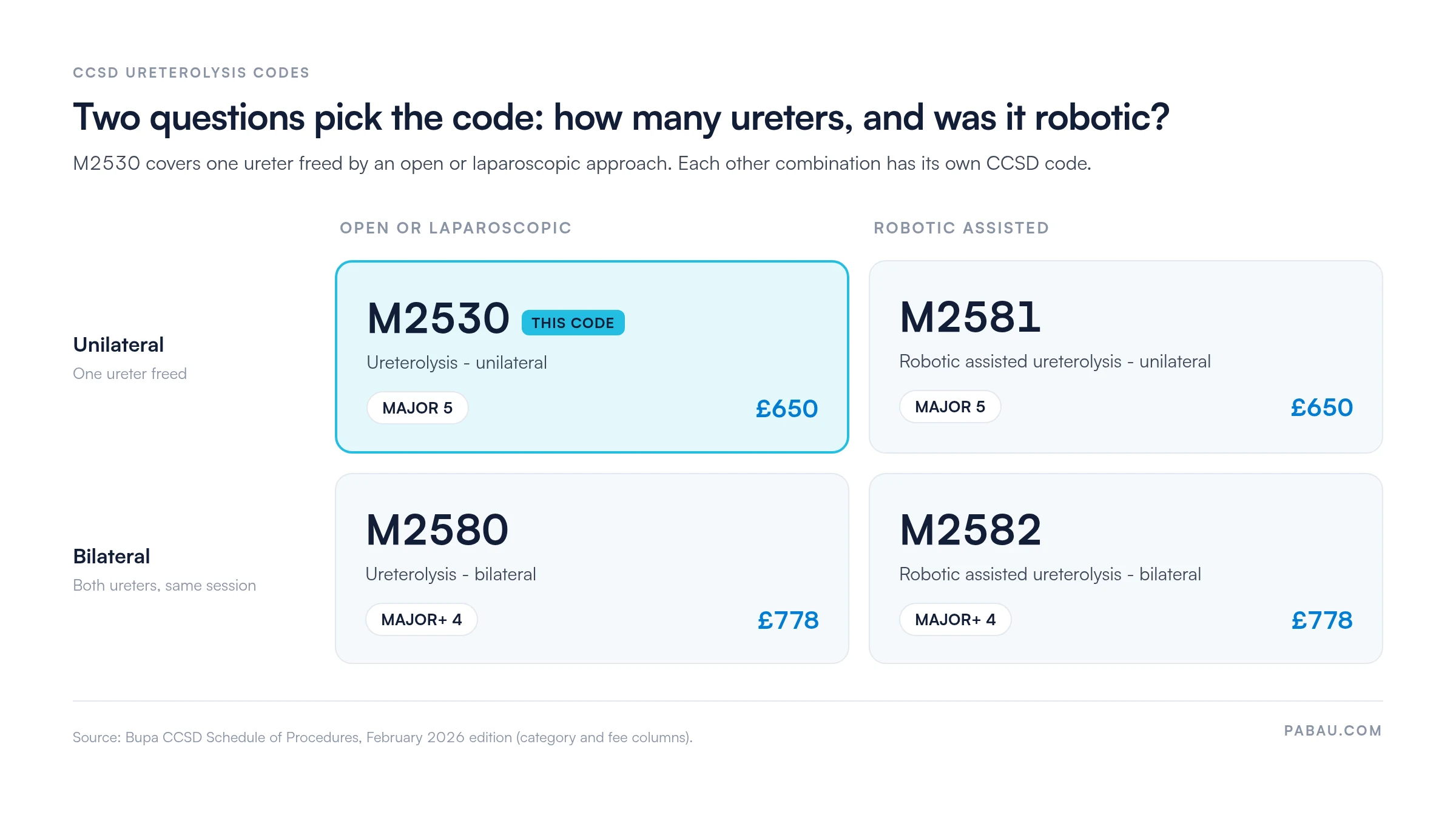
M2530 is the CCSD code for unilateral ureterolysis, the surgical freeing of one ureter from adhesions, fibrosis or extrinsic compression. It covers open and laparoscopic approaches in a single operative episode.
Both ureters in the same session are coded M2580. Robotic-assisted cases use M2581 for one ureter or M2582 for both. The code sits in Chapter 12 of the CCSD schedule, Urinary system and male reproductive organs, and Bupa rates it MAJOR 5.
Let Pabau's smart automation suggest the right codes, reduce claim denials, and keep your practice compliant—effortlessly.
Automate repetitive tasks and focus on what matters most—your patients.
Reduce coding errors and ensure compliance with the latest regulations.
Clean claims, fewer denials, and faster reimbursements.
Powerful insights and reporting to help your practice thrive.
HIPAA compliant SOC 2 certified GDPR-compliant Trusted by 4,000+ clinics worldwide

CCSD Code M2530 covers open or laparoscopic lysis of one ureter only. Bill M2580 when both ureters are freed in the same operative episode.
Robotic-assisted ureterolysis has its own codes, M2581 for one side and M2582 for both, so the operative note must record the approach.
The note must also confirm which ureter was treated, because missing laterality is the leading denial trigger for M2530 claims.
Most major UK private insurers require pre-authorisation for elective ureterolysis. Reference the paired ICD-10 codes, typically K68.2 for retroperitoneal fibrosis plus N13.5 for an associated ureteral obstruction.
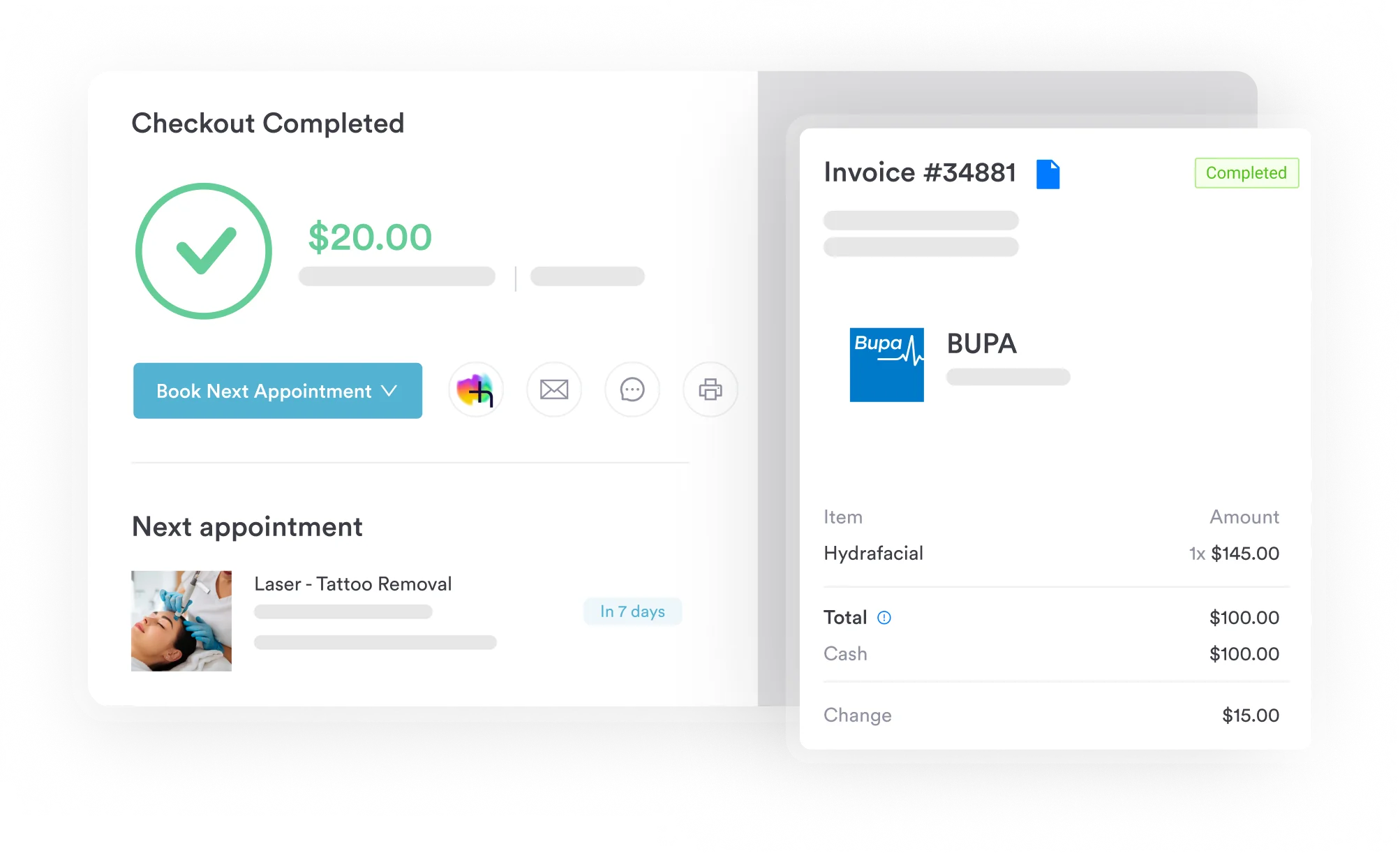
Pabau’s claims management software sends CCSD claims through Healthcode and stores each pre-authorisation against the booking, which cuts manual errors on M2530 submissions.
CCSD Code M2530 is the CCSD Schedule of Procedures code for unilateral ureterolysis. The official descriptor reads: Ureterolysis – unilateral.
It sits in chapter 12 of the schedule, urinary system and male reproductive organs. It applies when a surgeon frees one ureter from adhesions, fibrotic tissue or extrinsic compression in a dedicated operative episode.
M2530 covers open and laparoscopic ureterolysis. Robotic-assisted lysis of one ureter has its own code, M2581, so the approach recorded in the operative note decides which code you bill. Bupa’s February 2026 schedule puts both codes in the MAJOR 5 category with a £650 fee.
The “unilateral” qualifier sets the billing limit: one ureter, one code. When the surgeon frees both ureters in the same session, M2580 applies instead, or M2582 for a robotic case. The grid below shows how laterality and approach split the four ureterolysis codes.
Ureterolysis is the surgical freeing of a ureter that has become encased by, or stuck to, surrounding fibrotic or neoplastic tissue. The ureter runs from the kidney to the bladder through the retroperitoneal space.
When disease makes the tissue around it contract or thicken, the ureter is compressed, which impairs urine drainage and puts the kidney at risk.
The surgical steps follow a consistent pattern regardless of approach:
Stent placement is a common accompanying procedure. Whether it can be coded separately depends on each insurer’s bundling rules, covered under “Associated and add-on codes” below. If the stent is later taken out by cystoscopy, that removal is billed as M2930 stent removal.
Retroperitoneal fibrosis (RPF), also called Ormond’s disease, is the most common indication for ureterolysis. RPF causes progressive encasement of the ureters in a fibro-inflammatory mass originating around the aorta. Other common indications include:
Each indication has a corresponding ICD-10 diagnosis code that must accompany the M2530 claim. The table below lists the most common pairings.
The treating clinician is responsible for selecting the ICD-10 code, so confirm which ICD-10 edition the insurer expects. Billing teams should check the diagnosis against the consultant’s discharge summary or outpatient letter before coding.
Knowing the code’s boundaries prevents three common miscoding errors: upcoding to the bilateral code, missing a robotic approach, and confusing ureterolysis with ureteroscopy.
A key point for billing teams: the approach does change the code. CCSD Code M2530 covers open and laparoscopic lysis of one ureter. Robotic-assisted ureterolysis has its own CCSD codes, M2581 for one side and M2582 for both. Read the operative note for the approach before you choose the code.
Several CCSD urology codes describe procedures on or around the ureter, and confusing them leads to either under-coding or claim rejection. The table below sets out the most commonly conflated codes alongside M2530.
Ureteroscopy is the mix-up that looks least like ureterolysis on paper. Ureteroscopy codes such as M3000 describe a telescope passed up the ureter, with no external dissection at all.
Fees and bundling guidance can change between CCSD editions, so check every code against the current schedule. Our CCSD code library lists the neighbouring urology codes alongside M2530. Open excision of a ureterocele at the bladder end of the ureter, for example, is coded M2510.
Before submitting any CCSD urology claim, cross-check the operative note against the CCSD technical guide. Confirm that no bundling restriction applies to the codes you plan to submit together. Bundling errors are harder to appeal than documentation errors.
An M2530 claim without a complete operative note is almost always rejected. UK private insurers adjudicate CCSD urology claims closely. The documentation bar for a major surgical code is higher than for an outpatient consultation. The following elements are required in every submission.
Practices that keep patient records in a digital system can attach operative notes and consent forms directly to the claim. That removes the manual assembly step that causes delays. Structuring these documents at the point of care, rather than rebuilding them at billing time, cuts the risk of a laterality omission reaching the insurer.
Elective ureterolysis falls within the category of major urological surgery for which most UK private medical insurers require pre-authorisation before treatment.
Submitting a claim for M2530 without a valid authorisation number is grounds for automatic rejection at many payers, regardless of clinical necessity. Requirements differ by insurer, and the table below summarises the general framework for the major providers.
Policies change, so check the insurer’s current portal rather than relying on past approvals. For practices new to UK private billing, our overview of Bupa CCSD codes covers the Bupa-specific workflow in more detail.
Most UK private healthcare claims flow through Healthcode, the industry-standard e-billing network. The steps below reflect the standard Healthcode-based workflow; practices using an insurer’s proprietary portal follow a similar sequence.
Practices with several consultants and high CCSD claim volumes benefit most from automation. A claims management tool that integrates with Healthcode cuts the manual steps between operative note and submitted claim.
Most M2530 denials can be prevented at the documentation stage, long before an appeal. The table below sets out the common causes and the fix for each.
The bilateral-for-unilateral error deserves attention because it is so easy to avoid. Use M2530 when the operative note documents lysis of one ureter only. M2580 applies only when the surgeon frees both ureters in the same operative episode, and the operative note explicitly confirms this.
Do not default to the bilateral code on the assumption that retroperitoneal fibrosis always affects both sides. Many RPF cases present with asymmetric obstruction and unilateral involvement at the time of surgery. The clinical documentation – not the diagnosis – determines laterality for coding purposes.
Several procedures are legitimately performed alongside ureterolysis and may attract separate CCSD coding, subject to insurer bundling rules. Always verify against the current CCSD schedule and each insurer’s fee schedule before billing add-on codes.
The Bupa fee schedule provides guidance on which procedures it considers bundled into a primary surgical code. Consulting that schedule before finalising a claim prevents the bundling denials described in the previous section. Our guide to the Bupa fee schedule explains how its procedure codes and fees fit together.
When an anaesthetist and assistant surgeon both work on an M2530 procedure, check their codes before anyone submits. Each one must match the primary CCSD procedure code. Mismatched codes across different bills for the same episode are a consistent query trigger at Bupa and AXA Health.
UK private urology practices billing codes like M2530 face a timing problem. The operative note is written on the day of surgery, but nobody checks it for coding completeness until claim preparation, days or weeks later. By then the surgeon has moved on, so the billing team either delays the claim or submits it without the laterality or approach.
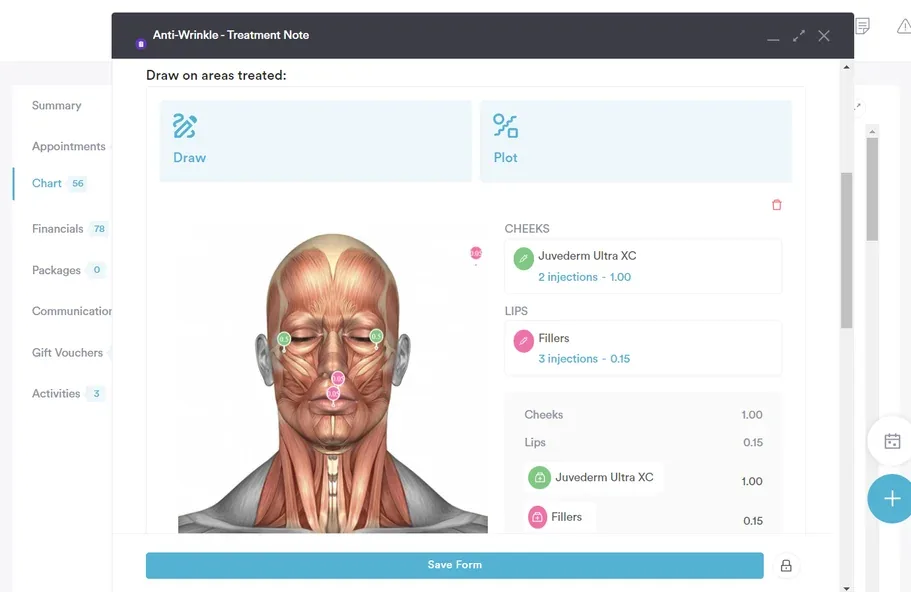
Pabau, the practice management platform we build, moves that check to the point of care. Consultants complete structured digital operative notes built to capture what a CCSD claim needs: laterality, approach, additional procedures and the linked diagnosis. The note sits on the patient record, so the billing team reads it without chasing theatre.
Pabau stores each insurer’s pre-authorisation as a case that you attach when you book the procedure, so the number follows the patient to the claim. You can also check a patient’s Bupa cover in seconds before surgery is scheduled.
Claims then go to Bupa, AXA Health, Vitality and other insurers through Healthcode. The claims dashboard tracks each one from Pending to Paid, so a queried M2530 claim surfaces before the response window closes.

Pabau sends CCSD claims through Healthcode and keeps each pre-authorisation on the booking. Your urology billing team spends less time chasing paperwork and more time on patient care.

Coding M2530 correctly comes down to two facts in the operative note: how many ureters the surgeon freed, and whether a robot was docked. Get either one wrong and the claim belongs to a different code, or it fails review.
So fix it upstream. Build laterality and approach into the operative note template, and the claim can be coded from the note without a call to theatre. The setup takes a few minutes per consultant, which is far less than one stalled claim costs.
Book a demo to see how Pabau carries a urology operative note through to a clean Healthcode claim.

Reimplanting both ureters? CCSD Code M2030 covers bilateral replantation of the ureters into the bladder in one operative episode.
Correcting reflux on one side? CCSD Code M2210 covers open correction of unilateral vesico-ureteric reflux, another chapter 12 ureter procedure.
CCSD Code M2530 covers unilateral ureterolysis, the surgical freeing of one ureter from adhesions, fibrosis or extrinsic compression. It applies to open or laparoscopic approaches only, because robotic-assisted unilateral ureterolysis is coded M2581. Common indications include retroperitoneal fibrosis, post-surgical adhesions and endometriosis. The code does not cover bilateral procedures (M2580) or ureteroscopic interventions.
M2530 applies when only one ureter is freed during the operative episode. M2580 applies when both ureters are treated in the same session and the operative note explicitly confirms this. Billing M2580 when only one ureter was treated is a documentation mismatch that leads to denial. The operative note, not the diagnosis, determines which code is correct.
Yes. Most major UK private insurers, including Bupa, AXA Health, Aviva, Cigna and Vitality, require pre-authorisation for elective surgical admissions such as ureterolysis. Requirements vary by insurer and by individual patient policy. Always confirm through the insurer’s current provider portal before scheduling surgery. A claim without a valid authorisation number is grounds for automatic rejection at many payers.
The operative note must specify the operating consultant’s details, the procedure date and the side treated. It also needs the surgical approach (open, laparoscopic or robotic), the extent of dissection, any additional procedures and the linked ICD-10 diagnosis code. A note that describes ureterolysis without confirming laterality is the most common cause of first-review rejection for M2530 claims.
M2580, the bilateral ureterolysis code, is the most frequent source of confusion, and it applies only when both ureters are treated. Robotic-assisted cases are another trap, because they take M2581 or M2582 rather than M2530. Ureteroscopy codes such as M3000 describe an endoscopic technique but are sometimes miscoded as M2530. Stent insertion may be bundled into M2530 by some insurers, so confirm before billing it separately.
Yes. Anaesthetic fees and assistant surgeon fees are typically billed separately under their own CCSD codes and are not bundled into M2530. Ureteral stent insertion is more variable – some insurers bundle it into the primary procedure fee while others permit separate billing. Confirm against the relevant insurer’s current fee schedule or bundling guidance before submitting add-on codes.



