









CPT Code 20700: drug delivery device billing guide (2026)
Add-on codes are where billing errors quietly accumulate. CPT Code 20700 enters ...

Last Updated: August 19, 2026


CPT code 15851 covers suture or staple removal that requires general anesthesia or moderate sedation. Medicare prices it in the facility setting only.
CPT 15850 was deleted on January 1, 2023. A claim that still reports it rejects as an invalid code.
The same-surgeon distinction is gone, so 15851 applies no matter who placed the sutures or staples.
Office removal without anesthesia is reported as an E/M visit plus add-on code 15853 or 15854.
CPT 15852 covers a dressing change under anesthesia, so it is never a substitute for a removal code.
CPT code 15851 reports removal of sutures or staples when the patient needs general anesthesia or moderate sedation. Local anesthesia does not qualify, and Medicare prices the code in the facility setting only.
Much of that is new. The 2023 CPT update deleted 15850, rewrote 15851, and added two add-on codes for office removals.
Older guidance is still in circulation, though. So claims keep going out against a code set that no longer exists. The rejection then looks like a clerical slip rather than a coding problem.
The current descriptor from the American Medical Association (AMA) is: Removal of sutures or staples requiring anesthesia (i.e., general anesthesia, moderate sedation). The anesthesia types sit inside the descriptor, which is what makes the code so narrow.
Removal with no anesthesia at all does not qualify either. If the record documents general anesthesia or moderate sedation, 15851 is the correct code. If it does not, the visit is reported another way.
The code carries a 0-day global period, so no postoperative days attach to it. Two things changed in 2023, and both affect payment. Medicare now prices the code in the facility setting only, and it no longer matters who placed the sutures.
A wound closed elsewhere, say a complex repair reported with 13100, still routes to 15851 when the removal needs sedation.
The 2023 CPT cycle reshaped this small family. One code was deleted, one was revised, and two add-on codes were created for the office. A fifth code, 15852, gets pulled into the discussion by mistake.
CPT 15850 is where most of the damage happens. It described same-surgeon suture removal under anesthesia, and the AMA retired it with a parenthetical pointing coders to 15851. A claim carrying 15850 for a date of service from 2023 onward rejects as an invalid code.
The revision also settled the old argument about ownership. CPT 15851 now applies whether or not the physician removing the sutures performed the original procedure. Who placed them still matters for global period bundling, covered further down.
Add-on codes 15853 and 15854 cover the office scenario that 15850 used to absorb. Neither carries a physician work relative value unit. Both were valued for practice expense alone, meaning clinical staff time, supplies, and equipment. Report 15853 when sutures or staples come out, and 15854 when both do at one visit.
One boundary is worth knowing before you reach for any of them. A wound closed with tissue adhesive alone is reported with G0168, and nothing has to come out afterward.
CPT 15852 covers a dressing change, for other than burns, under anesthesia other than local. It predates the 2023 revision and has nothing to do with removing sutures or staples. Anesthesia beyond local is required, so it is not the office alternative to 15851 either.
The practical rule is short. Reporting 15851 for a dressing change is a coding error, and so is reporting 15852 for a suture removal. The procedure performed decides the code, and the anesthesia decides which removal code applies.
CPT 15851 applies when the removal cannot be completed without general anesthesia or moderate sedation. The record has to say why that level was needed. Patient preference on its own does not support the code.
Scenarios that typically justify it include:
Setting now carries more weight than it used to. Medicare prices 15851 for the facility only, so the place of service should match the anesthesia in the record. An office claim with a sedation narrative reads as a mismatch. That raises audit exposure for skin and wound care practices that report the code often.
Most 15851 denials are modifier problems rather than coding problems. The right modifier depends on how the removal relates to any earlier surgery. Check National Correct Coding Initiative (NCCI) edits and the payer’s policy before you submit.
Modifier rules vary by payer, and what Medicare accepts is not always what a commercial plan wants. So verify the policy first, then write the decision path down. One shared rule stops providers from applying modifiers inconsistently.
CPT 15851 carries a 0-day global period, so no postoperative days attach to the code itself. That is not the same as being separately payable during someone else’s global period.
Read the global period off the original procedure code, not off 15851. An intermediate repair reported with 12032 runs 10 days. A larger excision such as 15835 runs 90, so a suture check three weeks later is still bundled.
In plastic surgery practices, postoperative wound work is routine, so the global end date decides more claims than the code choice does. Knowing that date before the follow-up is booked prevents avoidable denials.
The add-on codes carry their own global rule. CPT 15853 and 15854 are reported with an E/M service for a procedure that has a 0-day global period. If the sutures came from your own 10-day or 90-day global surgery, the removal is already paid for. Adding an E/M plus an add-on code invites a refund request.
Every 15851 claim needs a diagnosis that supports medical necessity. Aftercare codes in the Z48 family cover routine removal. Complication codes fit better when a clinical problem forced the sedation.
Traumatic wounds follow a different path. ICD-10-CM guidelines send you to the injury code with a subsequent-encounter seventh character, such as S01.111D, rather than an aftercare code. Z48.02 belongs on a surgical wound.
There is also a mismatch worth watching. A routine aftercare code sits awkwardly beside a code that requires sedation, because routine removal rarely needs it.
When a complication drove the anesthesia decision, lead with the T-code or the abscess code. The record then explains the rest.
Payment runs through the CMS Physician Fee Schedule and the resource-based relative value scale.
The 2023 revision removed the non-facility practice expense values for 15851, so the code is priced for the facility only. Look up your locality rate before you quote a figure internally.
Both add-on codes are practice expense only, with no work relative value unit attached.
When they launched in 2023, the national average Medicare payment was roughly $11.52 for 15853 and $16.27 for 15854. Each is paid on top of the E/M service, not instead of it.
Report the add-on once per day, even when staff take sutures out of several wounds at one visit. Check the current year’s fee schedule before you build the figure into a revenue forecast. Practice expense values are revised annually.
Commercial payers set their own schedules, usually as a percentage of Medicare. Some still price 15851 in the office, so a plan may pay a claim Medicare would not. Record those rates in your fee schedule table.
Watch the authorization requirement too. Facility sedation for a small procedure is the kind of case a plan reviews first.
A prior authorization form on file saves a scheduling scramble. For claims management, expected rates per payer stop silent underpayments from aging in accounts receivable.
The record has to support every element of the descriptor. A 15851 claim without explicit anesthesia documentation fails on audit, whatever happened in the procedure room.
HIPAA-compliant documentation standards expect the note to justify both the procedure and the level billed.
What an auditor looks for:
Practice management software like Pabau can carry those prompts inside the note itself. Treatment forms can require the anesthesia type before staff are able to complete a record.
Digital intake forms capture consent and history before the procedure starts. A shared template for medical notes keeps every provider writing to the same prompts. That turns the audit list into fields rather than habits.
Coding is one step in a longer medical billing chain, and the claim usually breaks somewhere else. Here is the path a clean one takes.
Two steps in that chain are where claims die. One is the note that never names the anesthesia type. The other is a modifier decision made without the original surgery date in front of you.
The denials on this code follow a short list of patterns, and most of them start with an out-of-date code list.
Tracking denial reason codes by CPT code turns this list into your own data. That habit is the difference between fixing one claim and fixing the process behind it.
Build a five-point check for every suture removal claim. First, confirm the anesthesia type in the record. Second, confirm the reason local was inadequate. Third, confirm the place of service matches that anesthesia. Fourth, check the original surgery’s global period status. Fifth, confirm the code set: 15851 for facility sedation, or an E/M visit plus 15853 or 15854 in the office.
Denials on this code usually trace back to a record that does not say what the coder needs. When the sedation note, the wound note, and the invoice live in three systems, the biller reconstructs the visit from fragments.
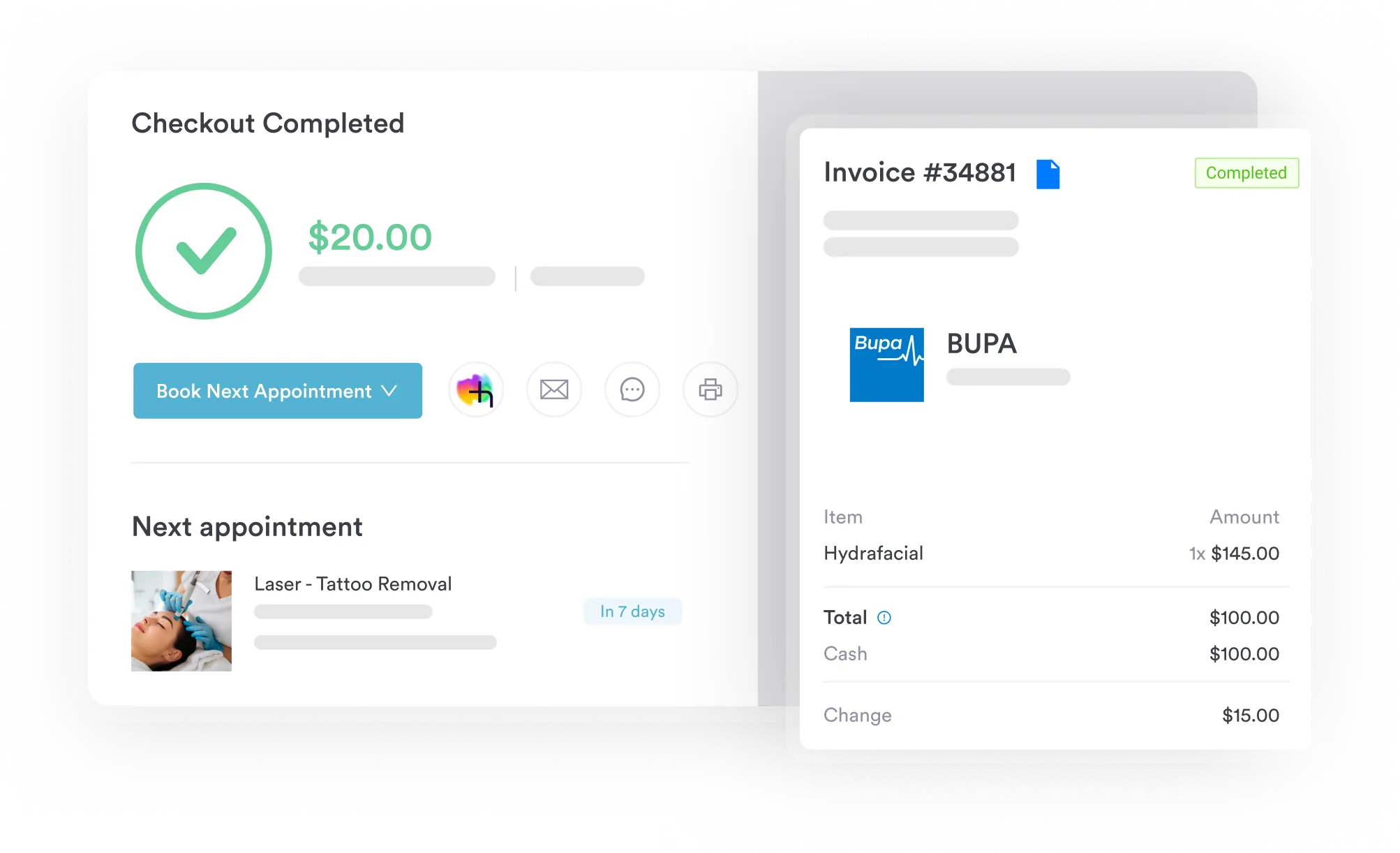
Pabau keeps them in one record. Custom treatment forms can make the anesthesia type and the clinical reason required fields, so the note cannot be completed without them. The removal is then invoiced from that same record. That keeps the billed line and the clinical narrative in step.
The client record also holds the surgical history and the original procedure date. That date decides the global period question.
Medical records management and automated workflows handle the follow-up admin around it. Staff then spend their attention on the coding decision instead of the paper trail.

Pabau captures the anesthesia type, the wound detail, and the original procedure date in one client record, then bills from it. The documentation that supports CPT code 15851 is ready before the claim goes out, not after a denial.

The 2023 revision turned suture removal into a setting question. Facility plus general anesthesia or moderate sedation means 15851. An office visit means an E/M service plus an add-on code worth about the price of a dressing tray.
So the useful work sits upstream of the claim. Delete 15850 from the charge list. Make anesthesia type a required field on the removal note, and put the original procedure date where the biller can see it.
Those three changes stop the rejected claim and the quieter loss of billing 15851 where Medicare will not pay it. Book a demo to see how Pabau ties sedation notes, treatment records, and invoicing together for postoperative visits.

Need to keep insurance claims moving? Pabau’s claims management tracks claim status with each insurer and checks the required fields before you submit.
Coding the surgery those sutures came from? 15828 covers rhytidectomy of the cheek, chin, and neck, including its postoperative period.
Billing the anesthesia side of the same case? 01622 shows how an anesthesia claim is built, timed, and priced.
Documenting the wound that needed closing? S31.33XA covers puncture wound coding when no foreign body is involved.
Standardizing what providers write down? The medical diagnosis form gives you a field-by-field starting point you can adapt.
Timing depends on the site. Face sutures often come out in five to seven days. Trunk and arm sutures run seven to 10 days, and sutures over a joint can stay 10 to 14. The surgeon’s own instructions override any general rule.
A facility code, because Medicare prices 15851 in the facility setting only. That usually means 21 for inpatient hospital, 22 for on-campus outpatient hospital, or 24 for an ambulatory surgical center. Place of service 11 signals an office visit and invites a denial.
The provider who delivered it. An anesthesiologist or nurse anesthetist submits a separate claim for the anesthesia service, while 15851 covers the removal. Neither claim substitutes for the other, and both carry the same date and setting.
No. Report it once per session, whatever the number of wounds. The descriptor is not written per wound or per suture, so a second unit on the same claim reads as a duplicate.
No. The descriptor names sutures and staples only. Tissue adhesive sloughs off on its own, and adhesive strips come off during a normal wound check. That visit is reported as an E/M service.